Chapter 27 The Theory of Active Portfolio Management Answer Key
Multiple Choice Questions
1.
In the Treynor-Black model
2.
Absent research, you should assume the alpha of a stock is
3.
If you begin with a ______ and obtain additional data from an experiment you can form a
______.
4.
Benchmark risk is defined as
5.
Benchmark risk
6.
____________ can be used to measure forecast quality and guide in the proper adjustment
of forecasts.
7.
Even low-quality forecasts have proven to be valuable because R-squares of only
____________ in regressions of analysts’ forecasts can be used to substantially improve
portfolio performance.
8.
The ____________ model allows the private views of the portfolio manager to be
incorporated with market data in the optimization procedure.
9.
The Black-Litterman model and Treynor-Black model are
10.
The Black-Litterman model is geared toward ____________ while the Treynor-Black model
is geared toward ____________.
11.
Alpha forecasts must be ____________ to account for less-than-perfect forecasting quality.
When alpha forecasts are ____________ to account for forecast imprecision, the resulting
portfolio position becomes ____________.
12.
Tracking error is defined as

13.
The tracking error of an optimized portfolio can be expressed in terms of the ____________
of the portfolio and thus reveals ____________.
14.
The Treynor-Black model is a model that shows how an investment manager can use
security analysis and statistics to construct
15.
If a portfolio manager consistently obtains a high Sharpe measure, the manager’s
forecasting ability
16.
Active portfolio management consists of
17.
Passive portfolio management consists of
18.
The critical variable in the determination of the success of the active portfolio is
19.
The Treynor-Black model requires estimates of
20.
Active portfolio managers try to construct a risky portfolio with
21.
The beta of an active portfolio is 1.20. The standard deviation of the returns on the market
index is 20%. The nonsystematic variance of the active portfolio is 1%. The standard
deviation of the returns on the active portfolio is
22.
The beta of an active portfolio is 1.36. The standard deviation of the returns on the market
index is 22%. The nonsystematic variance of the active portfolio is 1.2%. The standard
deviation of the returns on the active portfolio is
23.
Consider the Treynor-Black model. The alpha of an active portfolio is 2%. The expected
return on the market index is 16%. The variance of return on the market portfolio is 4%.
The nonsystematic variance of the active portfolio is 1%. The risk-free rate of return is 8%.
The beta of the active portfolio is 1. The optimal proportion to invest in the active portfolio
is

24.
Consider the Treynor-Black model. The alpha of an active portfolio is 1%. The expected
return on the market index is 16%. The variance of the return on the market portfolio is 4%.
The nonsystematic variance of the active portfolio is 1%. The risk-free rate of return is 8%.
The beta of the active portfolio is 1.05. The optimal proportion to invest in the active
portfolio is
25.
There appears to be a role for a theory of active portfolio management because
26.
The Treynor-Black model
27.
Which of the following are not true regarding the Treynor-Black model?
28.
To improve future analyst forecasts using the statistical properties of past forecasts, a
regression model can be fitted to past forecasts. The intercept of the regression is a
__________ coefficient, and the regression beta represents a __________ coefficient.
29.
A purely passive strategy is defined as
30.
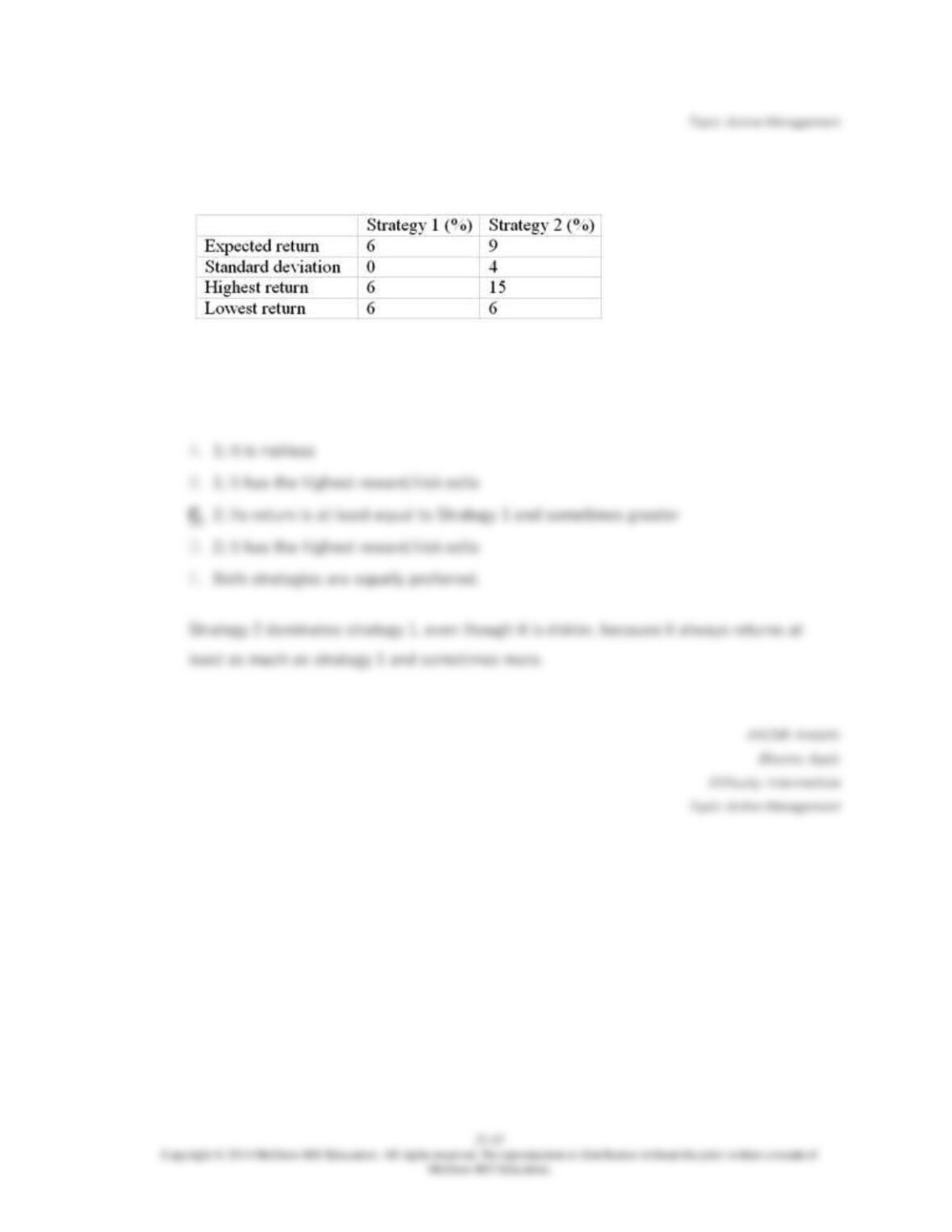
Consider these two investment strategies:
Strategy __________ is the dominant strategy because __________.