
31.
Assume there is a fixed exchange rate between the Canadian and U.S. dollar. The expected
return and standard deviation of return on the U.S. stock market are 18% and 15%,
respectively. The expected return and standard deviation on the Canadian stock market are
13% and 20%, respectively. The covariance of returns between the U.S. and Canadian stock
markets is 1.5%.
If you invested 50% of your money in the Canadian stock market and 50% in the U.S. stock
market, the standard deviation of return of your portfolio would be
32.
The major concern that has been raised with respect to the weighting of countries within
the EAFE index is
33.
You are a U.S. investor who purchased British securities for 2,000 pounds one year ago
when the British pound cost $1.50. No dividends were paid on the British securities in the
past year. Your total return based on U.S. dollars was __________ if the value of the
securities is now 2,400 pounds and the pound is worth $1.60.
34.
U.S. investors
35.
Exchange rate risk
36.
International investing
37.
Investors looking for effective international diversification should
38.
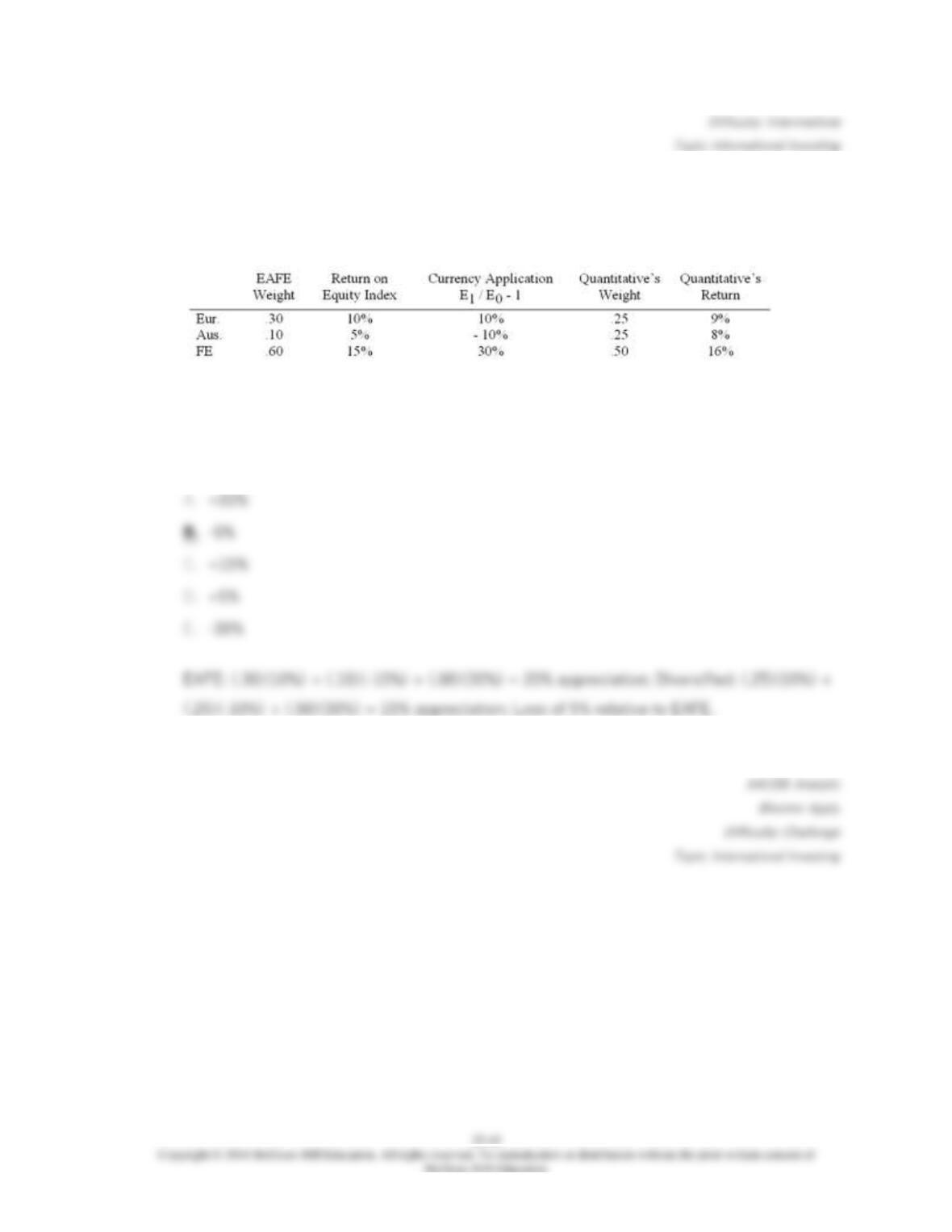
The manager of Quantitative International Fund uses EAFE as a benchmark. Last year’s
performance for the fund and the benchmark were as follows:
Calculate Quantitative’s currency selection return contribution.
39.
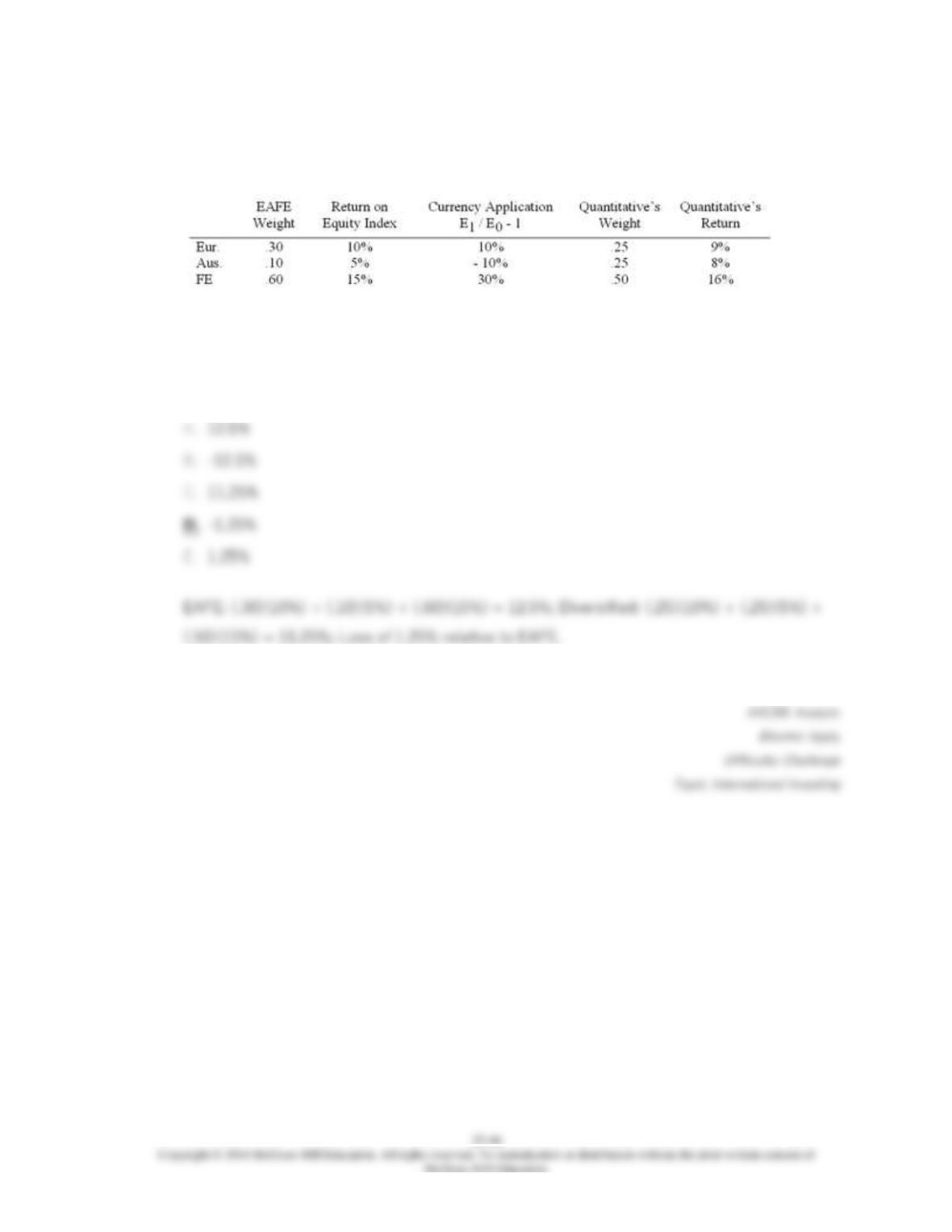
The manager of Quantitative International Fund uses EAFE as a benchmark. Last year’s
performance for the fund and the benchmark were as follows:
Calculate Quantitative’s country selection return contribution.
40.
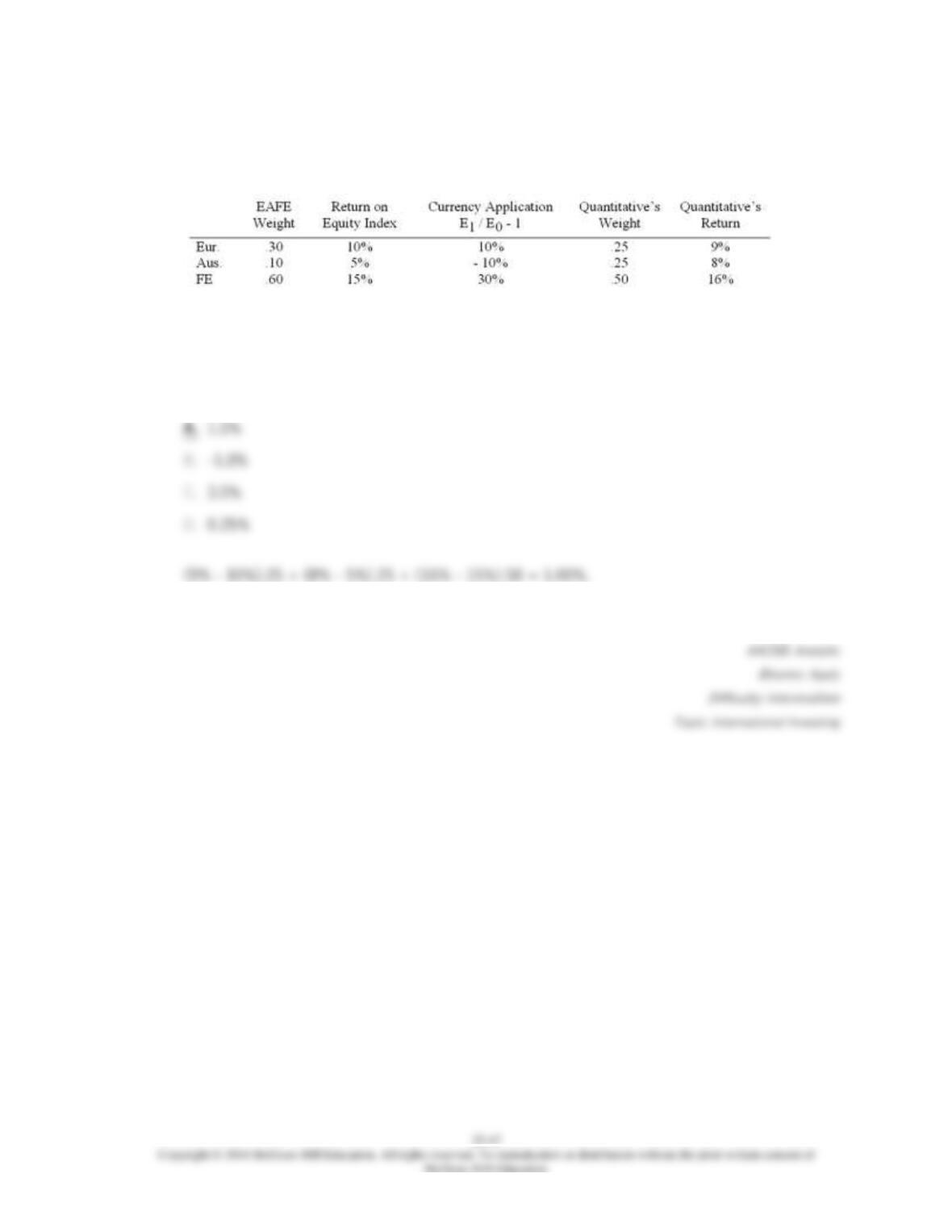
The manager of Quantitative International Fund uses EAFE as a benchmark. Last year’s
performance for the fund and the benchmark were as follows:
Calculate Quantitative’s stock selection return contribution.
41.
Using the S&P 500 portfolio as a proxy of the market portfolio
42.
The average country equity market share is
43.
When an investor adds international stocks to her U.S. stock portfolio
44.
Which of the following countries has an equity index that lies on the efficient frontier
generated by allowing international diversification?
45.
“ADRs” stands for ___________ and “WEBS” stands for ____________.
46.
WEBS portfolios
47.
The EAFE is
48.
Home bias refers to
Short Answer Questions
49.
Discuss performance evaluation of international portfolio managers in terms of potential
sources of abnormal returns.
50.
Discuss some of the factors that might be included in a multifactor model of security
returns in an international application of arbitrage pricing theory (APT).
Some of the factors that might be considered in a multifactor international APT model are:

51.
Marla holds her portfolio 100% in U.S. securities. She tells you that she believes foreign
investing can be extremely hazardous to her portfolio. She’s not sure about the details, but
has “heard some things.” Discuss this idea with Marla by listing three objections you have
heard from your clients who have similar fears. Explain each of the objections is subject to
faulty reasoning.
52.
You are managing a portfolio that consists of U.S. equities. You have prepared a
presentation to use when you discuss the possibility of adding international stocks to your
client’s portfolio.