Chapter 25 International Diversification Answer Key
Multiple Choice Questions
1.
Shares of several foreign firms are traded in the U.S. markets in the form of
2.
__________ refers to the possibility of expropriation of assets, changes in tax policy, and the
possibility of restrictions on foreign exchange transactions.
3.
__________ are mutual funds that invest in one country only.
4.
The performance of an internationally diversified portfolio may be affected by
5.
Over the period 2002-2011, most correlations between the U.S. stock index and stock-
index portfolios of other countries were
6.
The __________ index is a widely used index of non-U.S. stocks.
7.
The __________ equity market had the highest average local currency excess return
between 2002-2011.
8.
The developed country with the highest average local-currency equity-market excess
return between 2002-2011 is
9.
The emerging market country with the highest average local-currency equity-market
excess return between 2002-2011 is
10.
The __________ equity market had the highest average U.S. dollar excess return between
2002-2011.
11.
The developed country with the highest average U.S. dollar equity-market excess return
between 2002-2011 is
12.
The emerging market country with the highest average U.S. dollar equity-market excess
return between 2002-2011 is
13.
The __________ equity market had the lowest average local currency excess return between
2002-2011.
14.
The developed country with the lowest average local-currency equity-market excess return
between 2002-2011 is
15.
The emerging market country with the lowest average local-currency equity-market excess
return between 2002-2011 is
16.
The __________ equity market had the lowest average U.S. dollar excess return between
2002-2011.
17.
The developed country with the lowest average U.S. dollar equity-market excess return
between 2002-2011 is
18.
The emerging market country with the lowest average U.S. dollar equity-market excess
return between 2002-2011 is
19.
The __________ equity market had the highest average U.S. dollar standard deviation of
excess returns between 2002-2011.
20.
The __________ equity market had the lowest average U.S. dollar standard deviation of
excess returns between 2002-2011.
21.
The __________ equity market had the highest average local currency standard deviation of
excess returns between 2002-2011.
22.
The __________ equity market had the lowest average local currency standard deviation of
excess returns between 2002-2011.
23.
In 2011, the U.S. equity market represented __________ of the world equity market.
24.
The straightforward generalization of the simple CAPM to international stocks is
problematic because
25.
The yield on a 1-year bill in the U.K. is 8%, and the present exchange rate is 1 pound = U.S.
$1.60. If you expect the exchange rate to be 1 pound = U.S. $1.50 a year from now, the
return a U.S. investor can expect to earn by investing in U.K. bills is
26.
Suppose the 1-year risk-free rate of return in the U.S. is 5%. The current exchange rate is 1
pound = U.S. $1.60. The 1-year forward rate is 1 pound = $1.57. What is the minimum yield
on a 1-year risk-free security in Britain that would induce a U.S. investor to invest in the
British security?
27.
The interest rate on a 1-year Canadian security is 8%. The current exchange rate is C$ =
US $0.78. The 1-year forward rate is C$ = US $0.76. The return (denominated in U.S. $)
that a U.S. investor can earn by investing in the Canadian security is
28.
Suppose the 1-year risk-free rate of return in the U.S. is 4% and the 1-year risk-free rate of
return in Britain is 7%. The current exchange rate is 1 pound = U.S. $1.65. A 1-year future
exchange rate of __________ for the pound would make a U.S. investor indifferent between
investing in the U.S. security and investing in the British security.
29.
The present exchange rate is C$ = U.S. $0.78. The 1-year future rate is C$ = U.S. $0.76.
The yield on a 1-year U.S. bill is 4%. A yield of __________ on a 1-year Canadian bill will
make investor indifferent between investing in the U.S. bill and the Canadian bill.
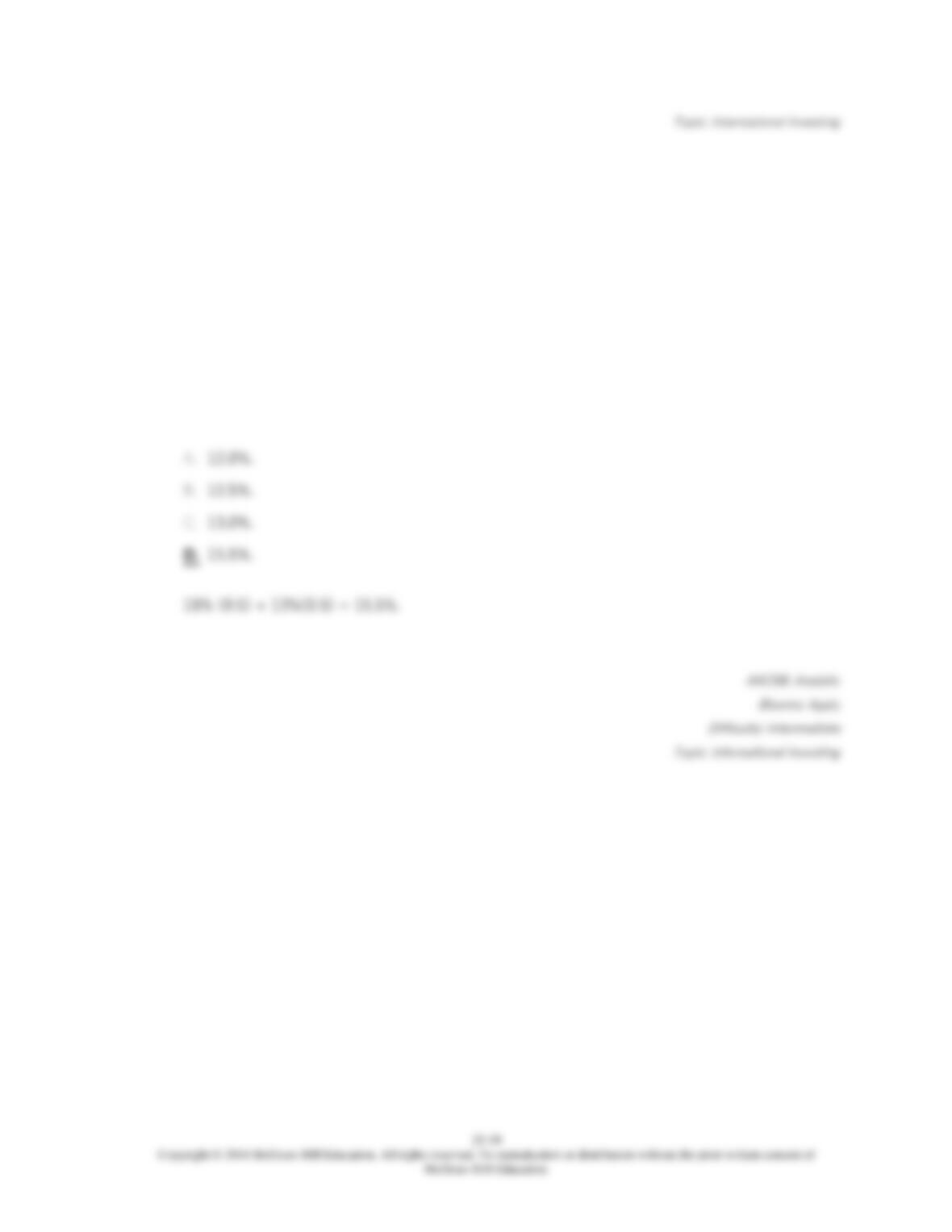
30.
Assume there is a fixed exchange rate between the Canadian and U.S. dollar. The expected
return and standard deviation of return on the U.S. stock market are 18% and 15%,
respectively. The expected return and standard deviation on the Canadian stock market are
13% and 20%, respectively. The covariance of returns between the U.S. and Canadian stock
markets is 1.5%.
If you invested 50% of your money in the Canadian stock market and 50% in the U.S. stock
market, the expected return on your portfolio would be