
Chapter 24 – Portfolio Performance Evaluation
24–34
67. The Value Line Index is an equally weighted geometric average of the returns of about
1,700 firms. The value of an index based on the geometric average returns of 3 stocks where
the returns on the 3 stocks during a given period were 32%, 5%, and -10%, respectively, is
__________.
Difficulty: Moderate
68. Risk-adjusted mutual fund performance measures have decreased in popularity because
Difficulty: Moderate
24–37
75. The M2 measure was developed by
Difficulty: Easy
76. Rodney holds a portfolio of risky assets that represents his entire risky investment. To
evaluate the performance of Rodney’s portfolio, which in which order would you complete the
steps listed?
I) Compare the Sharpe measure of Rodney’s portfolio to the Sharpe measure of the best
portfolio.
II) State your conclusions.
III) Assume that past security performance is representative of expected performance.
IV) Determine the benchmark portfolio that Rodney would have held if he had chosen a
passive strategy.
Difficulty: Moderate
24–39
80. If an investor has a portfolio that has constant proportions in T-bills and the market
portfolio, the portfolio’s characteristic line will plot as a line with ___________; if the
investor can time bull markets, the characteristic line will plot as a line with ___________.
Difficulty: Difficult
81. Studies of style analysis have found that ________ of fund returns can be explained by
asset allocation alone.
Difficulty: Moderate
24–40
82. Morningstar’s RAR method
I) is one of the most widely used performance measures.
II) indicates poor performance by placing up to 5 darts next to the fund’s name.
III) computes fund returns adjusted for loads.
IV) computes fund returns adjusted for risk.
V) produces ranking results that are the same as those produced with the Sharpe measure.
Difficulty: Moderate
83. Hedge funds
I) are appropriate as a sole investment vehicle for an investor.
II) should only be added to an already well-diversified portfolio.
III) pose performance evaluation issues due to non-linear factor exposures.
IV) have down-market betas that are typically larger than up-market betas.
V) have symmetrical betas.
Difficulty: Moderate

Chapter 24 – Portfolio Performance Evaluation
24–42
Short Answer Questions
87. Define and discuss the Sharpe, Treynor, and Jensen measures of portfolio performance
evaluation, and the situations in which each measure is the most appropriate measure.
Sharpe’s measure, (rP – rf)/sP, is a relative measure of the average portfolio return in excess of
the average risk-free return over a period time per unit of risk, as measured by the standard
deviation of the returns of the portfolio over that time period.
Treynor’s measure, (rP – rf)/bP, is a relative measure of the average portfolio return in excess of
the average risk-free return over a period of time per unit of risk, as measured by the beta of
Difficulty: Moderate
24–43
88. What is the problem with using the Sharpe measure for evaluation of an active portfolio
management strategy?
Difficulty: Moderate
89. Discuss, in general, the performance attribution procedures.
Difficulty: Moderate
24–44
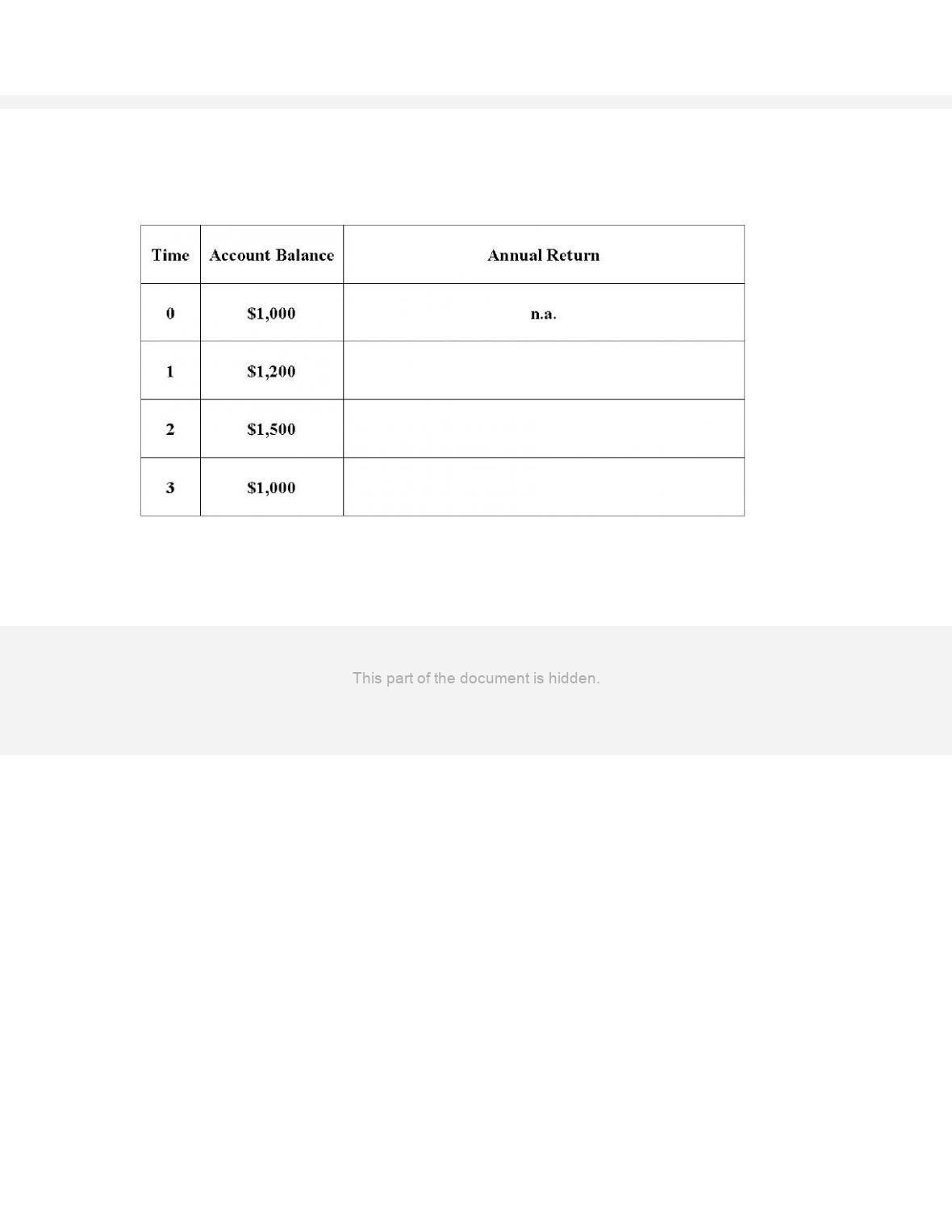
90. You invested $1,000 through your broker three years ago. Your account balance at the
beginning of each period is shown in the table below.
– Calculate the annual return for each year. Show your calculations in the table.
– Your broker called to tell you the good news that your average annual return over the three
years has been 4%. Where did he get this number?
– At first you are confused. It seems as though the broker must be mistaken because you are
Chapter 24 – Portfolio Performance Evaluation
24–45
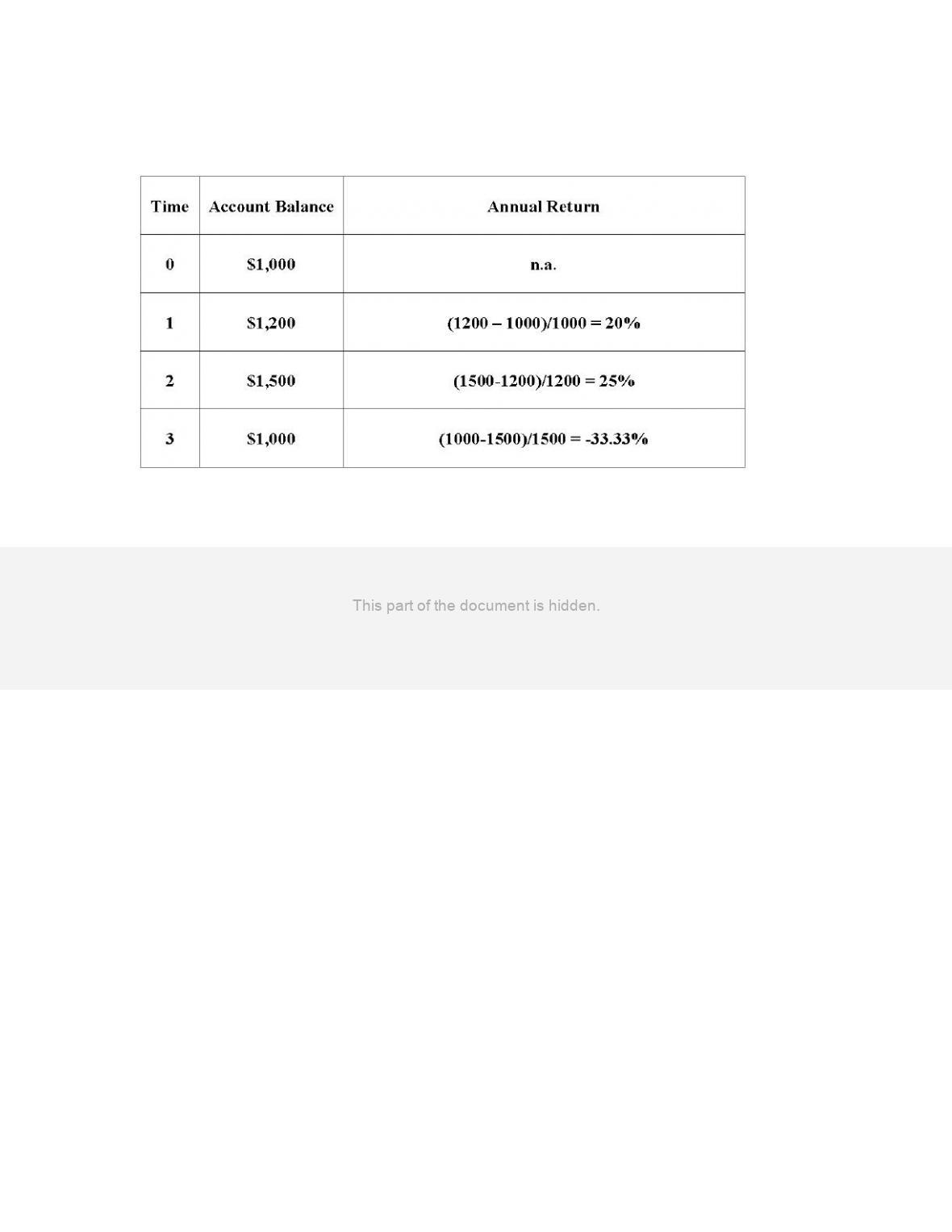
See the table below.
The broker calculated the arithmetic average return: (20% + 25% -33.33%)/3 = 4%.
The geometric average would be more appropriate for this purpose because it will accurately
reflect the compounded value of your investment. The geometric return is rG = [(1.20) *
Difficulty: Moderate

24–46
91. Discuss the M2 measure of performance by answering the following questions. Why is M2
better than the Sharpe measure? What measure of risk does M2 use? How do you construct a
managed portfolio, P, to use in computing the M2 measure? What is the formula for M2?
Draw a graph that shows how M2 would be measured. Be sure to label the axes and all
relevant points.
The Sharpe measure indicates whether a portfolio underperformed the market index, but the
difference between the market’s Sharpe measure and the portfolio’s Sharpe measure is difficult
to interpret. M2 uses the same measure of risk as the Sharpe measure – variation in total return,
Difficulty: Difficult