Chapter 24 – Portfolio Performance Evaluation
24-1
Chapter 24
Portfolio Performance Evaluation
Multiple Choice Questions
1. Trading activity by mutual funds just prior to quarterly reporting dates is known as
Difficulty: Moderate
2. Window dressing is
Difficulty: Moderate
24-2
3. The comparison universe is __________.
Difficulty: Easy
4. The comparison universe is not __________.
Difficulty: Easy
5. __________ did not develop a popular method for risk-adjusted performance evaluation of
mutual funds.
Difficulty: Easy
24-3
6. __________ developed a popular method for risk-adjusted performance evaluation of
mutual funds.
Difficulty: Easy
7. Henriksson (1984) found that, on average, betas of funds __________ during market
advances
Difficulty: Moderate
24-4
8. Most professionally managed equity funds generally __________.
Difficulty: Moderate
9. Suppose two portfolios have the same average return, the same standard deviation of
returns, but portfolio A has a higher beta than portfolio B. According to the Sharpe measure,
the performance of portfolio A __________.
Difficulty: Moderate
24-5
10. Suppose two portfolios have the same average return, the same standard deviation of
returns, but portfolio A has a higher beta than portfolio B. According to the Treynor measure,
the performance of portfolio A __________.
Difficulty: Moderate
11. Suppose two portfolios have the same average return, the same standard deviation of
returns, but portfolio A has a lower beta than portfolio B. According to the Treynor measure,
the performance of portfolio A __________.
Difficulty: Moderate
24-6
12. Suppose two portfolios have the same average return, the same standard deviation of
returns, but Aggie Fund has a higher beta than Raider Fund. According to the Sharpe
measure, the performance of Aggie Fund
Difficulty: Moderate
13. Suppose two portfolios have the same average return, the same standard deviation of
returns, but Aggie Fund has a higher beta than Raider Fund. According to the Treynor
measure, the performance of Aggie Fund
Difficulty: Moderate
24-7
14. Suppose two portfolios have the same average return, the same standard deviation of
returns, but Aggie Fund has a lower beta than Raider Fund. According to the Treynor
measure, the performance of Aggie Fund
Difficulty: Moderate
15. Suppose two portfolios have the same average return, the same standard deviation of
returns, but Buckeye Fund has a higher beta than Gator Fund. According to the Sharpe
measure, the performance of Buckeye Fund
Difficulty: Moderate
24-8
16. Suppose two portfolios have the same average return, the same standard deviation of
returns, but Buckeye Fund has a lower beta than Gator Fund. According to the Sharpe
measure, the performance of Buckeye Fund
Difficulty: Moderate
17. Suppose two portfolios have the same average return, the same standard deviation of
returns, but Buckeye Fund has a lower beta than Gator Fund. According to the Treynor
measure, the performance of Buckeye Fund
Difficulty: Moderate
24-9
18. Suppose two portfolios have the same average return, the same standard deviation of
returns, but Buckeye Fund has a higher beta than Gator Fund. According to the Treynor
measure, the performance of Buckeye Fund
Difficulty: Moderate
19. Consider the Sharpe and Treynor performance measures. When a pension fund is large
and has many managers, the __________ measure is better for evaluating individual managers
while the __________ measure is better for evaluating the manager of a small fund with only
one manager responsible for all investments.
Difficulty: Moderate
24–10
20. Suppose you purchase 100 shares of GM stock at the beginning of year 1, and purchase
another 100 shares at the end of year 1. You sell all 200 shares at the end of year 2. Assume
that the price of GM stock is $50 at the beginning of year 1, $55 at the end of year 1, and $65
at the end of year 2. Assume no dividends were paid on GM stock. Your dollar-weighted
return on the stock will be __________; your time-weighted return on the stock.
Difficulty: Moderate
21. Suppose the risk-free return is 4%. The beta of a managed portfolio is 1.2, the alpha is 1%,
and the average return is 14%. Based on Jensen’s measure of portfolio performance, you
would calculate the return on the market portfolio as
Difficulty: Difficult
24–11
22. Suppose the risk-free return is 3%. The beta of a managed portfolio is 1.75, the alpha is
0%, and the average return is 16%. Based on Jensen’s measure of portfolio performance, you
would calculate the return on the market portfolio as
Difficulty: Difficult
23. Suppose the risk-free return is 6%. The beta of a managed portfolio is 1.5, the alpha is 3%,
and the average return is 18%. Based on Jensen’s measure of portfolio performance, you
would calculate the return on the market portfolio as
Difficulty: Difficult
24. Suppose a particular investment earns an arithmetic return of 10% in year 1, 20% in year 2
and 30% in year 3. The geometric average return for the year period will be __________.
Difficulty: Moderate
24–12
25. Suppose you buy 100 shares of Abolishing Dividend Corporation at the beginning of year
1 for $80. Abolishing Dividend Corporation pays no dividends. The stock price at the end of
year 1 is $100, the price $120 at the end of year 2, and the price is $150 at the end of year 3.
The stock price declines to $100 at the end of year 4, and you sell your 100 shares. For the
four years, your geometric average return is
Difficulty: Difficult
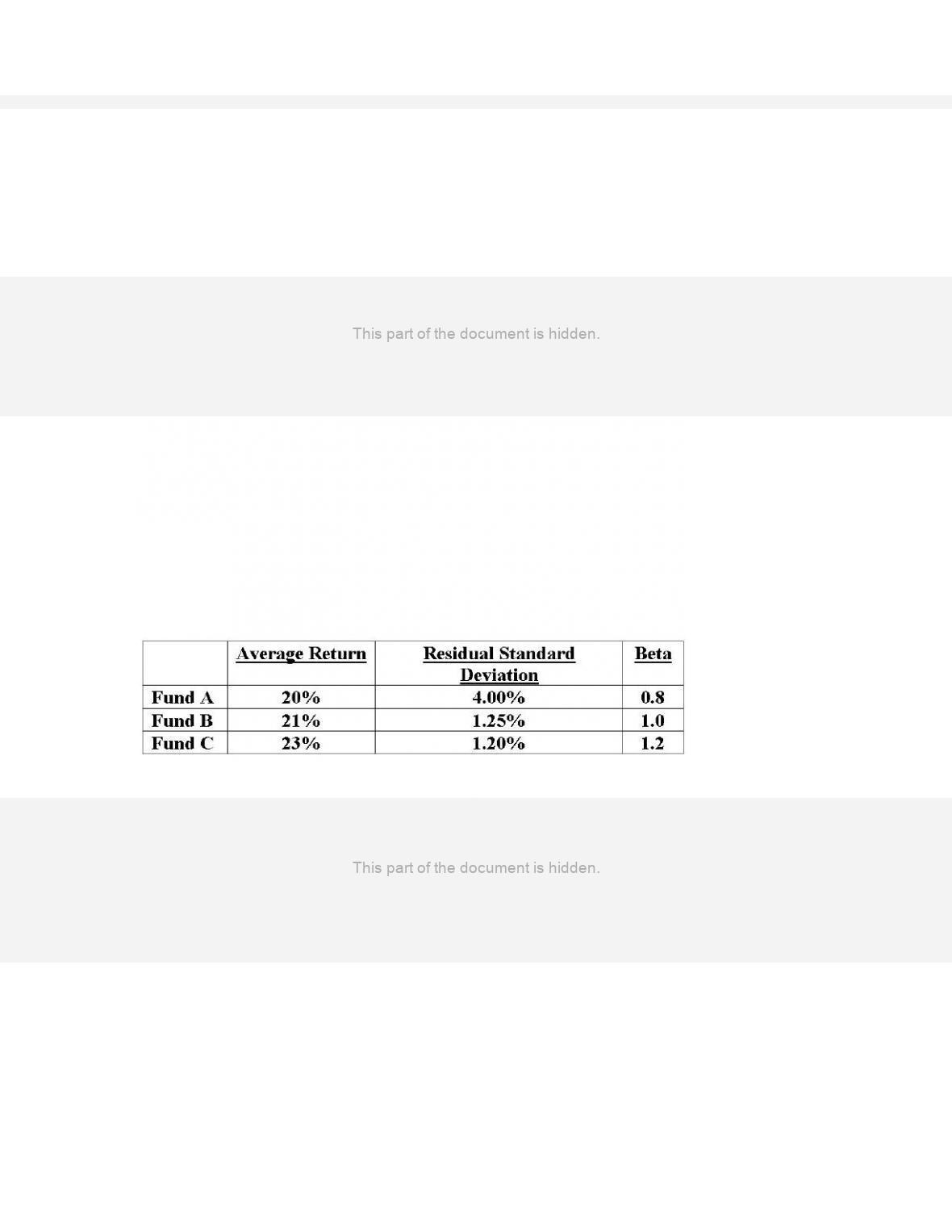
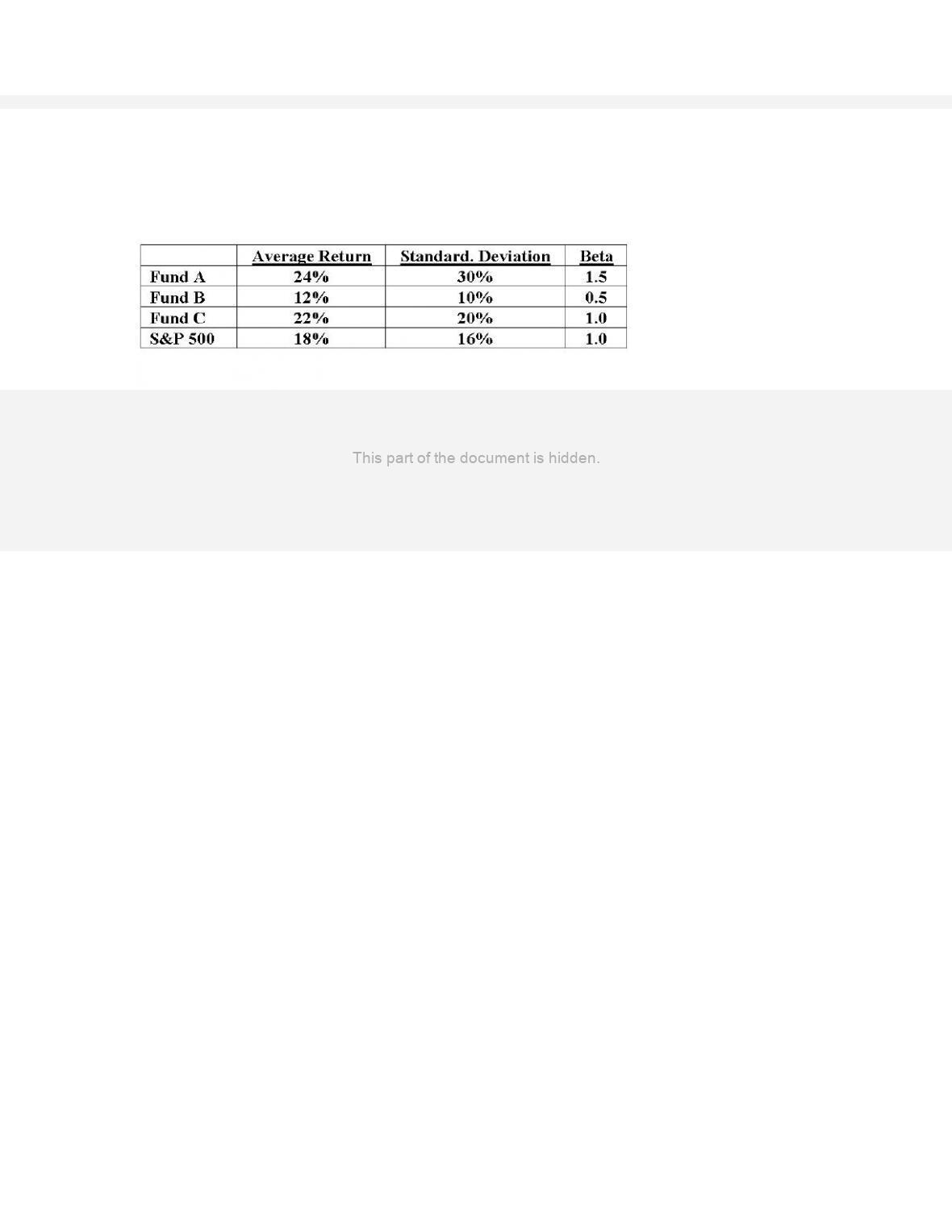
26. You want to evaluate three mutual funds using the information ratio measure for
performance evaluation. The risk-free return during the sample period is 6%, and the average
return on the market portfolio is 19%. The average returns, residual standard deviations, and
betas for the three funds are given below.
The fund with the highest information ratio measure is __________.
Difficulty: Difficult
24–13
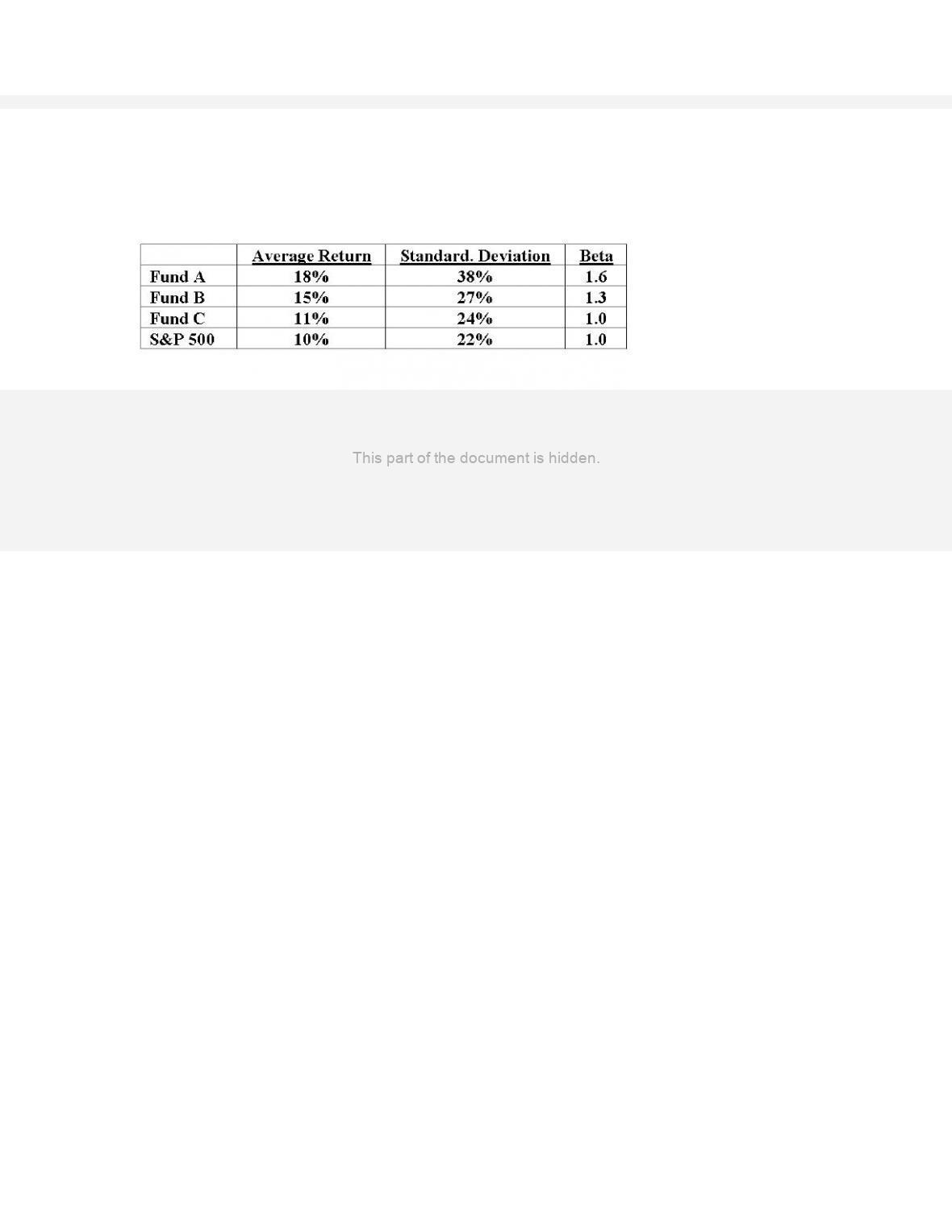
27. You want to evaluate three mutual funds using the Sharpe measure for performance
evaluation. The risk-free return during the sample period is 6%. The average returns, standard
deviations and betas for the three funds are given below, as is the data for the S&P 500 index.
The fund with the highest Sharpe measure is __________.
Difficulty: Moderate
24–14
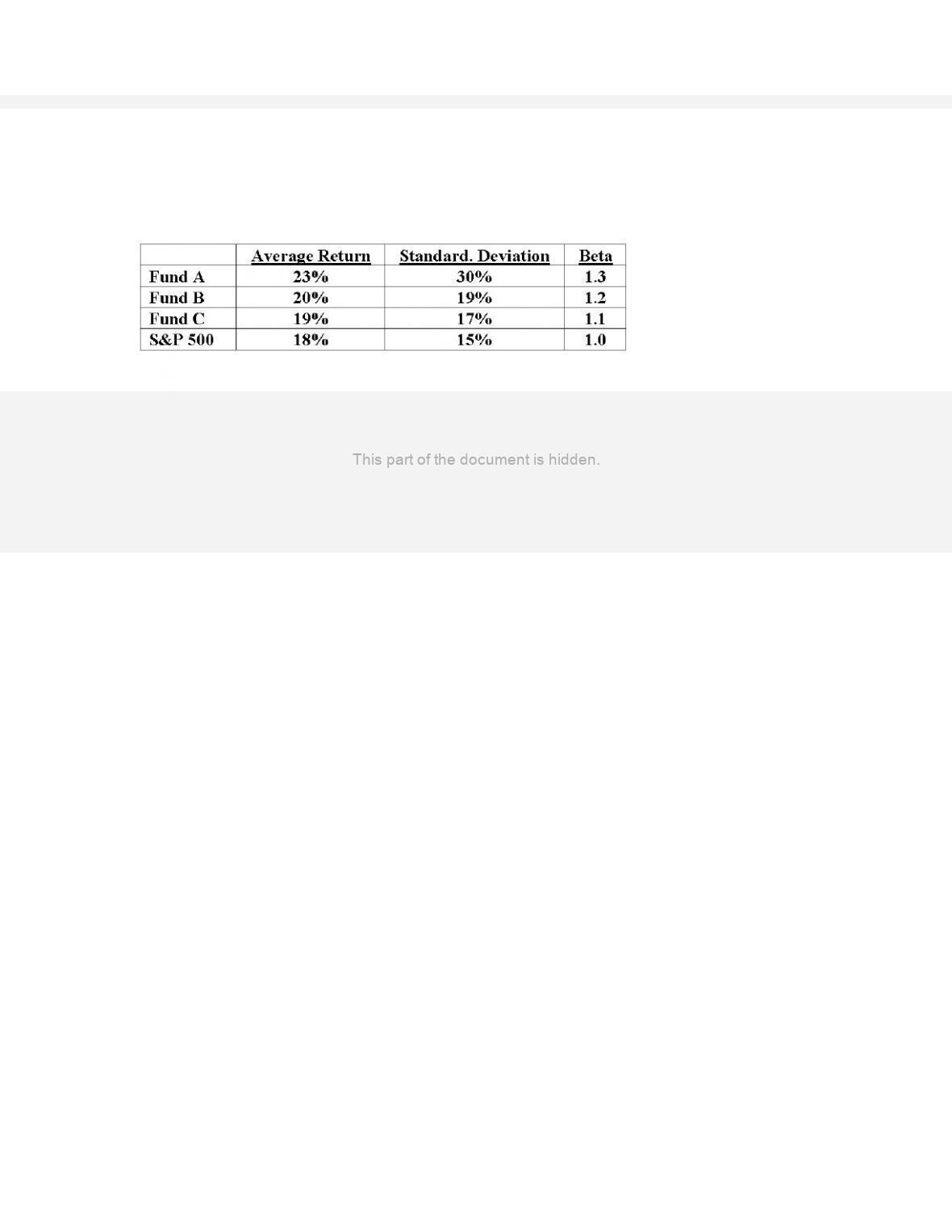
28. You want to evaluate three mutual funds using the Sharpe measure for performance
evaluation. The risk-free return during the sample period is 4%. The average returns, standard
deviations and betas for the three funds are given below, as is the data for the S&P 500 index.
The fund with the highest Sharpe measure is __________.
Difficulty: Moderate
24–15
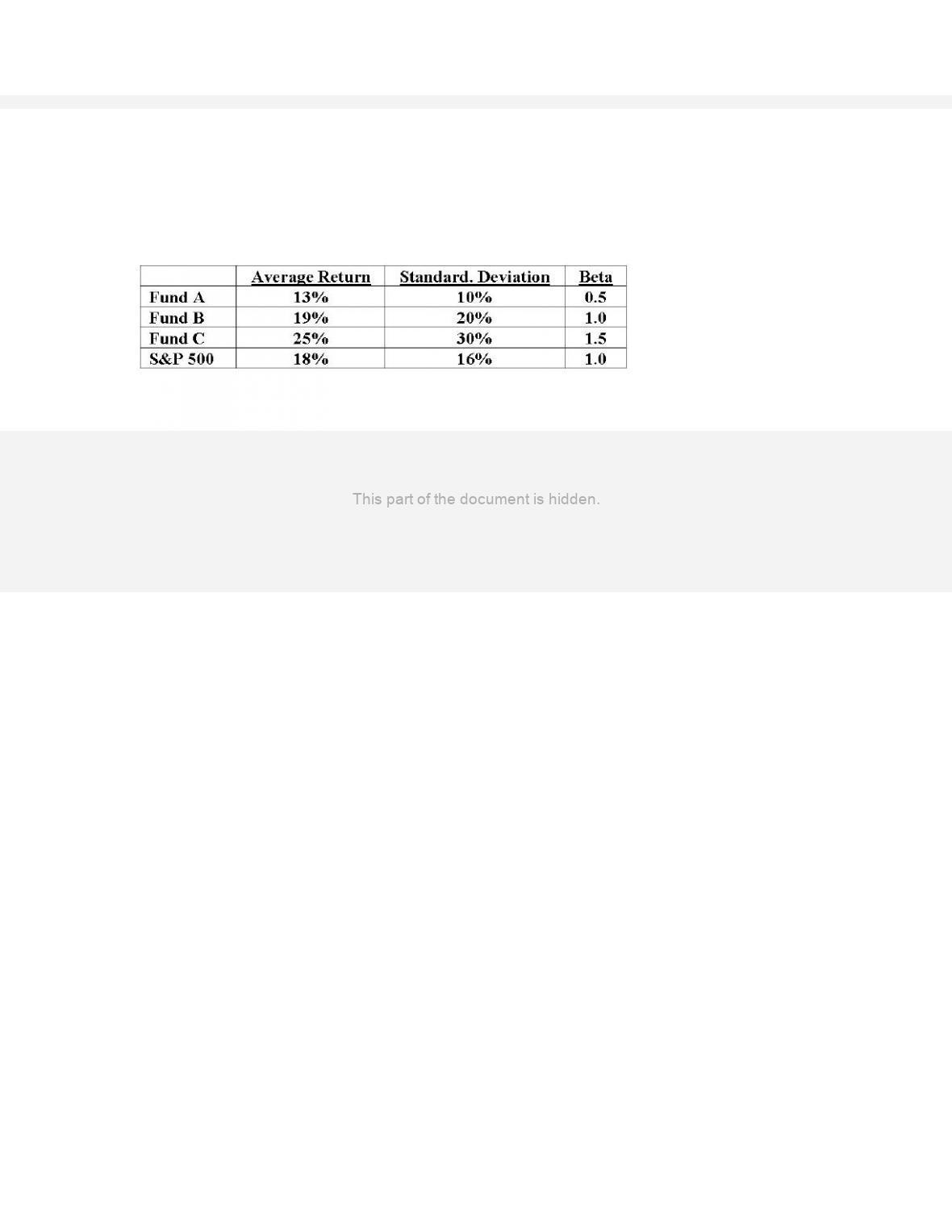
29. You want to evaluate three mutual funds using the Sharpe measure for performance
evaluation. The risk-free return during the sample period is 5%. The average returns, standard
deviations and betas for the three funds are given below, as is the data for the S&P 500 index.
The investment with the highest Sharpe measure is __________.
Difficulty: Moderate
24–16
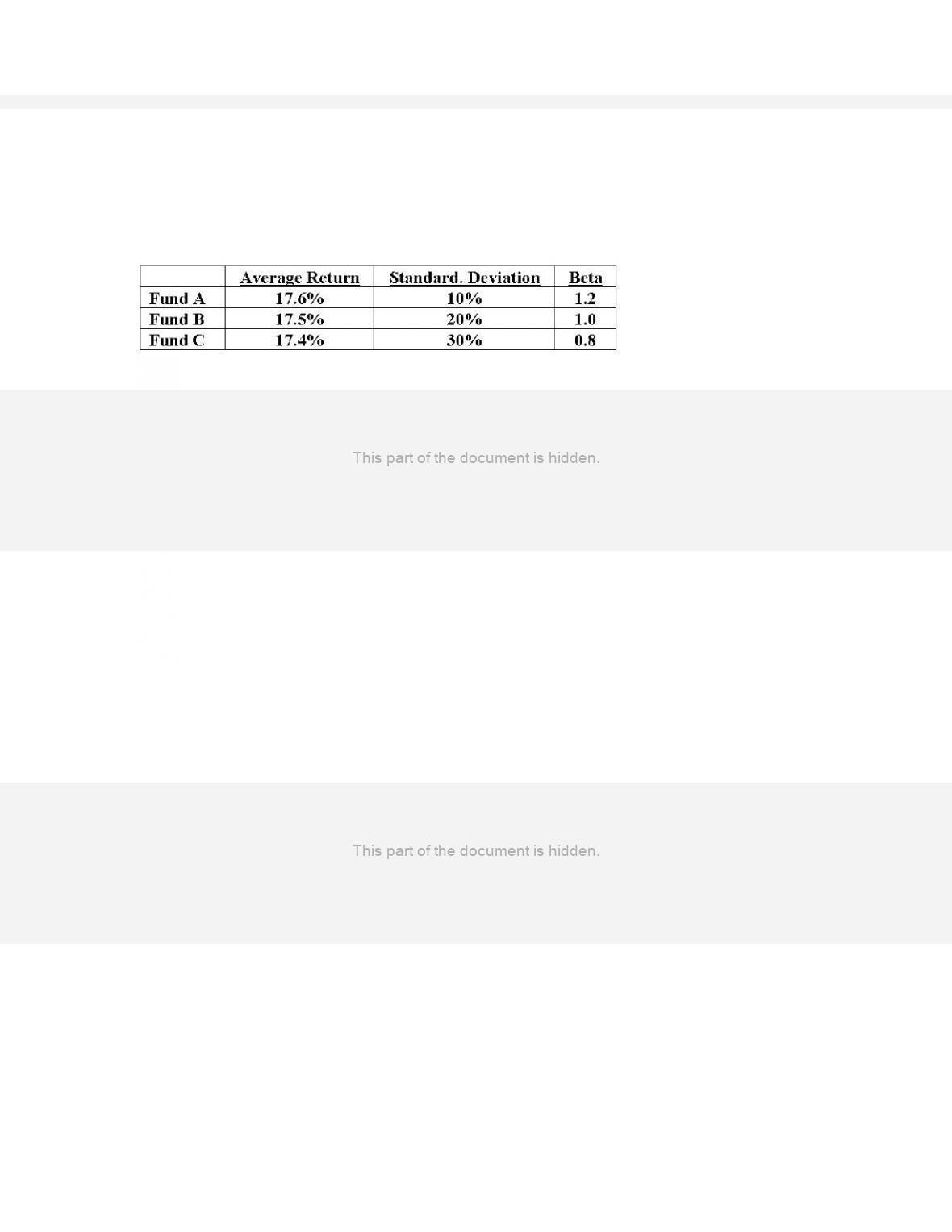
30. You want to evaluate three mutual funds using the Treynor measure for performance
evaluation. The risk-free return during the sample period is 6%. The average returns, standard
deviations, and betas for the three funds are given below, in addition to information regarding
the S&P 500 index.
The fund with the highest Treynor measure is __________.
Difficulty: Difficult
24–17
31. You want to evaluate three mutual funds using the Jensen measure for performance
evaluation. The risk-free return during the sample period is 6%, and the average return on the
market portfolio is 18%. The average returns, standard deviations, and betas for the three
funds are given below.
The fund with the highest Jensen measure is __________.
Difficulty: Difficult
32. Suppose you purchase one share of the stock of Volatile Engineering Corporation at the
beginning of year 1 for $36. At the end of year 1, you receive a $2 dividend, and buy one
more share for $30. At the end of year 2, you receive total dividends of $4 (i.e., $2 for each
share), and sell the shares for $36.45 each. The time-weighted return on your investment is
________.
Difficulty: Moderate
24–18
33. Suppose you purchase one share of the stock of Volatile Engineering Corporation at the
beginning of year 1 for $36. At the end of year 1, you receive a $2 dividend, and buy one
more share for $30. At the end of year 2, you receive total dividends of $4 (i.e., $2 for each
share), and sell the shares for $36.45 each. The dollar-weighted return on your investment is
_______.
Difficulty: Moderate
34. Suppose you purchase one share of the stock of Cereal Correlation Company at the
beginning of year 1 for $50. At the end of year 1, you receive a $1 dividend, and buy one
more share for $72. At the end of year 2, you receive total dividends of $2 (i.e., $1 for each
share), and sell the shares for $67.20 each. The time-weighted return on your investment is
__________.
20.36%.
Difficulty: Moderate
24–19
35. Suppose you purchase one share of the stock of Cereal Correlation Company at the
beginning of year 1 for $50. At the end of year 1, you receive a $1 dividend, and buy one
more share for $72. At the end of year 2, you receive total dividends of $2 (i.e., $1 for each
share), and sell the shares for $67.20 each. The dollar-weighted return on your investment is
__________.
Difficulty: Moderate
36. Suppose you own two stocks, A and B. In year 1, stock A earns a 2% return and stock B
earns a 9% return. In year 2, stock A earns an 18% return and stock B earns an 11% return.
__________ has the higher arithmetic average return.
Difficulty: Moderate
24–20
37. Suppose you own two stocks, A and B. In year 1, stock A earns a 2% return and stock B
earns a 9% return. In year 2, stock A earns an 18% return and stock B earns an 11% return.
Which stock has the higher geometric average return?
38. What is the Sharpe measure of performance evaluation for Sooner Stock Fund?
Difficulty: Moderate