Chapter 23 – Futures, Swaps, and Risk Management
23–14
32. The value of a futures contract for storable commodities can be determined by the
_______ and the model __________ consistent with parity relationships.
Difficulty: Moderate
33. In the equation Profits = a + b*($/₤ exchange rate), b is a measure of
A. the firm’s beta when measured in terms of the foreign currency.
B. the ratio of the firm’s beta in terms of dollars to the firm’s beta in terms of pounds.
Difficulty: Moderate
23–15
34. You would like to take a position in the S&P500 stock index, but have decided to use
market-index futures contracts and T-bills rather than actually purchasing the index. Your
strategy will duplicate the payoff you would receive if you held the index and your goal is to
time the market. If you want to minimize transactions costs and are bullish you should
A. sell futures contracts and buy T-bills and shift back and forth between them as you expect
the market to turn up or down.
B. sell futures contracts and T-bills and shift back and forth between them as you expect the
market to turn up or down.
Difficulty: Difficult
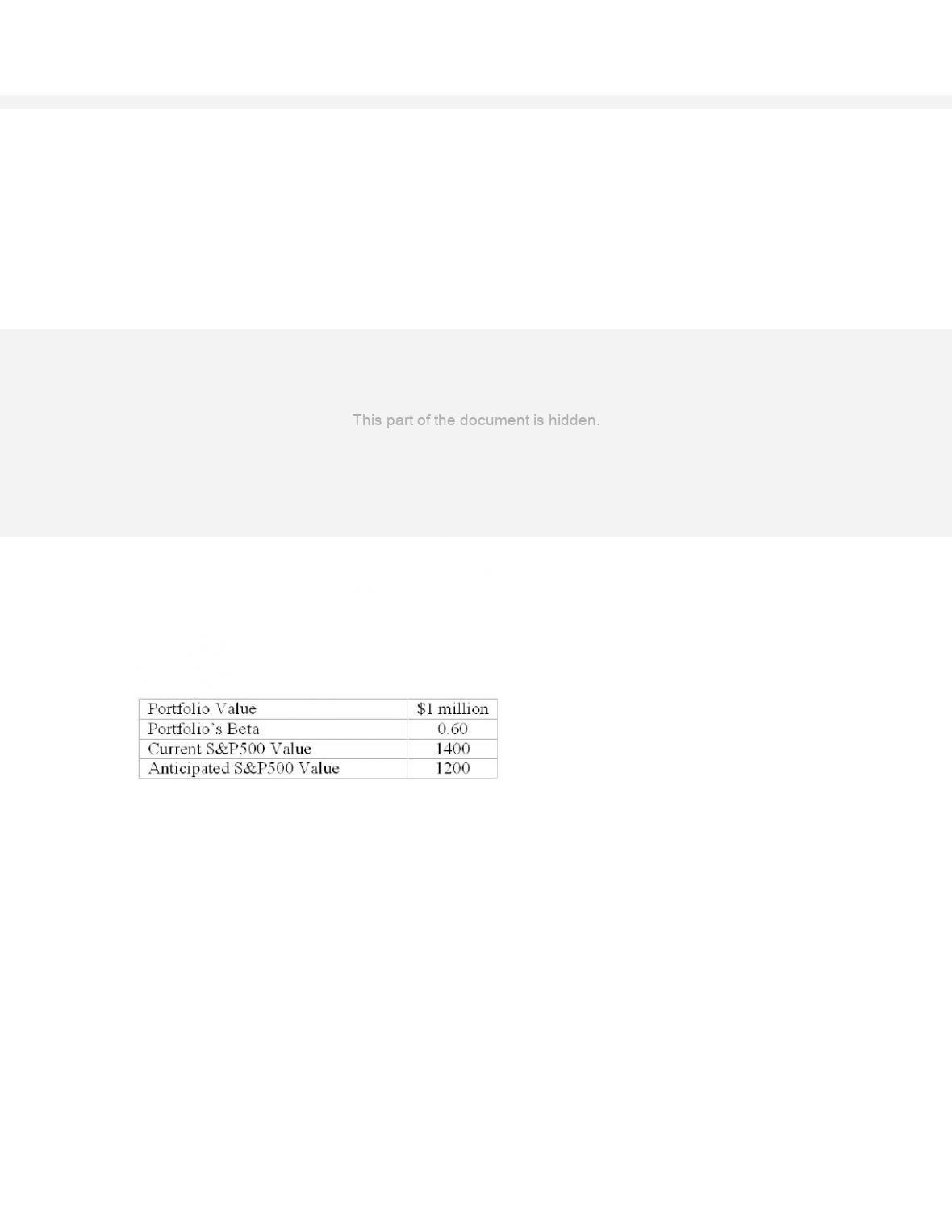
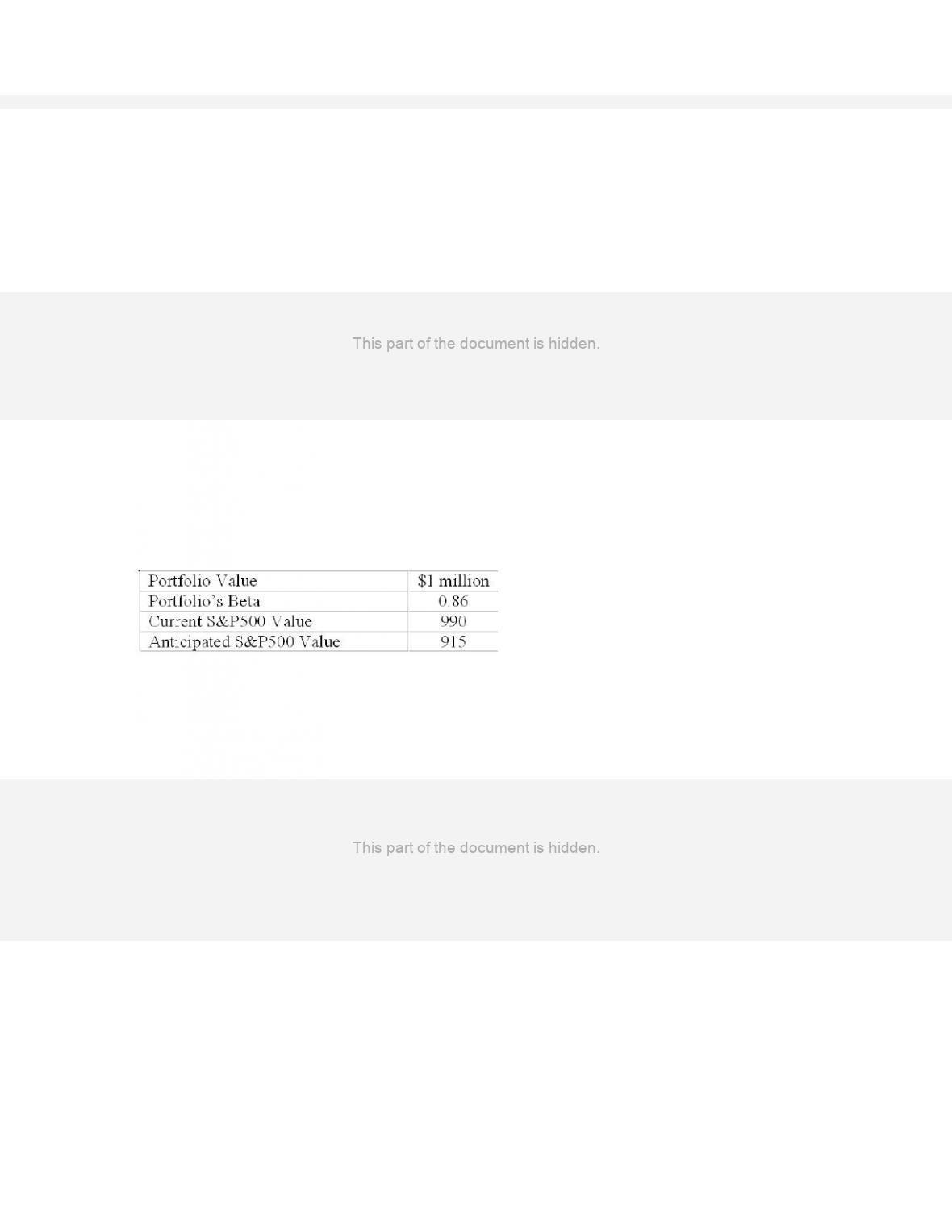
You are given the following information about a portfolio you are to manage. For the long-
term you are bullish, but you think the market may fall over the next month.
23–16
35. If the anticipated market value materializes, what will be your expected loss on the
portfolio?
Difficulty: Moderate
36. What is the dollar value of your expected loss?
Difficulty: Easy
37. For a 200-point drop in the S&P500, by how much does the index change?
Difficulty: Easy
23–17
38. How many contracts should you buy or sell to hedge your position? Allow fractions of
contracts in your answer.
Difficulty: Moderate
39. You purchased sold S&P 500 Index futures contract at a price of 950 and closed your
position when the index futures was 947, you incurred:
Difficulty: Moderate
40. You took a short position in three S&P 500 futures contracts at a price of 900 and closed
the position when the index futures was 885, you incurred:
Difficulty: Easy
23–18
41. Suppose that the risk-free rates in the United States and in the Canada are 3% and 5%,
respectively. The spot exchange rate between the dollar and the Canadian dollar (C$) is
$0.80/C$. What should the futures price of the C$ for a one-year contract be to prevent
arbitrage opportunities, ignoring transactions costs.
Difficulty: Moderate
42. Suppose that the risk-free rates in the United States and in the Canada are 5% and 3%,
respectively. The spot exchange rate between the dollar and the Canadian dollar (C$) is
$0.80/C$. What should the futures price of the C$ for a one-year contract be to prevent
arbitrage opportunities, ignoring transactions costs.
Difficulty: Moderate
23–19
43. Suppose that the risk-free rates in the United States and in the United Kingdom are 6%
and 4%, respectively. The spot exchange rate between the dollar and the pound is $1.60/BP.
What should the futures price of the pound for a one-year contract be to prevent arbitrage
opportunities, ignoring transactions costs.
A. $1.60/BP
B. $1.70/BP
Difficulty: Moderate
You are given the following information about a portfolio you are to manage. For the long-
term you are bullish, but you think the market may fall over the next month.
44. If the anticipated market value materializes, what will be your expected loss on the
portfolio?
Difficulty: Moderate
23–20
45. What is the dollar value of your expected loss?
Difficulty: Easy
46. For a 75-point drop in the S&P500, by how much does the index change?
Difficulty: Easy
47. How many contracts should you buy or sell to hedge your position? Allow fractions of
contracts in your answer.
Difficulty: Moderate
23–21
48. Covered interest arbitrage ____________.
Difficulty: Easy
49. A hedge ratio can be computed as ____________.
A. profit derived from one futures position for a given change in the exchange rate divided by
the change in value of the unprotected position for the same exchange rate
Difficulty: Moderate
23–22
50. E-Minis typically have a value of ____________ percent of the standard contract and exist
for ____________.
Difficulty: Easy
51. The most common short term interest rate used in the swap market is
Difficulty: Easy
52. If interest rate parity holds
Difficulty: Moderate
23–23
53. If interest rate parity does not hold
Difficulty: Moderate
54. If covered interest arbitrage opportunities do not exist
Difficulty: Moderate
55. If covered interest arbitrage opportunities exist
Difficulty: Moderate
Chapter 23 – Futures, Swaps, and Risk Management
23–24
Short Answer Questions
56. Why are commodity futures prices different from other futures prices? Explain the
difference and give an example of a commodity and the factors involved.
The price of a futures contract for a commodity that must be stored is given by F0 = P0 * (1 +
rf + c), where P0 is the spot price of the commodity, rf is the risk-free rate that applies to the
opportunity cost of holding the commodity, and c is the carrying cost.
Commodity futures have an extra cost integrated into their price – carrying costs can be
significant. Carrying costs can include interest costs, storage costs, insurance costs, and an
Difficulty: Moderate
57. Suppose that the risk-free rate is 4% and the market risk premium is 6%. You are
interested in a cocoa futures contract. The beta of cocoa is -0.291.
– What is the required annual rate of return on the cocoa contract?
Difficulty: Difficult
23–25
58. Explain how a firm that has issued $1 million of long-term bonds with a fixed 6% interest
rate can convert its fixed-rate debt into floating-rate debt. Give two numerical examples that
show the possible outcomes, one favorable and one unfavorable.
The firm can enter a swap arrangement, committing to pay .06 * $1 million = $60,000 in
exchange for receiving payments equal to $1 million times the LIBOR rate. If the LIBOR rate
Difficulty: Easy