Chapter 23 – Futures, Swaps, and Risk Management
23-1
Chapter 23
Futures, Swaps, and Risk Management
Multiple Choice Questions
1. Which one of the following stock index futures has a multiplier of $250 times the index
value?
Difficulty: Easy
2. Which one of the following stock index futures has a multiplier of $10 times the index
value?
Difficulty: Easy
23-2
3. Which one of the following stock index futures has a multiplier of $500 times the index
value?
Difficulty: Easy
4. Which one of the following stock index futures has a multiplier of $500 times the index
value?
Difficulty: Easy
5. Which one of the following stock index futures has a multiplier of $100 times the index
value?
Difficulty: Easy
23-3
6. Which one of the following stock index futures has a multiplier of 10 euros times the
index?
Difficulty: Easy
7. Which one of the following stock index futures has a multiplier of 10 euros times the
index?
Difficulty: Easy
8. Which one of the following stock index futures has a multiplier of 25 euros times the
index?
Difficulty: Easy
23-4
9. You purchased one S&P 500 Index futures contract at a price of 950 and closed your
position when the index futures was 947, you incurred:
Difficulty: Moderate
10. You took a short position in two S&P 500 futures contracts at a price of 910 and closed
the position when the index futures was 892, you incurred:
Difficulty: Easy
11. If a stock index futures contract is overpriced, you would exploit this situation by:
Difficulty: Moderate
23-5
12. Foreign Exchange Futures markets are __________ and the Foreign Exchange Forward
markets are __________.
Difficulty: Easy
13. Suppose that the risk-free rates in the United States and in the United Kingdom are 4%
and 6%, respectively. The spot exchange rate between the dollar and the pound is $1.60/BP.
What should the futures price of the pound for a one-year contract be to prevent arbitrage
opportunities, ignoring transactions costs.
Difficulty: Moderate
23-6
14. Suppose that the risk-free rates in the United States and in the United Kingdom are 5%
and 4%, respectively. The spot exchange rate between the dollar and the pound is $1.80/BP.
What should the futures price of the pound for a one-year contract be to prevent arbitrage
opportunities, ignoring transactions costs.
Difficulty: Moderate
15. Suppose that the risk-free rates in the United States and in the Japan are 5.25% and 4.5%,
respectively. The spot exchange rate between the dollar and the yen is $0.008828/yen. What
should the futures price of the yen for a one-year contract be to prevent arbitrage
opportunities, ignoring transactions costs.
Difficulty: Moderate
23-7
16. Let RUS be the annual risk free rate in the United States, RUK be the risk free rate in the
United Kingdom, F be the futures price of $/BP for a 1-year contract, and E the spot exchange
Difficulty: Difficult
17. Let RUS be the annual risk free rate in the United States, RJ be the risk free rate in Japan, F
be the futures price of $/yen for a 1-year contract, and E the spot exchange rate of $/yen.
Difficulty: Difficult
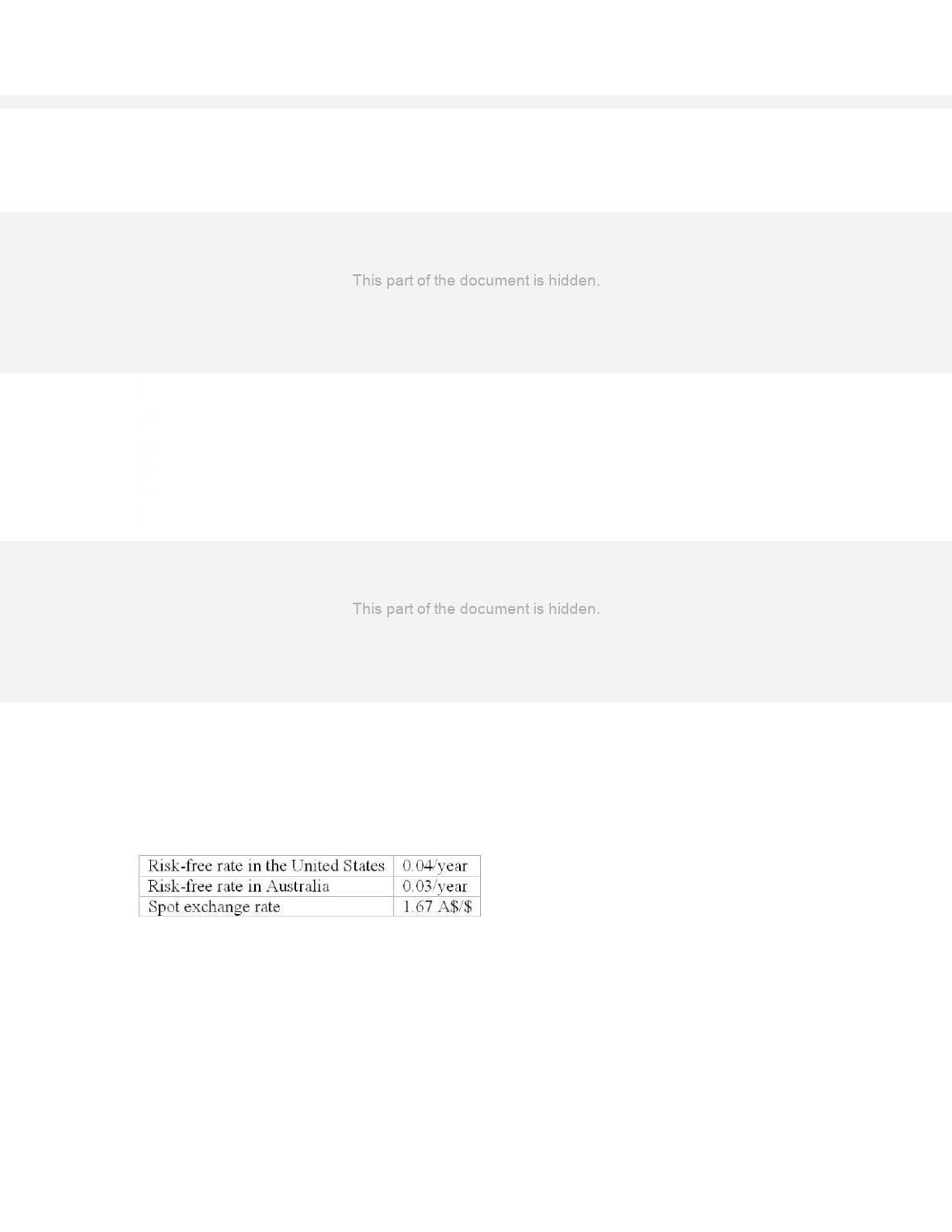
Consider the following:
23-8
18. What should be the proper futures price for a 1-year contract?
A. 1.703 A$/$
Difficulty: Moderate
19. If the futures market price is 1.63 A$/$, how could you arbitrage?
A. Borrow Australian Dollars in Australia, convert them to dollars, lend the proceeds in the
United States and enter futures positions to purchase Australian Dollars at the current futures
price.
Difficulty: Difficult
23-9
20. If the market futures price is 1.69 A$/$, how could you arbitrage?
C. Borrow U.S. dollars in the United States and invest them in the U.S. and enter futures
positions to purchase Australian Dollars at the current futures price.
D. Borrow Australian Dollars in Australia and invest them there, then convert back to U.S.
dollars at the spot price.
E. There is no arbitrage opportunity.
Difficulty: Difficult
21. Assume the current market futures price is 1.66 A$/$. You borrow 167,000 A$ and
convert the proceeds to U.S. dollars and invest them in the U.S. at the risk-free rate. You
simultaneously enter a contract to purchase 170,340 A$ at the current futures prices (maturity
of 1 year). What would be your profit (loss)?
Difficulty: Difficult
23–10
22. Which of the following are examples of interest rate futures contracts?
Difficulty: Easy
23. You hold a $50 million portfolio of par value bonds with a coupon rate of 10 percent paid
annually and 15 years to maturity. How many T-bond futures contracts do you need to hedge
the portfolio against an unanticipated change in the interest rate of 0.18%? Assume the market
interest rate is 10 percent and that T-bond futures contracts call for delivery of an 8 percent
coupon, paid annually 20-year _______ maturity T-bond.
A. 398 contracts long
Difficulty: Difficult
23–11
24. A swap
A. obligates two counterparties to exchange cash flows at one or more future dates.
B. allow participants to restructure their balance sheets.
Difficulty: Easy
25. Credit risk in the swap market
D. A and C.
E. none of the above.
Difficulty: Easy
23–12
26. Trading in stock index futures
A. now exceeds buying and selling of shares in most markets.
B. reduces transactions costs as compared to trading in stocks.
C. increases leverage as compared to trading in stocks.
Difficulty: Moderate
27. Commodity futures pricing
Difficulty: Easy
28. Arbitrage proofs in futures market pricing relationships
Difficulty: Difficult
23–13
29. One reason swaps are desirable is that
Difficulty: Moderate
30. Which two indices had the lowest correlation between them during the 2001-2006
period?
Difficulty: Easy
31. Which two indices had the highest correlation between them during the 2001-2006
period?
Difficulty: Easy