69.
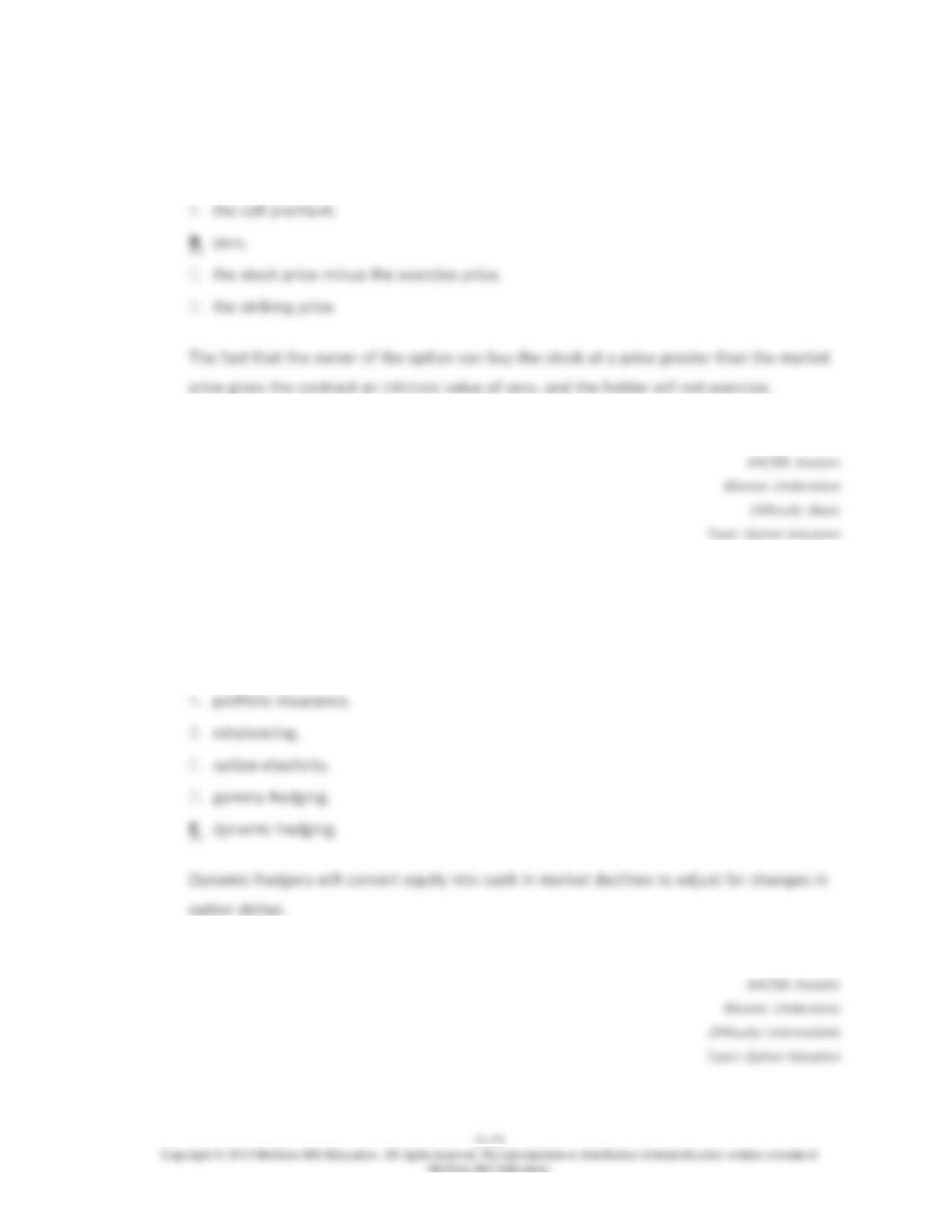
The intrinsic value of an out-of–the-money call option is equal to
70.
Since deltas change as stock values change, portfolio hedge ratios must be constantly
updated in active markets. This process is referred to as
71.
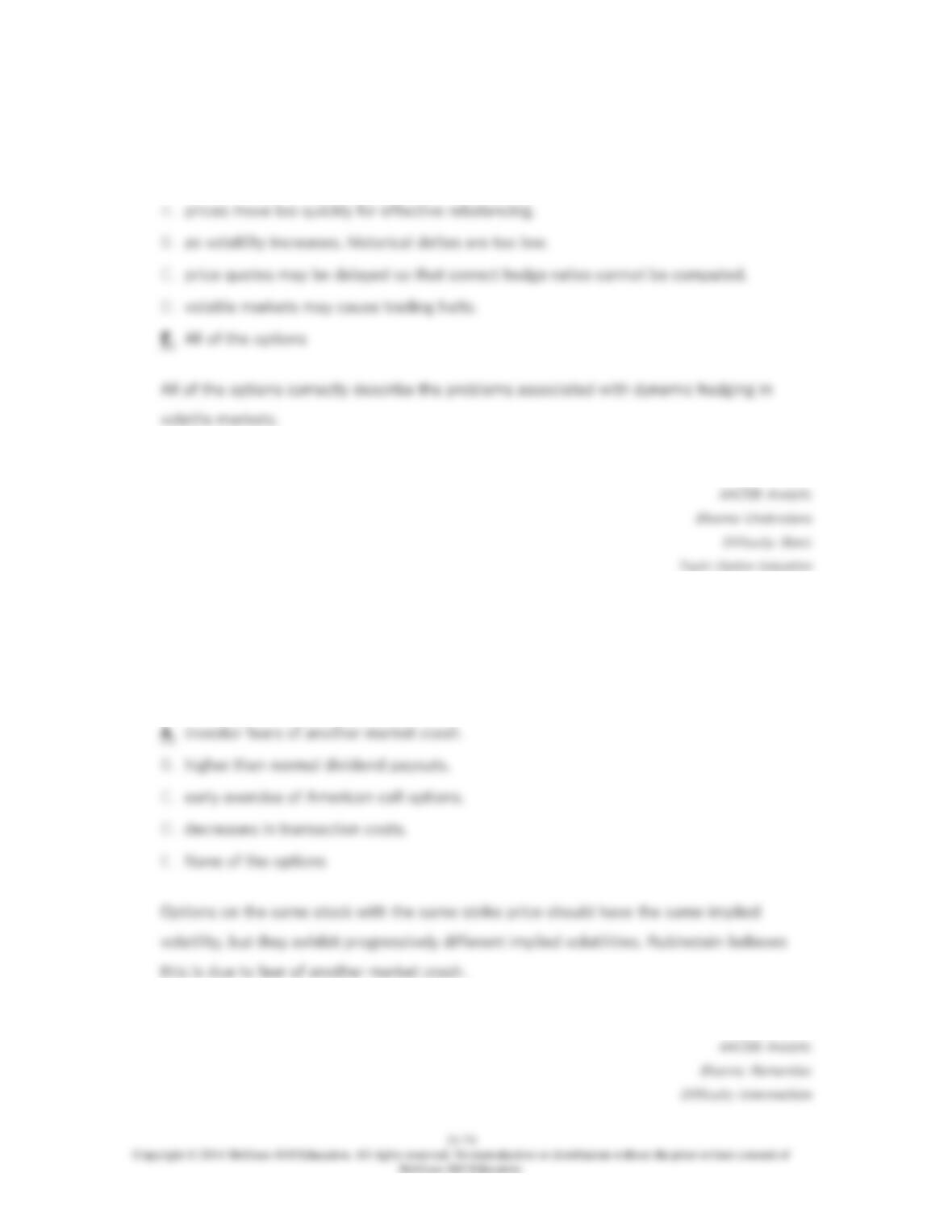
In volatile markets, dynamic hedging may be difficult to implement because
72.
Rubinstein (1994) observed that the performance of the Black-Scholes model had
deteriorated in recent years, and he attributed this to
73.
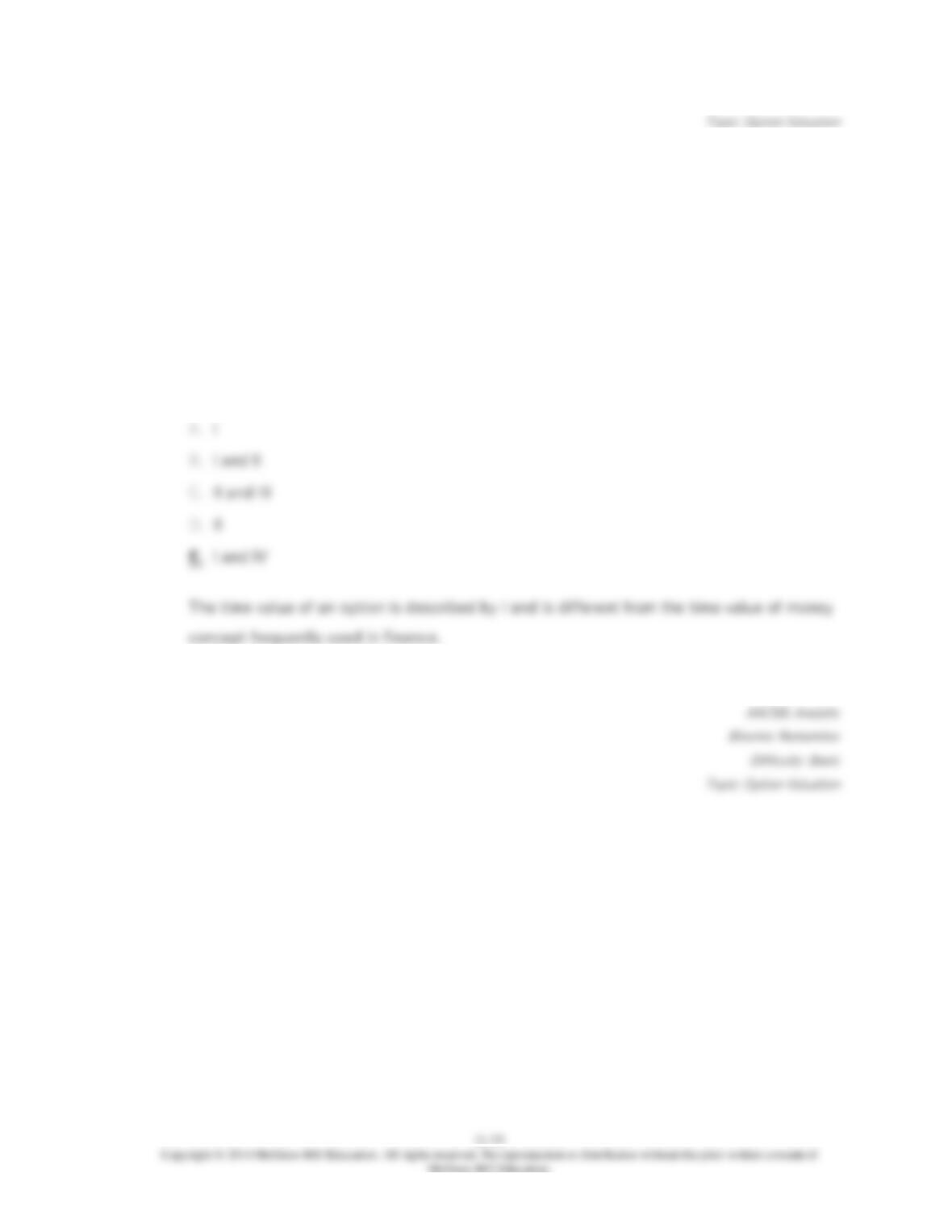
The time value of a call option is
I) the difference between the option’s price and the value it would have if it were expiring
immediately.
II) the same as the present value of the option’s expected future cash flows.
III) the difference between the option’s price and its expected future value.
IV) different from the usual time value of money concept.
74.
The time value of a put option is
I) the difference between the option’s price and the value it would have if it were expiring
immediately.
II) the same as the present value of the option’s expected future cash flows.
III) the difference between the option’s price and its expected future value.
IV) different from the usual time value of money concept.
75.
The intrinsic value of an at-the-money call option is equal to
76.
As the underlying stock’s price increased, the call option valuation function’s slope
approaches
77.
The intrinsic value of an in-of–the-money call option is equal to
78.
The Black-Scholes formula assumes that
I) the risk-free interest rate is constant over the life of the option.
II) the stock price volatility is constant over the life of the option.
III) the expected rate of return on the stock is constant over the life of the option.
IV) there will be no sudden extreme jumps in stock prices.
79.
The intrinsic value of an in-the-money put option is equal to
80.
The hedge ratio of an option is also called the options
81.
The intrinsic value of an at-the-money put option is equal to
82.
An American-style call option with six months to maturity has a strike price of $42. The
underlying stock now sells for $50. The call premium is $14.
What is the intrinsic value of the call?
83.
An American-style call option with six months to maturity has a strike price of $42. The
underlying stock now sells for $50. The call premium is $14.
What is the time value of the call?
84.
An American-style call option with six months to maturity has a strike price of $42. The
underlying stock now sells for $50. The call premium is $14.
If the company unexpectedly announces it will pay its first-ever dividend four months from
today, you would expect that
85.
The intrinsic value of an out-of–the-money put option is equal to
21–84
86.
Vega is defined as
Short Answer Questions
87.
Discuss the relationship between option prices and time to expiration, volatility of the
underlying stocks, and the exercise price.
88.
Which of the variables affecting option pricing is not directly observable? If this variable is
estimated to be higher or lower than the variable actually is, how is the option valuation
affected?
89.
What is an option hedge ratio? How does the hedge ratio for a call differ from that of a put
(or are the two equivalent)? Explain.
21–88
90.
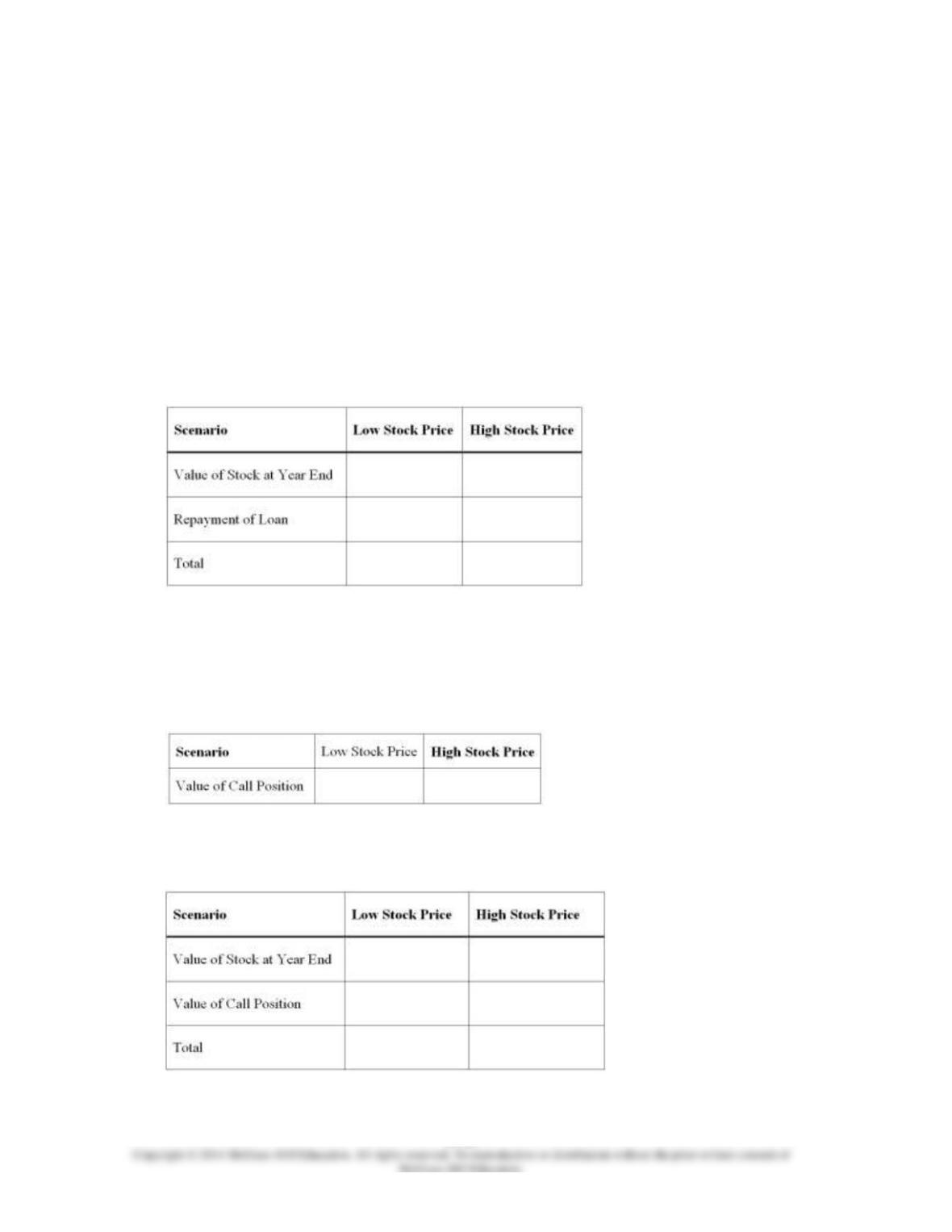
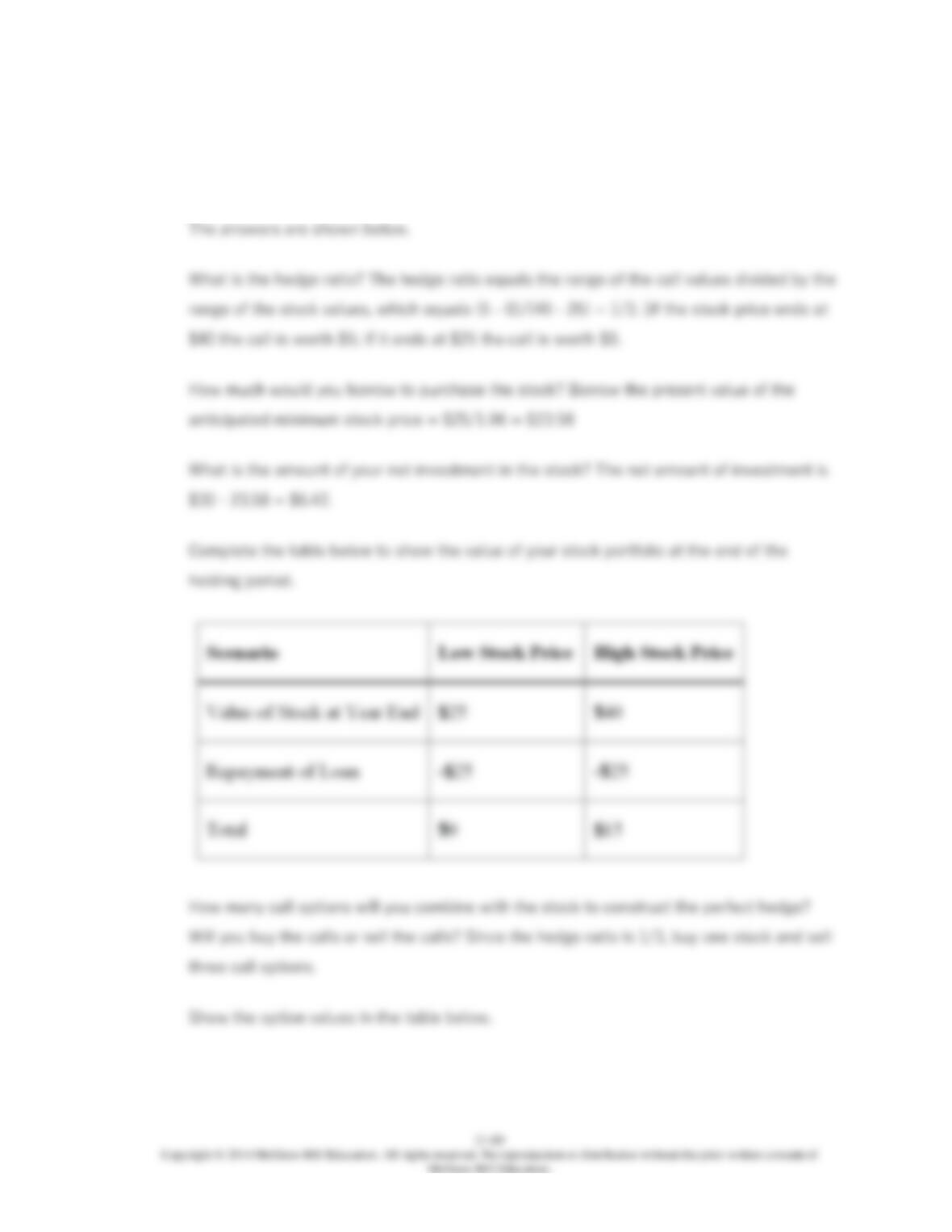
You are evaluating a stock that is currently selling for $30 per share. Over the investment
period you think that the stock price might get as low as $25 or as high as $40. There is a
call option available on the stock with an exercise price of $35. Answer the following
questions about hedging your position in the stock. Assume that you will hold one share.
What is the hedge ratio?
How much would you borrow to purchase the stock?
What is the amount of your net investment in the stock?
Complete the table below to show the value of your stock portfolio at the end of the
holding period.
How many call options will you combine with the stock to construct the perfect hedge?
Will you buy the calls or sell the calls?
Show the option values in the table below.
Show the net payoff to your portfolio in the table below.
What must the price of one call option be?