68) When Country A’s currency strengthens against Country B’s, citizens of Country A will
A) pay less to buy Country B’s products.
B) pay more to buy Country B’s products.
C) pay more to buy domestically produced products.
D) not be affected by the change in their currency’s value.
69) You travel to Cancun Mexico for spring break. The current exchange rate is 13 pesos to the
dollar. When you arrive, you convert $1,000 into how many pesos?
A) 1,300 pesos
B) 80 pesos
C) 13,000 pesos
D) 77 pesos
70) You are leaving Mexico and have 290 pesos to change into dollars. The exchange rate is now
12 pesos to the dollar. Approximately how many dollars will you receive?
A) $3025.00
B) $24.17
C) $264.00
D) $3,480.00
71) In the past, the U.S. dollar’s exchange rate with the Iceland krona was 0.0008 dollars per
krona. If today the exchange rate is 0.0006 dollars per krona, the dollar
A) strengthened against the krona.
B) weakened against the krona.
C) is not highly correlated to the krona.
D) The answer cannot be determined without knowing the number of kronas needed to buy a
dollar.
72) While shopping in the Mexican market, you find that limes cost 11 pesos each. You
remember that back in the U.S., they cost 80 cents each. If the purchasing power parity theory
holds, the rate of exchange is
A) 13.75 pesos/dollar or 7.3 cents/peso.
B) 80 pesos/dollar or 1.25 cents/peso.
C) 7.3 pesos/dollar or 13.75 cents/peso.
D) 11 pesos/dollar or 0.80 cents/peso.
73) Which of the following factors will NOT increase the value of a currency in foreign markets?
A) High interest rates in that country
B) High inflation in that country
C) A positive balance of payments with that country
D) A strong stock market rally in that country
74) Which of the following are strategies that can be used to minimize transaction exposure?
A) Hedging in the forward exchange market.
B) Hedging in the money market.
C) Hedging in the currency futures market.
D) All are strategies used to minimize transaction exposure.
75) The interplay between interest rate differentials and exchange rates such that each adjusts
until the foreign exchange market and the money market reach equilibrium is called the
A) purchasing power parity theory.
B) balance of payments.
C) interest rate parity theory.
D) multinational corporation.
76) The value of a country’s currency may increase by
A) continuous excessive government spending.
B) a stock market rally in that country.
C) an increase in that country’s money supply.
D) More than one of the options is correct.
77) The belief that shifts in exchange rates result from increasing or decreasing demand for a
country’s exports (or the corresponding opposite movements in supply of a country’s imports)
forms the basis for the
A) purchasing power theory of exchange rates.
B) interest rate parity theory of exchange rates.
C) balance of payments theory of exchange rates.
D) government intervention theory of exchange rates.
78) Which of the following statements about forward exchange rates is false?
A) They reduce uncertainty about the future value of currencies.
B) They reflect expectations about the future value of currencies.
C) They are usually slightly lower than the spot rate.
D) All of these options are true.
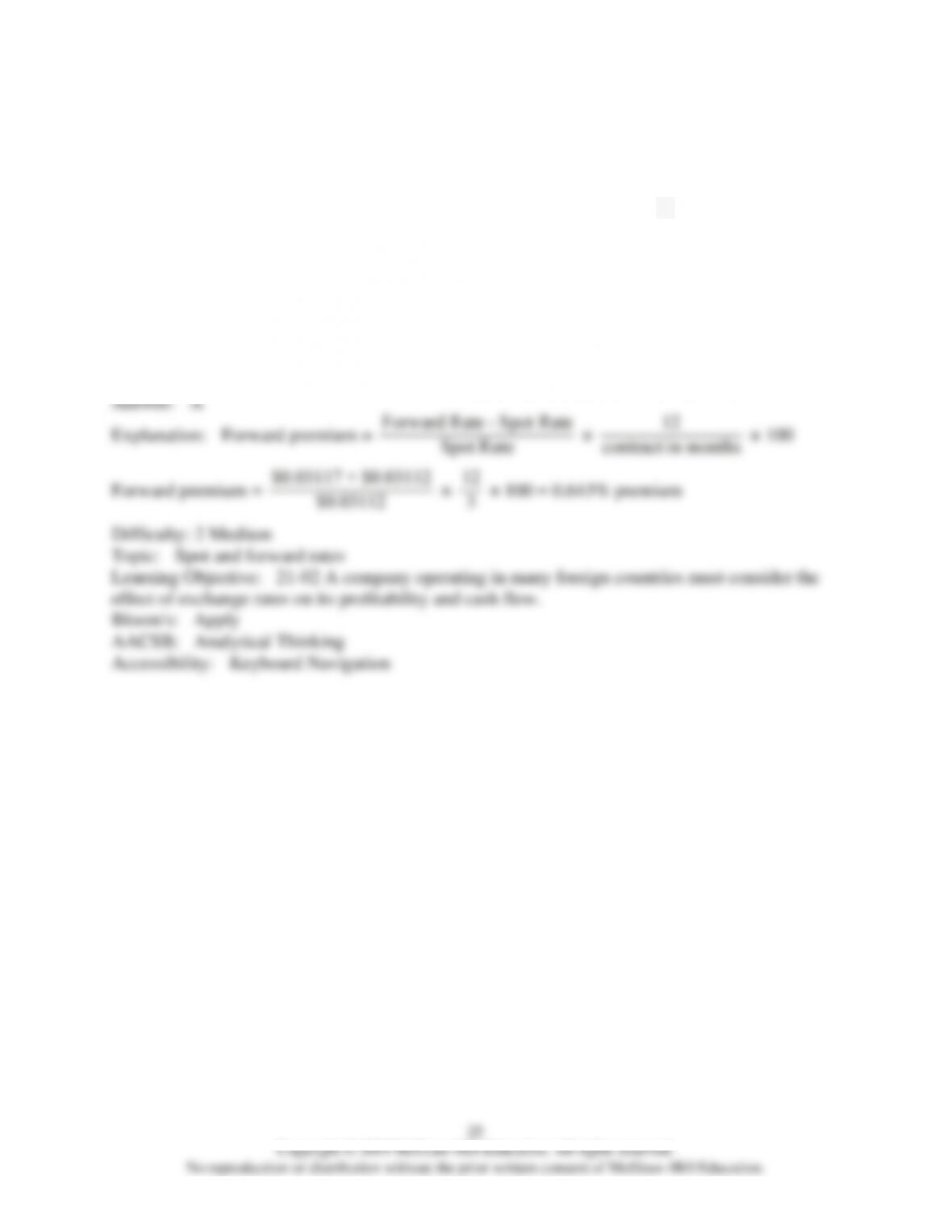
79) The following are the prices in the foreign exchange market between the U.S. dollar and
another local currency (LC).
Spot
$0.03112/LC
3-month forward
$0.03117/LC
6-month forward
$0.03118/LC
What was the approximate discount or premium on a three-month forward for LC?
A) 0.643% premium
B) 0.013% premium
C) 0.013% discount
D) 0.643% discount
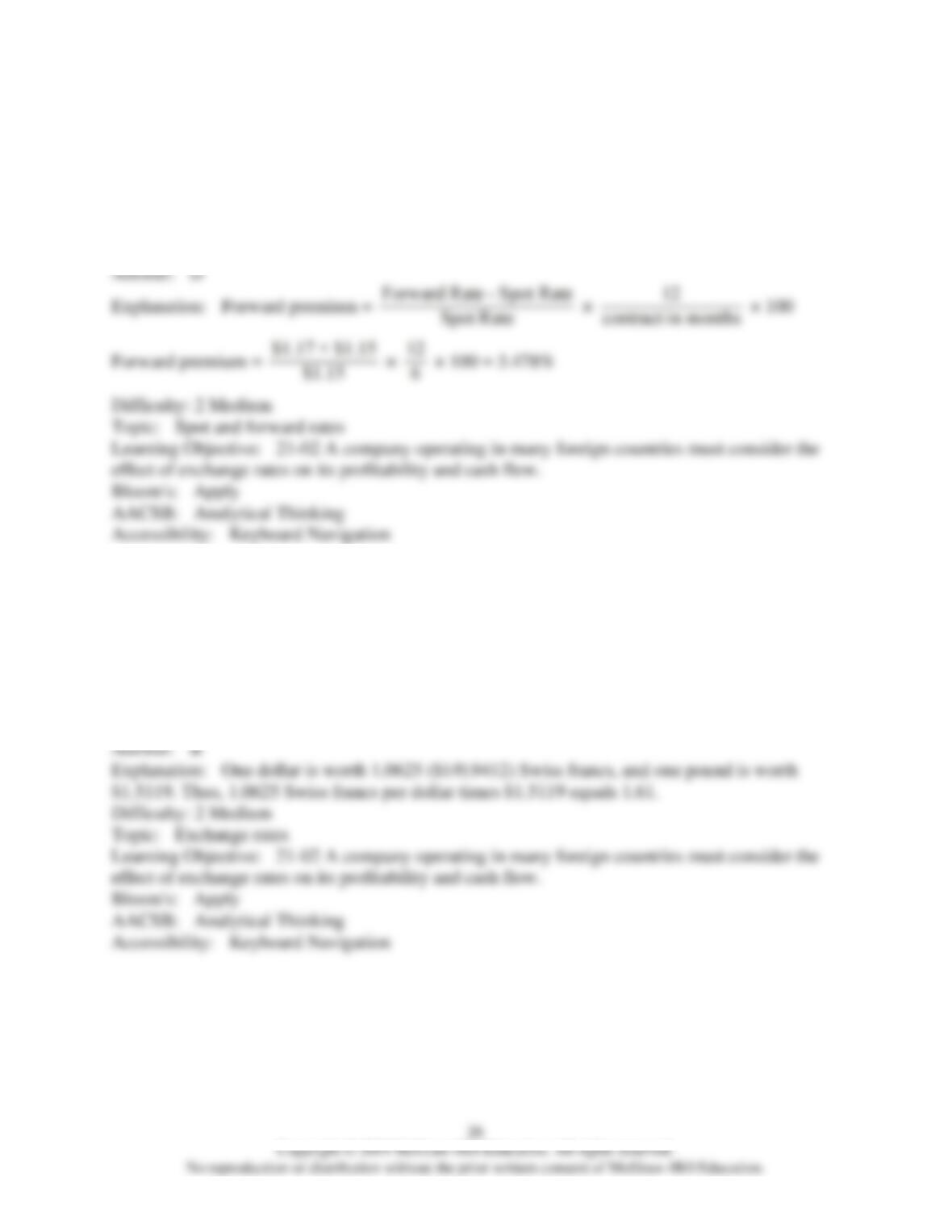
80) The spot rate of the British pound to the dollar is $1.15. The 180-day forward rate is $1.17.
Thus, the approximate annualized forward premium is ________.
A) 1.018%
B) 3.571%
C) 7.273%
D) 3.478%
81) The Swiss franc is selling for $0.9412 and the British pound is selling for $1.5119. The cross
rate between the franc and the pound (the number of Swiss francs that would buy one British
pound) is approximately:
A) 0.161
B) 1.61
C) 0.0322
D) 3.22
82) Assume that you had U.S. dollar quotes for the Japanese yen and the British pound. If you
want to know the yen/pound exchange rate, you would rely on
A) forward rates.
B) cross rates.
C) The Wall Street Journal.
D) hedge ratios.
83) Which of the following hedging strategies is not used to minimize transaction exposure?
A) The Eurobond market
B) The forward exchange market
C) The money market
D) The currency futures market
84) Which of the following kinds of risk is NOT uniquely associated with multinational
corporations (MNCs)?
A) Exchange rate risk
B) Business risk
C) Political risk
D) None of these options are uniquely associated with MNCs.
85) The possibility of experiencing a drop in revenue or an increase in costs in an international
transaction due to a change in foreign exchange rates is called
A) foreign exchange risk.
B) political risk.
C) translation exposure.
D) hedging risk.
86) Which of the following is not commonly used to minimize transaction exposure in foreign
exchange dealings?
A) Hedging in the forward exchange market
B) Hedging in the money market
C) Hedging in the stock market
D) Hedging in the currency futures market
87) A firm exposed to exchange rate risk can hedge its risk by
A) using the forward exchange market.
B) borrowing in international money markets.
C) utilizing foreign currency futures markets.
D) All of these options are true.
88) Which of the following hedging strategies involves a loan without a futures contract?
A) The Eurobond market
B) The forward exchange market
C) The money market
D) An International Money Market (IMM) contract
89) What has motivated American firms to move their operations to foreign countries?
A) Trade barriers, lower production costs, access to skilled workers, and U.S. tax deferral
B) Trade barriers, lower production costs, access to natural resources, and manufacturing
C) Import tariffs, foreign unions, foreign technology, and expropriation
D) Lower production costs, U.S. tax deferral, access to natural resources, manufacturing, and
expropriation
90) Which of the following is not a reason for U.S. firms operating in foreign markets?
A) Less expensive labor
B) Better economic and political environment (in the U.S.)
C) Tax incentives
D) To achieve international diversification
91) Which of the following statements about foreign affiliates is (are) true?
A) In general, foreign affiliates are more profitable than domestic businesses.
B) Foreign affiliates usually lower the portfolio risk of the parent company.
C) Foreign affiliates may have a significant positive impact on the host company’s economic
growth, employment, trade, and balance of payments.
D) All of these options are true.
92) A portfolio of international stocks in comparison to purely U.S. stocks generally shows
A) a lower percentage risk for a given number of stocks.
B) higher percentage risk for a given number of stocks.
C) the same percentage risk for a given number of stocks.
D) a lower percentage return for a given number of stocks.
93) Which of the following is an inducement for foreign investment in the United States?
A) Shortage of land in foreign countries
B) Advanced technology
C) Large market size
D) All of these options are inducement for investment in U.S.
94) To minimize exposure to political risk, a multinational firm may establish a joint venture
with a local entrepreneur or a group of multinationals, or
A) purchase an insurance policy from the Foreign Credit Insurance Association (FCIA).
B) hedge in the Eurodollar market.
C) purchase an insurance policy from the Overseas Private Investment Corporation (OPIC).
D) any combination of the options.
95) To minimize exposure to political risk, a multinational firm may:
A) establish a joint venture with a local entrepreneur or a group of multinationals
B) purchase an insurance policy from the Foreign Credit Insurance Association (FCIA).
C) hedge in the Eurodollar market.
D) purchase an insurance policy from any foreign company within the area that the corporation
is doing business.
96) The Overseas Private Investment Corporation (OPIC)
A) loans money to multinational firms.
B) does feasibility studies for multinational firms.
C) sells insurance policies to qualified multinational firms.
D) sells foreign investments.
97) The Export-Import Bank (Eximbank)
A) lends money to foreign purchasers of U.S. goods.
B) issues letters of credit.
C) makes parallel loans.
D) makes fronting loans.
98) In a parallel loan arrangement, an example would be where
A) the United States parent firm lends dollars to the U.S. affiliate, while the Dutch parent firm
lends guilders to the Dutch affiliate.
B) the United States parent firm lends dollars to the Dutch affiliate, while the Dutch parent lends
guilders to the American affiliate.
C) the United States parent lends guilders to the Dutch affiliate, while the Dutch parent lends
dollars to the American affiliate.
D) the parent firms lend funds to each other, while the affiliates lend funds to each other.
99) A loan arrangement in which a parent company reduces its political risk by using an
intermediary bank rather than a direct transfer of funds to a subsidiary is called a(n)
A) parallel loan.
B) Eximbank direct loan.
C) fronting loan.
D) Overseas Private Investment Corporation (OPIC).
100) Which of the following is not an advantage of borrowing in the Eurodollar market?
A) Greater availability of credit
B) Lower overhead costs for lending banks
C) The absence of compensating balance requirements
D) A constant lending rate over time
101) Eurodollars are
A) United States dollars deposited in foreign banks.
B) foreign dollars deposited in United States banks.
C) investments of common market countries.
D) the euro used in many European countries.
102) The Eurodollar market has a lower borrowing cost as compared to the U.S. because of
A) lower inflation abroad.
B) higher inflation in the United States.
C) slower money growth in the United States.
D) smaller overhead costs and the absence of a compensating balance requirement abroad.
103) In the Eurobond market,
A) the interest rate is very high.
B) the security is denominated in a currency that is different from that of the nation in which the
bonds are issued.
C) the Swiss franc is the most important currency.
D) disclosure requirements are very strict.
104) Which of the following statements is true about international equity (stock) markets?
A) Japanese households are large investors in common stock.
B) Commercial banks are generally not involved in the international securities business.
C) Some foreign investors are more risk-averse than their counterparts in the United States and
prefer dividend income over less certain capital gains.
D) Foreign exchanges never include the listing of U.S. firms.
105) An American Depository Receipt “ADR” is used to
A) facilitate investment in foreign shares by American investors.
B) allow American investors to participate in the debt securities of other countries.
C) guarantee dividends from foreign companies.
D) insure against foreign exchange currency risk.
106) The Eurobond market has which of the following characteristics?
A) Eurobond issues are denominated in the currency where the bond issue is sold.
B) Disclosure requirements in the Eurobond market are much less stringent than those required
by the U.S. Securities and Exchange Commission.
C) Eurobond issues are underwritten by the European Central Bank.
D) Eurobond issues are always denominated in euros.
107) A long-term debt issue sold simultaneously in several different national capital markets, but
denominated in a currency different from that of the national market where the issue occurred is
called a(n)
A) World bond.
B) International capital bond.
C) Floating bond.
D) Eurobond.
108) Which of the following statements about the International Finance Corporation (IFC) is
false?
A) The decision to assist a venture depends on both the profitability of the project and the
potential benefit to the host country’s economy.
B) The IFC assumes no managerial responsibility and exercises no voting rights.
C) The IFC may either buy equity shares or provide long-term loans.
D) All of these options are true.
109) The International Finance Corporation (IFC) is
A) a unit of the World Bank charged with the responsibility of providing capital to multinational
corporations and others involved in international trade.
B) a regulatory agency for international trade.
C) a private firm that provides accounts receivable financing to international firms.
D) a foreign affiliate of 10 major U.S. banks.
110) Which of the following events will NOT affect world markets?
A) A currency crisis
B) Government defaults on foreign debt
C) Terrorism
D) All of these options affect world markets.
111) Which of the following is NOT an example of a factor that can significantly influence
exchange rates?
A) The cost to purchase a loaf of bread in the U.S. has increased by $0.50 while the cost has
remained the same in London.
B) The cost of capital has increased by 2% in the U.S. and has decreased by 2% in Germany.
C) Interest rates on short-term investments in the U.S. have decreased to 4% while interest rates
in Japan are at 8%.
D) The U.S. has begun to export a higher level of goods to China than the prior year.
E) All of the above are factors that influence exchange rates.
112) If a forward discount is prevalent in U.S. dollars to Swiss francs,
A) the forward rate is lower than the spot rate.
B) the forward rate is higher than the spot rate.
C) markets will expect the Swiss Franc to appreciate relative to the dollar.
D) the forward rate is lower than the spot rate and markets expect the Swiss franc to appreciate
relative to the dollar.
113) Which of the following is true of forward and spot rates?
A) The premium or discount is usually 7-10%.
B) Spot and forward transactions generally occur on the organized exchange.
C) The length of a forward and spot contract is generally between zero and six months.
D) Both the forward and spot rate occur in the over-the-counter market.
114) Which of the following groups is NOT subject to foreign exchange risk?
A) Importers and exporters
B) Investors
C) Multinational corporations
D) All of these options are subject to foreign exchange risk.