Chapter 02 Asset Classes and Financial Instruments Answer Key
Multiple Choice Questions
1.
Which of the following is not a characteristic of a money market instrument?
2.
The money market is a subsector of the
3.
Treasury Inflation-Protected Securities (TIPS)
Topic: Money Market Instruments
4.
Which one of the following is not a money market instrument?
5.
T-bills are financial instruments initially sold by ________ to raise funds.
6.
The bid price of a T-bill in the secondary market is
7.
The smallest component of the money market is
8.
The smallest component of the bond market is _______ debt.
9.
The largest component of the bond market is _______ debt.
10.
Which of the following is not a component of the money market?
11.
Commercial paper is a short-term security issued by ________ to raise funds.
12.
Which one of the following terms best describes Eurodollars?
13.
Deposits of commercial banks at the Federal Reserve Bank are called
Topic: Money Market Instruments
14.
The interest rate charged by banks with excess reserves at a Federal Reserve Bank to
banks needing overnight loans to meet reserve requirements is called the
15.
Which of the following statement(s) is(are) true regarding municipal bonds?
I) A municipal bond is a debt obligation issued by state or local governments.
II) A municipal bond is a debt obligation issued by the federal government.
III) The interest income from a municipal bond is exempt from federal income taxation.
IV) The interest income from a municipal bond is exempt from state and local taxation in
the issuing state.
16.
Which of the following statements is true regarding a corporate bond?
17.
In the event of the firm’s bankruptcy
18.
Which of the following is true regarding a firm’s securities?
19.
Which of the following is true of the Dow Jones Industrial Average?
Topic: Market Indexes
20.
Topic: Market Indexes
Which of the following indices is(are) market-value weighted?
I) The New York Stock Exchange Composite Index
II) The Standard and Poor’s 500 Stock Index
III) The Dow Jones Industrial Average
21.
The Dow Jones Industrial Average (DJIA) is computed by
22.
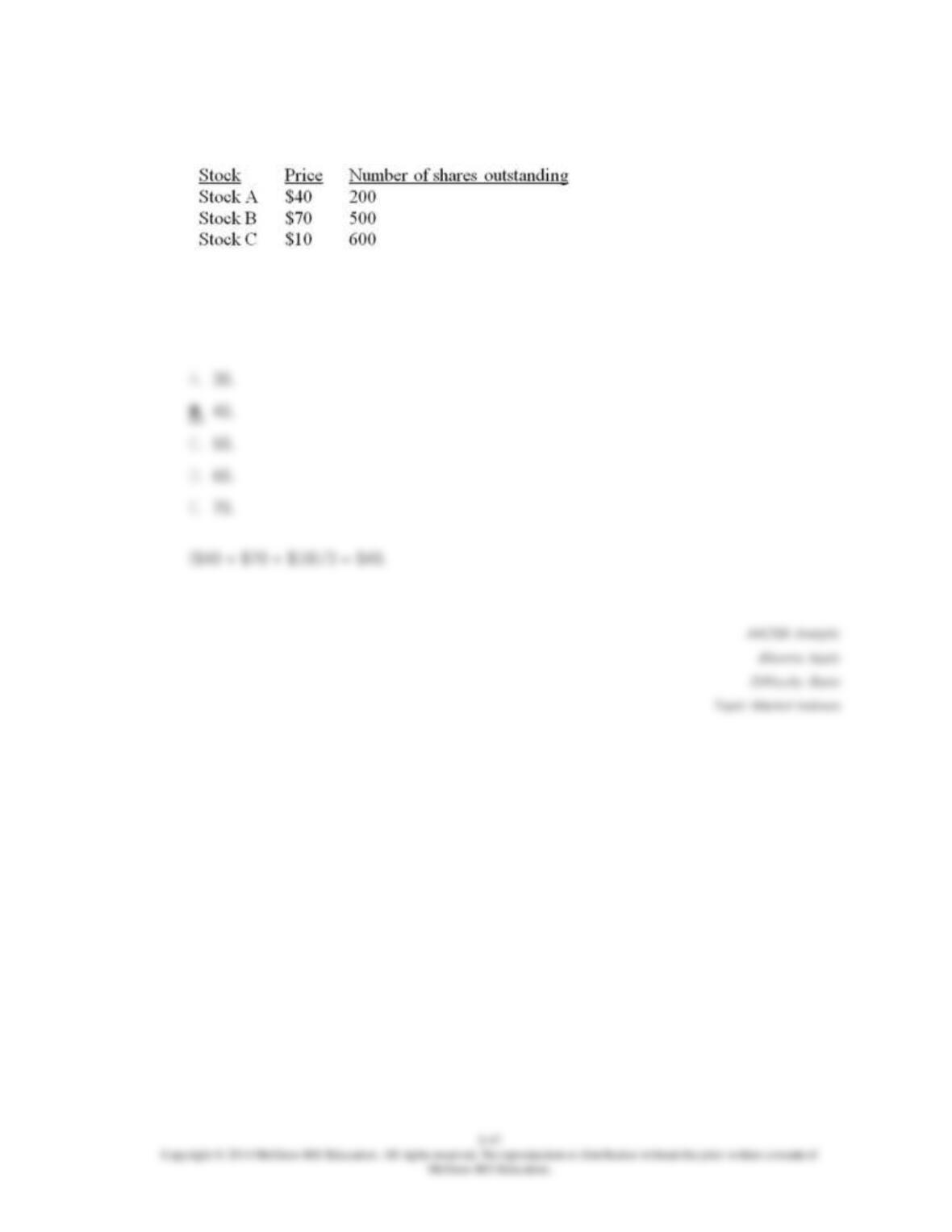
Consider the following three stocks:
The price-weighted index constructed with the three stocks is
23.
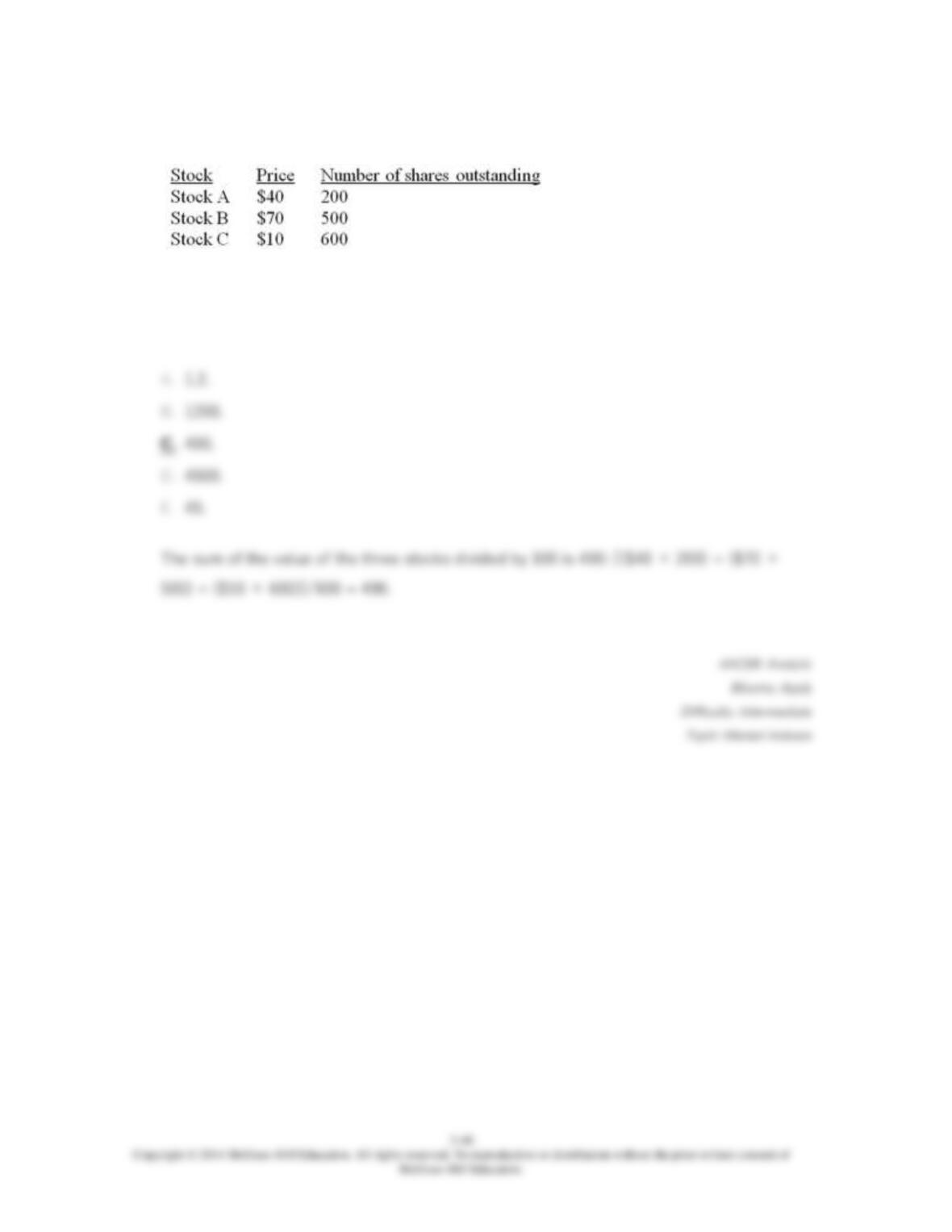
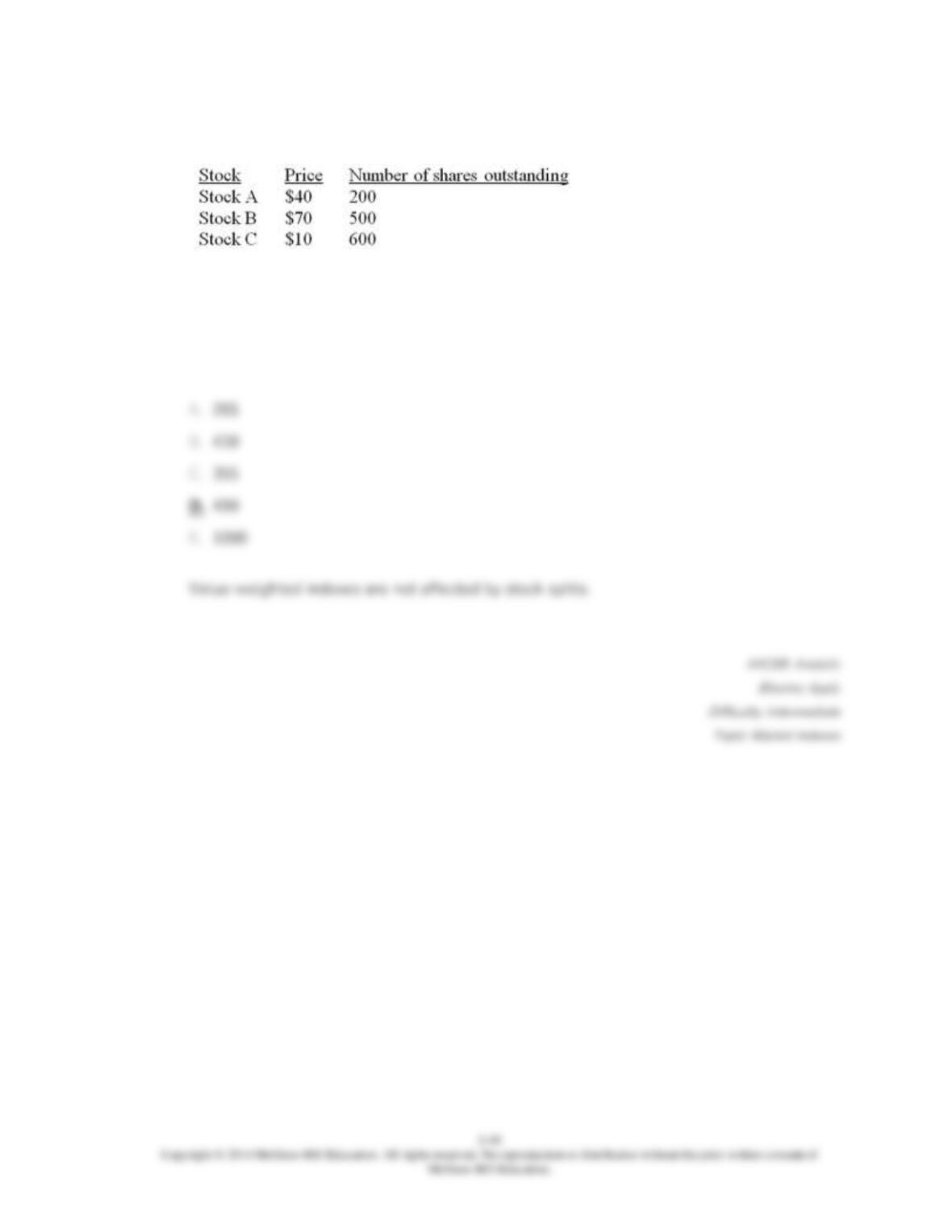
Consider the following three stocks:
The value-weighted index constructed with the three stocks using a divisor of 100 is
24.
Consider the following three stocks:
Assume at these prices that the value-weighted index constructed with the three stocks is
490. What would the index be if stock B is split 2 for 1 and stock C 4 for 1?
25.
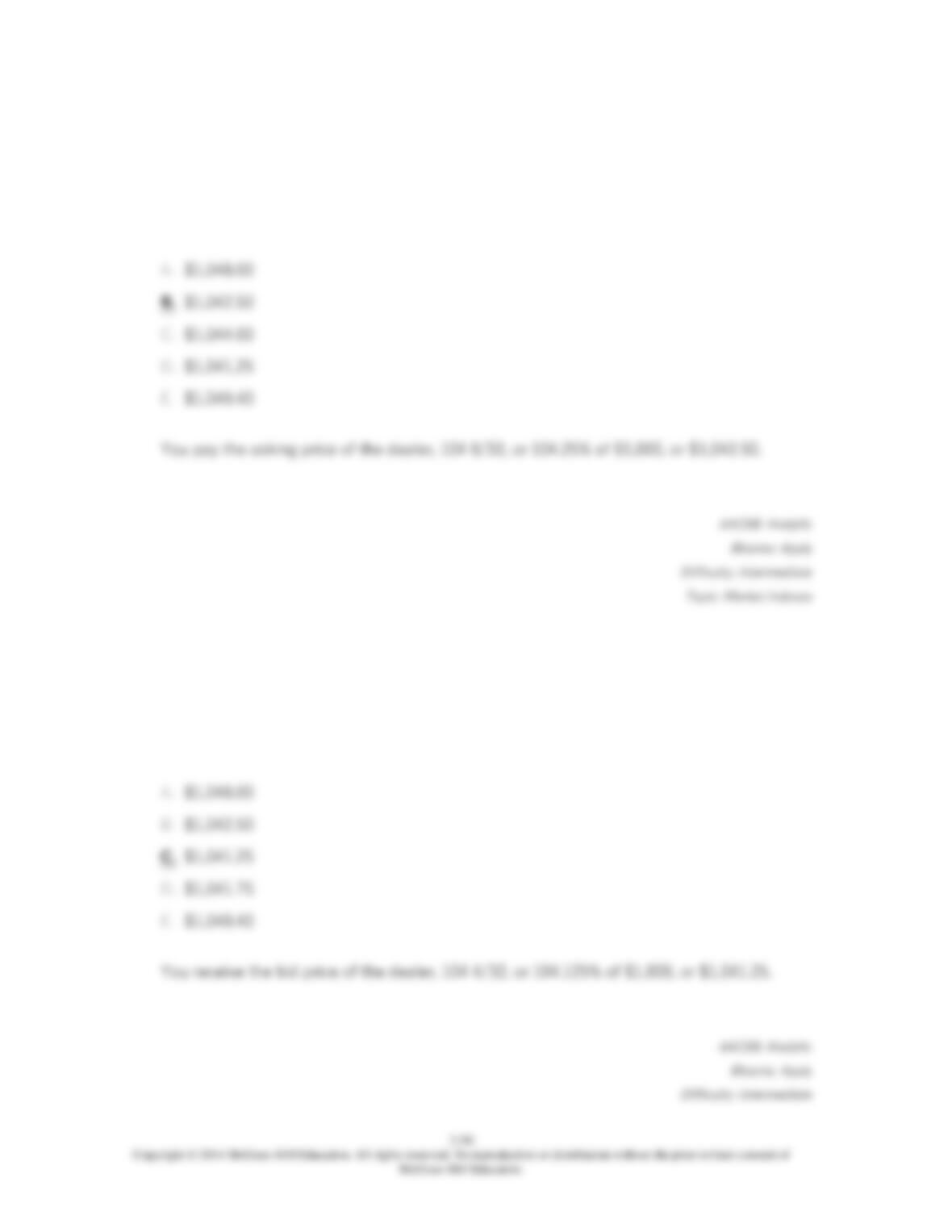
The price quotations of Treasury bonds in the
Wall
Street
Journal
show an ask price of
104:08 and a bid price of 104:04. As a buyer of the bond, what is the dollar price you
expect to pay?
26.
The price quotations of Treasury bonds in the
Wall
Street
Journal
show an ask price of
104:08 and a bid price of 104:04. As a seller of the bond what is the dollar price you expect
to pay?
Topic: Market Indexes
27.
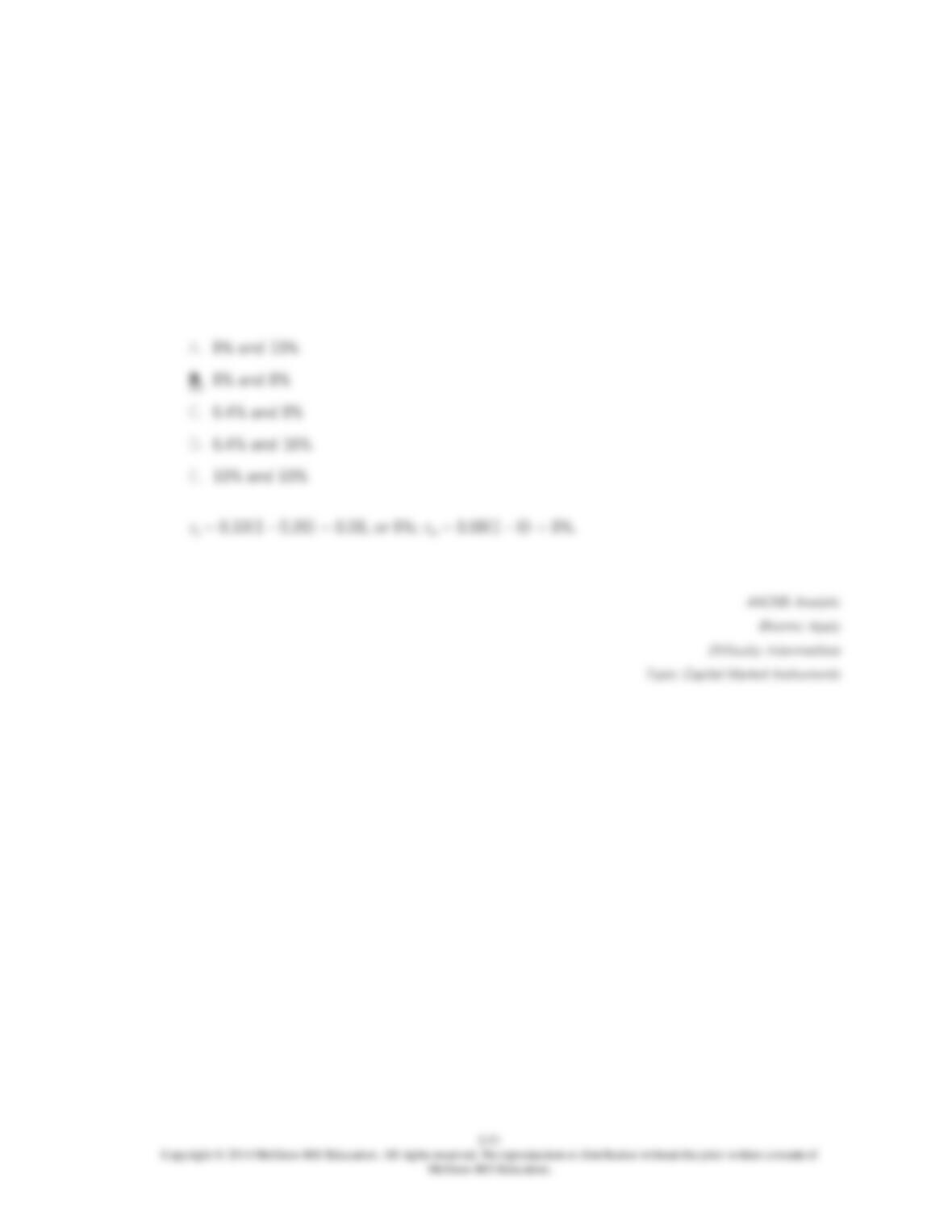
An investor purchases one municipal and one corporate bond that pay rates of return of
8% and 10%, respectively. If the investor is in the 20% marginal tax bracket, his or her
after-tax rates of return on the municipal and corporate bonds would be ________ and
______, respectively.
28.
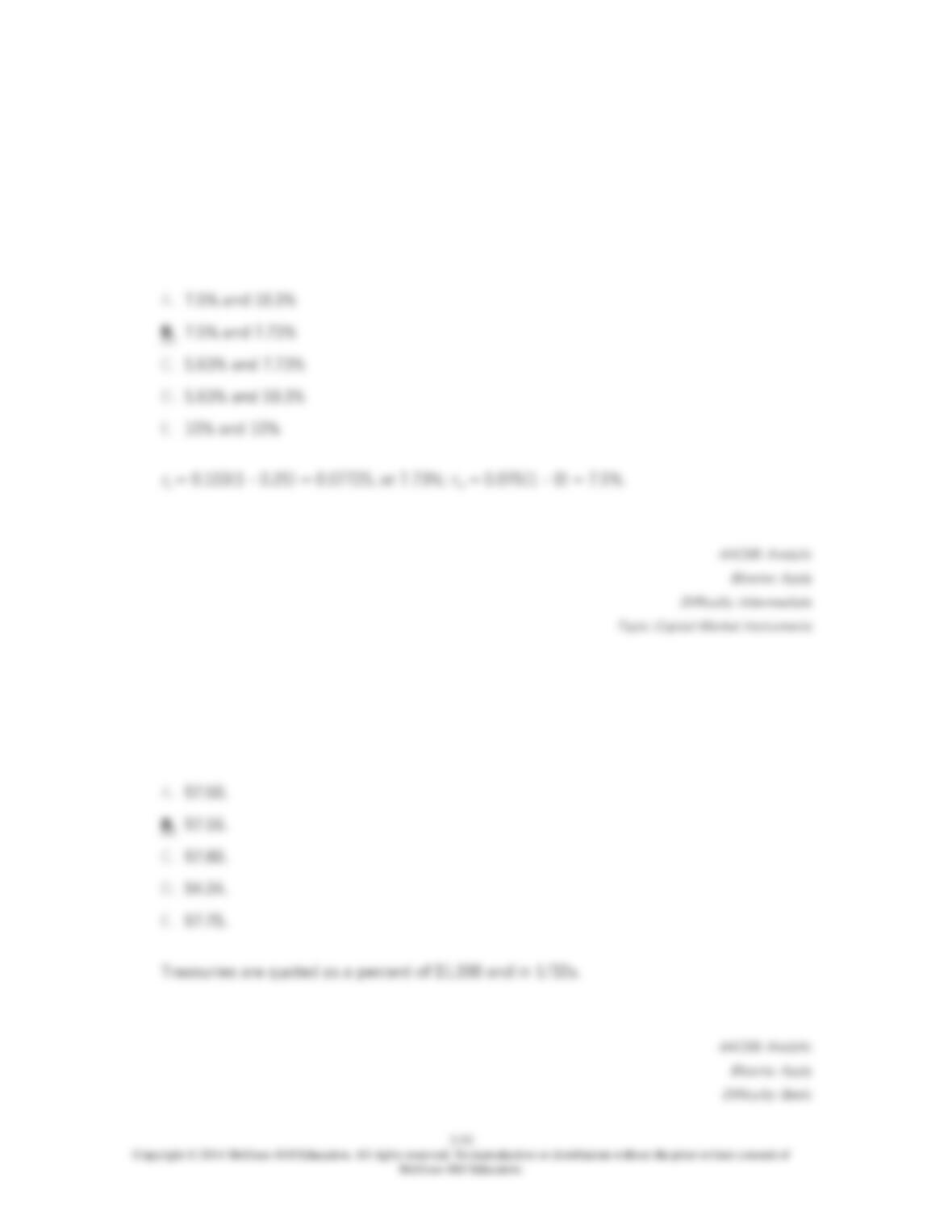
An investor purchases one municipal and one corporate bond that pay rates of return of
7.5% and 10.3%, respectively. If the investor is in the 25% marginal tax bracket, his or her
after-tax rates of return on the municipal and corporate bonds would be ________ and
______, respectively.
29.
If a Treasury note has a bid price of $975, the quoted bid price in the
Wall
Street
Journal
would be