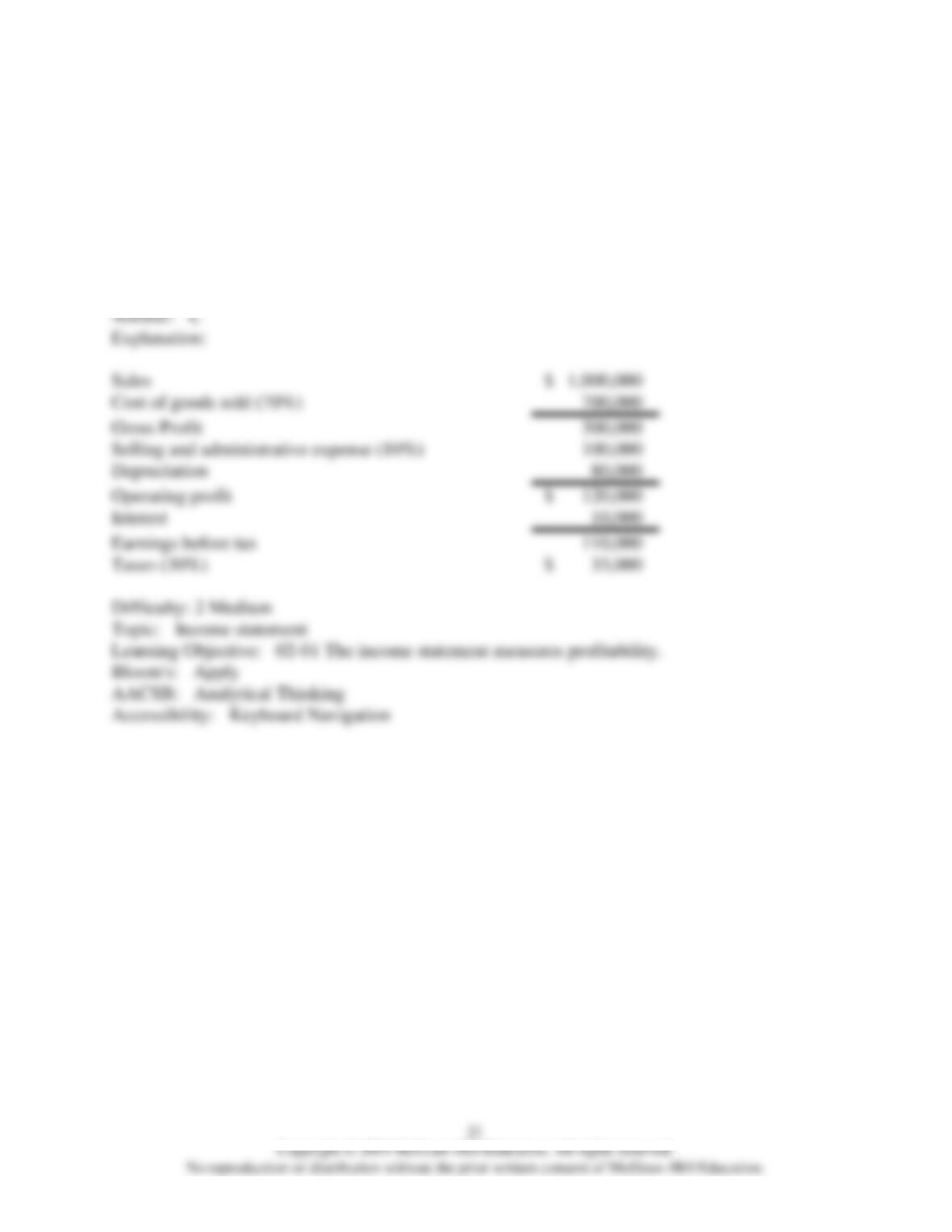
69) Elgin Battery Manufacturers had sales of $1,000,000 in 2015 and their cost of goods sold is
$700,000. Selling and administrative expenses were $100,000. Depreciation expense was
$80,000 and interest expense for the year was $10,000. The firm’s tax rate is 30 percent. What is
the dollar amount of taxes paid in 2015?
A) $36,000
B) $117,800
C) $33,000
D) $300,000
70) A firm has $1,500,000 in its common stock account and $1,000,000 in its capital paid in
excess of par account. The firm issued 100,000 shares of common stock. What was the issue
price (market value) if only one stock issuance has occurred?
A) $35 per share
B) $25 per share
C) $15 per share
D) Not enough information to determine
71) A firm has $4,000 in its common stock account and $10,000 in its paid-in capital account.
The firm issued 1,000 shares of common stock. What is the par value of the common stock?
A) $40 per share
B) $10 per share
C) $4 per share
D) $14 per share
72) A firm with earnings per share of $3 and a price-earnings (P/E) ratio of 24 will have a stock
market price of
A) $72.00.
B) $15.00.
C) $6.67.
D) $3.00.
73) Earnings per share is
A) operating profit divided by number of shares outstanding.
B) net income divided by number of shares outstanding.
C) net income divided by stockholders’ equity.
D) net income minus preferred dividends divided by number of shares outstanding.
74) Price-earnings (P/E) ratio is influenced by all of the following BUT
A) the business risk the firm takes on.
B) earnings per share.
C) quality of management.
D) All of the options are true.
75) Reinvested funds into retained earnings theoretically belong to
A) bond holders.
B) common stockholders.
C) employees.
D) All of the options
76) When a firm’s earnings are falling more rapidly than its stock price, its P/E ratio will
A) remain the same.
B) go up.
C) go down.
D) either go up or down.
77) Which of the following factors do not influence the firm’s P/E ratio?
A) Past earnings
B) Shares outstanding
C) Volatility in business performance
D) All of the options influence the firm’s P/E ratio.
78) Which of the following would not be classified as a current asset?
A) Marketable securities
B) Plant property and equipment
C) Prepaid expenses
D) Inventory
79) An item which may be converted to cash within one year or one operating cycle of the firm
is classified as a
A) current liability.
B) long-term asset.
C) current asset.
D) long-term liability.
80) Asset accounts on the balance sheet are listed in order of
A) liquidity.
B) profitability.
C) dollar amount.
D) importance.
81) Which of the following is not a primary source of raising money or capital for the firm?
A) Assets
B) Common stock
C) Preferred stock
D) Bonds
82) How many of the following balance sheet items are classified as a current asset or current
liability?
Retained earnings
Accounts payable
Plant and equipment
Inventory
Common stock
Bonds payable
Accrued wages payable
Accounts receivable
Preferred stock
A) Three of these items.
B) Four of these items.
C) Five of these items.
D) Six of these items.
83) How many of the following items are found on the balance sheet, rather than the income
statement?
Accounts receivable
Retained earnings
Income tax expense
Accrued payable
Cash
Selling and administrative expenses
Plant and equipment
Operating expense
Marketable securities
Interest expense
A) Three of these items are found on the balance sheet.
B) Four of these items are found on the balance sheet.
C) Five of these items are found on the balance sheet.
D) Six of these items are found on the balance sheet.
84) How many of the following items are found on the income statement, rather than the balance
sheet?
Sales
Notes payable (due in six months)
Bonds payable (mature in 10 years)
Common stock
Depreciation expense
Inventories
Capital in excess of par value
Net income (earnings after taxes)
Income tax payable
A) Two of these items are found on the income statement.
B) Three of these items are found on the income statement.
C) Four of these items are found on the income statement.
D) Five of these items are found on the income statement.
85) Which account represents the cumulative earnings of the firm since the firm started, minus
dividends paid?
A) Paid-in capital
B) Common stock
C) Retained earnings
D) Accumulated depreciation
86) The major limitation of financial statements are
A) their complexity.
B) their lack of comparability.
C) their use of historical cost accounting.
D) their lack of detail.
87) Net worth is equal to stockholders’ equity
A) plus dividends.
B) minus preferred stock.
C) plus preferred stock.
D) minus liabilities.
88) Book value is the same as
A) stockholders’ equity.
B) fixed assets minus long-term debt.
C) net worth.
D) current assets minus current debt.
89) Total stockholders’ equity consists of
A) preferred stock and common stock.
B) common stock and retained earnings.
C) common stock, preferred stock, and capital paid in excess of par.
D) preferred stock, common stock, capital paid in excess of par, and retained earnings.
90) The net worth of a firm
A) is usually the same as the firm’s market value.
B) is based on current asset costs.
C) is based on current assets less current liabilities.
D) None of the options
91) The book value per share is based off of ________ data, while the market value per share is
based off of ________ data.
A) short term; long term
B) future; historical
C) historical; future
D) long term; short term
92) The primary disadvantage of accrual accounting is that
A) it does not match revenues and expenses in the period in which they are incurred.
B) it does not appropriately measure accounting profit.
C) it does not recognize accounts receivable.
D) it does not adequately show the actual cash flows of the firm.
93) The statement of cash flows does not include which of the following sections?
A) Cash flows from operating activities
B) Cash flows from sales activities
C) Cash flows from investing activities
D) Cash flows from financing activities
94) Which of the following is an outflow of cash?
A) Profitable operations
B) The sale of equipment
C) The sale of the company’s common stock
D) The payment of cash dividends