Chapter 02 – Asset Classes and Financial Instruments
2-19
48. Which of the following are characteristics of preferred stock?
I) It pays its holder a fixed amount of income each year, at the discretion of its managers.
II) It gives its holder voting power in the firm.
III) Its dividends are usually cumulative.
IV) Failure to pay dividends may result in bankruptcy proceedings.
A. I, III, and IV
B. I, II, and III
Difficulty: Moderate
49. Bond market indexes can be difficult to construct because
A. they cannot be based on firms’ market values.
Difficulty: Moderate
50. With regard to a futures contract, the long position is held by
A. the trader who bought the contract at the largest discount.
Difficulty: Easy
Chapter 02 – Asset Classes and Financial Instruments
2-20
Short Answer Questions
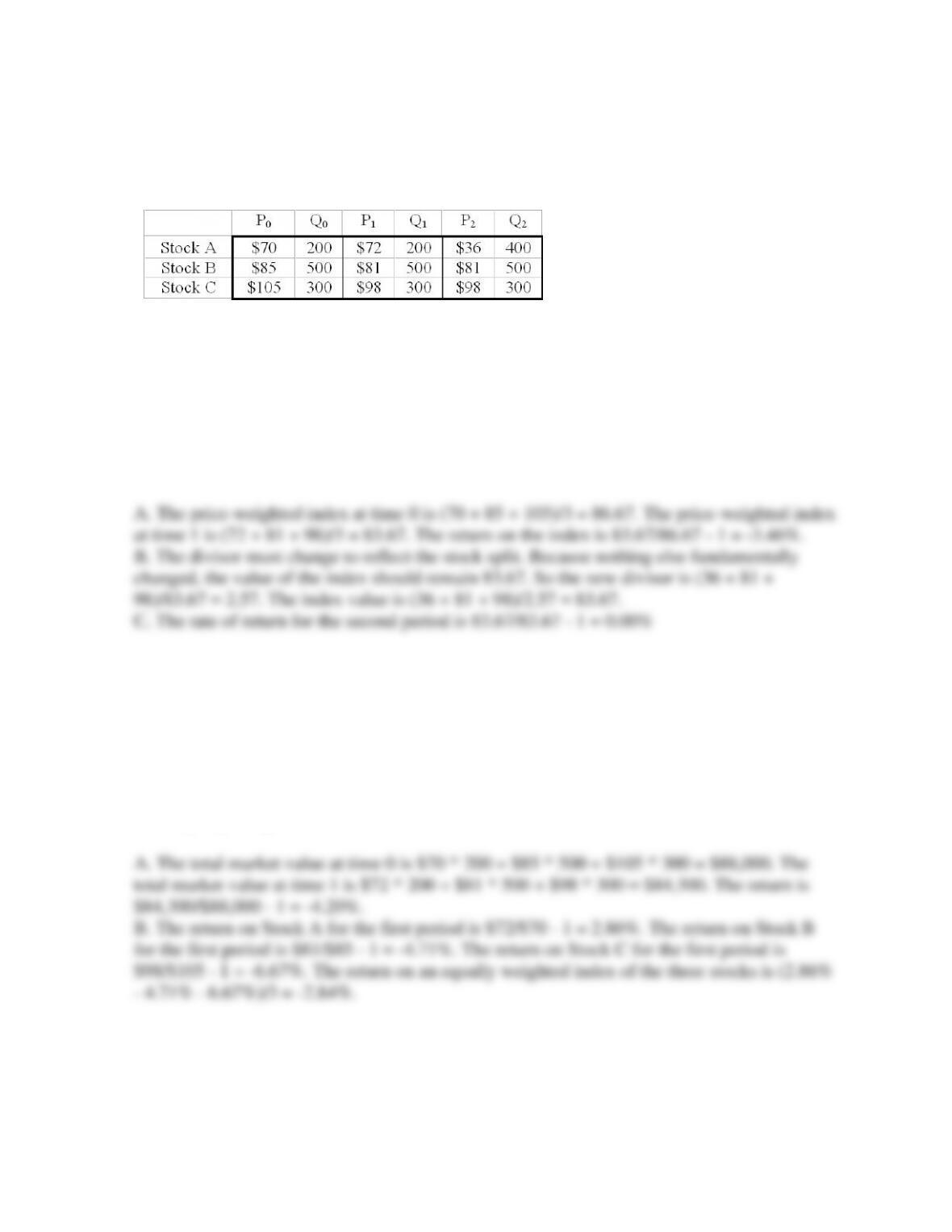
51. Based on the information given, for a price-weighted index of the three stocks calculate:
a. the rate of return for the first period (t=0 to t=1).
b. the value of the divisor in the second period (t=2). Assume that Stock A had a 2-1 split
during this period.
c. the rate of return for the second period (t=1 to t=2).
Difficulty: Difficult
52. Based on the information given for the three stocks, calculate the first-period rates of
return (from t=0 to t=1) on
a. a market-value-weighted index.
b. an equally-weighted index.
Difficulty: Difficult
Chapter 02 – Asset Classes and Financial Instruments
2-21
Multiple Choice Questions
53. In order for you to be indifferent between the after tax returns on a corporate bond paying
9% and a tax-exempt municipal bond paying 7%, what would your tax bracket need to be?
A. 17.6%
Difficulty: Moderate
54. In order for you to be indifferent between the after tax returns on a corporate bond paying
7% and a tax-exempt municipal bond paying 5.5%, what would your tax bracket need to be?
A. 22.6%
Difficulty: Moderate
Chapter 02 – Asset Classes and Financial Instruments
2-22
55. An investor purchases one municipal and one corporate bond that pay rates of return of
6% and 8%, respectively. If the investor is in the 25% marginal tax bracket, his or her after
tax rates of return on the municipal and corporate bonds would be ________ and ______,
respectively.
A. 6% and 8%
B. 4.5% and 6%
Difficulty: Moderate
56. An investor purchases one municipal and one corporate bond that pay rates of return of
7.2% and 9.1%, respectively. If the investor is in the 15% marginal tax bracket, his or her
after tax rates of return on the municipal and corporate bonds would be ________ and
______, respectively.
A. 7.2% and 9.1%
Difficulty: Moderate
Chapter 02 – Asset Classes and Financial Instruments
2-23
57. For a taxpayer in the 25% marginal tax bracket, a 20-year municipal bond currently
yielding 5.5% would offer an equivalent taxable yield of:
D. 4.125%.
E. none of the above.
Difficulty: Moderate
58. For a taxpayer in the 15% marginal tax bracket, a 15-year municipal bond currently
yielding 6.2% would offer an equivalent taxable yield of:
A. 6.2%.
Difficulty: Moderate
59. With regard to a futures contract, the short position is held by
A. the trader who bought the contract at the largest discount.
Difficulty: Easy
Chapter 02 – Asset Classes and Financial Instruments
2-24
60. A call option allows the buyer to
A. sell the underlying asset at the exercise price on or before the expiration date.
B. buy the underlying asset at the exercise price on or before the expiration date.
Difficulty: Easy
61. A put option allows the holder to
A. buy the underlying asset at the strike price on or before the expiration date.
Difficulty: Easy
62. The ____ index represents the performance of the German stock market.
E. None of the above
Difficulty: Easy
Chapter 02 – Asset Classes and Financial Instruments
2-25
63. The ____ index represents the performance of the Japanese stock market.
A. DAX
Difficulty: Easy
64. The ____ index represents the performance of the U.K. stock market.
A. DAX
Difficulty: Easy
65. The ____ index represents the performance of the Hong Kong stock market.
A. DAX
B. FTSE
Difficulty: Easy
Chapter 02 – Asset Classes and Financial Instruments
2-26
66. The ____ index represents the performance of the Canadian stock market.
A. DAX
Difficulty: Easy
E. None of the above.
Difficulty: Easy
68. The ____ is an example of a U.S. index of large firms.
A. Wilshire 5000
Difficulty: Easy
Chapter 02 – Asset Classes and Financial Instruments
2-27
69. The ____ is an example of a U.S. index of small firms.
A. S&P 500
Difficulty: Easy
70. The largest component of the money market is ____________.
A. repurchase agreements
B. money market mutual funds
Difficulty: Easy
71. Certificates of deposit are insured by the ____________.
A. SPIC
B. CFTC
Difficulty: Easy
Chapter 02 – Asset Classes and Financial Instruments
2-28
72. Certificates of deposit are insured for up to ____________ in the event of bank
insolvency.
A. $10,000
Difficulty: Easy
73. The maximum maturity of commercial paper that can be issued without SEC registration
is ____________.
D. 30 days
E. none of the above
Difficulty: Easy
74. Which of the following is used extensively in foreign trade when the creditworthiness of
one trader is unknown to the trading partner?
A. repos
Difficulty: Easy
Chapter 02 – Asset Classes and Financial Instruments
2-29
75. A US dollar denominated bond that is sold in Singapore is a ____________.
D. Bulldog bond
E. none of the above
Difficulty: Easy
76. A municipal bond issued to finance an airport, hospital, turnpike, or port authority is
typically a ____________.
D. A and B are equally likely
E. B and C are equally likely
Difficulty: Easy
77. Unsecured bonds are called ____________.
A. junk bonds
B. debentures
Difficulty: Easy
Chapter 02 – Asset Classes and Financial Instruments
2-30
78. A bond that can be retired prior to maturity by the issuer is a ____________ bond.
A. convertible
B. secured
Difficulty: Easy
79. Corporations can exclude ____________ percent of the dividends received from preferred
stock.
A. 50
Difficulty: Easy
80. You purchased a futures contract on corn at a futures price of 350 and at the time of
expiration the price was 352. What was your profit or loss?
A. $2.00
B. -$2.00
Difficulty: Easy
Chapter 02 – Asset Classes and Financial Instruments
2-31
81. You purchased a futures contract on corn at a futures price of 331 and at the time of
expiration the price was 343. What was your profit or loss?
A. -$12.00
B. $12.00
Difficulty: Easy
82. You sold a futures contract on corn at a futures price of 350 and at the time of expiration
the price was 352. What was your profit or loss?
A. $2.00
B. -$2.00
Difficulty: Easy
83. You sold a futures contract on corn at a futures price of 331 and at the time of expiration
the price was 343. What was your profit or loss?
A. -$12.00
B. $12.00
Difficulty: Easy
Chapter 02 – Asset Classes and Financial Instruments
2-32
84. You purchased a futures contract on oats at a futures price of 233.75 and at the time of
expiration the price was 261.25. What was your profit or loss?
D. $27.50
E. None of the above
Difficulty: Easy
85. You sold a futures contract on oats at a futures price of 233.75 and at the time of
expiration the price was 261.25. What was your profit or loss?
A. $1375.00
Difficulty: Easy
Chapter 02 – Asset Classes and Financial Instruments
2-33
Short Answer Questions
86. Distinguish between U.S. Treasury debt and U.S Agency debt.
Debt issued by the U.S. Treasury is backed by the full taxing power of the U.S. Treasury.
Such instruments are considered to be free of default risk. Some agencies of the U.S.
government issue debt also. Technically, this debt is not backed by the U.S. Treasury.
Difficulty: Moderate
Chapter 02 – Asset Classes and Financial Instruments
2-34
87. Discuss the advantages and disadvantages of common stock ownership, relative to other
investment alternatives.
The advantages of common stock ownership are: The stockholder is allowed to participate in
earnings, that is, if the firm is doing well, these benefits are passed on to the shareholder in the
form of dividends and/or increased market price of the stock (with fixed income investments,
such as bonds and preferred stock, the investor receives a fixed payment, regardless of the
earnings of the firm); in addition, common stock investment represents ownership in the firm,
Difficulty: Moderate
Chapter 02 – Asset Classes and Financial Instruments
2-35
88. The Dow Jones Industrial Average and the New York Stock Exchange Index have unique
characteristics. Discuss how these indices are calculated and any problems/advantages
associated with the specific indices.
The Dow Jones Industrial Average (DJIA) is the oldest index. The index consists of 30 “blue
chip” industrial firms. Thus, the index is comprised of a small sample and is not
representative of the market as a whole. The index is “price-weighted”, that is, the only
market variables in the calculation of the index are the prices of the stocks on the index. As
Difficulty: Moderate