Chapter 02 – Asset Classes and Financial Instruments
2-1
Chapter 02
Asset Classes and Financial Instruments
Multiple Choice Questions
1. Which of the following is not a characteristic of a money market instrument?
A. liquidity
B. marketability
Difficulty: Easy
2. The money market is a subsector of the
A. money market.
B. capital market.
Difficulty: Easy
Chapter 02 – Asset Classes and Financial Instruments
2-2
3. Treasury Inflation-Protected Securities (TIPS)
A. pay a fixed interest rate for life.
B. pay a variable interest rate that is indexed to inflation.
Difficulty: Easy
4. Which one of the following is not a money market instrument?
A. a Treasury bill
Difficulty: Easy
5. T-bills are financial instruments initially sold by ________ to raise funds.
A. commercial banks
Difficulty: Easy
Chapter 02 – Asset Classes and Financial Instruments
2-3
6. The bid price of a T-bill in the secondary market is
A. the price at which the dealer in T-bills is willing to sell the bill.
Difficulty: Easy
7. The smallest component of the money market is
A. repurchase agreements
Difficulty: Easy
8. The smallest component of the bond market is
A. Treasury
Difficulty: Easy
Chapter 02 – Asset Classes and Financial Instruments
2-4
D. tax-exempt
E. mortgage-backed
Difficulty: Easy
10. Which of the following is not a component of the money market is
A. repurchase agreements
B. Eurodollars
Difficulty: Easy
11. Commercial paper is a short-term security issued by ________ to raise funds.
A. the Federal Reserve Bank
B. commercial banks
Difficulty: Easy
Chapter 02 – Asset Classes and Financial Instruments
2-5
12. Which one of the following terms best describes Eurodollars:
A. dollar-denominated deposits in European banks.
B. dollar-denominated deposits at branches of foreign banks in the U.S.
Difficulty: Moderate
13. Deposits of commercial banks at the Federal Reserve Bank are called __________.
A. bankers’ acceptances
B. repurchase agreements
Difficulty: Easy
14. The interest rate charged by banks with excess reserves at a Federal Reserve Bank to
banks needing overnight loans to meet reserve requirements is called the _________.
A. prime rate
B. discount rate
Difficulty: Easy
Chapter 02 – Asset Classes and Financial Instruments
2-6
15. Which of the following statements is (are) true regarding municipal bonds?
I) A municipal bond is a debt obligation issued by state or local governments.
II) A municipal bond is a debt obligation issued by the federal government.
III) The interest income from a municipal bond is exempt from federal income taxation.
IV) The interest income from a municipal bond is exempt from state and local taxation in the
issuing state.
A. I and II only
B. I and III only
Difficulty: Moderate
16. Which of the following statements is true regarding a corporate bond?
A. A corporate callable bond gives the holder the right to exchange it for a specified number
of the company’s common shares.
B. A corporate debenture is a secured bond.
Difficulty: Easy
Chapter 02 – Asset Classes and Financial Instruments
2-7
17. In the event of the firm’s bankruptcy
A. the most shareholders can lose is their original investment in the firm’s stock.
Difficulty: Moderate
18. Which of the following is true regarding a firm’s securities?
A. Common dividends are paid before preferred dividends.
B. Preferred stockholders have voting rights.
Difficulty: Easy
19. Which of the following is true of the Dow Jones Industrial Average?
A. It is a value-weighted average of 30 large industrial stocks.
B. It is a price-weighted average of 30 large industrial stocks.
Difficulty: Easy
Chapter 02 – Asset Classes and Financial Instruments
2-8
20. Which of the following indices is (are) market-value weighted?
I) The New York Stock Exchange Composite Index
II) The Standard and Poor’s 500 Stock Index
III) The Dow Jones Industrial Average
A. I only
Difficulty: Moderate
21. The Dow Jones Industrial Average (DJIA) is computed by:
A. adding the prices of 30 large “blue-chip” stocks and dividing by 30.
B. calculating the total market value of the 30 firms in the index and dividing by 30.
Difficulty: Easy
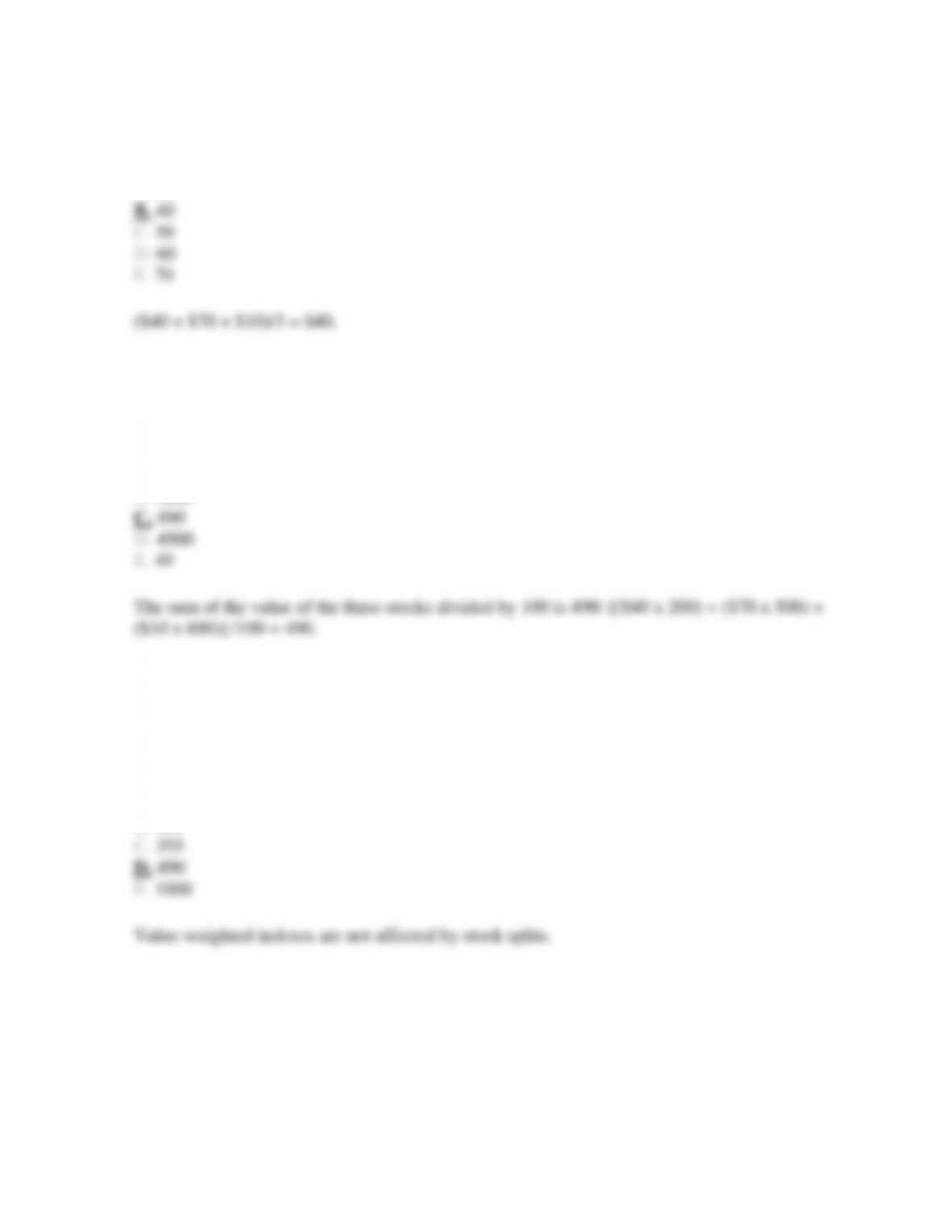
Consider the following three stocks:
Chapter 02 – Asset Classes and Financial Instruments
2-9
22. The price-weighted index constructed with the three stocks is
A. 30
Difficulty: Easy
23. The value-weighted index constructed with the three stocks using a divisor of 100 is
A. 1.2
B. 1200
Difficulty: Moderate
24. Assume at these prices the value-weighted index constructed with the three stocks is 490.
What would the index be if stock B is split 2 for 1 and stock C 4 for 1?
A. 265
B. 430
Difficulty: Moderate
Chapter 02 – Asset Classes and Financial Instruments
2-10
25. The price quotations of Treasury bonds in the Wall Street Journal show an ask price of
104:08 and a bid price of 104:04. As a buyer of the bond what is the dollar price you expect to
pay?
A. $1,048.00
Difficulty: Moderate
26. The price quotations of Treasury bonds in the Wall Street Journal show an ask price of
104:08 and a bid price of 104:04. As a seller of the bond what is the dollar price you expect to
pay?
A. $1,048.00
B. $1,042.50
Difficulty: Moderate
Chapter 02 – Asset Classes and Financial Instruments
2-11
27. An investor purchases one municipal and one corporate bond that pay rates of return of
8% and 10%, respectively. If the investor is in the 20% marginal tax bracket, his or her after
tax rates of return on the municipal and corporate bonds would be ________ and ______,
respectively.
A. 8% and 10%
Difficulty: Moderate
28. An investor purchases one municipal and one corporate bond that pay rates of return of
7.5% and 10.3%, respectively. If the investor is in the 25% marginal tax bracket, his or her
after tax rates of return on the municipal and corporate bonds would be ________ and
______, respectively.
A. 7.5% and 10.3%
Difficulty: Moderate
Chapter 02 – Asset Classes and Financial Instruments
2-12
29. If a Treasury note has a bid price of $975, the quoted bid price in the Wall Street Journal
would be
A. 97:50.
Difficulty: Easy
30. If a Treasury note has a bid price of $995, the quoted bid price in the Wall Street Journal
would be
A. 99:50.
Difficulty: Easy
31. In calculating the Standard and Poor’s stock price indices, the adjustment for stock split
occurs:
A. by adjusting the divisor.
Difficulty: Easy
Chapter 02 – Asset Classes and Financial Instruments
2-13
32. Which of the following statements regarding the Dow Jones Industrial Average (DJIA) is
false?
A. The DJIA is not very representative of the market as a whole.
B. The DJIA consists of 30 blue chip stocks.
Difficulty: Easy
33. The index that includes the largest number of actively traded stock is:
A. the NASDAQ Composite Index.
B. the NYSE Composite Index.
Difficulty: Easy
34. A 5.5% 20-year municipal bond is currently priced to yield 7.2%. For a taxpayer in the
33% marginal tax bracket, this bond would offer an equivalent taxable yield of:
A. 8.20%.
Difficulty: Moderate
Chapter 02 – Asset Classes and Financial Instruments
2-14
35. If the market prices of each of the 30 stocks in the Dow Jones Industrial Average (DJIA)
all change by the same percentage amount during a given day, which stock will have the
D. The stock having the lowest volatility.
E. None of the above.
Difficulty: Moderate
36. The stocks on the Dow Jones Industrial Average
A. have remained unchanged since the creation of the index.
B. include most of the stocks traded on the NYSE.
Difficulty: Easy
Chapter 02 – Asset Classes and Financial Instruments
2-15
37. Federally sponsored agency debt
A. is legally insured by the U.S. Treasury.
Difficulty: Easy
38. Brokers’ calls
A. are funds used by individuals who wish to buy stocks on margin.
B. are funds borrowed by the broker from the bank, with the agreement to repay the bank
Difficulty: Easy
Chapter 02 – Asset Classes and Financial Instruments
2-16
39. A form of short-term borrowing by dealers in government securities is
A. reserve requirements.
Difficulty: Easy
40. Which of the following securities is a money market instrument?
A. Treasury note
Difficulty: Easy
41. The yield to maturity reported in the financial pages for Treasury securities
A. is calculated by compounding the semiannual yield.
Difficulty: Easy
Chapter 02 – Asset Classes and Financial Instruments
2-17
42. Which of the following is not a mortgage-related government or government sponsored
agency?
A. The Federal Home Loan Bank
B. The Federal National Mortgage Association
Difficulty: Easy
43. In order for you to be indifferent between the after tax returns on a corporate bond paying
8.5% and a tax-exempt municipal bond paying 6.12%, what would your tax bracket need to
be?
A. 33%
B. 72%
Difficulty: Moderate
44. What does the term “negotiable” mean with regard to negotiable certificates of deposit?
D. The CD has staggered maturity dates built in.
E. The interest rate paid on the CD will vary with a designated market rate.
Difficulty: Easy
Chapter 02 – Asset Classes and Financial Instruments
2-18
45. Freddie Mac and Ginnie Mae were organized to provide
A. a primary market for mortgage transactions.
Difficulty: Easy
46. The type of municipal bond that is used to finance commercial enterprises such as the
construction of a new building for a corporation is called
A. a corporate courtesy bond.
B. a revenue bond.
Difficulty: Easy
47. Suppose an investor is considering a corporate bond with a 7.17% before-tax yield and a
municipal bond with a 5.93% before-tax yield. At what marginal tax rate would the investor
be indifferent between investing in the corporate and investing in the muni?
A. 15.4%
Difficulty: Moderate