92.
For most firms, P/E ratios and risk
93.
Dividend discount models and P/E ratios are used by __________ to try to find mispriced
securities.
94.
Which of the following is the best measure of the floor for a stock price?
95.
Who popularized the dividend discount model, which is sometimes referred to by his
name?
96.
If a firm follows a low-investment-rate plan (applies a low plowback ratio), its dividends
will be _______ now and _______ in the future than a firm that follows a high-reinvestment-
rate plan.
97.
The present value of growth opportunities (PVGO) is equal to
I) the difference between a stock’s price and its no-growth value per share.
II) the stock’s price.
III) zero if its return on equity equals the discount rate.
IV) the net present value of favorable investment opportunities.
98.
Low P/E ratios tend to indicate that a company will _______, ceteris paribus.
99.
Earnings management is
100.
A version of earnings management that became common in the 1990s was
101.
GAAP allows
102.
The most appropriate discount rate to use when applying a FCFE valuation model is the
103.
WACC is the most appropriate discount rate to use when applying a ______ valuation
model.
104.
The most appropriate discount rate to use when applying a FCFF valuation model is the
105.
The required rate of return on equity is the most appropriate discount rate to use when
applying a ______ valuation model.
106.
FCF and DDM valuations should be ____________ if the assumptions used are consistent.
107.
Siri had a FCFE of $1.6M last year and has 3.2M shares outstanding. Siri’s required return
on equity is 12% and WACC is 9.8%. If FCFE is expected to grow at 9% forever, the
intrinsic value of Siri’s shares are
108.
Zero had a FCFE of $4.5M last year and has 2.25M shares outstanding. Zero’s required
return on equity is 10% and WACC is 8.2%. If FCFE is expected to grow at 8% forever, the
intrinsic value of Zero’s shares are
109.
See Candy had a FCFE of $6.1M last year and has 2.32M shares outstanding. See’s
required return on equity is 10.6% and WACC is 9.3%. If FCFE is expected to grow at 6.5%
forever, the intrinsic value of See’s shares are
110.
SI International had a FCFE of $122.1M last year and has 12.43M shares outstanding. SI’s
required return on equity is 11.3% and WACC is 9.8%. If FCFE is expected to grow at 7.0%
forever, the intrinsic value of SI’s shares are
111.
Highpoint had a FCFE of $246M last year and has 123M shares outstanding. Highpoint’s
required return on equity is 10% and WACC is 9%. If FCFE is expected to grow at 8.0%
forever, the intrinsic value of Highpoint’s shares are
112.
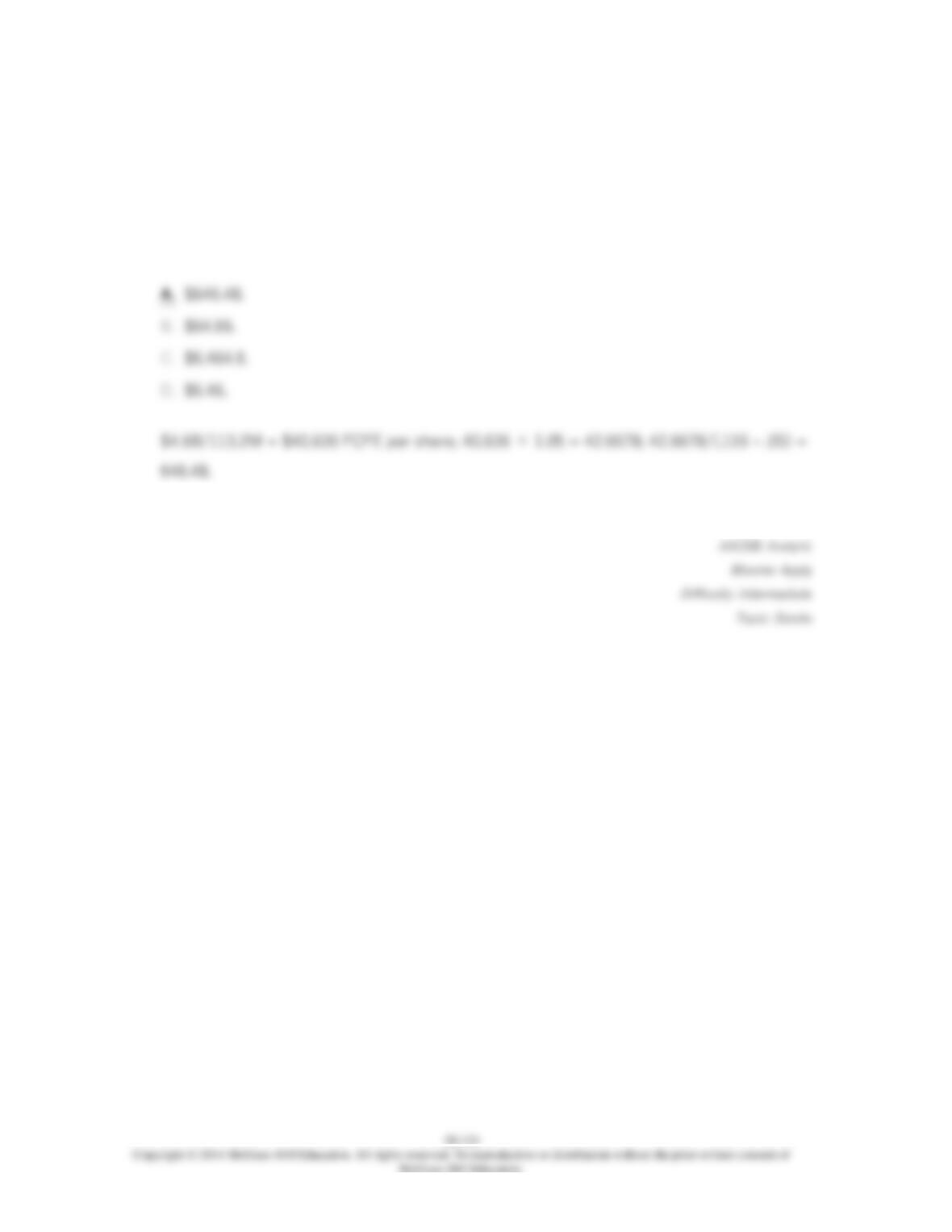
SGA Consulting had a FCFE of $3.2M last year and has 3.2M shares outstanding. SGA’s
required return on equity is 13% and WACC is 11.5%. If FCFE is expected to grow at 8.5%
forever, the intrinsic value of SGA’s shares are
113.
Seaman had a FCFE of $4.6B last year and has 113.2M shares outstanding. Seaman’s
required return on equity is 11.6% and WACC is 10.4%. If FCFE is expected to grow at 5%
forever, the intrinsic value of Seaman’s shares are
114.
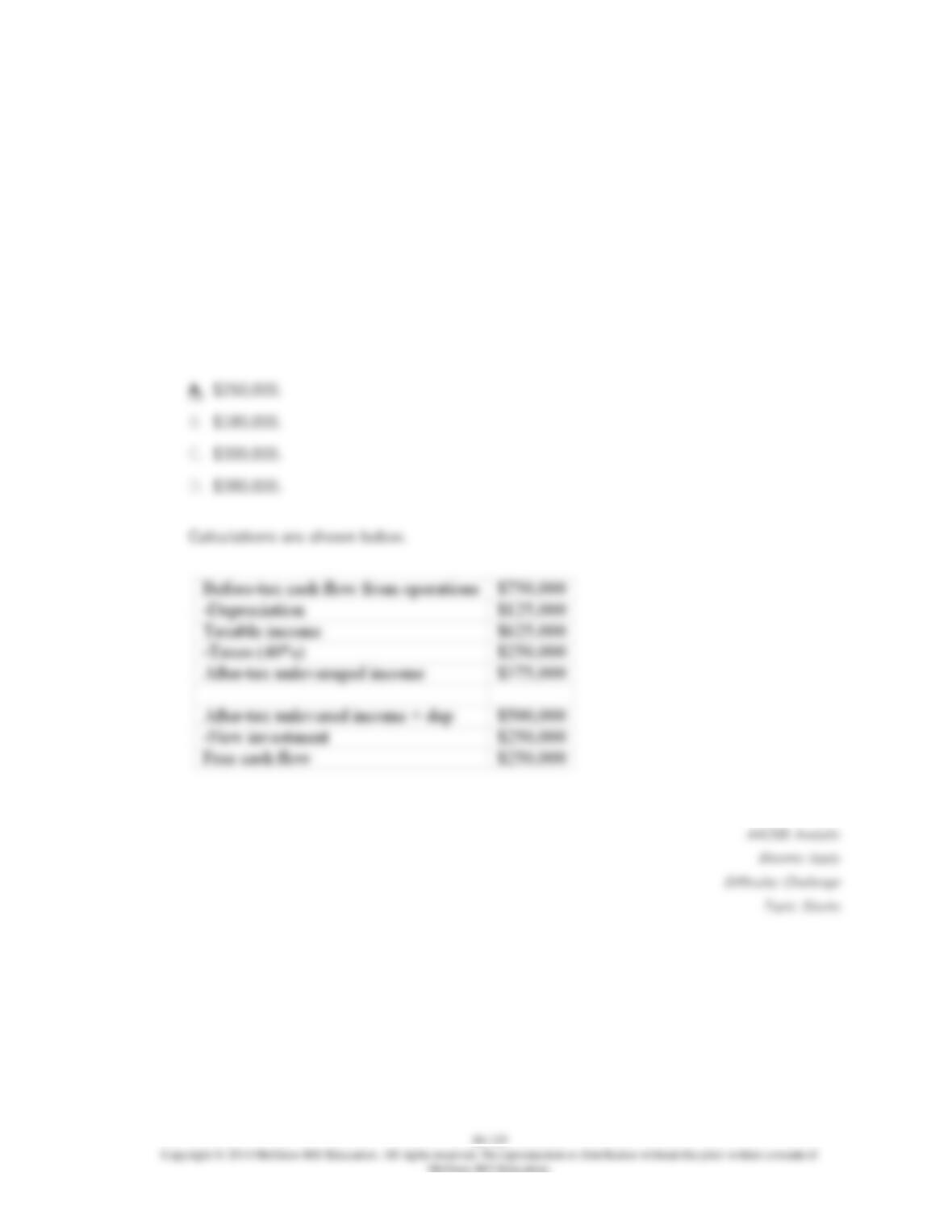
Consider the free cash flow approach to stock valuation. F&G Manufacturing Company is
expected to have before-tax cash flow from operations of $750,000 in the coming year.
The firm’s corporate tax rate is 40%. It is expected that $250,000 of operating cash flow
will be invested in new fixed assets. Depreciation for the year will be $125,000. After the
coming year, cash flows are expected to grow at 7% per year. The appropriate market
capitalization rate for unleveraged cash flow is 13% per year. The firm has no outstanding
debt. The projected free cash flow of F&G Manufacturing Company for the coming year is
115.
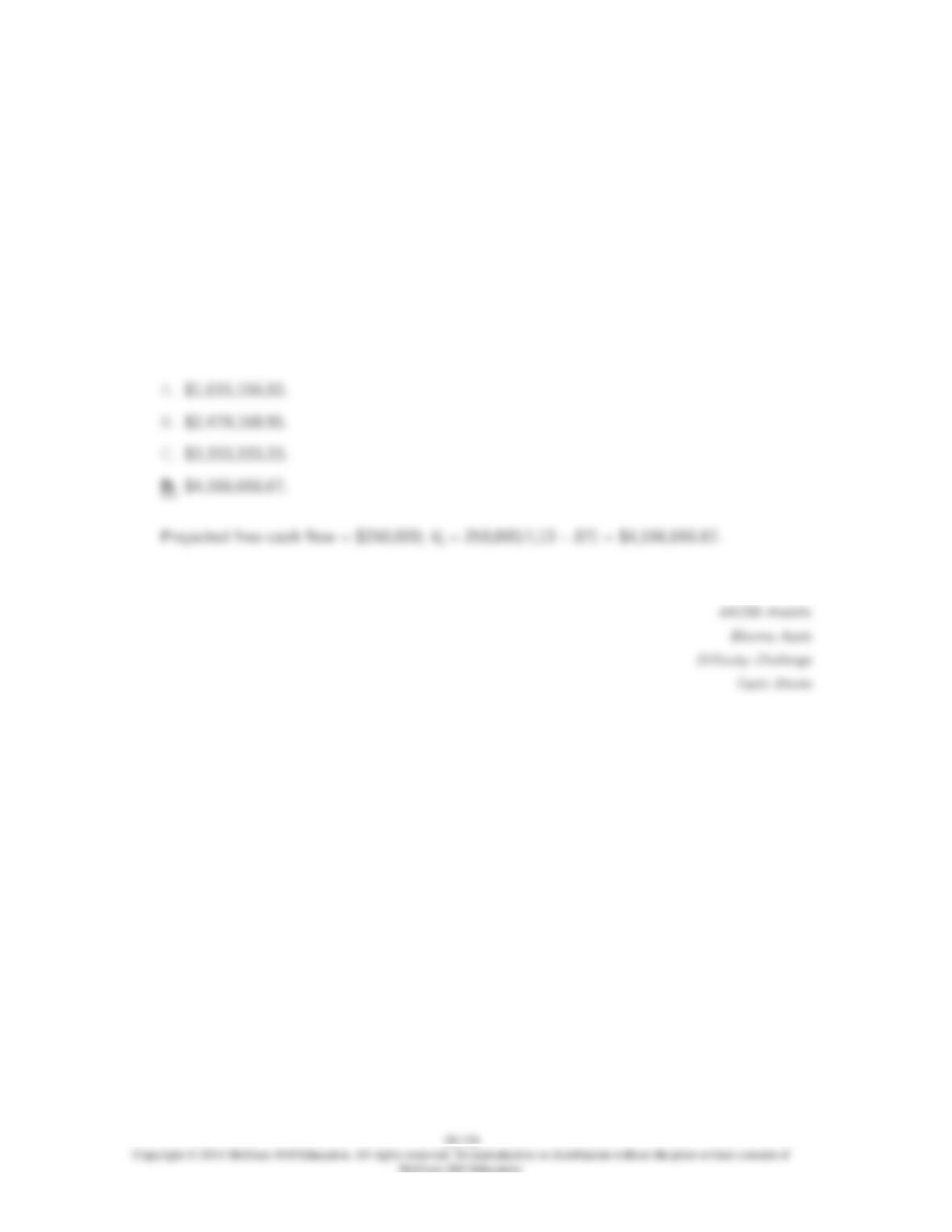
Consider the free cash flow approach to stock valuation. F&G Manufacturing Company is
expected to have before-tax cash flow from operations of $750,000 in the coming year.
The firm’s corporate tax rate is 40%. It is expected that $250,000 of operating cash flow
will be invested in new fixed assets. Depreciation for the year will be $125,000. After the
coming year, cash flows are expected to grow at 7% per year. The appropriate market
capitalization rate for unleveraged cash flow is 13% per year. The firm has no outstanding
debt. The total value of the equity of F&G Manufacturing Company should be