116.
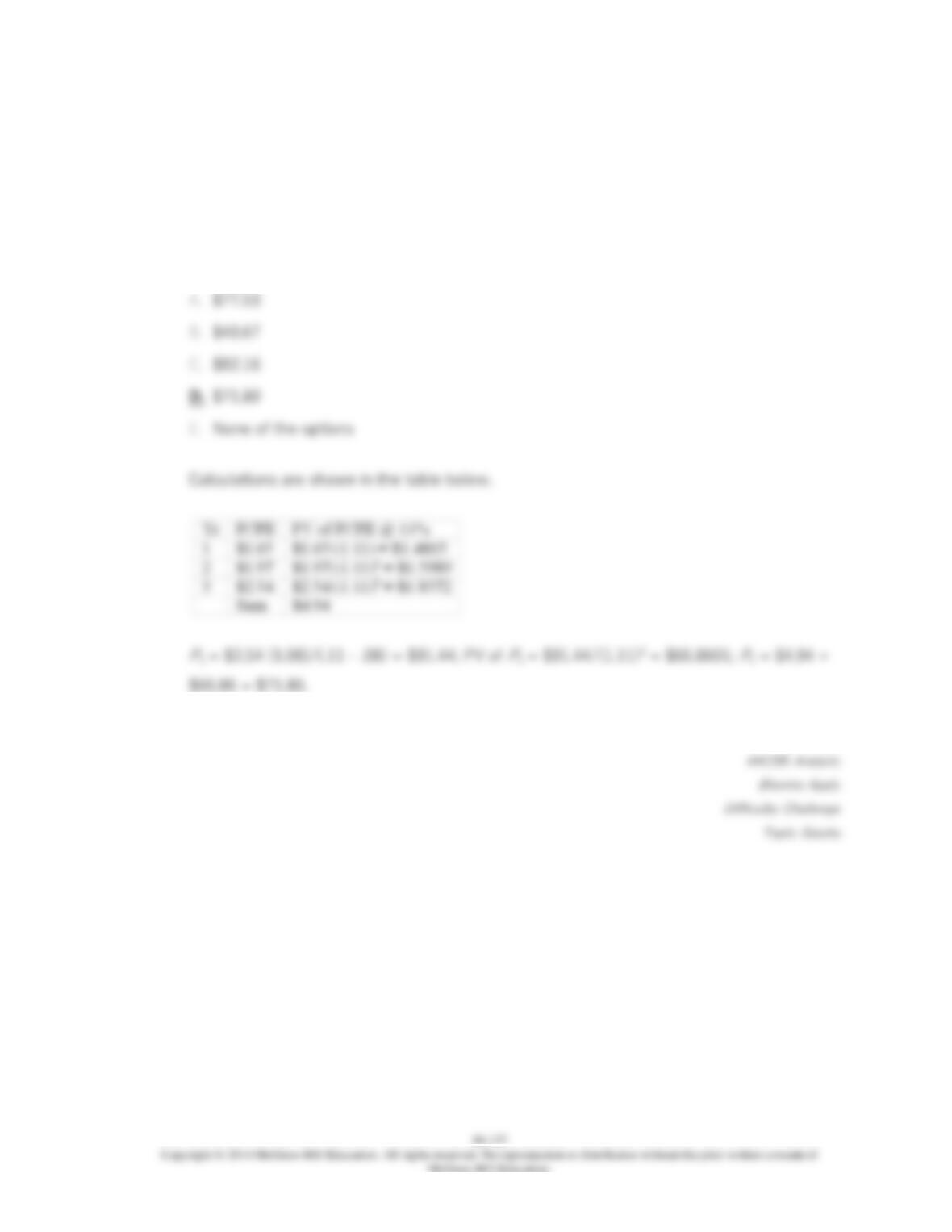
Boaters World is expected to have per share FCFE in year 1 of $1.65, per share FCFE in
year 2 of $1.97, and per share FCFE in year 3 of $2.54. After year 3, per share FCFE is
expected to grow at the rate of 8% per year. An appropriate required return for the stock is
11%. The stock should be worth _______ today.
117.
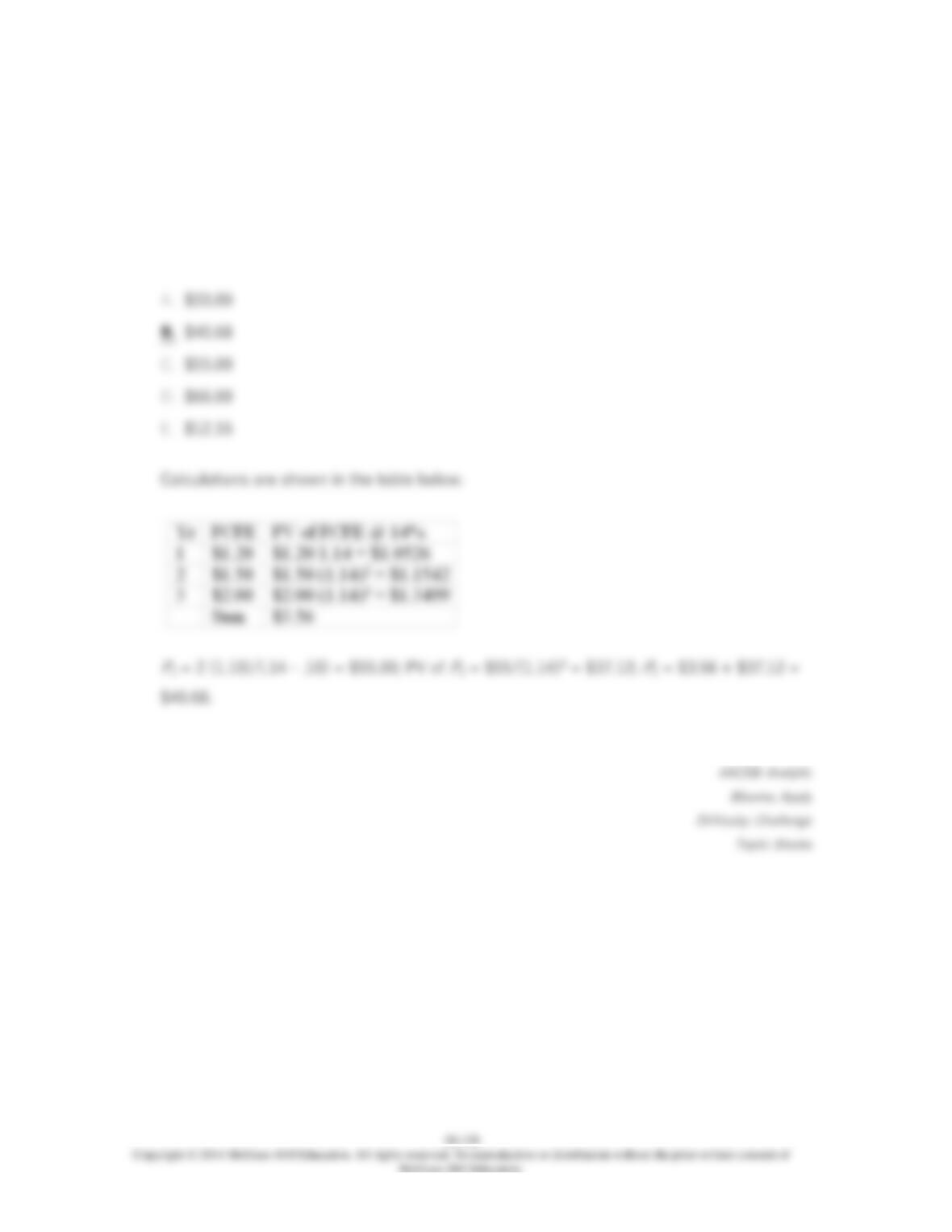
Smart Draw Company is expected to have per share FCFE in year 1 of $1.20, per share
FCFE in year 2 of $1.50, and per share FCFE in year 3 of $2.00. After year 3, per share
FCFE is expected to grow at the rate of 10% per year. An appropriate required return for
the stock is 14%. The stock should be worth _______ today.
118.
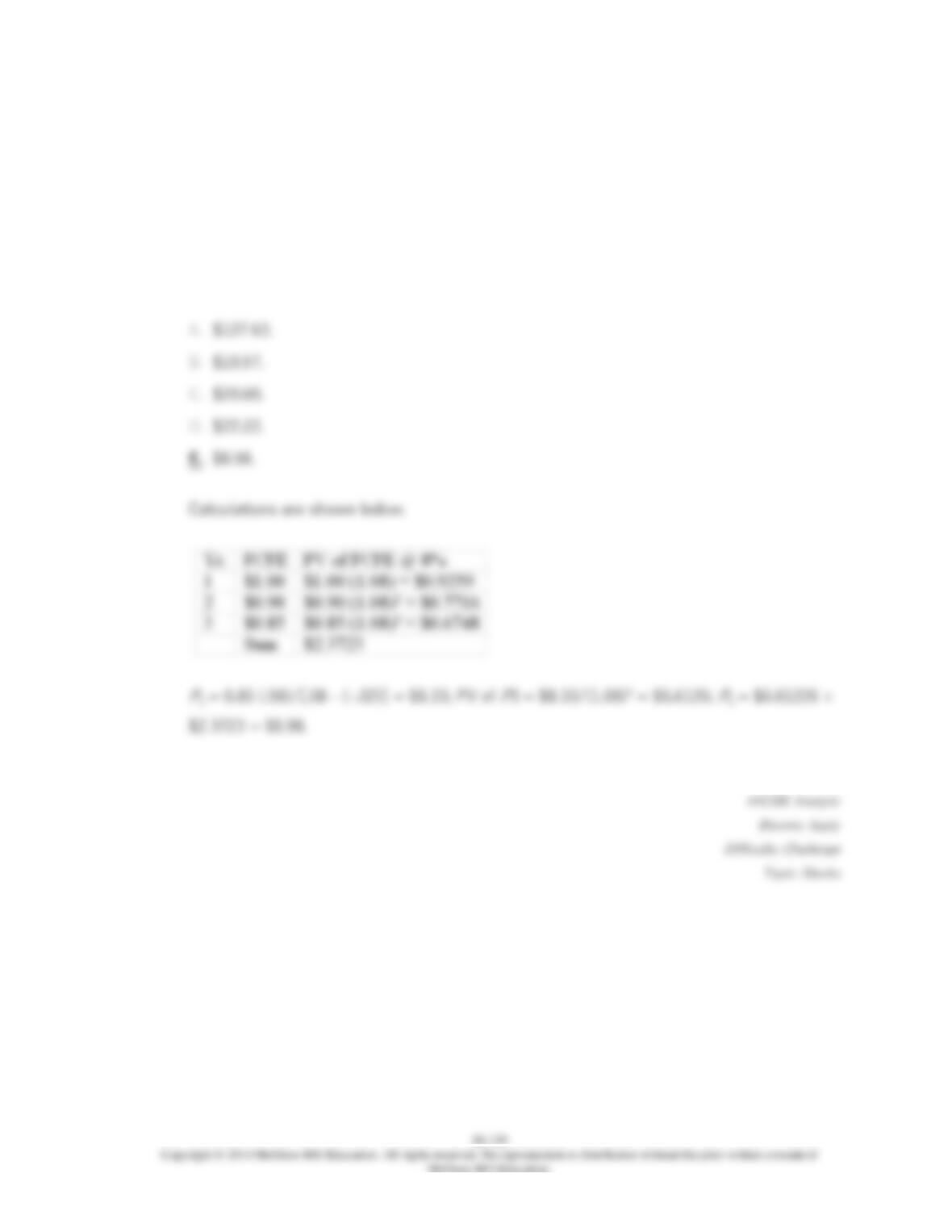
Old Style Corporation produces goods that are very mature in their product life cycles. Old
Style Corporation is expected to have per share FCFE in year 1 of $1.00, per share FCFE of
$0.90 in year 2, and per share FCFE of $0.85 in year 3. After year 3, per share FCFE is
expected to decline at a rate of 2% per year. An appropriate required rate of return for the
stock is 8%. The stock should be worth
119.
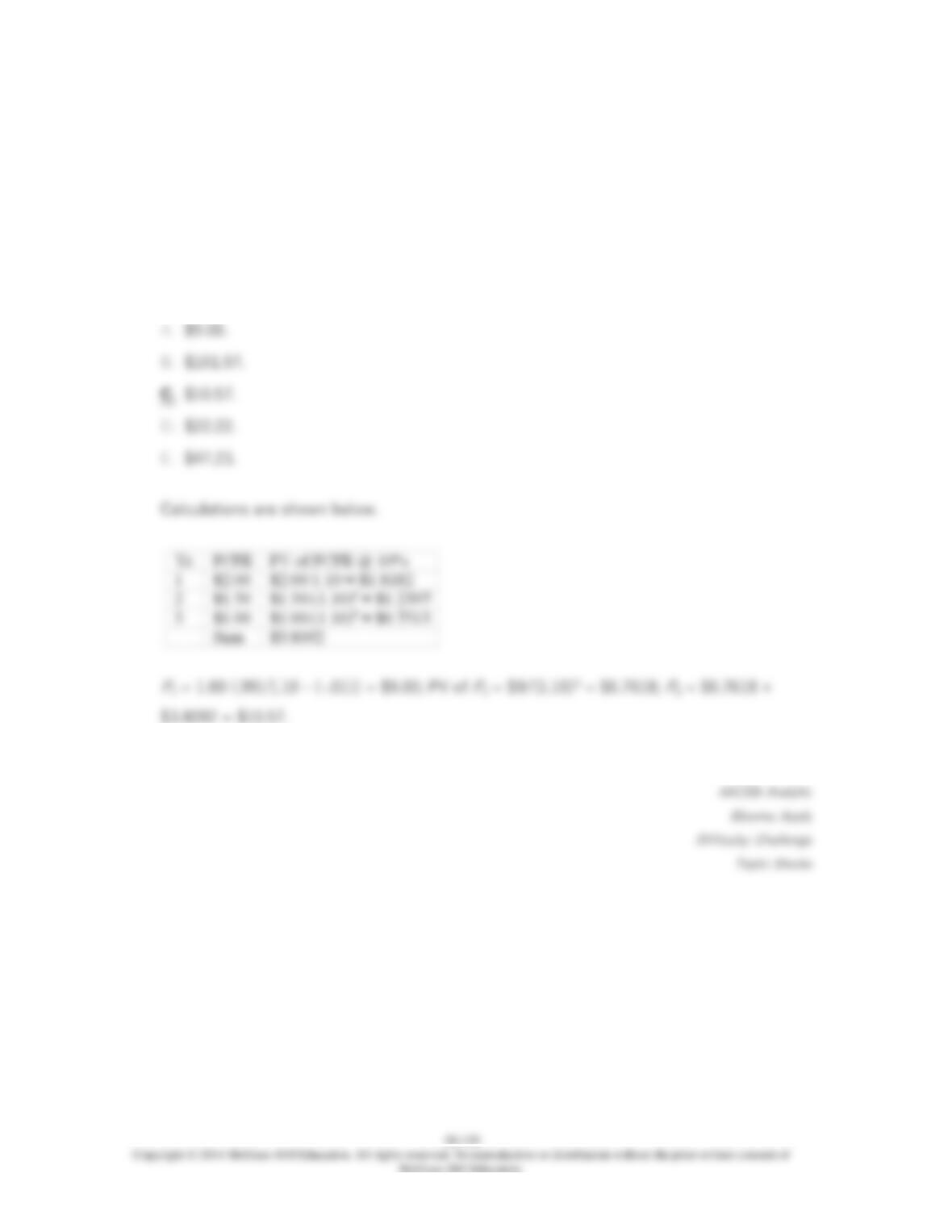
Goodie Corporation produces goods that are very mature in their product life cycles.
Goodie Corporation is expected to have per share FCFE in year 1 of $2.00, per share FCFE
of $1.50 in year 2, and per share FCFE of $1.00 in year 3. After year 3, per share FCFE is
expected to decline at a rate of 1% per year. An appropriate required rate of return for the
stock is 10%. The stock should be worth
120.
The growth in per share FCFE of SYNK, Inc. is expected to be 8% per year for the next two
years, followed by a growth rate of 4% per year for three years; after this five-year period,
the growth in per share FCFE is expected to be 3% per year, indefinitely. The required rate
of return on SYNC, Inc. is 11%. Last year’s per share FCFE was $2.75. What should the
stock sell for today?
121.
The growth in per share FCFE of FOX, Inc. is expected to be 15% per year for the next
three years, followed by a growth rate of 8% per year for two years; after this five-year
period, the growth in per share FCFE is expected to be 3% per year, indefinitely. The
required rate of return on FOX, Inc. is 13%. Last year’s per share FCFE was $1.85. What
should the stock sell for today?
122.
The growth in per share FCFE of CBS, Inc. is expected to be 10% per year for the next two
years, followed by a growth rate of 5% per year for three years; after this five-year period,
the growth in per share FCFE is expected to be 2% per year, indefinitely. The required rate
of return on CBS, Inc. is 12%. Last year’s per share FCFE was $2.00. What should the
stock sell for today?
123.
Stingy Corporation is expected have EBIT of $1.2M this year. Stingy Corporation is in the
30% tax bracket, will report $133,000 in depreciation, will make $76,000 in capital
expenditures, and will have a $24,000 increase in net working capital this year. What is
Stingy’s FCFF?
124.
Fly Boy Corporation is expected have EBIT of $800k this year. Fly Boy Corporation is in the
30% tax bracket, will report $52,000 in depreciation, will make $86,000 in capital
expenditures, and will have a $16,000 increase in net working capital this year. What is Fly
Boy’s FCFF?
125.
Lamm Corporation is expected have EBIT of $6.2M this year. Lamm Corporation is in the
40% tax bracket, will report $1.2M in depreciation, will make $1.4M in capital
expenditures, and will have a $160,000 increase in net working capital this year. What is
Lamm’s FCFF?
18–137
126.
Rome Corporation is expected have EBIT of $2.3M this year. Rome Corporation is in the
30% tax bracket, will report $175,000 in depreciation, will make $175,000 in capital
expenditures, and will have no change in net working capital this year. What is Rome’s
FCFF?
Short Answer Questions
127.
Discuss the Gordon, or constant discounted dividend, model of common stock valuation.
Include in your discussion the advantages, disadvantages, and assumptions of the model.
128.
The price/earnings ratio, or multiplier approach, may be used for stock valuation. Explain
this process and describe how the “multiplier” varies from the one available in the stock
market quotation pages.
129.
Discuss the relationships between the required rate of return on a stock, the firm’s return
on equity, the plowback rate, the growth rate, and the value of the firm.
130.
Describe the free cash flow approach to firm valuation. How does it compare to the
dividend discount model (DDM)?