58.
Two bonds are selling at par value and each has 17 years to maturity. The first bond has a
coupon rate of 6% and the second bond has a coupon rate of 13%. Which of the following
is true about the durations of these bonds?
59.
Two bonds are selling at par value and each has 17 years to maturity. The first bond has a
coupon rate of 6% and the second bond has a coupon rate of 13%. Which of the following
is false about the durations of these bonds?
60.
Which of the following offers a bond index?
61.
Which of the following two bonds is more price sensitive to changes in interest rates?
1) A par value bond, A, with a 12-year–to-maturity and a 12% coupon rate.
2) A zero-coupon bond, B, with a 12-year-to-maturity and a 12% yield to maturity.
62.
Which of the following two bonds is more price sensitive to changes in interest rates?
1) A par value bond, D, with a 2-year-to-maturity and a 8% coupon rate.
2) A zero-coupon bond, E, with a 2-year-to-maturity and a 8% yield to maturity.
63.
Holding other factors constant, which one of the following bonds has the smallest price
volatility?
64.
Holding other factors constant, which one of the following bonds has the smallest price
volatility?
65.
The duration of a 15-year zero-coupon bond is
66.
The duration of a 20-year zero-coupon bond is
67.
The duration of a perpetuity with a yield of 10% is
68.
The duration of a perpetuity with a yield of 6% is
69.
Par value bond F has a modified duration of 9. Which one of the following statements
regarding the bond is true?
70.
Par value bond GE has a modified duration of 11. Which one of the following statements
regarding the bond is true?
71.
Which of the following bonds has the longest duration?
72.
Which of the following bonds has the longest duration?
73.
A 10%, 30-year corporate bond was recently being priced to yield 12%. The Macaulay
duration for the bond is 11.3 years. Given this information, the bond’s modified duration
would be
74.
A 6%, 30-year corporate bond was recently being priced to yield 8%. The Macaulay
duration for the bond is 8.4 years. Given this information, the bond’s modified duration
would be
75.
A 9%, 16-year bond has a yield to maturity of 11% and duration of 9.25 years. If the market
yield changes by 32 basis points, how much change will there be in the bond’s price?
76.
A 7%, 14-year bond has a yield to maturity of 6% and duration of 7 years. If the market
yield changes by 44 basis points, how much change will there be in the bond’s price?
77.
Consider a bond selling at par with modified duration of 12 years and convexity of 265. A
1% decrease in yield would cause the price to increase by 12%, according to the duration
rule. What would be the percentage price change according to the duration-with-convexity
rule?
78.
Consider a bond selling at par with modified duration of 22 years and convexity of 415. A
2% decrease in yield would cause the price to increase by 44%, according to the duration
rule. What would be the percentage price change according to the duration-with-convexity
rule?
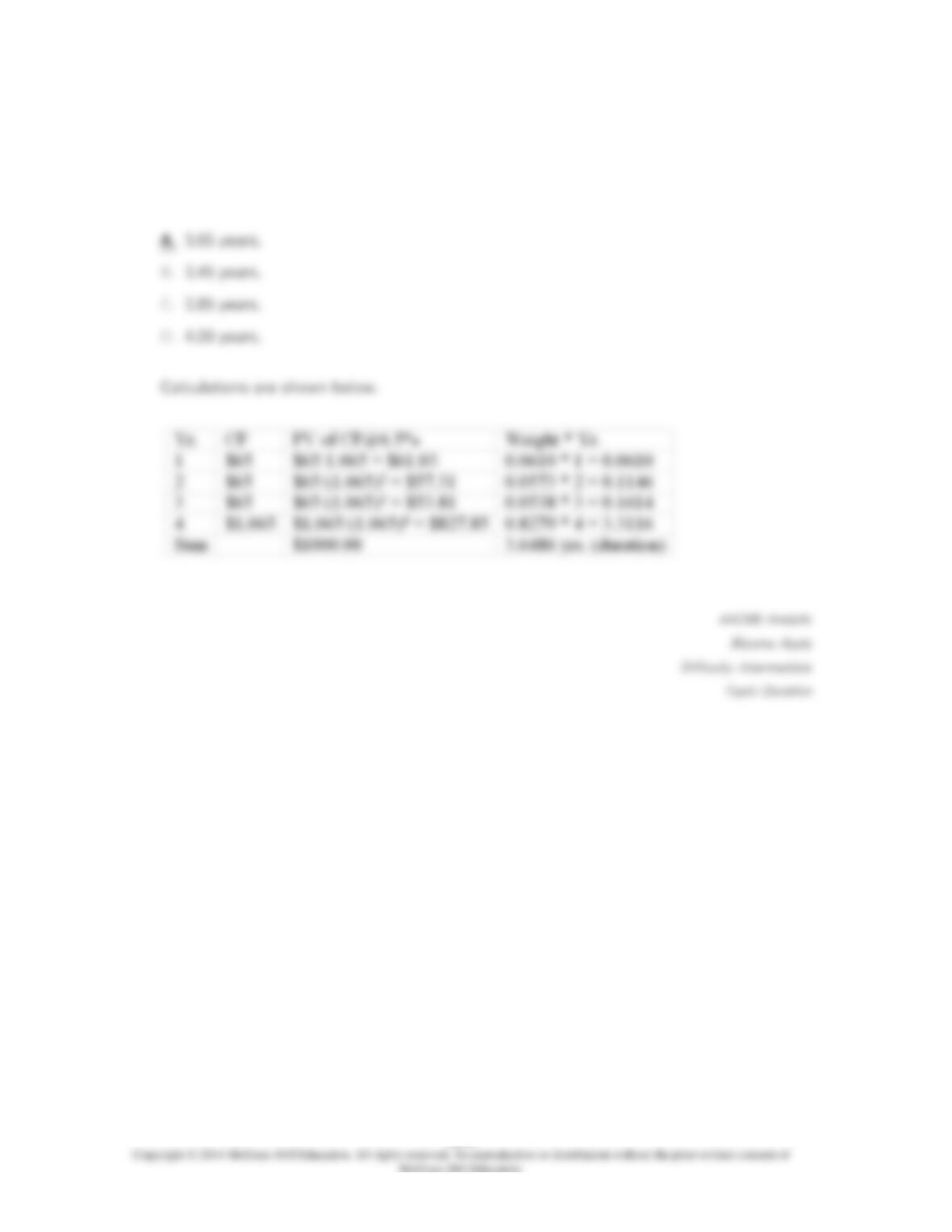
16–84
79.
The duration of a par value bond with a coupon rate of 6.5% and a remaining time to
maturity of 4 years is
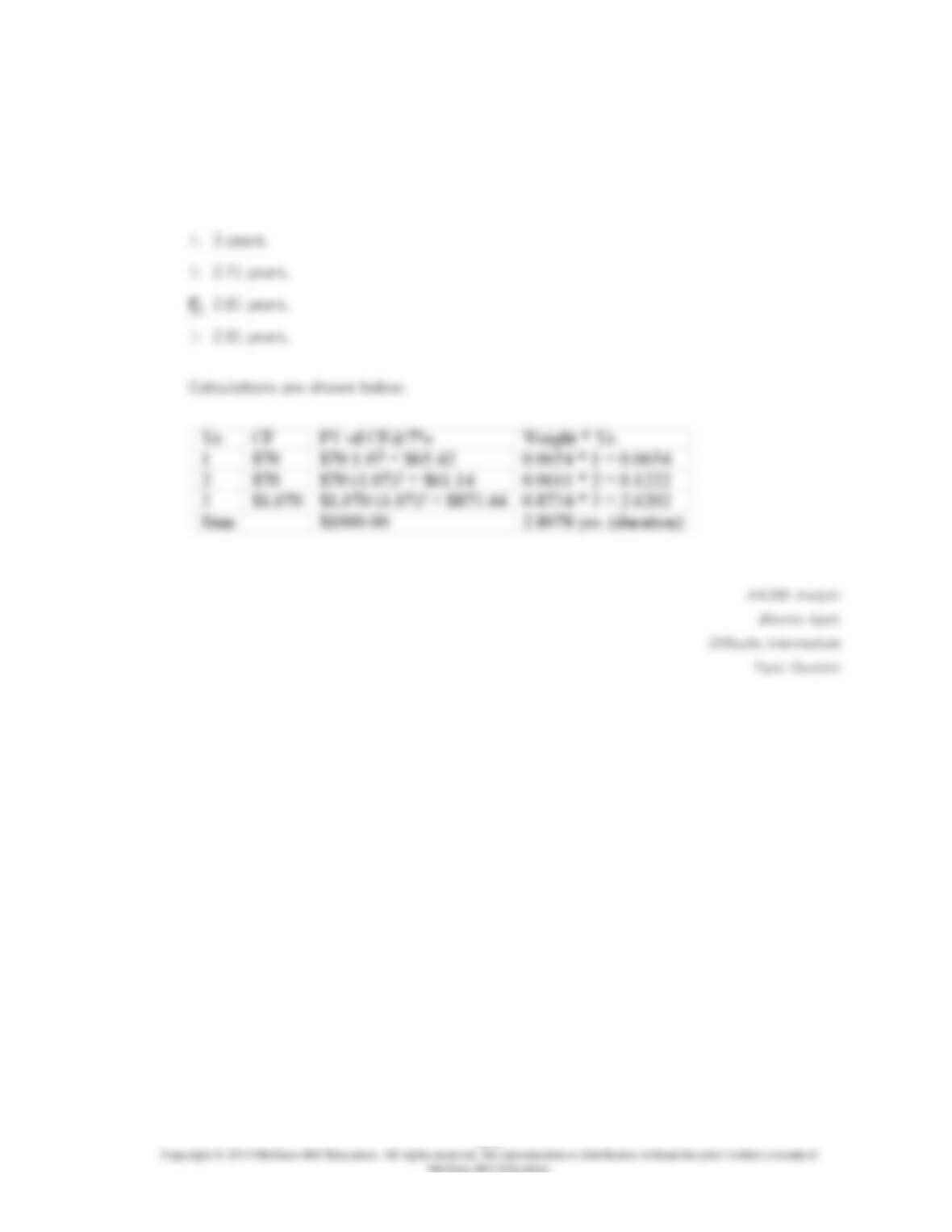
16–85
80.
The duration of a par value bond with a coupon rate of 7% and a remaining time to
maturity of 3 years is
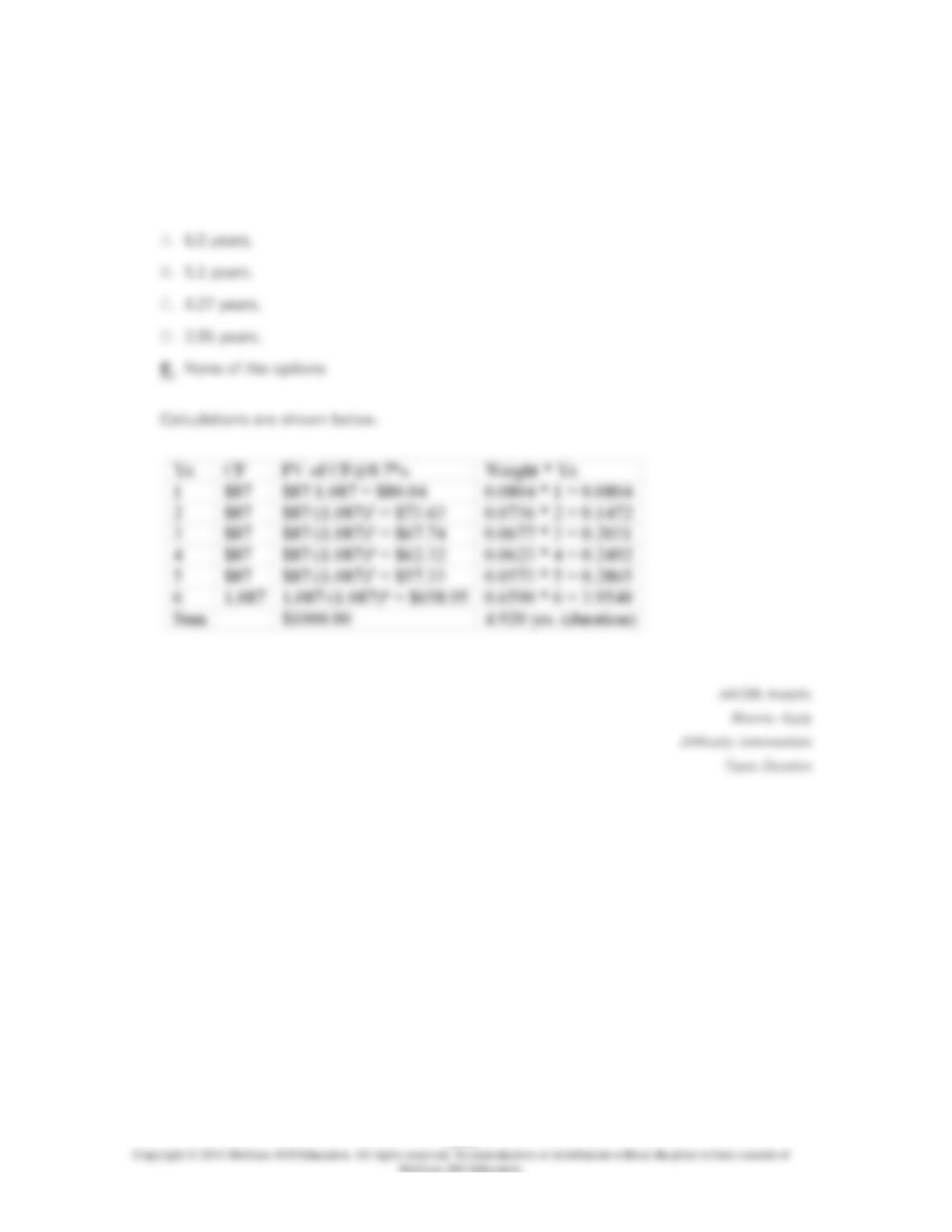
16–86
81.
The duration of a par value bond with a coupon rate of 8.7% and a remaining time to
maturity of 6 years is
Short Answer Questions
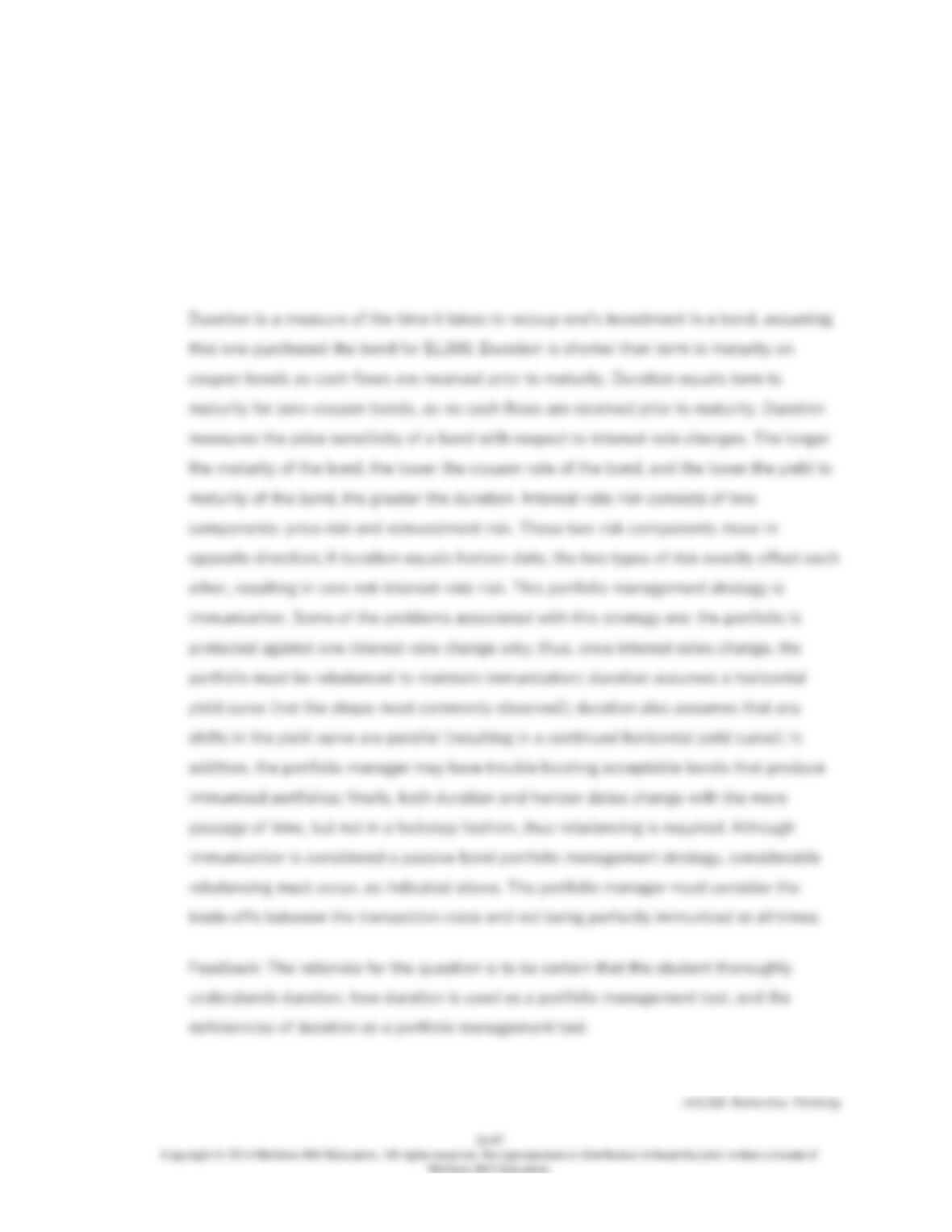
82.
Discuss duration. Include in your discussion what duration measures, how duration relates
to maturity, what variables affect duration, and how duration is used as a portfolio
management tool (include some of the problems associated with the use of duration as a
portfolio management tool).
83.
Discuss rate anticipation swaps as a bond portfolio management strategy.
16–89
84.
You have purchased a bond for $973.02. The bond has a coupon rate of 6.4%, pays
interest annually, has a face value of $1,000, 4 years to maturity, and a yield to maturity of
7.2%. The bond’s duration is 3.6481 years. You expect that interest rates will fall by .3%
later today.
Use the modified duration to find the approximate percentage change in the bond’s price.
Find the new price of the bond from this calculation.
Use your calculator to do the regular present-value calculations to find the bond’s new
price at its new yield to maturity.
What is the amount of the difference between the two answers? Why are your answers
different? Explain the reason in words and illustrate it graphically.