66) The coupon rate of the bond varies indirectly with changes in market interest rates.
67) Senior debentures usually provide lower interest rates than junior secured debt.
68) Bonds provide stable pricing because they offer a fixed coupon rate and maturity date unlike
stocks.
69) When making a decision to refund, outflows in the form of financing costs related to
redeeming and reissuing securities and inflows represented by savings in annual interest costs
and tax savings are involved.
70) The greater use of debt by corporations since the late 1970s is best shown by the
A) declining “times interest covered” ratio.
B) small amount of common stock sold.
C) rising cost of interest.
D) inability of earnings to keep up with inflation.
71) The main cause for the increase in corporate debt in America is
A) rapid business expansion.
B) inflationary impacts.
C) drop in interest rates.
D) all of these options are true.
72) The term debenture refers to
A) long-term, secured debt.
B) long-term, unsecured debt.
C) the after-acquired property clause.
D) a document covering the specific terms of the offering.
73) The document that outlines the covenants and duties existing between bondholders and the
issuing corporation is called
A) an indenture.
B) a debenture.
C) secured debt.
D) protective covenants.
74) Which of the following bonds offers the most security to the bondholder?
A) Junior mortgage bonds
B) Senior mortgage bonds
C) Debenture bonds
D) Income bonds
75) An indenture is
A) the section of a corporation’s bylaws pertaining to bond issues.
B) the summary of the essential features of a stock issue.
C) the contract between a corporation and a trustee acting for bondholders.
D) the underwriting contract.
76) A debenture represents
A) debt not secured by a specific asset.
B) secured debt.
C) a long document covering every detail of a bond issue.
D) debt that is subordinate to preferred stock.
77) Which of the following is the lowest in priority of claims against a bankrupt firm?
A) An unsecured bond
B) A senior debenture
C) Common stock
D) Federal taxes
78) Many bonds have some orderly, preplanned, alternative system of repayment. Which of the
following apply?
A) Sinking funds
B) Serial bonds
C) Income bonds
D) Sinking funds and serial bonds
79) A serial bond repayment plan involves a(n)
A) lump-sum payment at maturity.
B) conversion of debt to common stock.
C) early redemption of all debt.
D) series of installments to retire the debt over the life of the issue.
80) Which of the following best represents the hierarchy of creditor and stockholder claims?
A) Common stock, senior secured debt, subordinated debentures
B) Senior debentures, subordinated debentures, junior secured debt
C) Senior secured debt, subordinated debentures, common stock
D) Preferred stock, secured debt, debentures
81) A “subordinated debenture”
A) must be transferred with the bond to which it is attached.
B) is used mainly by railroad companies and usually specifies equipment as collateral.
C) entitles the bondholder to purchase shares of common stock at a specific price.
D) is an unsecured bond with an inferior claim on assets in the event of liquidation.
82) Which of the following properly represents the hierarchy of creditor and stockholder claims?
A) Common stock, senior secured debt, subordinated debentures
B) Preferred stock, common stock, subordinated debentures
C) Debentures, preferred stock, common stock
D) State taxes, preferred stockholders, wages due to workers
83) A call provision, which allows the corporation to force an early maturity on a bond issue,
usually contains all but which of the following characteristics?
A) Most bonds must be outstanding at least five years before being called.
B) After the call date, the call premium tends to decline over time.
C) The provision typically calls for debt conversion into common stock.
D) The corporation will pay a premium over par for the bonds.
84) A bond with a call provision would generally be sold to yield
A) less than a noncallable bond of similar character.
B) the same as a similar noncallable bond.
C) more than a noncallable bond of similar character.
D) the same as similar convertible bonds.
85) A call feature allows
A) the bondholder to redeem the bond before the maturity date.
B) the corporation to redeem the bond before the maturity date.
C) the corporation to convert the bond to common stock.
D) the bondholder to demand increased collateral.
86) The “call” provision on some bonds allows
A) the bondholder to redeem the bond earlier than maturity, but usually involves a call premium.
B) the corporation to request additional capital contributions from the bondholder.
C) the corporation to redeem the bonds earlier than maturity but usually for a premium over the
par value.
D) the bondholder to convert the bond into preferred stock.
87) Buchanan Corp. is refunding $10 million worth of 10% debt. The new bonds will be issued
for 8%. The corporation’s tax rate is 35%. The call premium is 9%. What is the net cost of the
call premium after taxes?
A) $390,000
B) $1,080,000
C) $585,000
D) $702,000
88) A conversion feature allows
A) the bondholder to redeem the bond before the maturity date.
B) the corporation to convert the bond to other debt.
C) the bondholder to convert the bond to common stock.
D) the bondholder to demand increased collateral.
89) The dollar interest received divided by the market price of the bond is called the
A) par value.
B) coupon rate.
C) current yield.
D) yield to maturity.
90) The true measure of the return on a bond is its
A) par value.
B) coupon rate.
C) current yield.
D) yield to maturity.
91) Prices of existing bonds move ________ as market interest rates move ________.
A) up; up
B) up; down
C) Bond prices don’t move as market interest rates move.
D) Only new bond prices move with the market interest rate.
92) Which of the following is not a form of yield on a bond?
A) Coupon rate (nominal yield)
B) Current yield
C) Dividend yield
D) Yield to maturity
93) With regard to interest rates and bond prices, it can be said that
A) a 1% change in interest rates will cause a greater change in long-term bond prices than short-
term prices.
B) a 1% change in interest rates will cause a greater change in short-term bond prices than long-
term prices.
C) long-term rates are more volatile than short-term rates.
D) a decrease in interest rates will cause bond prices to fall.
94) A bond with a coupon rate of 6.5% (assume it is paid once annually), maturing in 10 years at
a value of $1,000 and a current market price of $695, will have a current yield of
A) 11.3%.
B) 10.2%.
C) 9.4%.
D) 8.5%.
95) Short-term bond yields are generally ________ than long-term bond yields, whereas long-
term bond prices are generally ________ than short-term bond prices.
A) more volatile, less volatile
B) less volatile, more volatile
C) less volatile, less volatile
D) more volatile, more volatile
96) Which company is a leader in rating bonds?
A) Goldman Sachs
B) Bloomberg
C) ValueLine
D) Moody’s Investor Service
97) The higher the bond rating,
A) the higher the interest rate on a bond.
B) the lower the interest rate on a bond.
C) the higher the call premium.
D) the lower the call premium.
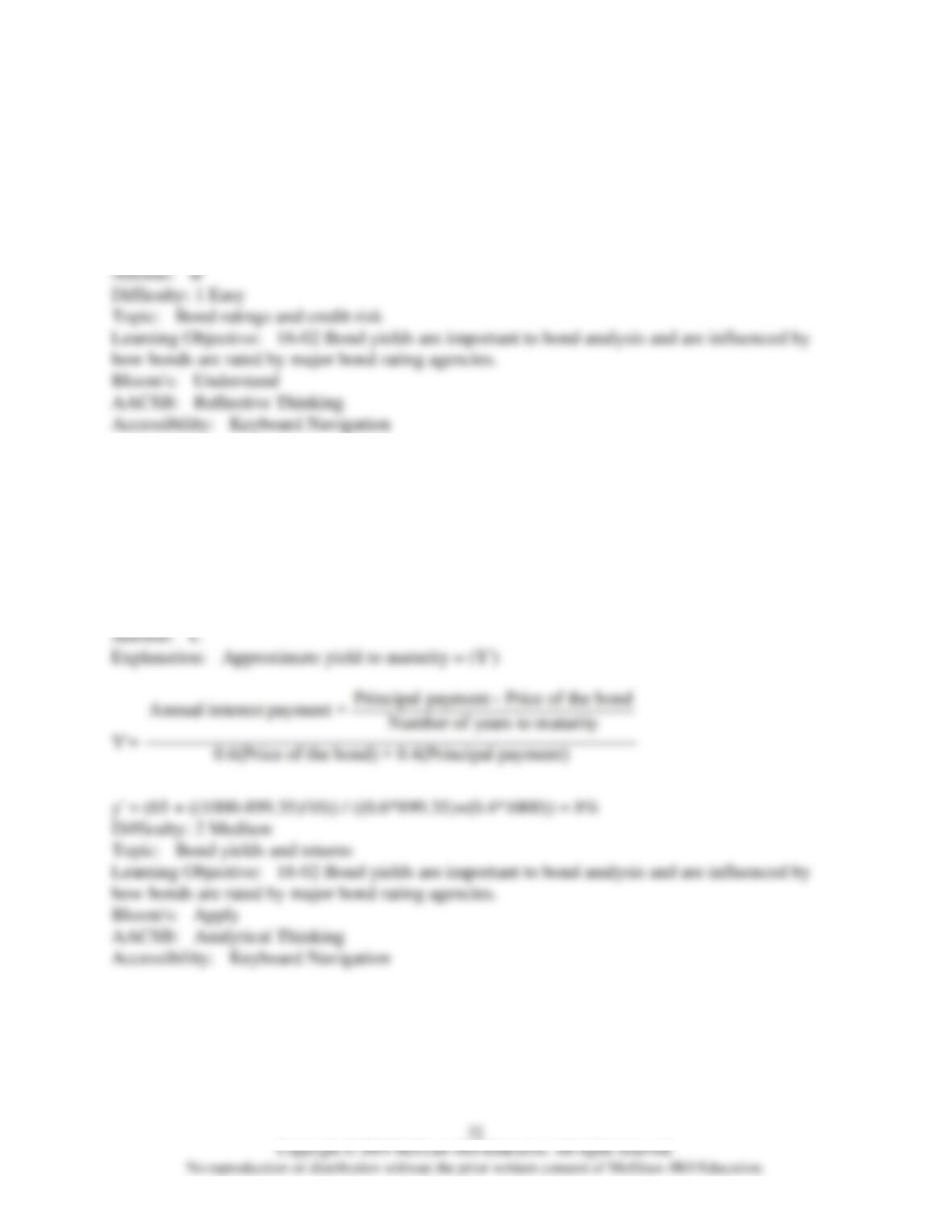
98) A bond with an annual coupon rate of 6.5%, maturing in 10 years at a value of $1,000 and a
current market price of $899.35, will have a yield to maturity (using the approximation formula)
of
A) between 5% and 6%.
B) between 6% and 7.5%.
C) between 7.5% and 8.5%.
D) between 8.5% and 10%.
99) Solow Corp. has a bond with annual interest payments of $109 maturing in 10 years at a
value of $1,000 per bond. The current market price is $960. What will the nominal yield be?
A) 9.1%
B) 12.5%
C) 11.6%
D) 10.9%
100) Allais Company’s bond has an $85 annual interest payment that will mature in 10 years at a
value of $1,000. The bond has a current market price of $1,140. What is the nominal yield of the
bond?
A) 6.5%
B) 12.4%
C) 8.5%
D) 10%
101) Investors consider which of the following to be the most important measure of bond
returns?
A) The coupon rate
B) The yield to maturity
C) The current yield
D) None of these options
102) Which of the following does a bond’s rating NOT depend on?
A) The corporation’s debt-to-equity ratio
B) The corporation’s size
C) The ability of the firm to make interest payments
D) The coupon rate on the bond
103) An Aa2 bond is rated lower than a ________ bond.
A) Aa1
B) Aa3
C) A1
D) A2