Chapter 16 – Managing Bond Portfolios
16-1
Chapter 16
Managing Bond Portfolios
Multiple Choice Questions
1. The duration of a bond is a function of the bond’s
A. coupon rate.
B. yield to maturity.
Difficulty: Easy
2. Ceteris paribus, the duration of a bond is positively correlated with the bond’s
D. all of the above.
E. none of the above.
Difficulty: Moderate
Chapter 16 – Managing Bond Portfolios
16-2
3. Ceteris paribus, the duration of a bond is negatively correlated with the bond’s
A. time to maturity.
B. coupon rate.
Difficulty: Moderate
4. Holding other factors constant, the interest-rate risk of a coupon bond is higher when the
bond’s:
A. term-to-maturity is lower.
B. coupon rate is higher.
Difficulty: Moderate
Chapter 16 – Managing Bond Portfolios
16-3
5. Holding other factors constant, the interest-rate risk of a coupon bond is higher when the
bond’s:
D. all of the above.
E. none of the above.
Difficulty: Moderate
6. Holding other factors constant, the interest-rate risk of a coupon bond is higher when the
bond’s:
A. term-to-maturity is lower.
Difficulty: Moderate
Chapter 16 – Managing Bond Portfolios
16-4
7. Holding other factors constant, the interest-rate risk of a coupon bond is lower when the
bond’s:
A. term-to-maturity is lower.
B. coupon rate is higher.
Difficulty: Moderate
8. Holding other factors constant, the interest-rate risk of a coupon bond is lower when the
bond’s:
A. term-to-maturity is lower.
B. coupon rate is higher.
Difficulty: Moderate
Chapter 16 – Managing Bond Portfolios
16-5
9. Holding other factors constant, the interest-rate risk of a coupon bond is lower when the
bond’s:
A. term-to-maturity is higher.
B. coupon rate is lower.
Difficulty: Moderate
10. The “modified duration” used by practitioners is equal to the Macaulay duration
A. times the change in interest rate.
B. times (one plus the bond’s yield to maturity).
Difficulty: Moderate
11. The “modified duration” used by practitioners is equal to ______ divided by (one plus the
bond’s yield to maturity).
A. current yield
Difficulty: Moderate
Chapter 16 – Managing Bond Portfolios
16-6
12. Given the time to maturity, the duration of a zero-coupon bond is higher when the
discount rate is
A. higher.
B. lower.
Difficulty: Moderate
13. The interest-rate risk of a bond is
A. the risk related to the possibility of bankruptcy of the bond’s issuer.
Difficulty: Moderate
14. Which of the following two bonds is more price sensitive to changes in interest rates?
1) A par value bond, X, with a 5-year-to-maturity and a 10% coupon rate.
2) A zero-coupon bond, Y, with a 5-year-to-maturity and a 10% yield-to-maturity.
A. Bond X because of the higher yield to maturity.
Difficulty: Moderate
Chapter 16 – Managing Bond Portfolios
16-7
15. Holding other factors constant, which one of the following bonds has the smallest price
volatility?
A. 5-year, 0% coupon bond
B. 5-year, 12% coupon bond
Difficulty: Moderate
16. Which of the following is not true?
A. Holding other things constant, the duration of a bond increases with time to maturity.
Difficulty: Moderate
Chapter 16 – Managing Bond Portfolios
16-8
17. Which of the following is true?
A. Holding other things constant, the duration of a bond decreases with time to maturity.
Difficulty: Moderate
18. The duration of a 5-year zero-coupon bond is
A. smaller than 5.
B. larger than 5.
Difficulty: Easy
19. The basic purpose of immunization is to
A. eliminate default risk.
B. produce a zero net interest-rate risk.
Difficulty: Moderate
Chapter 16 – Managing Bond Portfolios
16-9
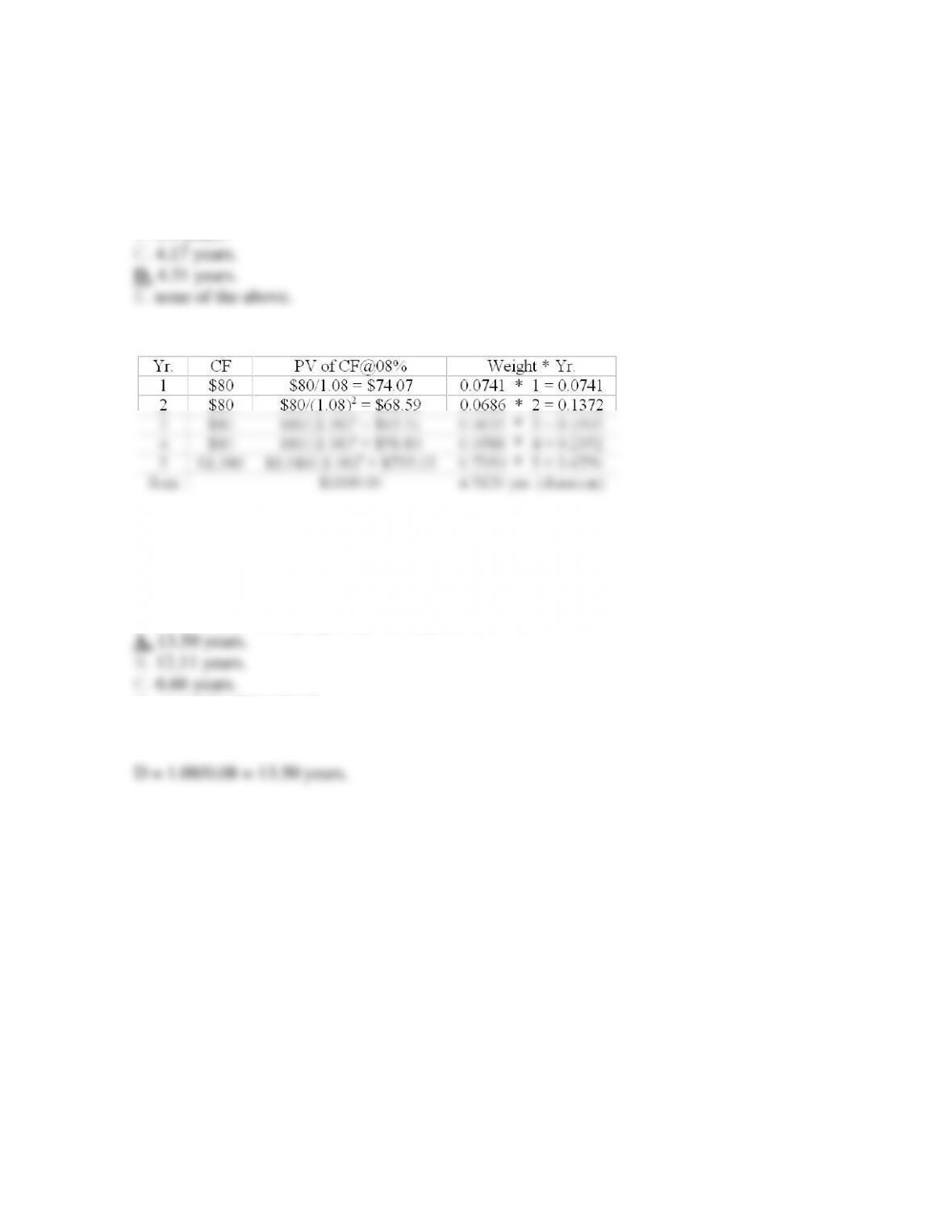
20. The duration of a par value bond with a coupon rate of 8% and a remaining time to
maturity of 5 years is
A. 5 years.
B. 5.4 years.
Calculations are shown below.
Difficulty: Moderate
21. The duration of a perpetuity with a yield of 8% is
D. cannot be determined.
E. none of the above.
Difficulty: Easy
Chapter 16 – Managing Bond Portfolios
16–10
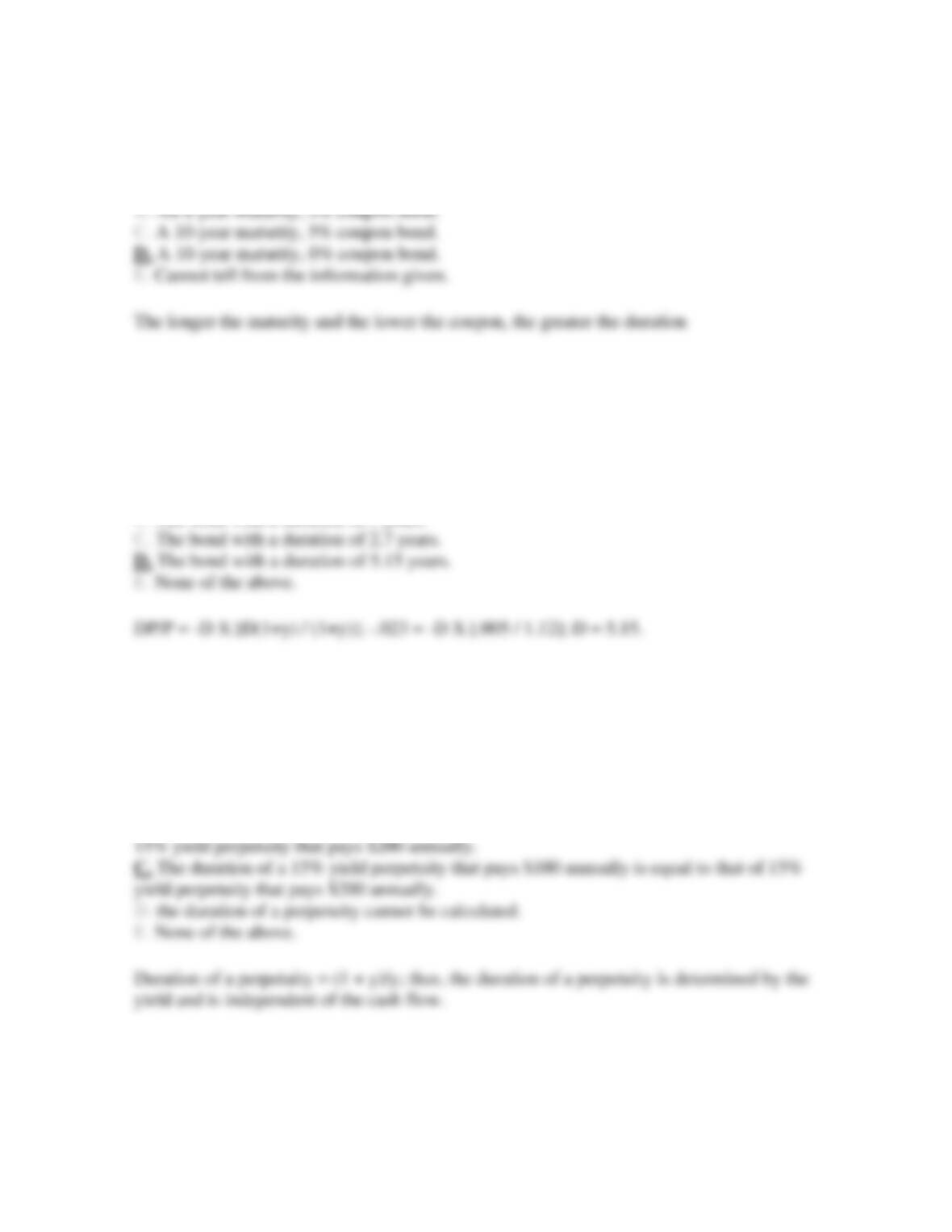
22. A seven-year par value bond has a coupon rate of 9% and a modified duration of
A. 7 years.
B. 5.49 years.
Calculations are shown below.
Difficulty: Difficult
23. Par value bond XYZ has a modified duration of 6. Which one of the following statements
regarding the bond is true?
D. If the market yield increases by 1% the bond’s price will increase by $60.
E. None of the above.
Difficulty: Moderate
Chapter 16 – Managing Bond Portfolios
16–11
24. Which of the following bonds has the longest duration?
A. An 8-year maturity, 0% coupon bond.
Difficulty: Moderate
25. Which one of the following par value 12% coupon bonds experiences a price change of
$23 when the market yield changes by 50 basis points?
A. The bond with a duration of 6 years.
B. The bond with a duration of 5 years.
Difficulty: Difficult
26. Which one of the following statements is true concerning the duration of a perpetuity?
A. The duration of 15% yield perpetuity that pays $100 annually is longer than that of a 15%
yield perpetuity that pays $200 annually.
B. The duration of a 15% yield perpetuity that pays $100 annually is shorter than that of a
Difficulty: Easy
Chapter 16 – Managing Bond Portfolios
16–12
27. Which one of the following statements is false concerning the duration of a perpetuity?
A. The duration of 15% yield perpetuity that pays $100 annually is longer than that of a 15%
yield perpetuity that pays $200 annually.
Difficulty: Easy
28. The two components of interest-rate risk are
A. price risk and default risk.
B. reinvestment risk and systematic risk.
Difficulty: Easy
29. The duration of a coupon bond
A. does not change after the bond is issued.
B. can accurately predict the price change of the bond for any interest rate change.
Difficulty: Easy
Chapter 16 – Managing Bond Portfolios
16–13
30. Indexing of bond portfolios is difficult because
A. the number of bonds included in the major indexes is so large that it would be difficult to
purchase them in the proper proportions.
Difficulty: Moderate
31. You have an obligation to pay $1,488 in four years and 2 months. In which bond would
you invest your $1,000 to accumulate this amount, with relative certainty, even if the yield on
the bond declines to 9.5% immediately after you purchase the bond?
A. a 6-year; 10% coupon par value bond
Difficulty: Difficult
Chapter 16 – Managing Bond Portfolios
16–14
32. Duration measures
A. weighted average time until a bond’s half-life.
B. weighted average time until cash flow payment.
Difficulty: Moderate
33. Duration
A. assesses the time element of bonds in terms of both coupon and term to maturity.
B. allows structuring a portfolio to avoid interest-rate risk.
Difficulty: Moderate
34. Identify the bond that has the longest duration (no calculations necessary).
A. 20-year maturity with an 8% coupon.
B. 20-year maturity with a 12% coupon.
Difficulty: Moderate
Chapter 16 – Managing Bond Portfolios
16–15
35. When interest rates decline, the duration of a 10-year bond selling at a premium
D. increases at first, then declines.
E. decreases at first, then increases.
Difficulty: Moderate
36. An 8%, 30-year corporate bond was recently being priced to yield 10%. The Macaulay
duration for the bond is 10.20 years. Given this information, the bond’s modified duration
would be ________.
A. 8.05
B. 9.44
Difficulty: Easy
37. An 8%, 15-year bond has a yield to maturity of 10% and duration of 8.05 years. If the
D. 6.44%
E. none of the above
Difficulty: Moderate
Chapter 16 – Managing Bond Portfolios
16–16
38. One way that banks can reduce the duration of their asset portfolios is through the use of
A. fixed rate mortgages.
Difficulty: Easy
39. The duration of a bond normally increases with an increase in
D. all of the above.
E. none of the above.
Difficulty: Moderate
40. Which one of the following is an incorrect statement concerning duration?
D. The duration is the same as term to maturity only in the case of zero-coupon bonds.
E. All of the statements are correct.
Difficulty: Moderate
Chapter 16 – Managing Bond Portfolios
16–17
41. Which one of the following is a correct statement concerning duration?
A. The higher the yield to maturity, the greater the duration
B. The higher the coupon, the shorter the duration.
Difficulty: Moderate
42. Immunization is not a strictly passive strategy because
A. it requires choosing an asset portfolio that matches an index.
B. there is likely to be a gap between the values of assets and liabilities in most portfolios.
Difficulty: Moderate
Chapter 16 – Managing Bond Portfolios
16–18
43. Contingent immunization
A. is a mixed-active passive bond portfolio management strategy.
B. is a strategy whereby the portfolio may or may not be immunized.
Difficulty: Easy
44. Some of the problems with immunization are
A. duration assumes that the yield curve is flat.
B. duration assumes that if shifts in the yield curve occur, these shifts are parallel.
Difficulty: Moderate
Chapter 16 – Managing Bond Portfolios
16–19
45. If a bond portfolio manager believes
A. in market efficiency, he or she is likely to be a passive portfolio manager.
B. that he or she can accurately predict interest rate changes, he or she is likely to be an active
Difficulty: Moderate
46. According to experts, most pension funds are underfunded because
A. their liabilities are of shorter duration than their assets.
Difficulty: Moderate
47. Cash flow matching on a multiperiod basis is referred to as a
A. immunization.
B. contingent immunization.
Difficulty: Easy
Chapter 16 – Managing Bond Portfolios
16–20
48. Immunization through duration matching of assets and liabilities may be ineffective or
inappropriate because
A. conventional duration strategies assume a flat yield curve.
B. duration matching can only immunize portfolios from parallel shifts in the yield curve.
Difficulty: Easy
49. The curvature of the price-yield curve for a given bond is referred to as the bond’s
A. modified duration.
B. immunization.
Difficulty: Easy