Chapter 16 – Managing Bond Portfolios
16–21
50. Consider a bond selling at par with modified duration of 10.6 years and convexity of 210.
A 2 percent decrease in yield would cause the price to increase by 21.2%, according to the
duration rule. What would be the percentage price change according to the duration-with-
convexity rule?
A. 21.2%
Difficulty: Difficult
51. A substitution swap is an exchange of bonds undertaken to
A. change the credit risk of a portfolio.
B. extend the duration of a portfolio.
Difficulty: Moderate
Chapter 16 – Managing Bond Portfolios
16–22
52. A rate anticipation swap is an exchange of bonds undertaken to
D. change the credit risk of the portfolio.
E. increase return by shifting into higher yield bonds.
Difficulty: Moderate
53. An analyst who selects a particular holding period and predicts the yield curve at the end
of that holding period is engaging in
A. a rate anticipation swap.
B. immunization.
Difficulty: Easy
54. The process of unbundling and repackaging the cash flows from one or more bonds into
new securities is called
A. speculation.
B. immunization.
Difficulty: Easy
Chapter 16 – Managing Bond Portfolios
16–23
55. An active investment strategy
A. implies that market prices are fairly set.
Difficulty: Easy
56. Interest-rate risk is important to
A. active bond portfolio managers.
B. passive bond portfolio managers.
Difficulty: Easy
Chapter 16 – Managing Bond Portfolios
16–24
57. Which of the following are true about the interest-rate sensitivity of bonds?
I) Bond prices and yields are inversely related.
II) Prices of long-term bonds tend to be more sensitive to interest rate changes than prices of
short-term bonds.
III) Interest-rate risk is directly related to the bond’s coupon rate.
IV) The sensitivity of a bond’s price to a change in its yield to maturity is inversely related to
the yield to maturity at which the bond is currently selling.
A. I and II
B. I and III
Difficulty: Moderate
58. Which of the following are false about the interest-rate sensitivity of bonds?
I) Bond prices and yields are inversely related.
II) Prices of long-term bonds tend to be more sensitive to interest rate changes than prices of
short-term bonds.
III) Interest-rate risk is directly related to the bond’s coupon rate.
IV) The sensitivity of a bond’s price to a change in its yield to maturity is inversely related to
the yield to maturity at which the bond is currently selling.
A. I
Difficulty: Moderate
Chapter 16 – Managing Bond Portfolios
16–25
59. Which of the following researchers have contributed significantly to bond portfolio
management theory?
I) Sidney Homer
II) Harry Markowitz
III) Burton Malkiel
IV) Martin Liebowitz
V) Frederick Macaulay
A. I and II
B. III and V
Difficulty: Moderate
60. According to the duration concept
A. only coupon payments matter.
B. only maturity value matters.
C. the coupon payments made prior to maturity make the effective maturity of the bond
greater than its actual time to maturity.
Difficulty: Easy
Chapter 16 – Managing Bond Portfolios
16–26
61. Duration is important in bond portfolio management because
I) it can be used in immunization strategies.
II) it provides a gauge of the effective average maturity of the portfolio.
III) it is related to the interest rate sensitivity of the portfolio.
IV) it is a good predictor of interest rate changes.
A. I and II
B. I and III
Difficulty: Moderate
62. Two bonds are selling at par value and each has 17 years to maturity. The first bond has a
coupon rate of 6% and the second bond has a coupon rate of 13%. Which of the following is
true about the durations of these bonds?
A. The duration of the higher-coupon bond will be higher.
Difficulty: Difficult
Chapter 16 – Managing Bond Portfolios
16–27
63. Two bonds are selling at par value and each has 17 years to maturity. The first bond has a
coupon rate of 6% and the second bond has a coupon rate of 13%. Which of the following is
false about the durations of these bonds?
A. The duration of the higher-coupon bond will be higher.
B. The duration of the lower-coupon bond will be higher.
Difficulty: Difficult
64. Which of the following offers a bond index?
A. Merrill Lynch
B. Salomon Smith Barney
Difficulty: Easy
Chapter 16 – Managing Bond Portfolios
16–28
65. Which of the following two bonds is more price sensitive to changes in interest rates?
1) A par value bond, A, with a 12-year-to-maturity and a 12% coupon rate.
2) A zero-coupon bond, B, with a 12-year-to-maturity and a 12% yield-to-maturity.
A. Bond A because of the higher yield to maturity.
Difficulty: Moderate
66. Which of the following two bonds is more price sensitive to changes in interest rates?
1) A par value bond, D, with a 2-year-to-maturity and a 8% coupon rate.
2) A zero-coupon bond, E, with a 2-year-to-maturity and a 8% yield-to–maturity.
A. Bond D because of the higher yield to maturity.
Difficulty: Moderate
Chapter 16 – Managing Bond Portfolios
16–29
67. Holding other factors constant, which one of the following bonds has the smallest price
volatility?
A. 7-year, 0% coupon bond
B. 7-year, 12% coupon bond
Difficulty: Moderate
68. Holding other factors constant, which one of the following bonds has the smallest price
volatility?
A. 20-year, 0% coupon bond
B. 20-year, 6% coupon bond
Difficulty: Moderate
69. The duration of a 15-year zero-coupon bond is
A. smaller than 15.
B. larger than 15.
Difficulty: Easy
Chapter 16 – Managing Bond Portfolios
16–30
70. The duration of a 20-year zero-coupon bond is
D. equal to that of a 20-year 10% coupon bond
E. none of the above.
Difficulty: Easy
71. The duration of a perpetuity with a yield of 10% is
A. 13.50 years.
Difficulty: Easy
72. The duration of a perpetuity with a yield of 6% is
A. 13.50 years.
B. 12.11 years.
Difficulty: Easy
Chapter 16 – Managing Bond Portfolios
16–31
73. Par value bond F has a modified duration of 9. Which one of the following statements
regarding the bond is true?
D. If the market yield decreases by 1% the bond’s price will increase by $60.
E. None of the above.
Difficulty: Moderate
74. Par value bond GE has a modified duration of 11. Which one of the following statements
regarding the bond is true?
A. If the market yield increases by 1% the bond’s price will decrease by $55.
B. If the market yield increases by 1% the bond’s price will increase by $55.
Difficulty: Moderate
75. Which of the following bonds has the longest duration?
A. A 15-year maturity, 0% coupon bond.
B. A 15-year maturity, 9% coupon bond.
Difficulty: Moderate
Chapter 16 – Managing Bond Portfolios
16–32
76. Which of the following bonds has the longest duration?
D. A 4-year maturity, 0% coupon bond.
E. Cannot tell from the information given.
Difficulty: Moderate
77. A 10%, 30-year corporate bond was recently being priced to yield 12%. The Macaulay
duration for the bond is 11.3 years. Given this information, the bond’s modified duration
would be
A. 8.05
Difficulty: Easy
78. A 6%, 30-year corporate bond was recently being priced to yield 8%. The Macaulay
duration for the bond is 8.4 years. Given this information, the bond’s modified duration would
be
A. 8.05
B. 9.44
Difficulty: Easy

Chapter 16 – Managing Bond Portfolios
16–33
79. A 9%, 16-year bond has a yield to maturity of 11% and duration of 9.25 years. If the
market yield changes by 32 basis points, how much change will there be in the bond’s price?
A. 1.85%
B. 2.01%
Difficulty: Moderate
80. A 7%, 14-year bond has a yield to maturity of 6% and duration of 7 years. If the market
yield changes by 44 basis points, how much change will there be in the bond’s price?
A. 1.85%
Difficulty: Moderate
Chapter 16 – Managing Bond Portfolios
16–34
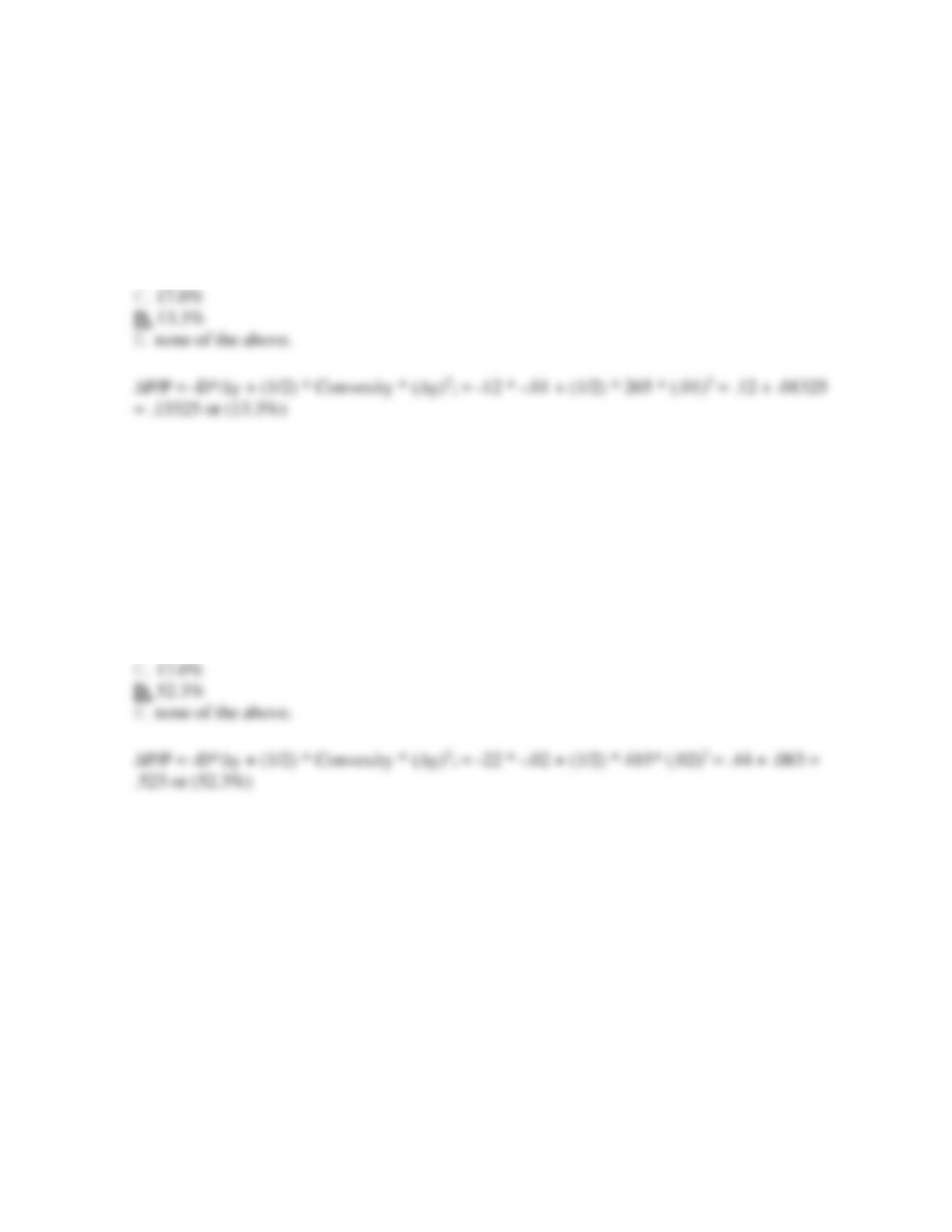
81. Consider a bond selling at par with modified duration of 12 years and convexity of 265. A
1 percent decrease in yield would cause the price to increase by 12%, according to the
duration rule. What would be the percentage price change according to the duration-with-
convexity rule?
A. 21.2%
B. 25.4%
Difficulty: Difficult
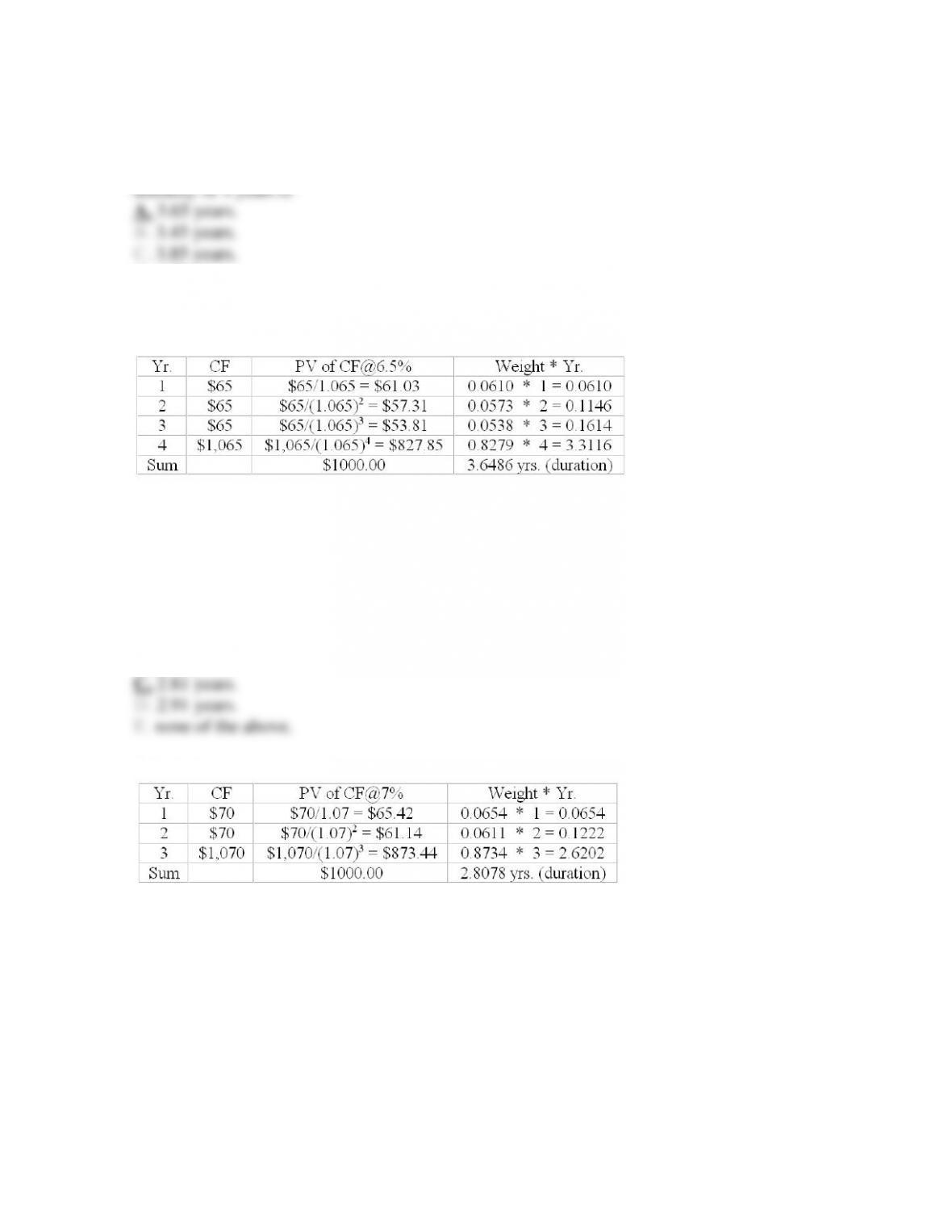
82. Consider a bond selling at par with modified duration of 22-years and convexity of 415. A
2 percent decrease in yield would cause the price to increase by 44%, according to the
duration rule. What would be the percentage price change according to the duration-with-
convexity rule?
A. 21.2%
B. 25.4%
Difficulty: Difficult
Chapter 16 – Managing Bond Portfolios
16–35
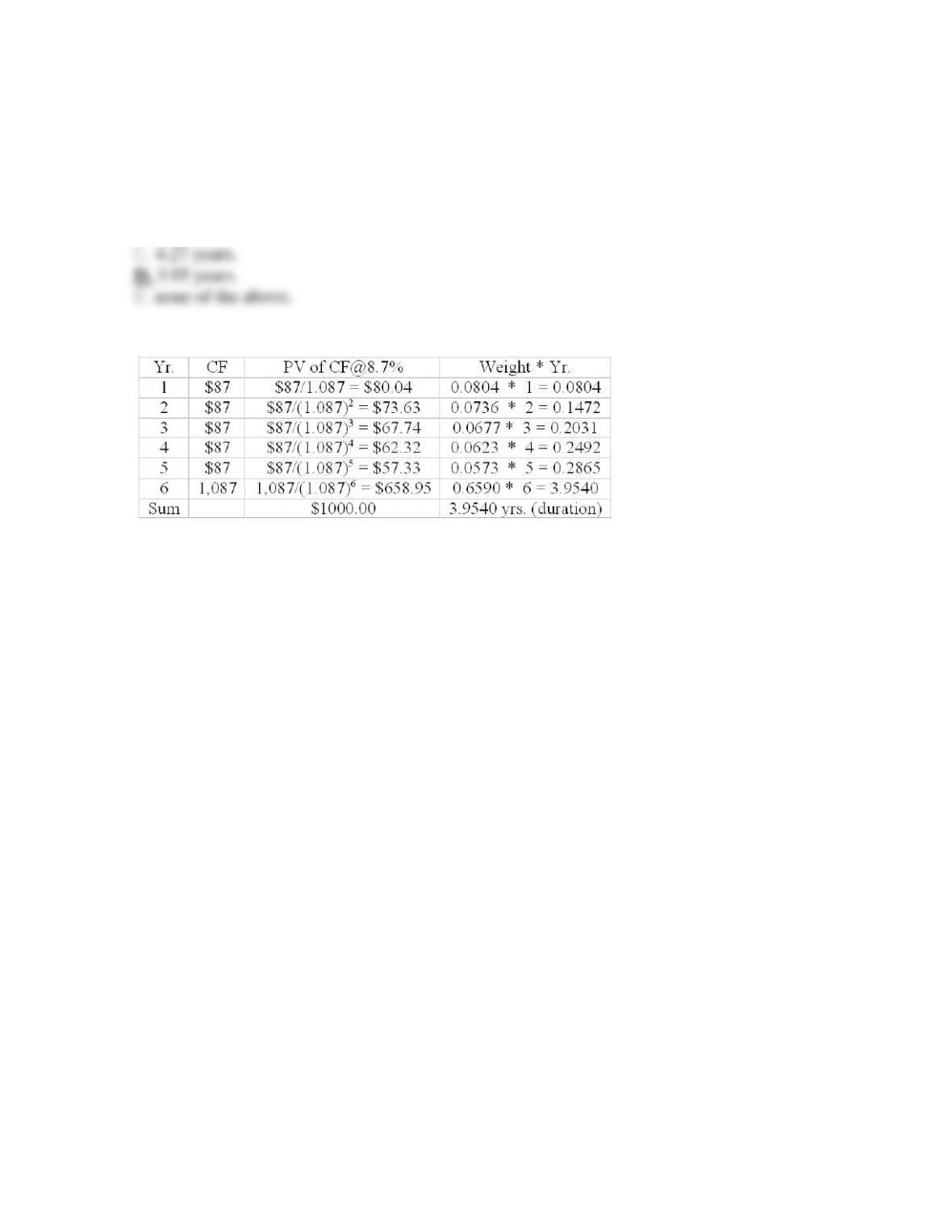
83. The duration of a par value bond with a coupon rate of 6.5% and a remaining time to
D. 4.00 years.
E. none of the above.
Calculations are shown below.
Difficulty: Moderate
84. The duration of a par value bond with a coupon rate of 7% and a remaining time to
maturity of 3 years is
A. 3 years.
B. 2.71 years.
Calculations are shown below.
Difficulty: Moderate
Chapter 16 – Managing Bond Portfolios
16–36
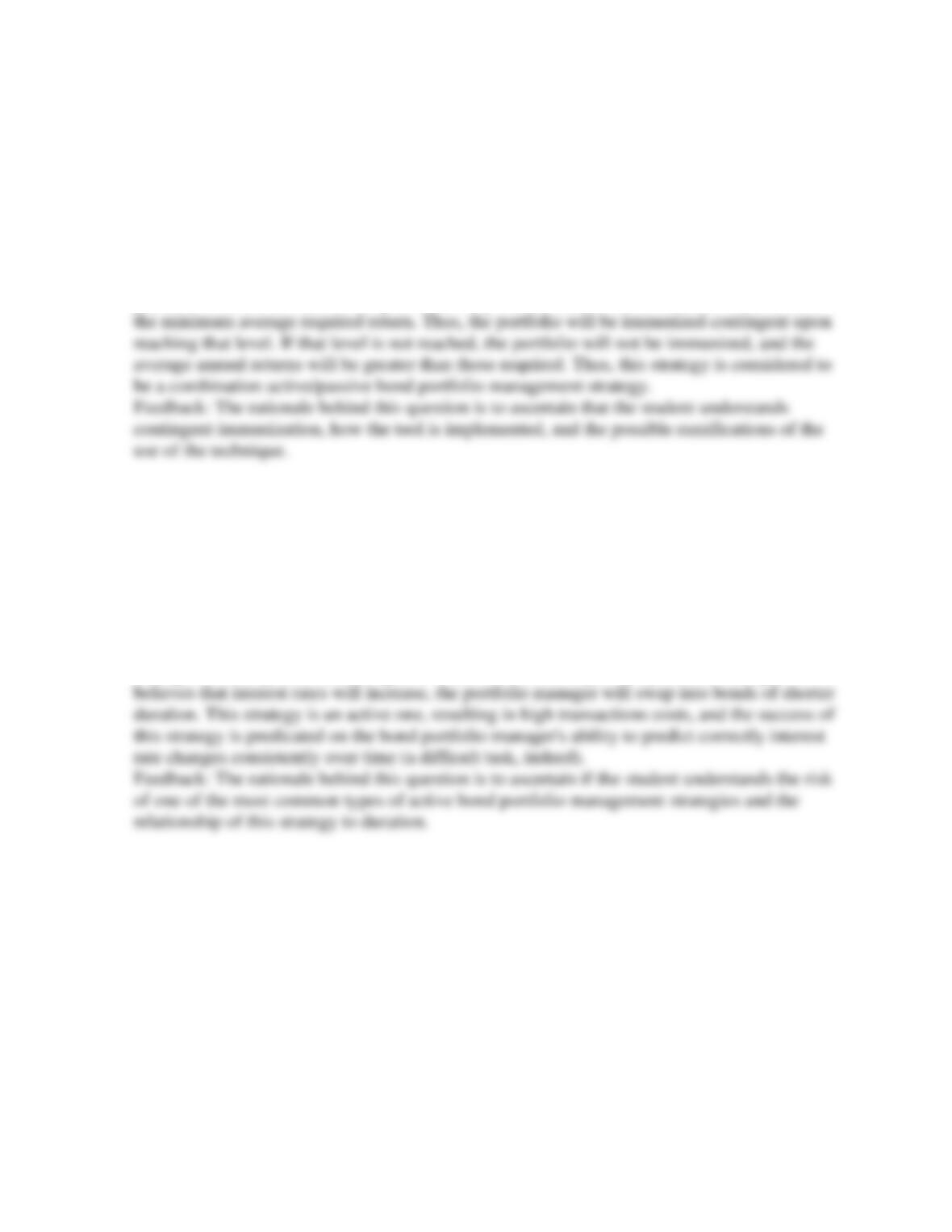
85. The duration of a par value bond with a coupon rate of 8.7% and a remaining time to
maturity of 6 years is
A. 6.0 years.
B. 5.1 years.
Calculations are shown below.
Difficulty: Moderate

Chapter 16 – Managing Bond Portfolios
16–37
Short Answer Questions
86. Discuss duration. Include in your discussion what duration measures, how duration relates
to maturity, what variables affect duration, and how duration is used as a portfolio
management tool (include some of the problems associated with the use of duration as a
portfolio management tool).
Duration is a measure of the time it takes to recoup one’s investment in a bond, assuming that
one purchased the bond for $1,000. Duration is shorter than term to maturity on coupon bonds
as cash flows are received prior to maturity. Duration equals term to maturity for zero-coupon
bonds, as no cash flows are received prior to maturity. Duration measures the price sensitivity
of a bond with respect interest rate changes. The longer the maturity of the bond, the lower the
coupon rate of the bond, and the higher the yield to maturity of the bond, the greater the
Difficulty: Moderate
Chapter 16 – Managing Bond Portfolios
16–38
87. Discuss contingent immunization. Is this form of bond portfolio management strategy an
active, passive, or combination of both, strategy?
Contingent immunization is portfolio management technique where the portfolio owner is
willing to accept an average annual return over a period of time that is lower than that
currently available. The portfolio manager may actively manage the portfolio until (if) the
portfolio declines in value to the point that the portfolio must be immunized in order to earn
Difficulty: Moderate
88. Discuss rate anticipation swaps as a bond portfolio management strategy.
Rate anticipation swap is an active bond portfolio management strategy, based on predicting
future interest rates. If a portfolio manager believes that interest rates will decline, the
manager will swap into bonds of greater duration. Conversely, if the portfolio manager
Difficulty: Moderate

Chapter 16 – Managing Bond Portfolios
16–39
89. You manage a portfolio for Ms. Greenspan, who has instructed you to be sure her
portfolio has a value of at least $350,000 at the end of six years. The current value of Ms.
Greenspan’s portfolio is $250,000. You can invest the money at a current interest rate of 8%.
You have decided to use a contingent immunization strategy.
– What amount would need to be invested today to achieve the goal, given the current interest
rate?
– Suppose that four years have passed and the interest rate is 9%. What is the trigger point for
Angel’s portfolio at this time? (That is, how low can the value of the portfolio be before you
will be forced to immunize to be assured of achieving the minimum acceptable return?)
– Illustrate the situation graphically.
– If the portfolio’s value after 4 years is $291,437 what should you do?
Calculations are shown below.
– Amount needed to reach the goal = $350,000/1.086 = $220,559.37
– The trigger point = $350,000/1.092 = $294,588.00

Chapter 16 – Managing Bond Portfolios
16–40
90. You have purchased a bond for $973.02. The bond has a coupon rate of 6.4%, pays
interest annually, has a face value of $1,000, 4 years to maturity, and a yield to maturity of
7.2%. The bond’s duration is 3.6481 years. You expect that interest rates will fall by .3% later
today.
– Use the modified duration to find the approximate percentage change in the bond’s price.
Find the new price of the bond from this calculation.
– Use your calculator to do the regular present value calculations to find the bond’s new price
at its new yield to maturity.
– What is the amount of the difference between the two answers? Why are your answers
different? Explain the reason in words and illustrate it graphically.
Calculations are shown below.
– Find new price using modified duration:
Modified duration = 3.6481/1.072 = 3.403 years.
Difficulty: Difficult