Chapter 14 – Bond Prices and Yields
14–37
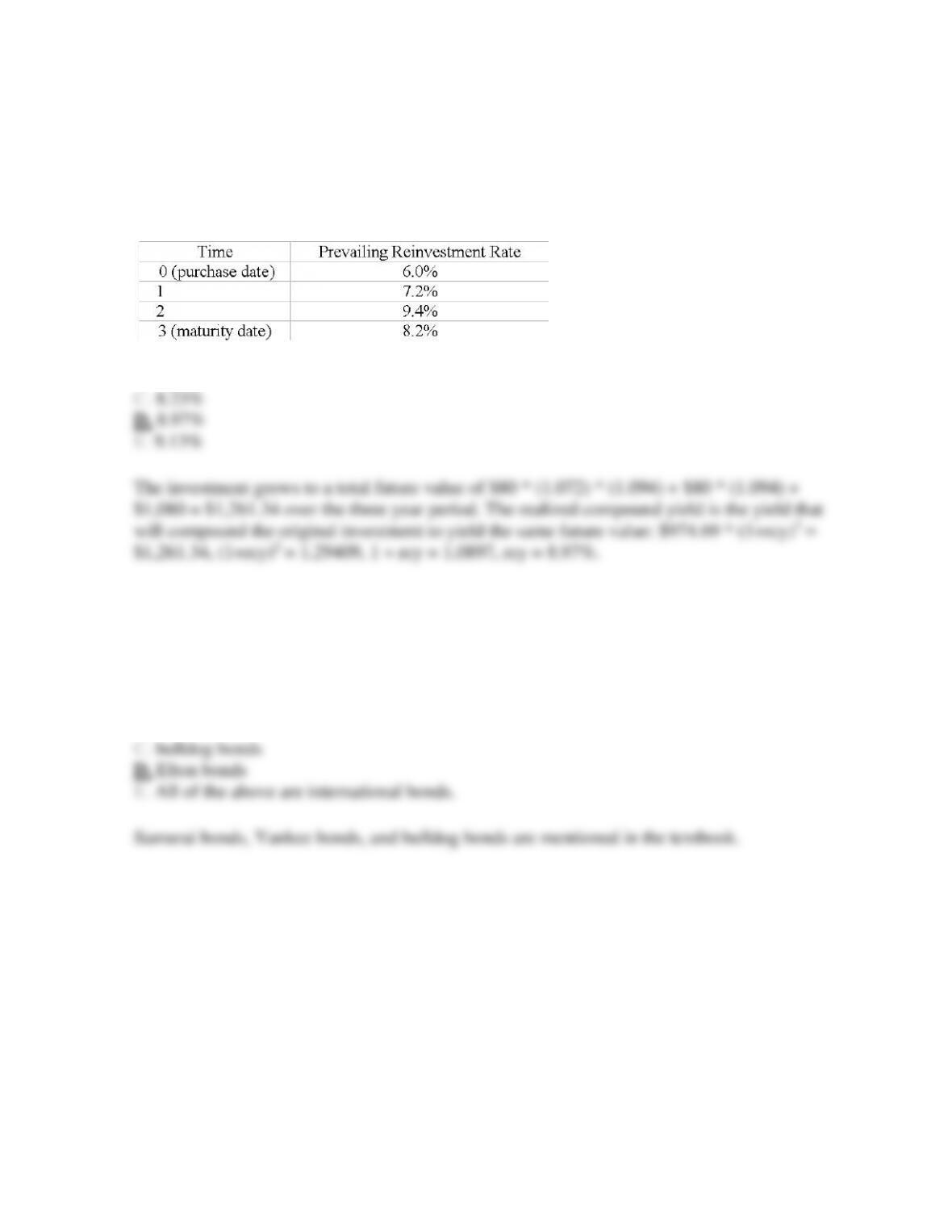
92. Three years ago you purchased a bond for $974.69. The bond had three years to maturity,
a coupon rate of 8%, paid annually, and a face value of $1,000. Each year you reinvested all
coupon interest at the prevailing reinvestment rate shown in the table below. Today is the
bond’s maturity date. What is your realized compound yield on the bond?
A. 6.43%
B. 7.96%
Difficulty: Difficult
93. Which of the following is not a type of international bond?
A. Samurai bonds
B. Yankee bonds
Difficulty: Easy
Chapter 14 – Bond Prices and Yields
14–38
94. A coupon bond that pays interest annually has a par value of $1,000, matures in 6 years,
and has a yield to maturity of 11%. The intrinsic value of the bond today will be ______ if the
coupon rate is 7.5%.
A. $712.99
Difficulty: Moderate
95. A coupon bond that pays interest annually has a par value of $1,000, matures in 8 years,
and has a yield to maturity of 9%. The intrinsic value of the bond today will be ______ if the
coupon rate is 6%.
D. $886.28
E. $1,000.00
Difficulty: Moderate
96. A coupon bond that pays interest semi-annually has a par value of $1,000, matures in 6
years, and has a yield to maturity of 9%. The intrinsic value of the bond today will be
__________ if the coupon rate is 9%.
A. $922.78
B. $924.16
Difficulty: Moderate
Chapter 14 – Bond Prices and Yields
14–39
97. A coupon bond that pays interest semi-annually has a par value of $1,000, matures in 7
years, and has a yield to maturity of 11%. The intrinsic value of the bond today will be
__________ if the coupon rate is 8.8%.
A. $922.78
Difficulty: Moderate
98. A coupon bond that pays interest of $90 annually has a par value of $1,000, matures in 9
years, and is selling today at a $66 discount from par value. The yield to maturity on this bond
is __________.
A. 9.00%
Difficulty: Moderate
99. A coupon bond that pays interest of $40 semi annually has a par value of $1,000, matures
in 4 years, and is selling today at a $36 discount from par value. The yield to maturity on this
bond is __________.
A. 8.69%
Difficulty: Moderate
Chapter 14 – Bond Prices and Yields
14–40
100. You purchased an annual interest coupon bond one year ago that now has 18 years
remaining until maturity. The coupon rate of interest was 11% and par value was $1,000. At
the time you purchased the bond, the yield to maturity was 10%. The amount you paid for this
bond one year ago was
A. $1,057.50
B. $1,075.50
Difficulty: Moderate
101. You purchased an annual interest coupon bond one year ago that had 9 years remaining
to maturity at that time. The coupon interest rate was 10% and the par value was $1,000. At
the time you purchased the bond, the yield to maturity was 8%. If you sold the bond after
receiving the first interest payment and the yield to maturity continued to be 8%, your annual
total rate of return on holding the bond for that year would have been _________.
D. 11.95%
E. none of the above
Difficulty: Difficult
Chapter 14 – Bond Prices and Yields
14–41
102. Consider two bonds, F and G. Both bonds presently are selling at their par value of
$1,000. Each pays interest of $90 annually. Bond F will mature in 15 years while bond G will
mature in 26 years. If the yields to maturity on the two bonds change from 9% to 10%,
____________.
A. both bonds will increase in value, but bond F will increase more than bond G
B. both bonds will increase in value, but bond G will increase more than bond F
Difficulty: Moderate
103. A zero-coupon bond has a yield to maturity of 12% and a par value of $1,000. If the
bond matures in 18 years, the bond should sell for a price of _______ today.
A. 422.41
Difficulty: Moderate
104. A zero-coupon bond has a yield to maturity of 11% and a par value of $1,000. If the
bond matures in 27 years, the bond should sell for a price of _______ today.
D. $483.49
E. none of the above
Difficulty: Moderate
Chapter 14 – Bond Prices and Yields
14–42
105. You have just purchased a 12-year zero-coupon bond with a yield to maturity of 9% and
a par value of $1,000. What would your rate of return at the end of the year be if you sell the
bond? Assume the yield to maturity on the bond is 10% at the time you sell.
A. 10.00%
B. 20.42%
Difficulty: Moderate
106. You have just purchased a 7-year zero-coupon bond with a yield to maturity of 11% and
a par value of $1,000. What would your rate of return at the end of the year be if you sell the
bond? Assume the yield to maturity on the bond is 9% at the time you sell.
A. 10.00%
Difficulty: Moderate
107. A convertible bond has a par value of $1,000 and a current market price of $975. The
current price of the issuing firm’s stock is $42 and the conversion ratio is 22 shares. The
bond’s market conversion value is ______.
A. $729
Difficulty: Easy
Chapter 14 – Bond Prices and Yields
14–43
108. A convertible bond has a par value of $1,000 and a current market price of $1105. The
current price of the issuing firm’s stock is $20 and the conversion ratio is 35 shares. The
bond’s market conversion value is ______.
D. $1,000
E. none of the above
Difficulty: Easy
109. A convertible bond has a par value of $1,000 and a current market value of $950. The
current price of the issuing firm’s stock is $22 and the conversion ratio is 40 shares. The
bond’s conversion premium is _________.
A. $40
Difficulty: Moderate
110. A convertible bond has a par value of $1,000 and a current market value of $1150. The
current price of the issuing firm’s stock is $65 and the conversion ratio is 15 shares. The
bond’s conversion premium is _________.
A. $40
B. $150
Difficulty: Moderate
Chapter 14 – Bond Prices and Yields
14–44
111. If a 7% coupon bond that pays interest every 182 days paid interest 32 days ago, the
accrued interest would be
A. 5.67
B. 7.35
Difficulty: Easy
112. If a 7.5% coupon bond that pays interest every 182 days paid interest 62 days ago, the
accrued interest would be
A. 11.67
B. 12.35
Difficulty: Easy
113. If a 9% coupon bond that pays interest every 182 days paid interest 112 days ago, the
accrued interest would be
D. 27.98
E. 28.15
Difficulty: Easy
Chapter 14 – Bond Prices and Yields
14–45
114. A 7% coupon bond with an ask price of 100:00 pays interest every 182 days. If the bond
paid interest 32 days ago, the invoice price of the bond would be
A. 1,005.67
Difficulty: Easy
115. A 7.5% coupon bond with an ask price of 100:00 pays interest every 182 days. If the
bond paid interest 62 days ago, the invoice price of the bond would be
A. 1,011.67
B. 1,012.35
Difficulty: Easy
116. A 9% coupon bond with an ask price of 100:00 pays interest every 182 days. If the bind
paid interest 112 days ago, the invoice price of the bond would be
D. 1,027.98
E. 1,028.15
Difficulty: Easy
Chapter 14 – Bond Prices and Yields
14–46
117. One year ago, you purchased a newly issued TIPS bond that has a 5% coupon rate, five
years to maturity, and a par value of $1,000. The average inflation rate over the year was
3.2%. What is the amount of the coupon payment you will receive and what is the current face
value of the bond?
A. $50.00, $1,000
B. $32.00, $1,032
Difficulty: Moderate
118. One year ago, you purchased a newly issued TIPS bond that has a 4% coupon rate, five
years to maturity, and a par value of $1,000. The average inflation rate over the year was
3.6%. What is the amount of the coupon payment you will receive and what is the current face
value of the bond?
A. $40.00, $1,000
Difficulty: Moderate
Chapter 14 – Bond Prices and Yields
14–47
119. A CDO is a
A. Command Duty Officer
Difficulty: Easy
120. SIVs are
Difficulty: Moderate
121. SIVs raise funds by ______ and then use the proceeds to ______.
A. issuing short-term commercial paper; retire other forms of their debt
Difficulty: Moderate
Chapter 14 – Bond Prices and Yields
14–48
122. CDOs are divided in tranches
A. that provide investors with securities with varying degrees of credit risk
Difficulty: Moderate
123. Mortgage-backed CDOs were a disaster in 2007 because
A. they were formed by pooling high quality fixed-rated loans with low interest rates
Difficulty: Moderate
Chapter 14 – Bond Prices and Yields
14–49
Short Answer Questions
124. If you are buying a coupon bond between interest paying dates, is the amount you would
pay to your broker for the bond more or less than the amount quoted in the financial quotation
pages? Discuss the differences and how these differences arise.
If you are buying a bond between interest paying dates, you will pay more than the amount
quoted in the financial pages. You will pay that price plus the interest that has accrued since
Difficulty: Easy
125. Discuss the taxation ramifications of zero coupon bonds. How has this taxation
procedure changed over the years? How has this change affected the demand for these
bonds?
The only return on a zero coupon bond is the capital gain realized when the bond is sold.
Initially, the investor was required to pay capital gains tax only when the bond was sold.
However, the IRS later decided that part of this capital gain each year was really imputed
interest and thus now one must pay tax on this imputed interest income (income that the
Difficulty: Moderate
Chapter 14 – Bond Prices and Yields
14–50
126. Why are many bonds callable? What is the disadvantage to the investor of a callable
bond? What does the investor receive in exchange for a bond being callable? How are bond
valuation calculations affected if bonds are callable?
Many bonds are callable to give the issuer the option of calling the bond in and refunding
(reissuing) the bond if interest rates decline. Bonds issued in a high interest rate environment
will have the call feature. Interest rates must decline enough to offset the cost of floating a
new issue. The disadvantage to the investor is that the investor will not receive that long
Difficulty: Moderate
Chapter 14 – Bond Prices and Yields
14–51
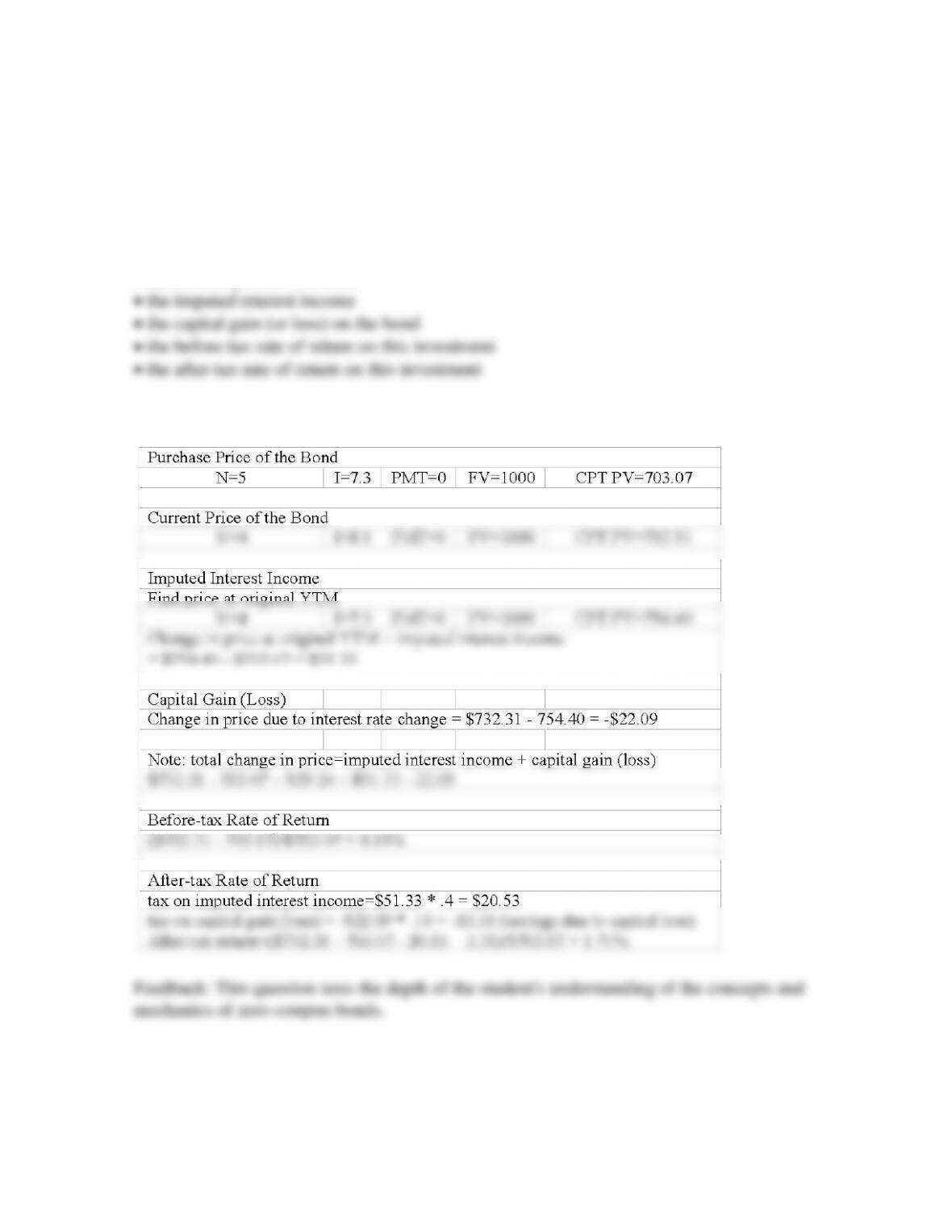
127. You purchased a zero-coupon bond that has a face value of $1,000, five years to maturity
and a yield to maturity of 7.3%. It is one year later and similar bonds are offering a yield to
maturity of 8.1%. You will sell the bond now. You have a tax rate of 40% on regular income
and 15% on capital gains. Calculate the following for this bond.
• the purchase price of the bond
• the current price of the bond
Calculations are shown in the table below.
Difficulty: Difficult