Chapter 14 – Bond Prices and Yields
14–21
53. A coupon bond pays interest semi-annually, matures in 5 years, has a par value of $1,000
and a coupon rate of 12%, and an effective annual yield to maturity of 10.25%. The price the
bond should sell for today is ________.
A. $922.77
B. $924.16
Difficulty: Moderate
54. A convertible bond has a par value of $1,000 and a current market price of $850. The
current price of the issuing firm’s stock is $29 and the conversion ratio is 30 shares. The
bond’s market conversion value is ______.
A. $729
B. $810
Difficulty: Easy
55. A convertible bond has a par value of $1,000 and a current market value of $850. The
current price of the issuing firm’s stock is $27 and the conversion ratio is 30 shares. The
bond’s conversion premium is _________.
D. $200
E. none of the above
Difficulty: Moderate
Chapter 14 – Bond Prices and Yields
14–22
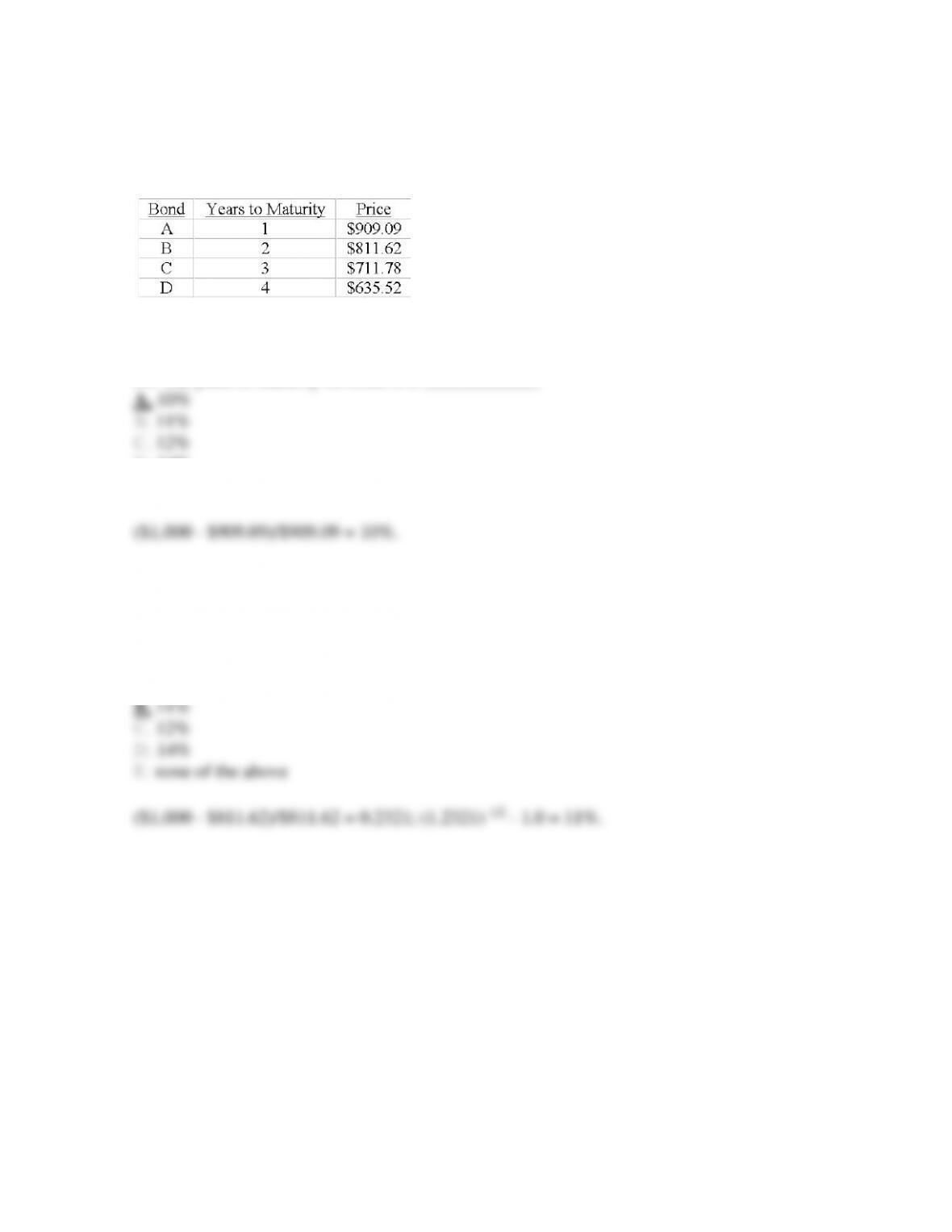
Consider the following $1,000 par value zero-coupon bonds:
56. The yield to maturity on bond A is ____________.
D. 14%
E. none of the above
Difficulty: Moderate
57. The yield to maturity on bond B is _________.
A. 10%
Difficulty: Moderate
Chapter 14 – Bond Prices and Yields
14–23
58. The yield to maturity on bond C is ____________.
A. 10%
B. 11%
Difficulty: Moderate
59. The yield to maturity on bond D is _______.
A. 10%
B. 11%
Difficulty: Moderate
60. A 10% coupon bond, annual payments, 10 years to maturity is callable in 3 years at a call
price of $1,100. If the bond is selling today for $975, the yield to call is _________.
A. 10.26%
B. 10.00%
Difficulty: Moderate
Chapter 14 – Bond Prices and Yields
14–24
61. A 12% coupon bond, semiannual payments, is callable in 5 years. The call price is $1,120;
if the bond is selling today for $1,110, what is the yield to call?
A. 12.03%.
B. 10.86%.
Difficulty: Moderate
62. A 10% coupon, annual payments, bond maturing in 10 years, is expected to make all
coupon payments, but to pay only 50% of par value at maturity. What is the expected yield on
this bond if the bond is purchased for $975?
A. 10.00%.
Difficulty: Moderate
Chapter 14 – Bond Prices and Yields
14–25
63. You purchased an annual interest coupon bond one year ago with 6 years remaining to
maturity at the time of purchase. The coupon interest rate is 10% and par value is $1,000. At
the time you purchased the bond, the yield to maturity was 8%. If you sold the bond after
receiving the first interest payment and the bond’s yield to maturity had changed to 7%, your
annual total rate of return on holding the bond for that year would have been _________.
A. 7.00%
B. 8.00%
Difficulty: Difficult
64. The ________ is used to calculate the present value of a bond.
A. nominal yield
B. current yield
Difficulty: Easy
Chapter 14 – Bond Prices and Yields
14–26
65. The yield to maturity on a bond is ________.
A. below the coupon rate when the bond sells at a discount, and equal to the coupon rate when
the bond sells at a premium.
Difficulty: Easy
66. A bond will sell at a discount when __________.
A. the coupon rate is greater than the current yield and the current yield is greater than yield to
maturity
B. the coupon rate is greater than yield to maturity
C. the coupon rate is less than the current yield and the current yield is greater than the yield
to maturity
Difficulty: Moderate
Chapter 14 – Bond Prices and Yields
14–27
67. Consider a 5-year bond with a 10% coupon that has a present yield to maturity of 8%. If
interest rates remain constant, one year from now the price of this bond will be _______.
A. higher
Difficulty: Moderate
68. A bond has a par value of $1,000, a time to maturity of 20 years, a coupon rate of 10%
with interest paid annually, a current price of $850 and a yield to maturity of 12%. Intuitively
and without the use calculations, if interest payments are reinvested at 10%, the realized
compound yield on this bond must be ________.
A. 10.00%
Difficulty: Difficult
Chapter 14 – Bond Prices and Yields
14–28
69. A bond with a 12% coupon, 10 years to maturity and selling at 88 has a yield to maturity
of _______.
E. less than 12%
Difficulty: Moderate
70. Using semiannual compounding, a 15-year zero coupon bond that has a par value of
$1,000 and a required return of 8% would be priced at approximately ______.
D. $555
E. none of the above
Difficulty: Moderate
71. The yield to maturity of a 20-year zero coupon bond that is selling for $372.50 with a
value at maturity of $1,000 is ________.
D. 13.4%
E. none of the above
Difficulty: Moderate
Chapter 14 – Bond Prices and Yields
14–29
72. Which one of the following statements about convertibles is true?
D. The collateral that is used to secure a convertible bond is one reason convertibles are more
attractive than the underlying stock.
E. Convertibles are not callable.
Difficulty: Moderate
73. Which one of the following statements about convertibles is false?
A. The longer the call protection on a convertible, the less the security is worth.
B. The more volatile the underlying stock, the greater the value of the conversion feature.
C. The smaller the spread between the dividend yield on the stock and the yield-to-maturity
Difficulty: Moderate
Chapter 14 – Bond Prices and Yields
14–30
74. Consider a $1,000 par value 20-year zero coupon bond issued at a yield to maturity of
10%. If you buy that bond when it is issued and continue to hold the bond as yields decline to
9%, the imputed interest income for the first year of that bond is
A. zero.
Difficulty: Moderate
75. The bond indenture includes
A. the coupon rate of the bond.
B. the par value of the bond.
Difficulty: Easy
76. A Treasury bond quoted at 107:16 107:18 has a bid price of _______ and an asked price
of _____.
A. $107.16, $107.18
B. $1,071.60, $1,071.80
Difficulty: Moderate
Chapter 14 – Bond Prices and Yields
14–31
77. Bearer bonds are
A. bonds traded without any record of ownership.
B. helpful to tax authorities in the enforcement of tax collection.
Difficulty: Moderate
78. Most corporate bonds are traded
A. on a formal exchange operated by the New York Stock Exchange.
B. by the issuing corporation.
Difficulty: Moderate
79. The process of retiring high-coupon debt and issuing new bonds at a lower coupon to
reduce interest payments is called
A. deferral.
B. reissue.
Difficulty: Moderate
Chapter 14 – Bond Prices and Yields
14–32
80. Convertible bonds
A. give their holders the ability to share in price appreciation of the underlying stock.
B. offer lower coupon rates than similar nonconvertible bonds.
Difficulty: Moderate
81. TIPS are
A. securities formed from the coupon payments only of government bonds.
B. securities formed from the principal payments only of government bonds.
Difficulty: Moderate
82. Altman’s Z scores are assigned based on a firm’s financial characteristics and are used to
predict
A. required coupon rates for new bond issues.
Difficulty: Easy
Chapter 14 – Bond Prices and Yields
14–33
83. When a bond indenture includes a sinking fund provision
A. firms must establish a cash fund for future bond redemption.
B. bondholders always benefit, because principal repayment on the scheduled maturity date is
guaranteed.
Difficulty: Moderate
84. Subordination clauses in bond indentures
A. may restrict the amount of additional borrowing the firm can undertake.
B. are sometimes referred to as “me-first” rules.
Difficulty: Easy
85. Collateralized bonds
A. rely on the general earning power of the firm for the bond’s safety.
B. are backed by specific assets of the issuing firm.
Difficulty: Easy
Chapter 14 – Bond Prices and Yields
14–34
86. Debt securities are often called fixed-income securities because
A. the government fixes the maximum rate that can be paid on bonds.
B. they are held predominantly by older people who are living on fixed incomes.
C. they pay a fixed amount at maturity.
Difficulty: Easy
87. A zero-coupon bond is one that
D. is issued by state governments because they don’t have to pay interest.
E. is analyzed primarily by focusing (“zeroing in”) on the coupon rate.
Difficulty: Moderate
Chapter 14 – Bond Prices and Yields
14–35
88. Swingin’ Soiree, Inc. is a firm that has its main office on the Right Bank in Paris. The firm
just issued bonds with a final payment amount that depends on whether the Seine River
floods. This type of bond is known as
A. a contingency bond
Difficulty: Easy
89. One year ago, you purchased a newly issued TIPS bond that has a 6% coupon rate, five
years to maturity, and a par value of $1,000. The average inflation rate over the year was
4.2%. What is the amount of the coupon payment you will receive and what is the current face
value of the bond?
A. $60.00, $1,000
Difficulty: Moderate
Chapter 14 – Bond Prices and Yields
14–36
90. Bond analysts might be more interested in a bond’s yield to call if
A. the bond’s yield to maturity is insufficient.
B. the firm has called some of its bonds in the past.
Difficulty: Difficult
91. What is the relationship between the price of a straight bond and the price of a callable
bond?
D. The straight bond and the callable bond will have the same price.
E. There is no consistent relationship between the two types of bonds.
Difficulty: Moderate