Foundations of Financial Management, 17e (Block)
Chapter 13 Risk and Capital Budgeting
1) A basic assumption in financial theory is that most investors and managers are risk seekers.
2) If we are risk-averse, a risky investment with an 8% return will be preferred over an 8% risk-
free investment.
3) Risk is not only measured in terms of losses, but also in terms of variability.

4) The expected value is a weighted average of the outcomes multiplied by their probabilities of
occurrence.
5) Investment A may have a higher standard deviation than investment B and still have less risk.
6) Expected value is defined as ΣDP where the outcomes are D and probabilities are P.
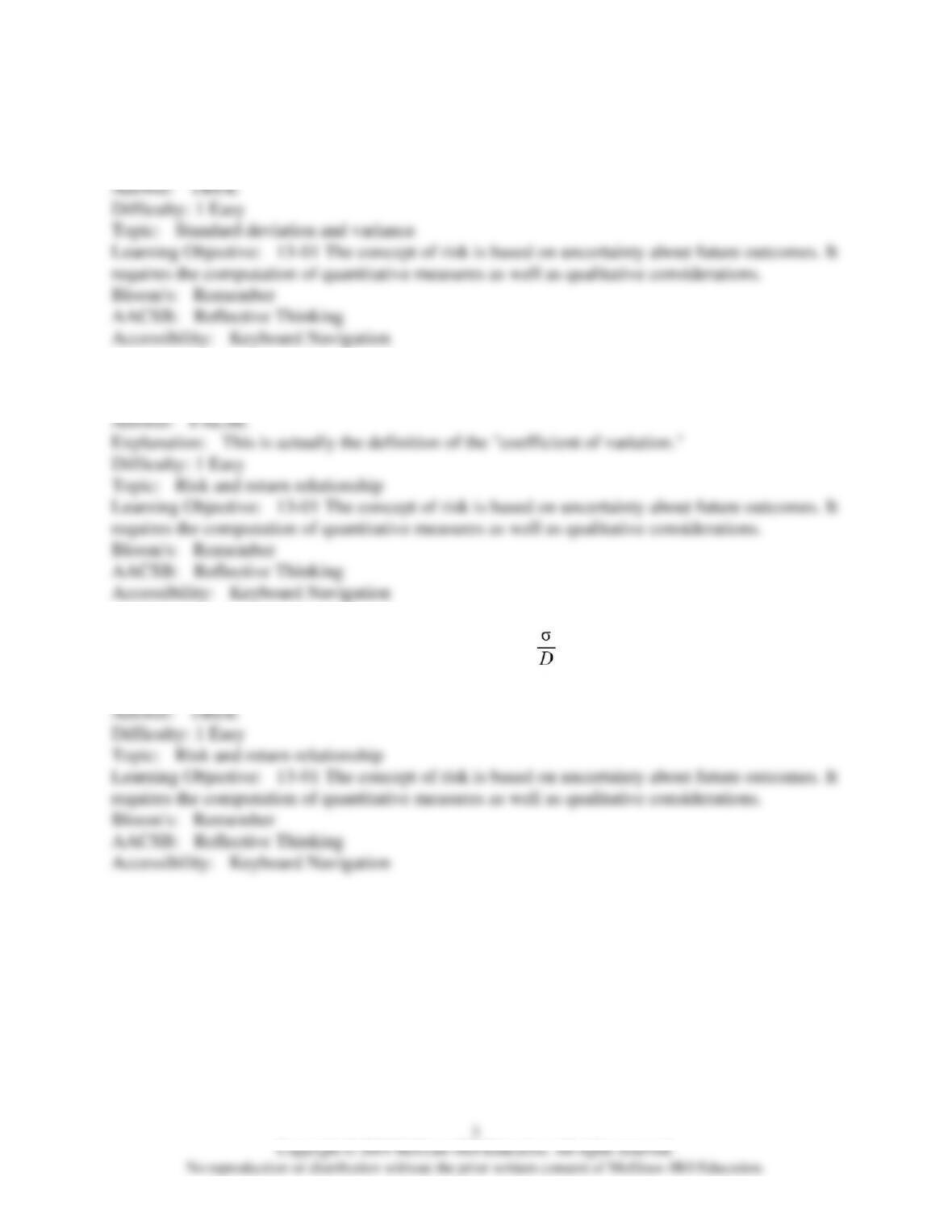
7) If possible outcomes are D and probabilities are P, the standard deviation is defined as
σ =
8) The standard deviation is the measure of dispersion or variability around the expected value.
9) The coefficient of correlation represents the standard deviation divided by the expected value.
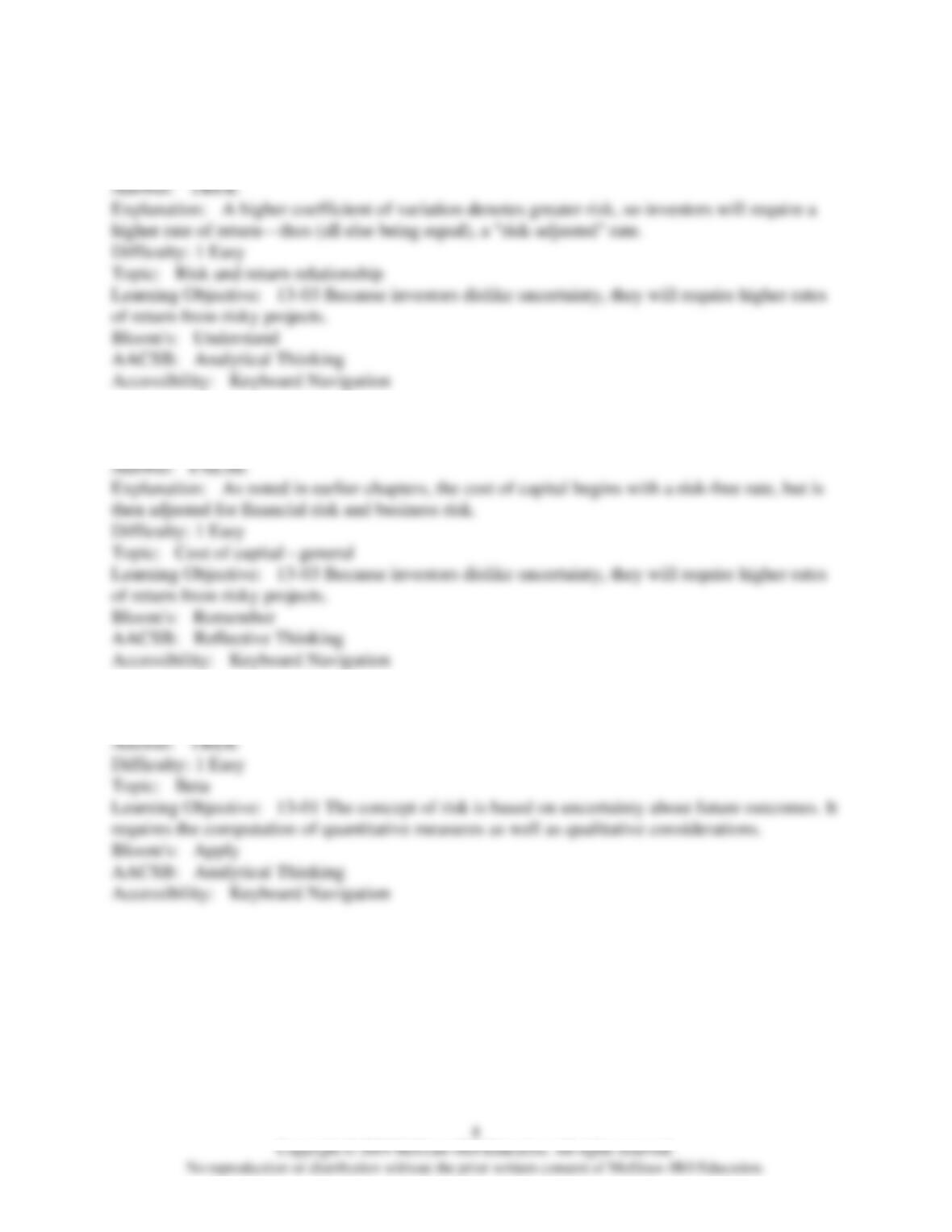
10) The equation for the coefficient of variation is (V) =
11) Generally, the higher the coefficient of variation a project has, the higher the discount rate it
should be assigned.
12) The cost of capital is assumed to contain no risk for the firm.
13) A common stock with a beta of 1.0 is said to be of equal risk with the market.
14) Beta is another measurement of risk and measures the stability of returns on an individual
stock relative to the stock market index of returns.
15) Regardless of risk, no projects should be accepted unless they earn more than the firm’s
weighted average cost of capital.
16) As the time horizon becomes shorter, more uncertainty enters the forecast.
17) As the time horizon increases, the standard deviation for each forecast of cash flow normally
increases.
18) Simulation models allow the analyst to test possible changes in the variables used in the
model.
19) Decision trees present a tabular or graphical comparison of projected decision outcomes.
20) A firm might be willing to accept high risk in a given investment if the portfolio effect (for
the whole firm) is beneficial.

7
21) In order to reduce risk, one should diversify into areas that are positively correlated with
current areas of involvement.
22) Projects that are totally uncorrelated should provide some overall reduction in portfolio risk.
23) The highest possible value for positive correlation is +1.
24) Projects with high positive correlation are sometimes valuable because they allow us to
smooth out the overall performance of the firm during a business cycle.
25) Combining assets with highly correlated returns will greatly reduce portfolio risk.
26) Projects that are totally uncorrelated provide more overall risk reduction than negatively
correlated projects.

27) Assume that Widget Repair Corporation provides services to 100 customers whose decision
to change suppliers is uncorrelated. The portfolio effect suggests that the entrepreneur/owner of
Widget, who is compensated on the basis of the firm’s profits, may have lower cash-flow risk
than a clerk who works full-time for Widget on a fixed salary.
28) Insurance companies take advantage of the portfolio effect by insuring many different
homeowners against loss. However, the risks of loss for individual homes in hurricane-prone or
earthquake-prone areas such as Florida and California are highly correlated. This suggests that
insurance companies should avoid writing (or consider canceling) some customers’ policies in
Florida and California, even when the policies are both needed by homeowners and expected to
be highly profitable to the insurer.
29) When choosing portfolios of assets, management should try to achieve the highest possible
return at a given level of risk.

30) Selection of portfolio combinations from the efficient frontier will depend upon our
willingness to assume risk.
31) The investor’s portfolio should always be on the efficient frontier.
32) The efficient frontier is always along the left-most portion of the risk-return trade-off
diagram in which risk is measured on the X-axis and return is measured on the Y-axis.
33) In considering the share price effect on risk-return trade-offs, our goal should always be to
earn the highest return possible.
34) Generally, because of the unpredictability of earnings, cyclical stocks are given higher price–
earnings multiples than growth stocks.
35) The capital budgeting decisions of a firm will have no effect on the share price of the
common stock.
36) Choosing projects with returns equal to the company norm but having a higher level of risk
will most likely lower the company’s stock price.
37) Sensitivity analysis helps the financial planner determine how sensitive shareholders will be
to changes in investment strategy.
38) Cyclical businesses are likely to have higher costs of capital than firms with less variability
in earnings. Therefore, more cyclical firms should typically use a higher discount rate in project
evaluation.
39) The coefficient of variation is calculated to help correlate the standard deviation and the
relative expected value of an investment, which makes it easier to compare different sized
investments.
40) The coefficient of variation considers how an investment impacts the total risk of the firm,
while the coefficient of correlation considers the specific risk of an investment.
41) The higher the risk of an investment, the lower the required rate of return by investors.
42) An investment with a $500 standard deviation and a $5,000 expected value has a higher risk
than an investment with a $4,000 standard deviation and a $50,000 expected value.
43) Investors tend to decrease required rates of return over time for projects with longer lives.
44) The measure of risk is best described as
A) potential loss.
B) the variability of outcomes around some expected value.
C) the probability of expected values.
D) the potential expected loss.
45) The term “risk-averse” means that
A) an individual refuses to take risks.
B) most investors and businessmen seek risk.
C) an individual will seek to avoid risk or be compensated with a higher return.
D) only investment proposals with no risk should be accepted.
46) Which of the following is a false statement?
A) Risky investments may produce large losses.
B) Risky investments may produce large gains.
C) The coefficient of variation is a risk measure.
D) Risk-averse investors cannot be induced to invest in risky assets.
47) The concept of being risk-averse means
A) investors don’t want to take on any risk.
B) investors would usually prefer investments with high standard deviations and a greater
opportunity for gain.
C) that the greater the risk, the lower the expected return must be.
D) that for a given situation, investors would prefer relative certainty to uncertainty, and the
greater the risk, the higher the expected return must be.
48) If one project has a higher standard deviation than another,
A) it may have a lower risk.
B) it may have a lower expected value.
C) it has fewer possible outcomes.
D) it may be riskier, but this can only be determined by the coefficient of variation.
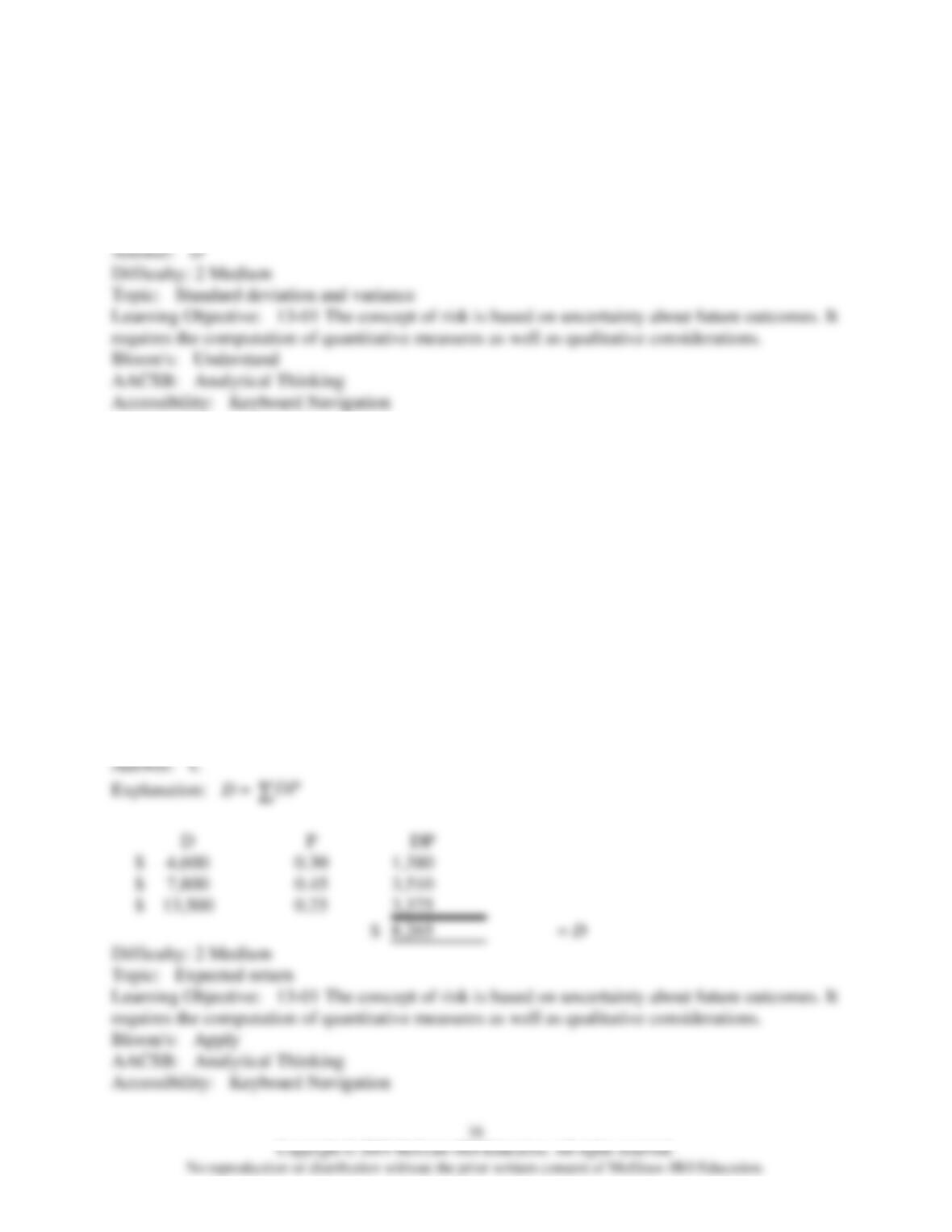
49) Firm X is considering a project and its analysts have projected the following outcomes and
their probabilities.
Outcome
Probability of
Outcome
Assumptions
$
4,600
30%
pessimistic
$
7,800
45%
moderately successful
$
13,500
25%
optimistic
What is the expected value of the outcomes?
A) $3,375
B) $8,633
C) $8,265
D) Cannot be determined. Depends upon which prediction is correct.
1,380
3,510
3,375
$
8,265

50) A project has the following projected outcomes in dollars: $250, $350, and $500. The
probabilities of their outcomes are 25%, 50%, and 25%, respectively. What is the expected value
of these outcomes?
A) $362.5
B) $89.4
C) $94.5
D) $178.3
51) The standard deviation can be defined as
A)
B)
C)
D)