93) Which statement(s) are true about depreciation?
A) Depreciation is a non-cash expense that provides tax shield benefits.
B) The greater the depreciation expenses in earlier years, the higher the present value of the
project.
C) For tax purposes, the MACRS depreciation schedules supersede the old methods of sum-of-
the-years’ digits, double declining balance, and so on.
D) All of these are true.
94) Which statement(s) are true about the tax law changes in 2017?
A) Congress wanted businesses to invest more in long-lived assets.
B) Companies are temporarily allowed to take 100% bonus depreciation in the first year that an
asset is placed in service.
C) This bonus will be phased out beginning in 2023 and expire by 2027.
D) All of these are true.
95) The Wet Corp. has an investment project that will reduce expenses by $25,000 per year for
three years. The project’s cost is $55,000. If the asset is part of the three-year MACRS category
(33% first year depreciation) and the company’s combined tax rate is 25%, what is the cash flow
from the project in year 1?
A) $4,521
B) $15,100
C) $23,287
D) $16,667
96) An asset fitting into the 7-year MACRS category was purchased two years ago for $72,000.
The book value of this asset is now ________.
A) $44,064
B) $31,200
C) $48,317
D) $51,429
97) For MACRS depreciation, automobiles and light trucks fit into the
A) 3-year MACRS category.
B) 5-year MACRS category.
C) 7-year MACRS category.
D) 10-year MACRS category.
98) With the exception of real estate investments, MACRS depreciation is beneficial to
corporations because it
A) increases total depreciation.
B) lengthens the lives of assets for depreciation purposes.
C) shortens the lives of assets for depreciation purposes.
D) classifies assets into specific, well-understood groups for depreciation purposes.
99) A firm purchases an asset falling into the 3-year MACRS category for $48,000. The second
year’s depreciation expense for this asset would be ________.
A) $34,710
B) $21,360
C) $16,000
D) The answer cannot be determined without knowing second-year earnings before depreciation
and taxes.
100) Which of the following does MACRS depreciation provide to corporations?
A) Increases total depreciation.
B) Lengthens the lives of assets for depreciation purposes.
C) Shortens the lives of assets for depreciation purposes.
D) Full-year versus half-year convention.
101) Elective expensing has the following characteristic:
A) It is primarily beneficial to large businesses.
B) It is exclusively used for financial reporting.
C) It allows a more rapid write-off than MACRS depreciation.
D) It is primarily beneficial to large businesses and it allows a more rapid write-off than MACRS
depreciation.
102) At higher tax rates, depreciation is
A) more beneficial.
B) less beneficial.
C) unaffected.
D) None of these options are correct.
103) If the capital budgeting decision includes a replacement analysis, then
A) a gain from the sale of the old asset will represent a tax savings inflow.
B) only incremental cash flows should be considered.
C) the sale price and tax savings will increase the cash inflows throughout the asset’s life.
D) net present value can no longer be measured in replacement analysis.
104) An equipment replacement decision, under incremental analysis, requires
A) calculating the present value of all cash flows associated with the new equipment minus the
salvage value of the old asset.
B) calculating the present value of all changes in cash flows from the old equipment to the new
equipment.
C) subtracting the purchase price of the old equipment from the purchase price of the new
equipment.
D) Two of the options are correct.
105) In a replacement decision, if an old asset sells below its book value
A) a gain has incurred.
B) a loss has incurred.
C) there is no gain or loss since it is replaced.
D) the net present value is negative.
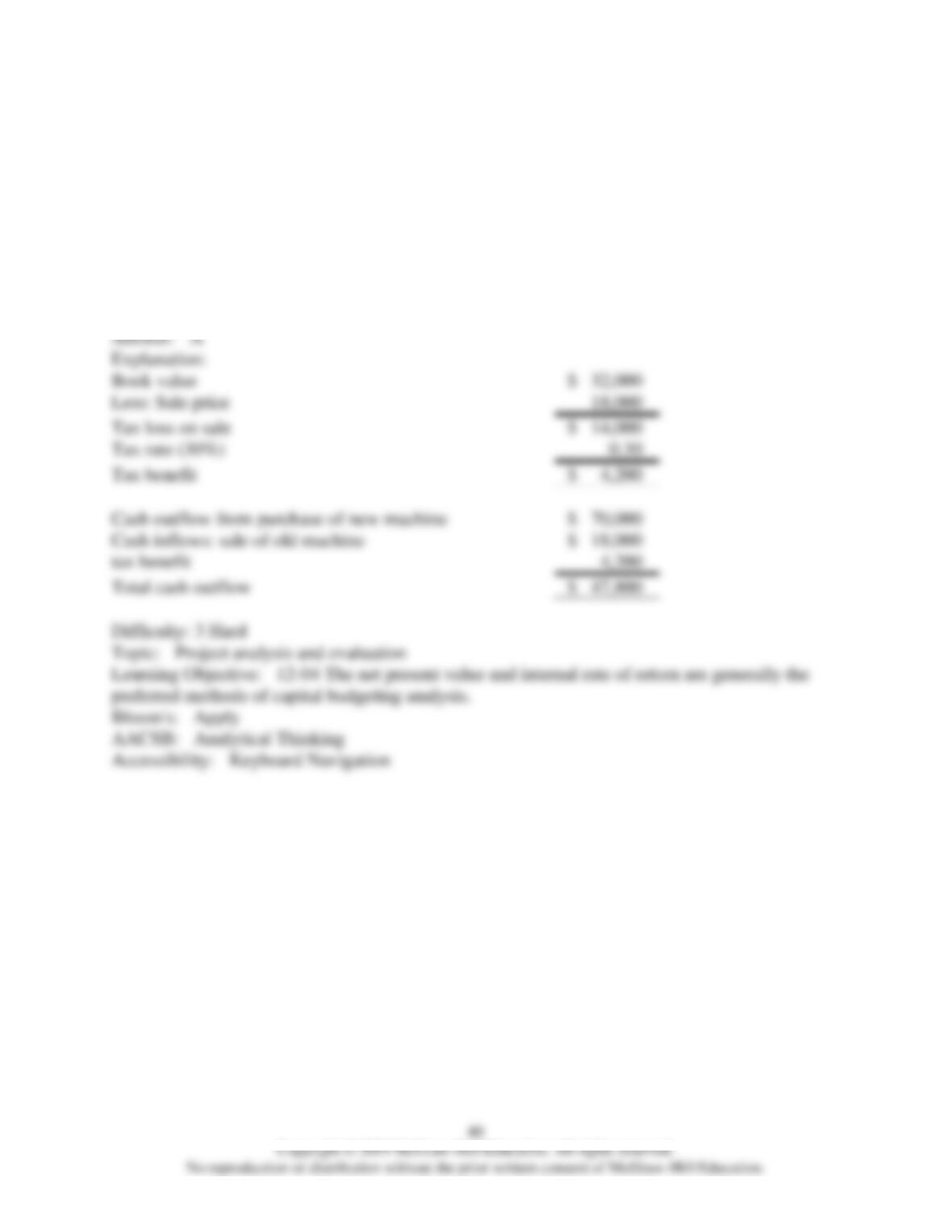
106) Firm X is considering the replacement of an old machine with one that has a purchase price
of $70,000. The current market value of the old machine is $18,000 but the book value is
$32,000. The firm’s combined tax rate is 30%. What is the net cash outflow for the new machine
after considering the sale of the old machine? Disregard the effect of depreciation of the new
machine if acquired.
A) $47,800
B) $70,000
C) $52,000
D) $40,100
107) A firm is selling an old asset below book value in a replacement decision. As the firm’s tax
rate is raised, the net cash outflow (purchase price less proceeds from the sale of the old asset)
would
A) go up.
B) go down.
C) remain the same.
D) More information is required to determine an answer.
108) Project X has a cost of $100,000 and provides the following annual earnings: year 1
$35,000; year 2 $25,000; year 3 $175,000; and year 4 $10,000. Under the payback method, in
which year is the investment recouped?
A) Year 2
B) Year 3
C) Year 4
D) Not enough information is given to determine an answer.
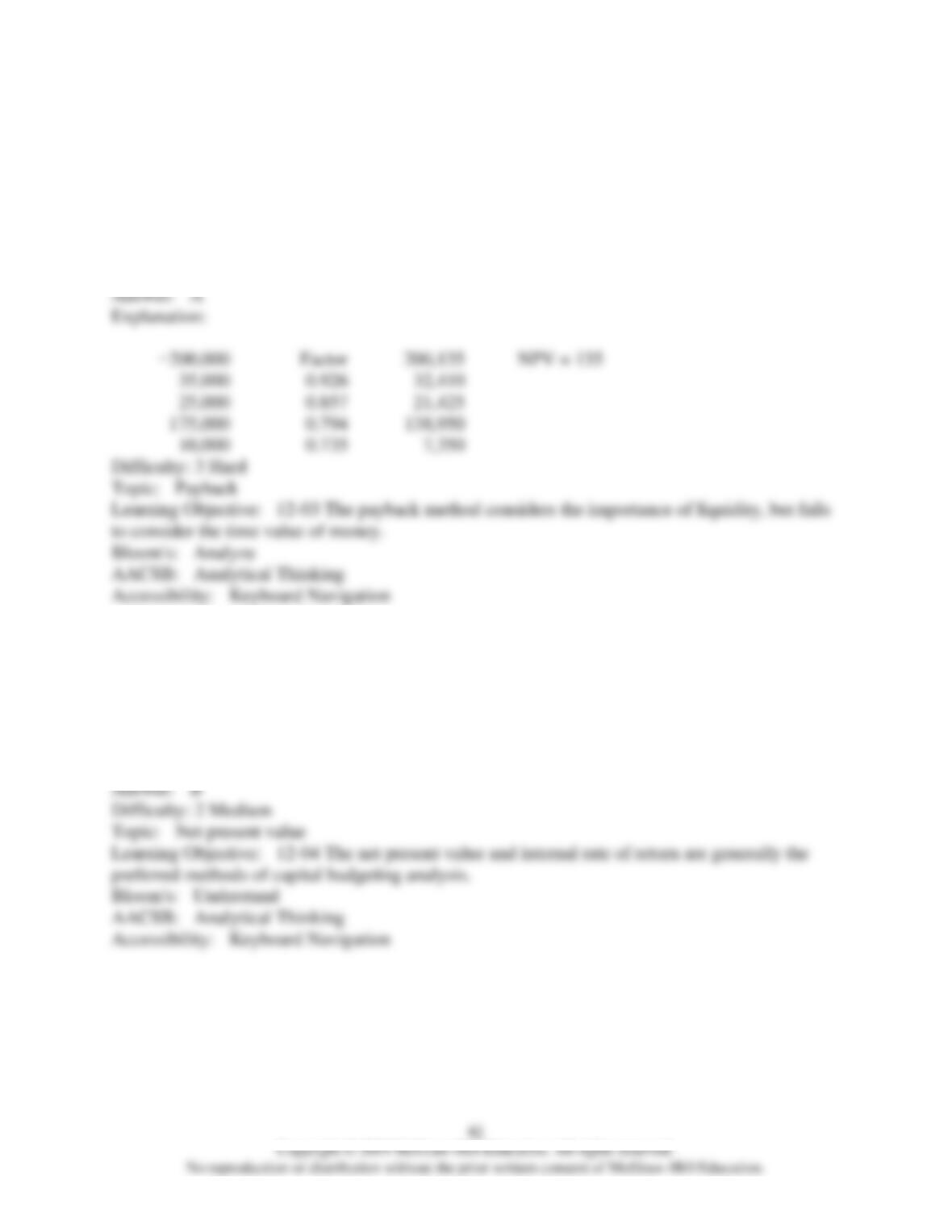
109) Project XYZ has a cost of $200,000 and provides the following annual cash inflows: year 1
$35,000; year 2 $25,000; year 3 $175,000; and year 4 $10,000. What is the net present value of
this investment, assuming the discount rate is 8%?
A) $135
B) $4,687
C) $101,050
D) $200,135
110) All of the following is information required to create a net present value profile except for
which one?
A) NPV at a 0 discount rate
B) NPV at the risk-free rate
C) NPV at the cost of capital
D) IRR of investment
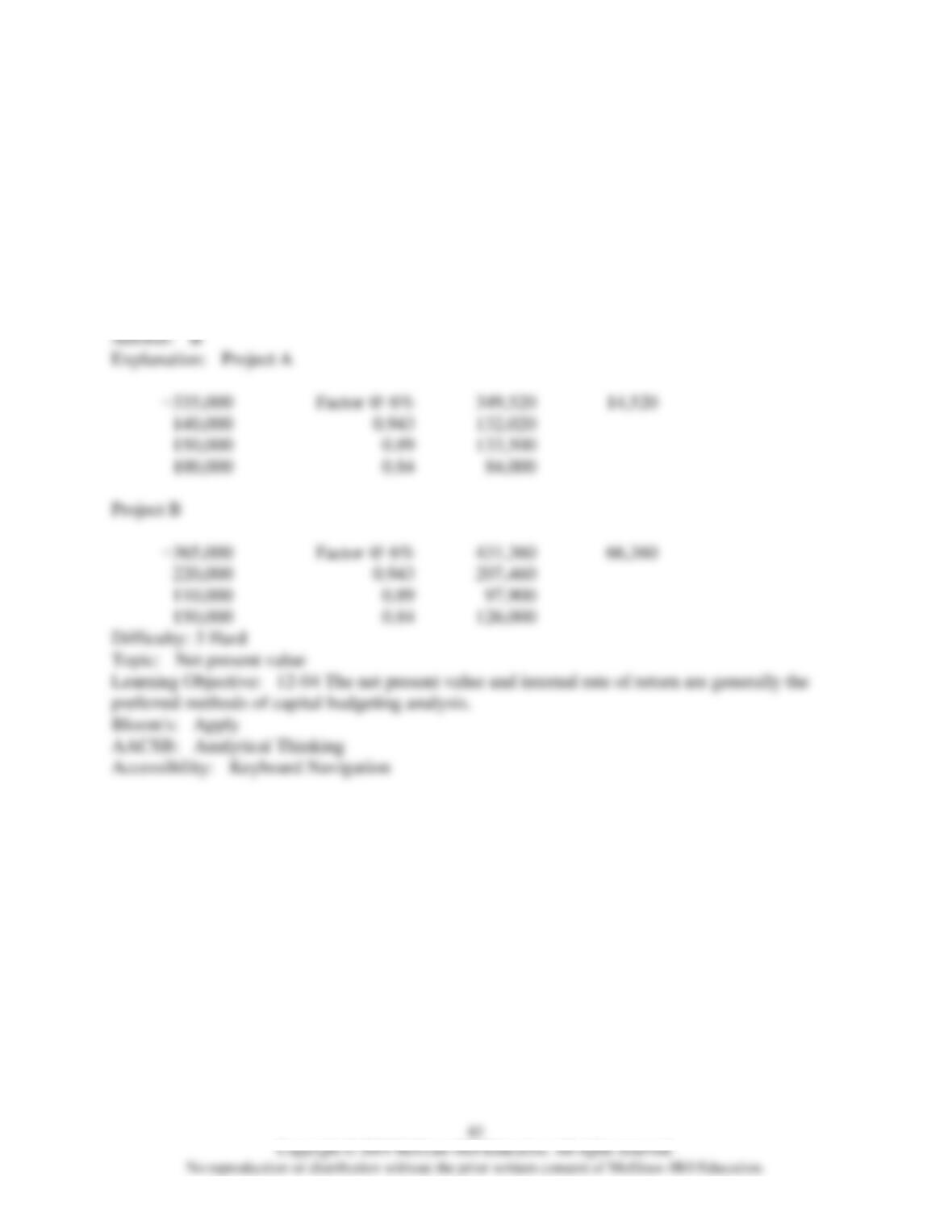
111) A firm utilizes a strategy of capital rationing, which is currently $375,000 and is
considering the following two projects: Project A has a cost of $335,000 and the following cash
flows: year 1 $140,000; year 2 $150,000; and year 3 $100,000. Project B has a cost of $365,000
and the following cash flows: year 1 $220,000; year 2 $110,000; and year 3 $150,000. Using a
6% cost of capital, which decision should the financial manager make?
A) Select project A.
B) Select project B.
C) Do not select either project.
D) Select both projects.
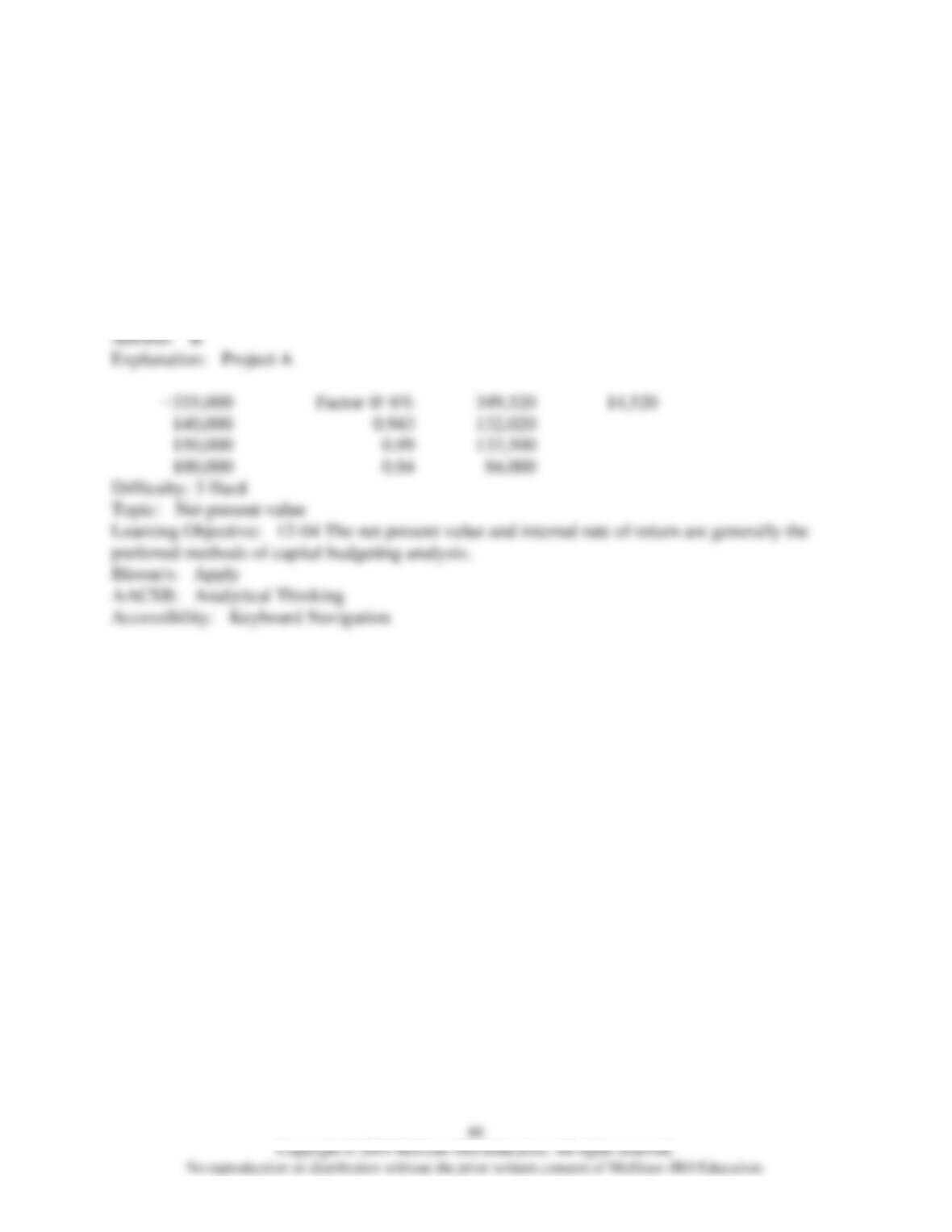
112) A firm utilizes a strategy of capital rationing, which is currently $375,000 and is
considering the following two projects: Project A has a cost of $335,000 and the following cash
flows: year 1 $140,000; year 2 $150,000; and year 3 $100,000. Project B has a cost of $365,000
and the following cash flows: year 1 $220,000; year 2 $110,000; and year 3 $150,000. Using a
6% cost of capital, what is the net present value of project A?
A) $25,930
B) $14,520
C) $11,589
D) $19,230
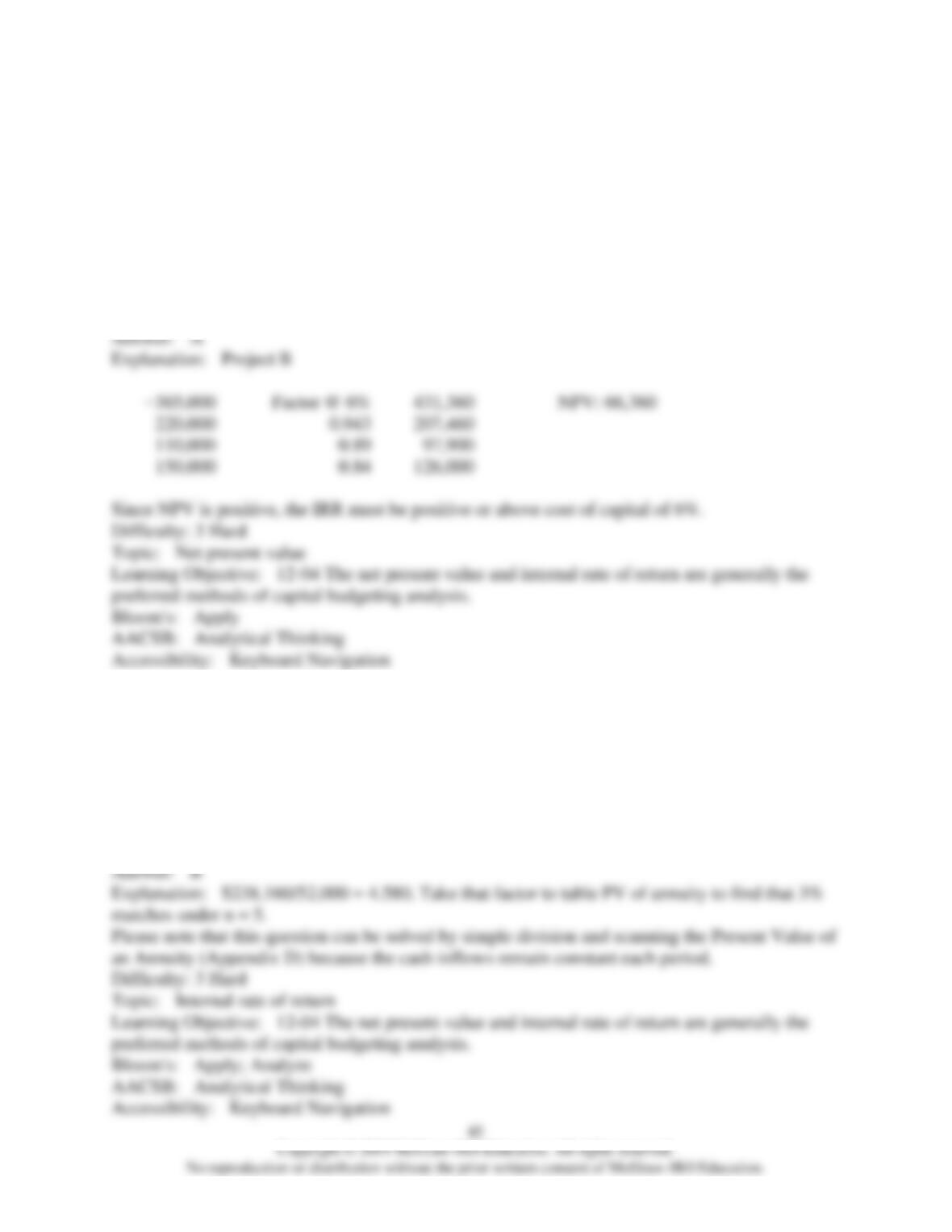
113) A firm utilizes a strategy of capital rationing, which is currently $375,000 and is
considering the following two projects: Project A has a cost of $335,000 and the following cash
flows: year 1 $140,000; year 2 $150,000; and year 3 $100,000. Project B has a cost of $365,000
and the following cash flows: year 1 $220,000; year 2 $110,000; and year 3 $150,000. Using a
6% cost of capital, what is the internal rate of return of project B?
A) Higher than 6%
B) Lower than 6%
C) Exactly 6%
D) Can not be determined from the given information
114) Technology Corp. is considering a $238,160 investment in a new marketing campaign that
it anticipates will provide annual cash flows of $52,000 for the next five years. The firm has a
6% cost of capital. What should the analysis indicate to the firm’s managers?
A) IRR is 8%. Accept the project.
B) IRR is 3%. Reject the project.
C) IRR is 4%. Reject the project.
D) IRR is 6%. Accept the project.