84) Within the capital asset pricing model
A) the risk-free rate is usually higher than the return in the market.
B) the higher the beta, the lower the required rate of return.
C) beta measures the volatility of an individual stock relative to a stock market index.
D) dividends are considered in the calculations.
85) Using the constant growth model, a firm’s expected dividend yield (D1) is 4% of the stock
price, and its growth rate is 5%. If the tax rate is 21%, what is the firm’s cost of equity?
A) 10%
B) 6.65%
C) 9.0%
D) 5.85%
86) Expected cash dividends are $3.00, the dividend yield is 4%, flotation costs are 4% of price,
and the growth rate is 3%. Compute the approximate cost of new common stock.
A) 7.00%
B) 7.2%
C) 6.9%
D) 4.2%
87) A firm’s stock is selling for $65. The dividend yield is 6%. A 7% growth rate is expected for
the common stock. The firm’s tax rate is 21%. What is the firm’s cost of retained earnings?
A) 8.16%
B) 13.00%
C) 12.35%
D) 7.8%.
88) A firm’s stock is selling for $62. The next annual dividend is expected to be $3.00. The
growth rate is 9%. The flotation cost is $5.00. What is the cost of retained earnings?
A) 13.84%
B) 12.46%
C) 12.7%
D) None of these options are correct
89) For many firms, the cheapest and most important source of equity capital is in the form of
A) debt.
B) common stock.
C) preferred stock.
D) retained earnings.
90) Retained earnings has a cost associated with it because
A) new funds must be raised.
B) there is an opportunity cost associated with stockholder funds.
C) Ke > g.
D) flotation costs increase the cost of funding.
91) There may be a change in the marginal cost of capital curve when
A) the tax rate charged to investors changes.
B) the firm has exhausted its supply of retained earnings.
C) the firm is limited in the amount of depreciation it can take.
D) the tax rate charged to investors changes and the firm has exhausted its supply of retained
earnings.
92) The after-tax cost of debt will almost always be below
A) the before-tax cost of debt.
B) the weighted average cost of capital.
C) the cost of equity.
D) all of these options are true.
93) The optimal capital structure for firms in cyclical industries should contain ________ than
firms in stable industries.
A) more debt
B) less debt
C) an equal amount of debt
D) None of these options are valid. There is no relationship between the cyclical nature of an
industry and optimal capital structure.
94) The component parts of the cost of capital should be weighted by their proportion in the
firm’s
A) current capital structure.
B) historical capital structure.
C) optimum capital structure.
D) expected capital structure.
95) Which of the following is NOT true about debt financing and the weighted average cost of
capital?
A) Debt is usually the cheapest source of financing.
B) As the level of debt increases beyond the optimum capital structure, the cost of capital
increases.
C) No debt in the firm’s capital structure will minimize the firm’s weighted average cost of
capital.
D) None of these options are false.
96) A firm in a stable industry should use
A) a large amount of debt to lower the cost of capital.
B) no debt at all.
C) preferred stock in place of debt.
D) a limited amount of debt to lower the cost of capital.
97) Although debt financing is usually the cheapest component of capital, it cannot be used in
excess because
A) interest rates may change.
B) the firm’s stock price will increase and raise the cost of equity financing.
C) the financial risk of the firm may increase and thus drive up the cost of all sources of
financing.
D) underwriting costs may change.
98) A firm in a cyclical industry should use
A) a large amount of debt to lower the cost of capital.
B) no debt at all.
C) preferred stock in place of debt.
D) a limited amount of debt to lower the cost of capital.
99) Most firms are able to use ________% debt in their capital structure without exceeding
norms acceptable to creditors and investors.
A) 30-50
B) 40-60
C) 50-70
D) 60-80
100) Marginal cost of capital
A) recognizes that cost of capital does not stay constant as more funds are raised.
B) usually provides the same capital budgeting choices as the use of weighted average cost of
capital.
C) can be defined as the cost of capital when no retained earnings are available for expansion.
D) None of these options apply.
101) The weighted average cost of capital is used as a discount rate because
A) it is an indication of how much the firm is earning overall.
B) as long as the cost of capital is earned, the common stock value of the firm will be
maintained.
C) it is comparable to the prevailing market interest rates.
D) returns below the cost of capital will cover all fixed costs associated with capital and provide
an excess return to stockholders.
102) Use of the marginal cost of capital
A) acknowledges that when retained earnings are used up as a source of equity, the cost of
capital rises as new common stock is sold to support more growth.
B) recognizes that the return from the last dollar of funds generated should be greater than or
equal to the cost of the last dollar of funds raised.
C) acknowledges that when retained earnings are used up as a source of equity, the cost of
capital rises as new common stock is sold to support more growth and recognizes that the return
from the last dollar of funds generated should be greater than or equal to the cost of the last
dollar of funds raised.
D) None of these options are correct.
103) The general rule for using the weighted average cost of capital (WACC) in capital
budgeting decisions is to accept all projects with
A) rates of return greater than or equal to the WACC.
B) rates of return less than the WACC.
C) rates of return equal to or less than the WACC.
D) positive rates of return.
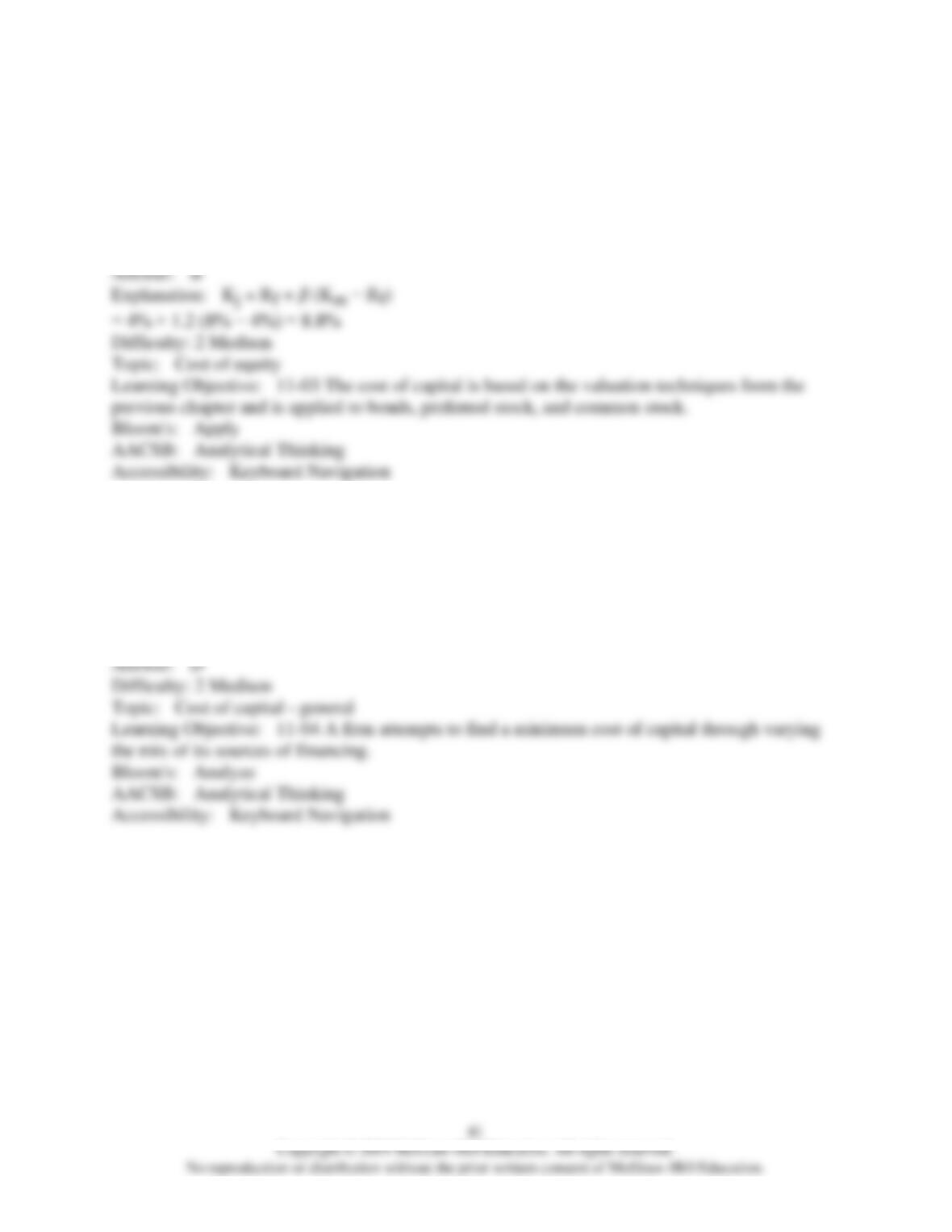
104) Oak Enterprises has a beta of 1.2, the market return is 8%, and the T-bill rate is 4%. Its tax
rate is 21%. What is its expected required return of common equity?
A) Between 11% and 12%
B) Between 8% and 9%
C) Between 7% and 8%
D) Between 5% and 6%
105) All of the following are important considerations for minimizing the cost of capital
EXCEPT:
A) future inflation rates
B) industry debt ratios
C) future economic conditions
D) current coupon rates of outstanding debt