59) For a firm paying 5% for new debt, the higher the firm’s tax rate
A) the higher the after-tax cost of debt.
B) the lower the after-tax cost of debt.
C) the after-tax cost is unchanged.
D) Not enough information to judge.
60) If a firm’s bonds are currently yielding 6% in the marketplace, why would the firm’s cost of
debt be lower?
A) Interest rates have changed.
B) Additional debt can be issued more cheaply than the original debt.
C) There should be no difference; the cost of debt is the same as the bond’s market yield.
D) Interest is tax-deductible, so tax savings are considered.
61) The cost of a firm’s debt is determined by taking the
A) present value of the interest payments and principal times one minus the tax rate.
B) coupon rate on bonds times one minus the tax rate.
C) yield on bonds issued minus the corporation’s marginal tax rate.
D) None of these options are true.
62) The coupon rate on a debt issue is 6%. If the yield to maturity on the debt is 9%, what is the
after-tax cost of debt in the weighted average cost of capital if the firm’s tax rate is 21%?
A) 3.96%
B) 4.08%
C) 7.11%
D) 7.92%
63) The coupon rate on an issue of debt is 8%. The yield to maturity on this issue is 10%. The
corporate tax rate is 21%. What would be the approximate after-tax cost of debt for a new issue
of bonds?
A) 5.28%
B) 2.48%
C) 7.9%
D) 3.14%
64) A firm’s cost of financing, in an overall sense, is equal to its
A) weighted average cost of capital.
B) required yield that investors seek for various kinds of securities.
C) required rate of return that investors seek for various kinds of securities.
D) all of these options are true.
65) A firm has $50 million in assets and its optimal capital structure is 60% equity. If the firm
has $12 million in retained earnings available to invest, at what asset level will the firm need to
issue additional stock? (Assume no growth in retained earnings.)
A) The firm should have already issued additional stock.
B) The firm can increase assets by $30 million.
C) The firm can increase assets by $20 million.
D) There is insufficient information to determine an answer.
66) Tobin’s Barbeque has a bank loan at 8% interest and an after-tax cost of debt of 6%. What
will the after-tax cost of debt be if a new loan is taken out yielding 11%.
A) 7.52%
B) 8.25%
C) 13.33%
D) None of these options are true.
67) The pre-tax cost of debt for a new issue of debt is determined by
A) the investor’s required rate of return on issued stock.
B) the coupon rate of existing debt.
C) the yield to maturity of outstanding or comparable bonds.
D) All of these options are true.
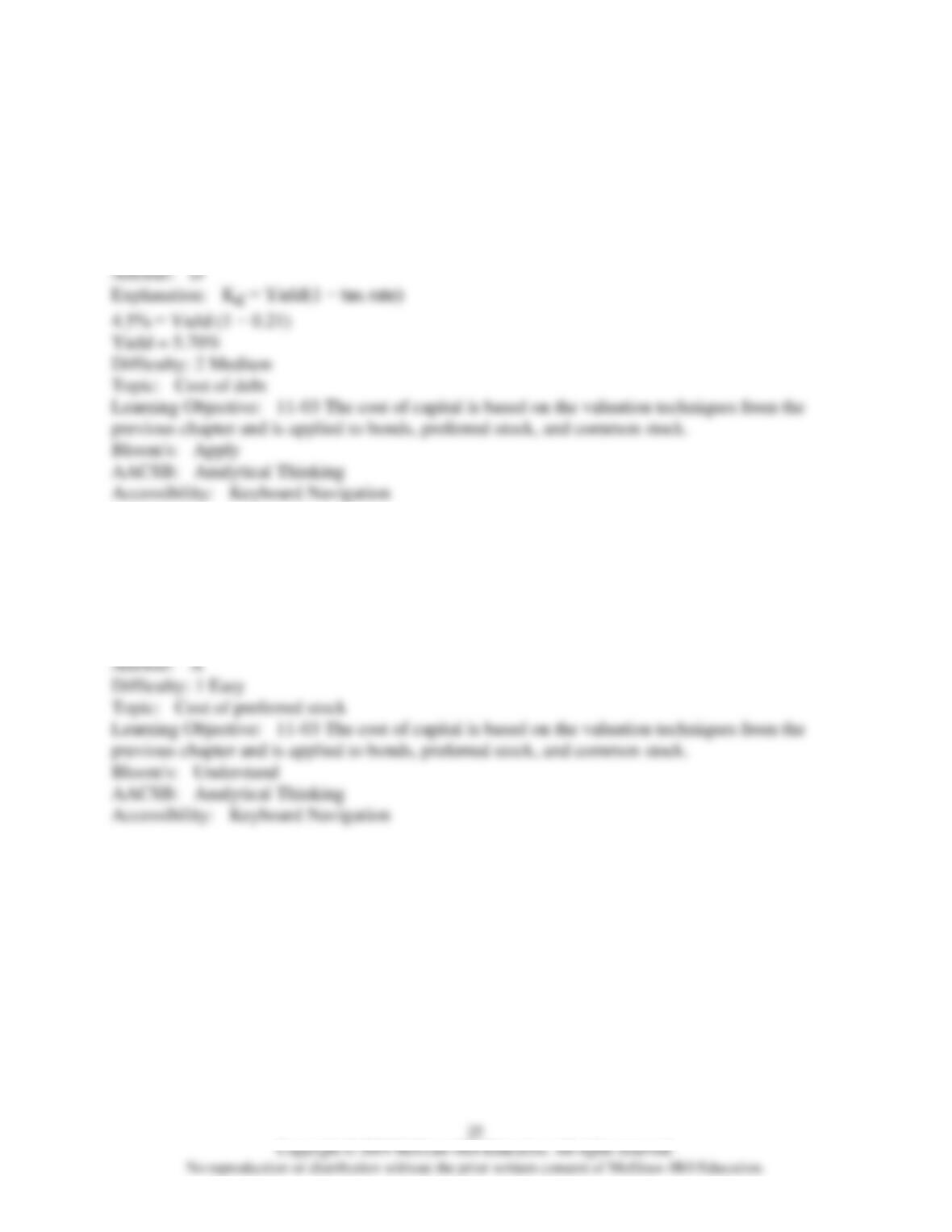
68) Lewis, Schultz, and Nobel Development Corp. has an after-tax cost of debt of 4.5%. With a
tax rate of 21%, what is the yield on the debt?
A) 4.5%
B) 9.0%
C) 1.89%
D) 5.70%
69) The after-tax cost of preferred stock to the issuing corporation
A) is the same as the before-tax cost.
B) is usually lower than the cost of debt.
C) is dependent on the firm’s tax bracket.
D) None of these options are true.
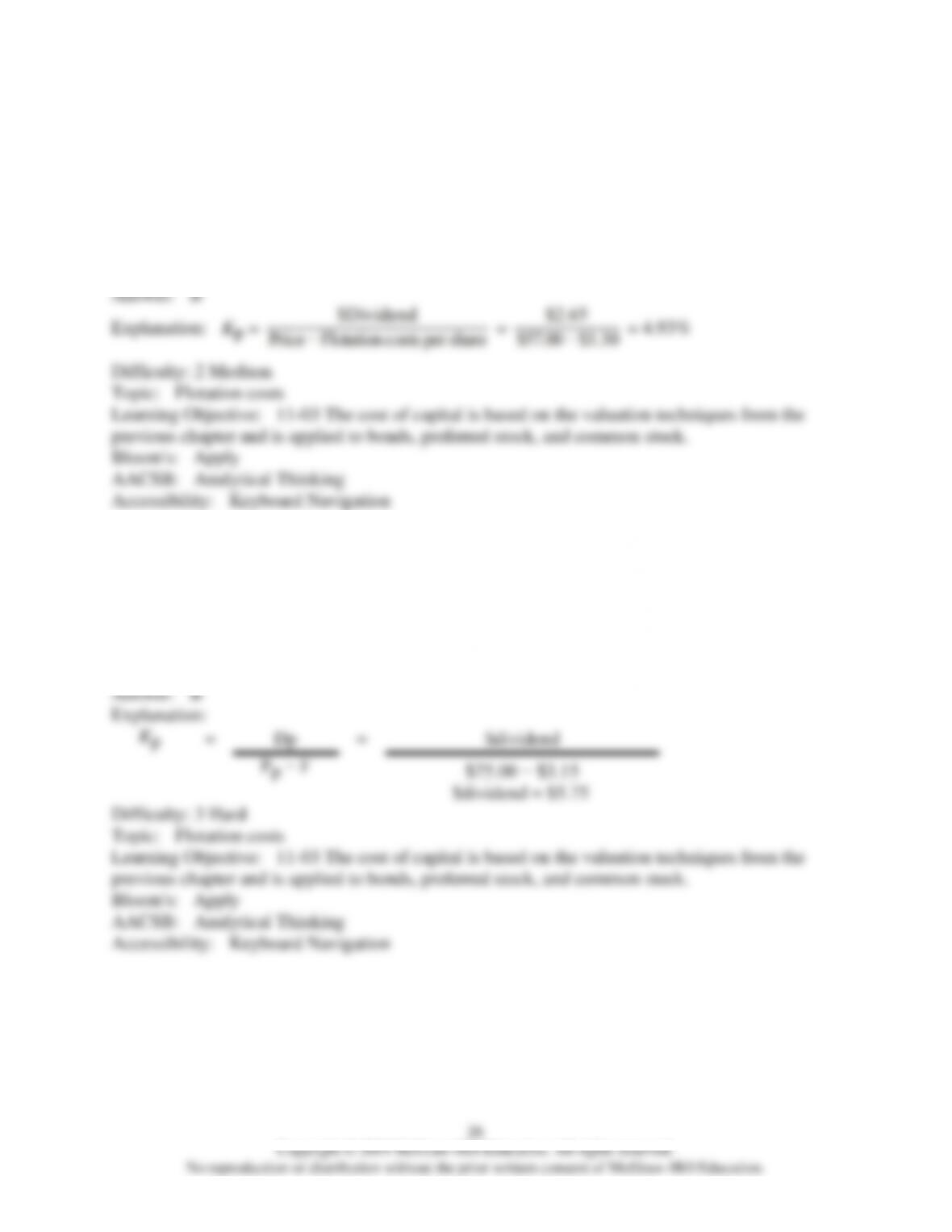
70) A firm is paying an annual dividend of $2.65 for its preferred stock that is selling for $57.00.
There is a selling cost of $3.30. What is the after-tax cost of preferred stock if the firm’s tax rate
is 21%?
A) 3.30%
B) 4.93%
C) 5.79%
D) 6.11%
71) Firm X has a tax rate of 21%. The price of its new preferred stock is $75 and its flotation cost
is $3.15. The cost of new preferred stock is 8%. What is the firm’s dividend?
A) $7.18
B) $5.75
C) $7.56
D) $4.03
72) The cost of equity capital in the form of new common stock will be higher than the cost of
retained earnings because of
A) the existence of taxes.
B) the existence of flotation costs.
C) investors’ unwillingness to purchase additional shares of common stock.
D) the existence of financial leverage.
73) If the flotation cost goes up, the cost of retained earnings will
A) go up.
B) go down.
C) stay the same.
D) slowly increase.
74) Flotation cost is the
A) cost of holding stock on hand.
B) cost of issuing new debt.
C) cost of issuing new stock.
D) sales price of common stock.
75) Why is the cost of debt normally lower than the cost of preferred stock?
A) Preferred stock dividends are tax deductions.
B) Interest on debt is tax deductible.
C) Preferred stock dividends must be paid before common stock dividends.
D) Common stock dividends are not tax-deductible.
76) If flotation costs go down, the cost of new preferred stock will
A) go up.
B) go down.
C) stay the same.
D) slowly increase.
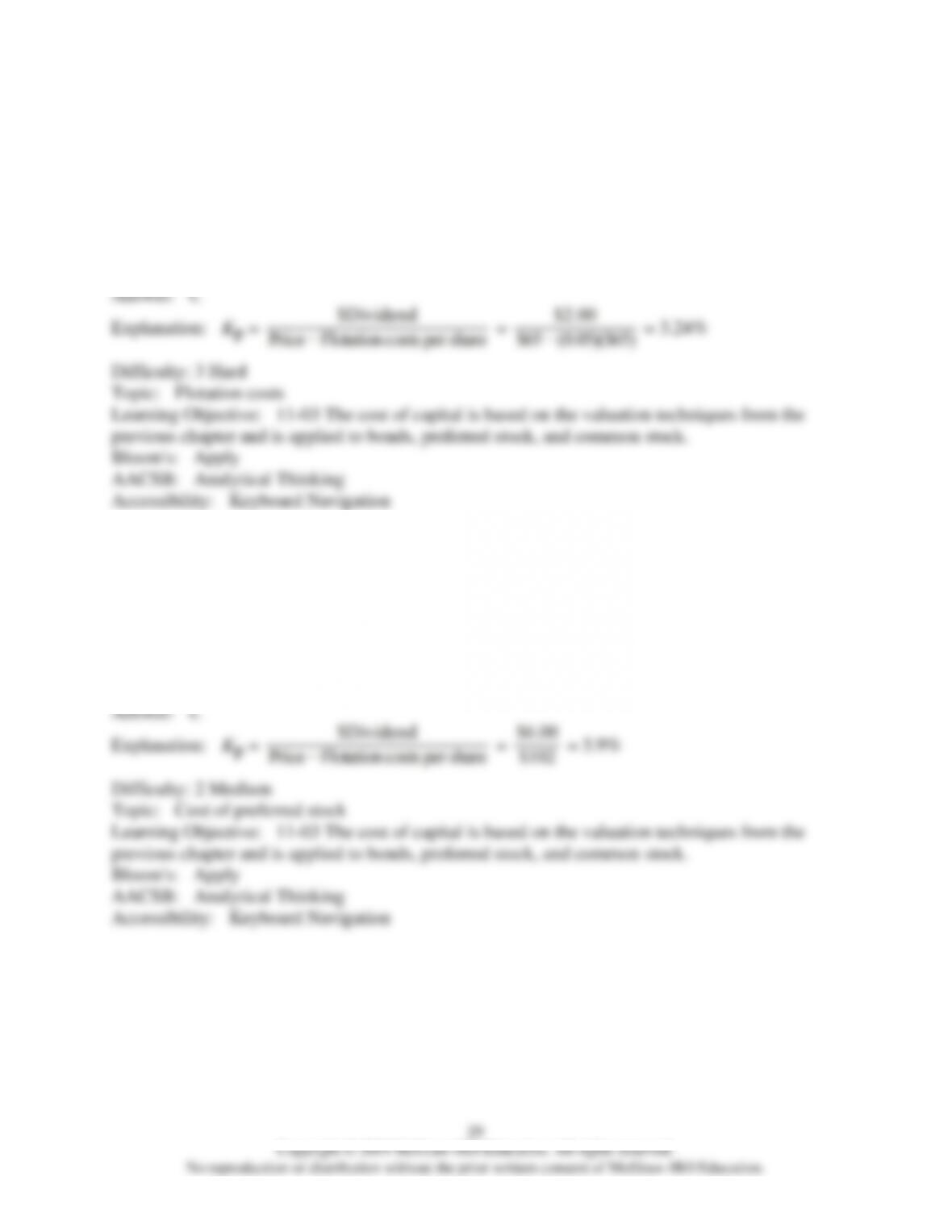
77) A firm’s preferred stock pays an annual dividend of $2, and the stock sells for $65. Flotation
costs for new issuances of preferred stock are 5% of the stock value. What is the after-tax cost of
preferred stock if the firm’s tax rate is 21%?
A) 1.2%
B) 1.58%
C) 3.24%
D) 5.26%
78) Ten years ago, Stigler Company issued $100 par value preferred stock yielding 6%. The
preferred stock is now selling for $102 per share. What is the approximate current yield or cost
of the preferred stock? (Disregard flotation costs.)
A) 7.76%
B) 8%
C) 5.9%
D) There is not enough information to answer the question.
79) A firm’s debt-to-equity ratio varies at times because
A) a firm will want to sell common stock when prices are high and bonds when interest rates are
low.
B) a firm will want to take advantage of timing its fund-raising in order to minimize costs over
the long run.
C) the market allows some leeway in the debt-to-equity ratio before penalizing the firm with a
higher cost of capital.
D) All of these are accurate statements.
80) Using the constant dividend growth model for common stock, if the market price of stock
(P0) goes up,
A) the assumed cost goes up.
B) the assumed cost goes down.
C) the assumed cost remains unchanged.
D) Further information is needed to answer the question.
81) New common stock is more expensive than required rate of return (Ke) because new
common stock has to
A) compensate for risk.
B) compensate for more dividends.
C) compensate for expansionary problems.
D) cover distribution costs.
82) In computing the cost of common equity, if the dividend (D1) goes downward and market
price (P0) goes up, required rate of return (Ke) will
A) go up.
B) go down.
C) stay the same.
D) slowly increase.
83) In determining the cost of retained earnings
A) the dividend valuation model is inappropriate.
B) flotation costs are included.
C) growth is not considered.
D) the capital asset pricing model can be used.