Foundations of Financial Management, 17e (Block)
Chapter 11 Cost of Capital
1) It is standard practice to evaluate investment decisions using the cost of the specific financing
method involved.
2) The calculation of the cost of capital depends upon the historical cost of funds.
3) The cost of capital for each source of funds is dependent on current market conditions and
expected rates of return.
4) The cost of capital refers to the cost that a company takes on to purchase a big project.
5) In determining the cost of debt, a firm could use its yields and prices of outstanding bonds.
6) The cost of debt is equal to the current bond yield on bonds of similar risk class, adjusted for
the corporate tax rate.
7) The cost of debt needs to consider tax, while the cost of stock does not need to consider tax.
8) The amount of debt capital used by a corporation is not related to the availability of equity
funds from retained earnings and new common stock.
9) A firm’s cost of preferred stock is equal to the preferred dividend divided by the net price after
flotation costs.
10) Beginning in 2022, a company can only deduct interest of up to 30% of its earnings before
interest and taxes (EBIT).
11) Earnings before interest, taxes, depreciation and amortization is lower than EBIT as long as
the company has depreciation or amortization expenses.
12) For companies with very high interest expense, or very low EBIT, the interest expense
limitation will reduce the tax advantage to issuing debt and the equation, K d (Cost of debt) = Y(1
− T ), would need to be adjusted to reflect the impact of the new tax law.
13) A firm’s cost of preferred stock is equal to the preferred dividend divided by market price
plus the dividend growth rate (Kp = D/P0 + g).
14) The cost of new common stock is greater than the cost of outstanding common stock.
15) In determining the cost of preferred stock, the earnings on outstanding preferred stock may
be used as a proxy.
16) The out-of-pocket cost of common stock is a good approximation of the cost of common
stock equity.
17) The discount rate that equates a future stream of expected dividends to the current price is a
good approximation of the cost of common stock.
18) Ke represents an expected return to stockholders as well as a cost to the firm.
19) The cost of retained earnings is considered to be equal to the required rate of return on a
firm’s outstanding common stock.
20) Retained earnings represent an internal source of funds that is raised without the payment of
interest or cost to the firm’s stockholders.
21) The only difference in the cost of retained earnings (Ke) and the cost of new common stock
(Kn) is the flotation cost on new common stock.
22) Regardless of the particular source of funds utilized for a project, the required rate of return,
or discount rate, will be the weighted average cost of capital.
23) The measurement of common stock equity in weighted average cost of capital uses the cost
of retained earnings (Ke), but not the cost of new common stock (Kn).
24) The use of the optimum capital structure minimizes the cost of capital.
25) All firms within particular industries have similar optimum capital structures.
26) A firm should always be at a single optimum debt-to-equity ratio to minimize its cost of
capital.
27) Weights used to calculate the weighted average cost of capital Ka are derived from the
optimum capital structure.
28) Taking on additional debt will reduce the cost of equity.
29) Firms in stable industries are advised to keep debt levels very low so that shareholders, rather
than creditors, receive the benefits of steady cash flows.
30) Most firms are able to use 60% to 70% debt in their capital structure without exceeding
norms acceptable to most creditors and investors.
31) Although the after-tax cost of debt is below the cost of equity, firms cannot increase their use
of debt to endless amounts.
32) According to traditional financial theory, the cost of capital curve is U-shaped over the range
of debt-equity mixes.
33) A firm that does not earn the cost of capital in the short run will probably be in bankruptcy.
34) A firm that does not earn the cost of capital in the long run will not maximize shareholder
wealth.
35) Companies prefer to maintain some financing flexibility in order to choose the lowest-cost
source of funds at a single point in time.
36) The use of the weighted average cost of capital assumes that the firm is in its optimum
capital structure range and the cost of each component stays constant over the range of financing.
37) The weighted average cost of capital calculates the average current cost of issued or new
issuance of debt and equity for a firm.
38) Larger bond issues can lower “liquidity risk,” or the possibility that an investor will not be
able to sell a bond quickly and easily.
39) Market values rather than book values should be used for determining the optimal capital
structure; however, in practice, book value is commonly used.
40) In determining the optimum capital structure, it is assumed that the firm will raise capital in
the same proportions every year.
41) The pretax cost of debt is generally less than the pretax cost of equity.
42) The capital asset pricing model (CAPM) relates the risk-return tradeoffs of individual assets
to market returns.
43) In the capital asset pricing model (CAPM), beta measures the volatility of the market.
44) Under the capital asset pricing model (CAPM), the required return for common stock (or
other investments) can be described by the following formula: Kj = Rf + b(Km − Rf), where Km
is equal to the return expected in the market as measured by an appropriate index.
45) Per the capital asset pricing model, the slope of the security market line (SML) must be 1.0.
46) The financial managers of the firm decide on its cost of capital for financing projects.
47) The cost of debt, preferred stock, and common equity must all be adjusted for tax
implications.
48) Although debt financing is generally cheaper than equity financing, financial managers
should not use debt financing significantly above the industry standard because it can increase
the firm’s overall cost of capital.
49) The cost of capital generally varies inversely with the size of the capital structure.
50) As the risk-free rate increases, the required rate of return for common stock decreases.
51) A firm with a higher beta than another firm will have a higher required rate of return.
52) The slope of the security market line (SML) will often increase when the economy is in a
boom period.
53) Each project should be judged against
A) the specific means of financing used to support its implementation.
B) the existing interest rate at that point in time.
C) the cost of new common stock equity.
D) None of these options are true.
54) Financial capital does not include
A) stocks.
B) bonds.
C) preferred stocks.
D) working capital.
55) The overall weighted average cost of capital is used instead of costs for individual sources of
funds because
A) the use of the cost for individual sources of capital would make investment decisions
inconsistent.
B) a project with the highest return would always be accepted under the specific cost criteria.
C) investments funded by low-cost debt would have an advantage over other investments.
D) the use of the cost for specific sources of capital would make investment decisions
inconsistent, and investments funded by low-cost debt would have an advantage over other
investments.
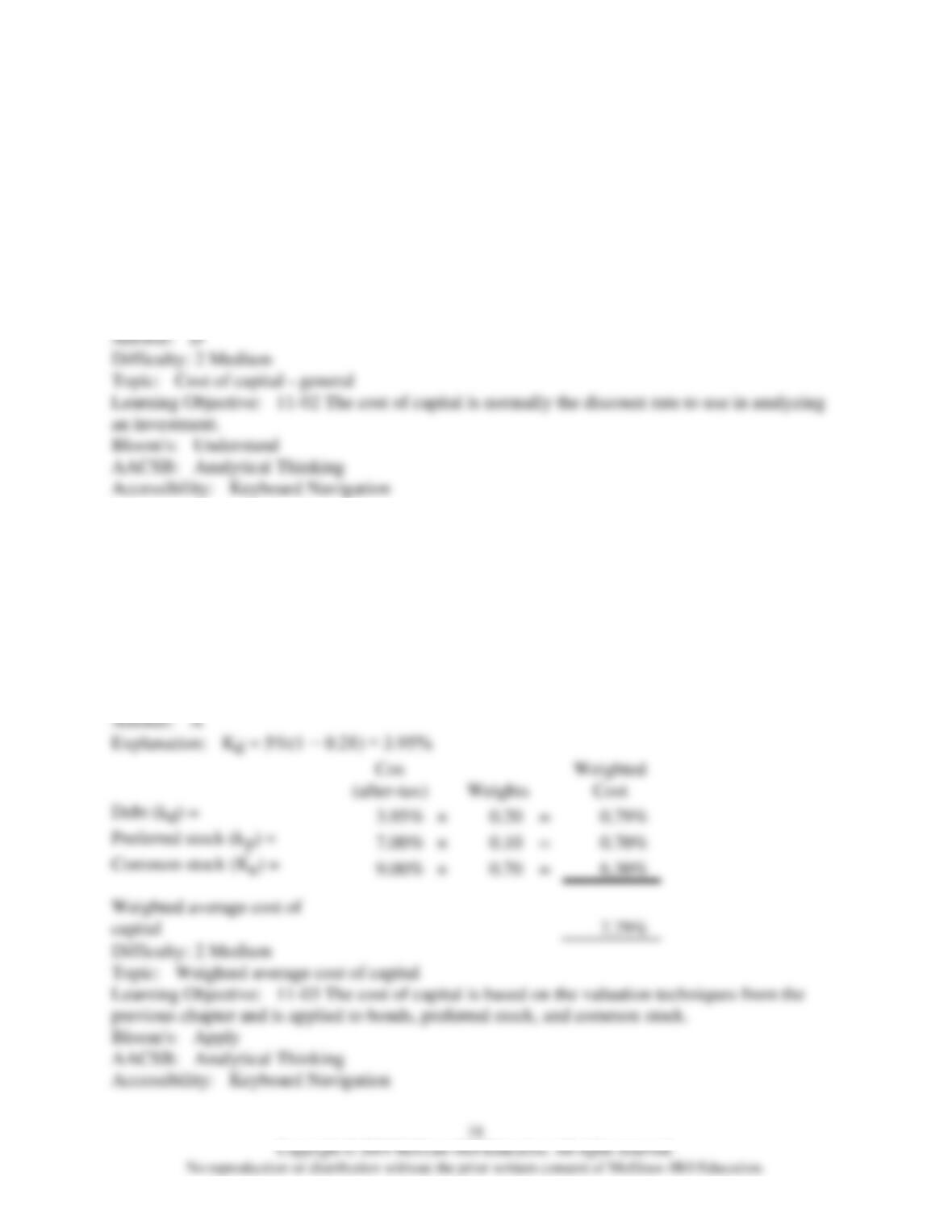
56) Debreu Beverages has an optimal capital structure that is 70% common equity, 20% debt,
and 10% preferred stock. Debreu’s pretax cost of equity is 9%. Its pretax cost of preferred equity
is 7%, and its pretax cost of debt is also 5%. If the corporate tax rate is 21%, what is the
weighted average cost of capital?
A) Between 7% and 8%
B) Between 8% and 9%
C) Between 9% and 10%
D) Between 10% and 12%
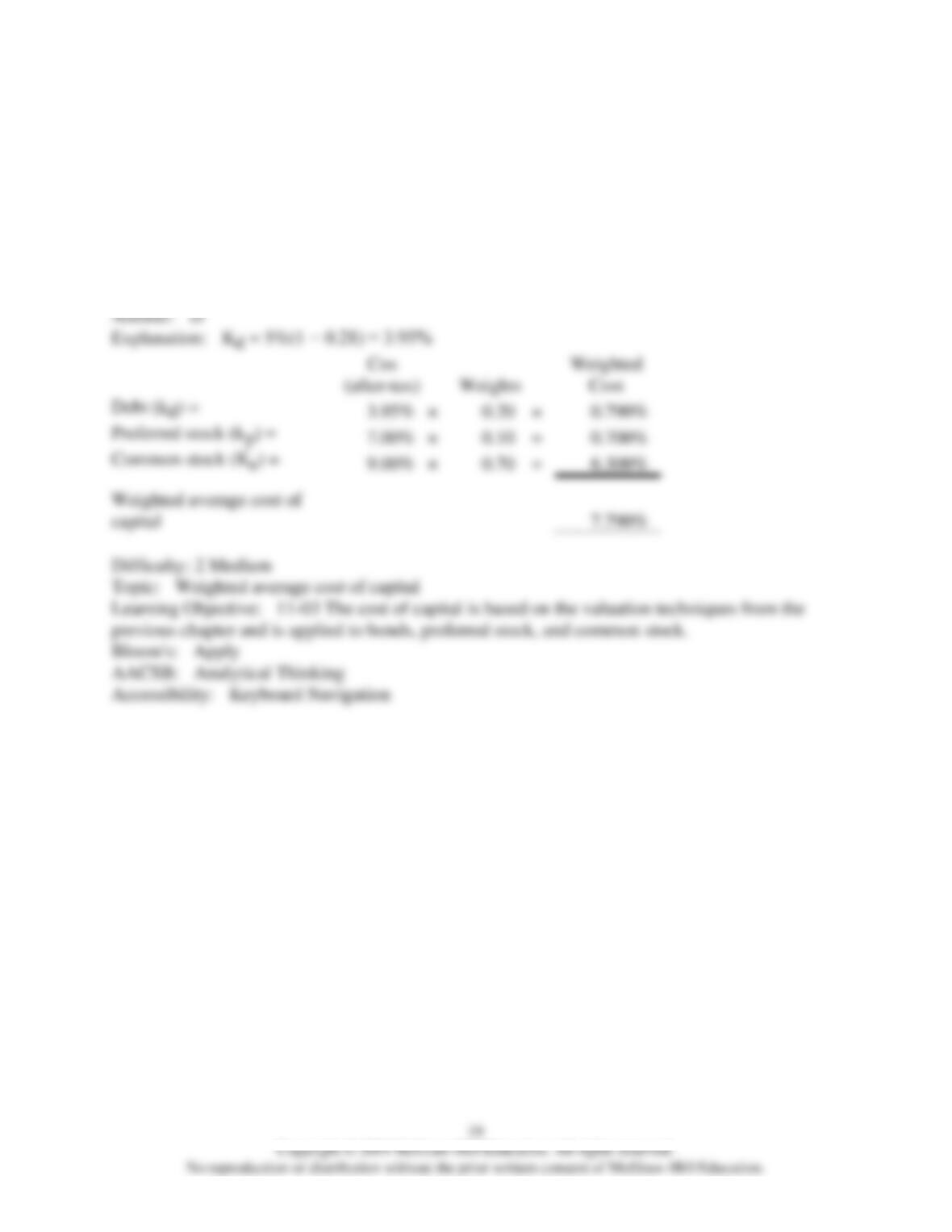
57) Debreu Beverages has an optimal capital structure that is 70% common equity, 10%
preferred stock, and 20% debt. Debreu’s pretax cost of equity is 9%. Its pretax cost of preferred
equity is 7%, and its pretax cost of debt is also 5%. If the corporate tax rate is 21%, what is the
weighted average cost of capital?
A) 8.74%
B) 8%
C) 5.2%
D) 7.79%
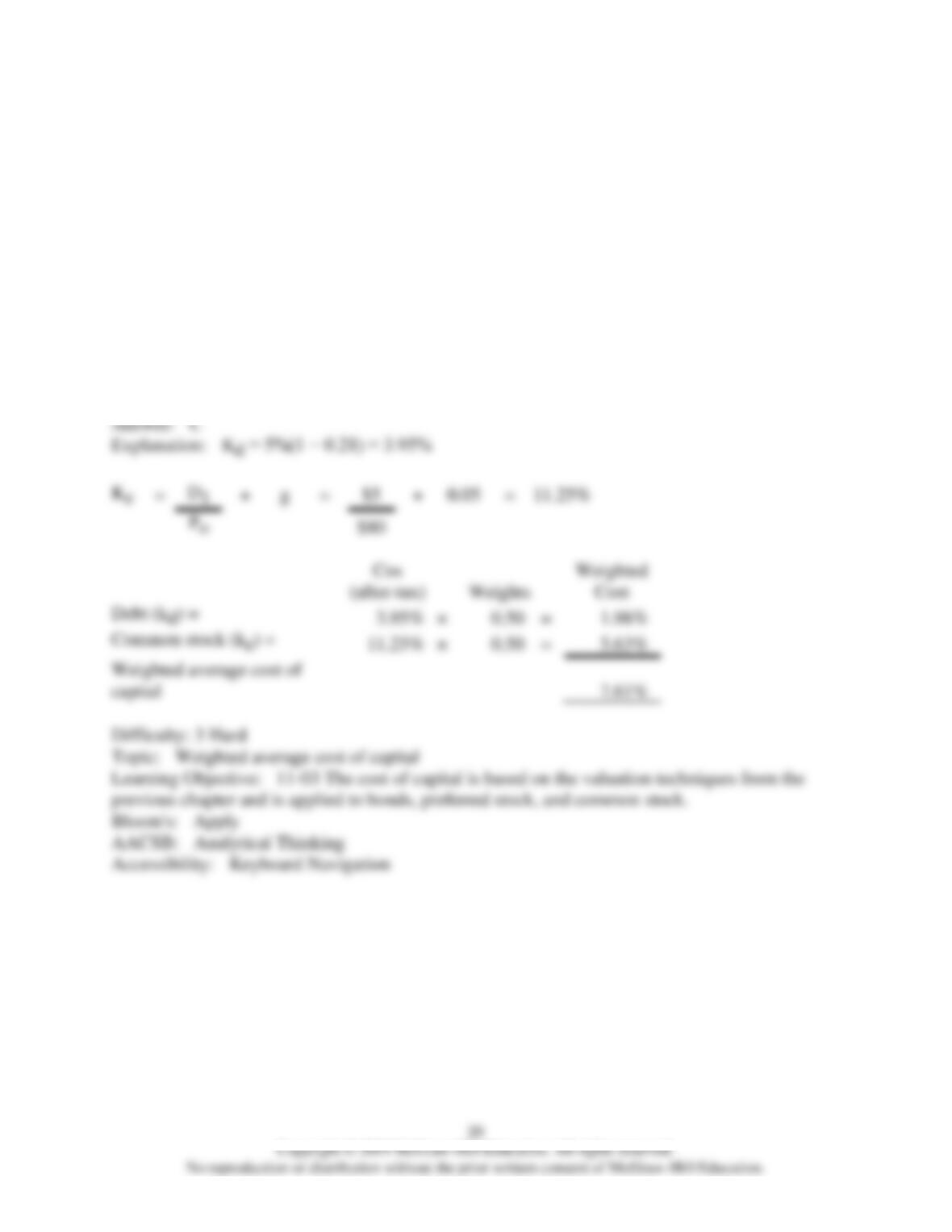
58) Given an optimal capital structure that is 50% debt and 50% common stock, calculate the
weighted average cost of capital for the company given the following additional information:
Bond coupon rate
8
%
Bond yield to maturity
5
%
Dividend, expected
$
5
Price, common
$
80
Growth rate
5
%
Corporate tax rate
21
%
A) Less than 6%.
B) More than 6% and less than 7%.
C) More than 7% and less than 8%.
D) More than 8%.
$80
Cos
(after-tax)
Weights
Weighted
Cost
Debt (kd) =
3.95
%
×
0.50
=
1.98
%
Common stock (ke) =
11.25
%
×
0.50
=
5.63
%
Weighted average cost of
capital
7.61
%