30.
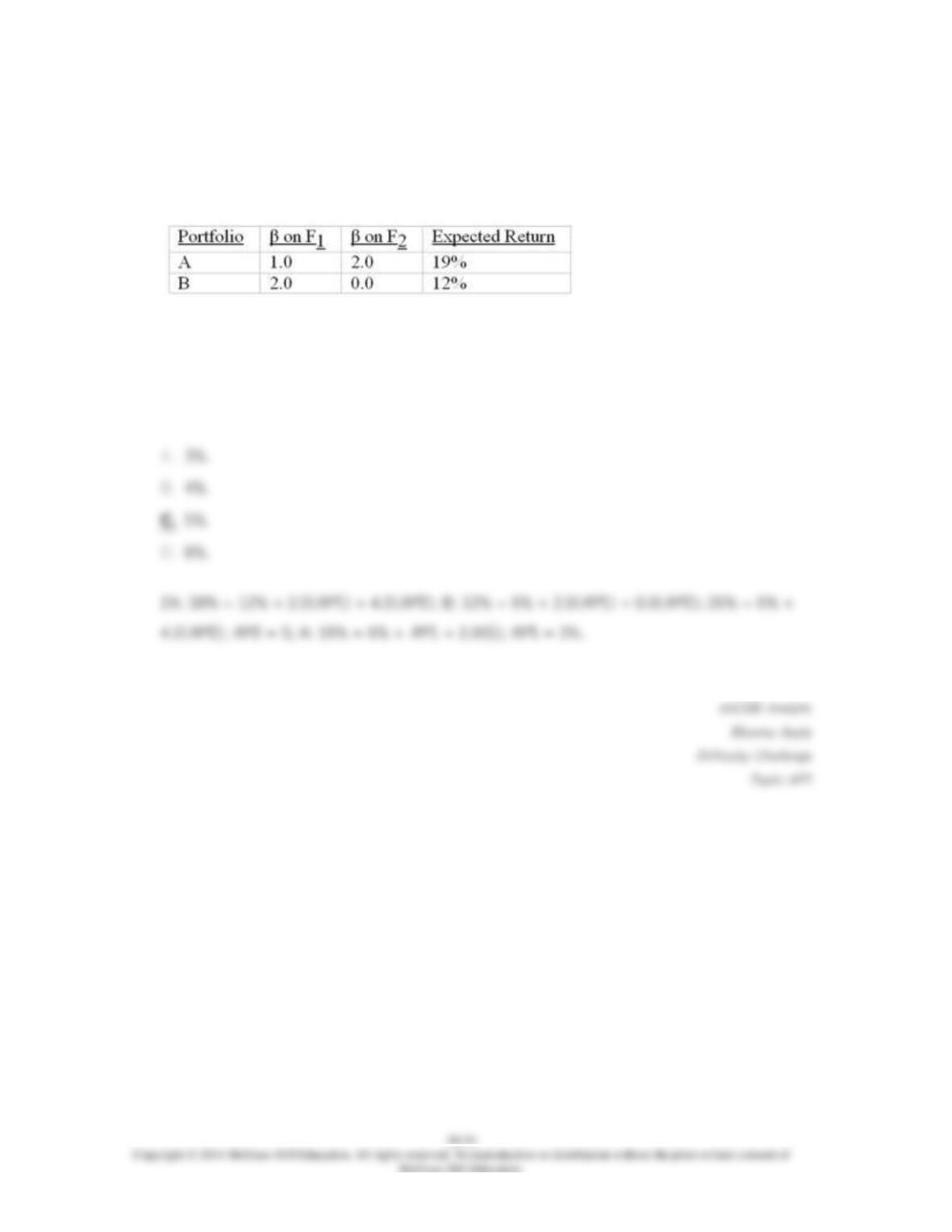
Consider the multifactor APT. There are two independent economic factors,
F
1 and
F
2. The
risk-free rate of return is 6%. The following information is available about two well-
diversified portfolios:
Assuming no arbitrage opportunities exist, the risk premium on the factor
F
2 portfolio
should be
31.
A zero-investment portfolio with a positive expected return arises when
32.
An investor will take as large a position as possible when an equilibrium price relationship
is violated. This is an example of
33.
The APT differs from the CAPM because the APT
34.
The feature of the APT that offers the greatest potential advantage over the CAPM is the
35.
In terms of the risk/return relationship in the APT,
36.
The following factors might affect stock returns
37.
Advantage(s) of the APT is(are)
38.
Portfolio A has expected return of 10% and standard deviation of 19%. Portfolio B has
expected return of 12% and standard deviation of 17%. Rational investors will
39.
An important difference between CAPM and APT is
40.
A professional who searches for mispriced securities in specific areas such as merger-
target stocks, rather than one who seeks strict (risk-free) arbitrage opportunities is
engaged in
41.
In the context of the Arbitrage Pricing Theory, as a well-diversified portfolio becomes
larger its nonsystematic risk approaches
42.
A well-diversified portfolio is defined as
43.
The APT requires a benchmark portfolio
44.
Imposing the no-arbitrage condition on a single-factor security market implies which of
the following statements?
I) The expected return-beta relationship is maintained for all but a small number of well-
diversified portfolios.
II) The expected return-beta relationship is maintained for all well-diversified portfolios.
III) The expected return-beta relationship is maintained for all but a small number of
individual securities.
IV) The expected return-beta relationship is maintained for all individual securities.
45.
Consider a well-diversified portfolio, A, in a two-factor economy. The risk-free rate is 6%,
the risk premium on the first factor portfolio is 4% and the risk premium on the second
factor portfolio is 3%. If portfolio A has a beta of 1.2 on the first factor and .8 on the
second factor, what is its expected return?
46.
The term “arbitrage” refers to
47.
To take advantage of an arbitrage opportunity, an investor would
I) construct a zero investment portfolio that will yield a sure profit.
II) construct a zero beta investment portfolio that will yield a sure profit.
III) make simultaneous trades in two markets without any net investment.
IV) short sell the asset in the low-priced market and buy it in the high-priced market.
48.
The factor F in the APT model represents
49.
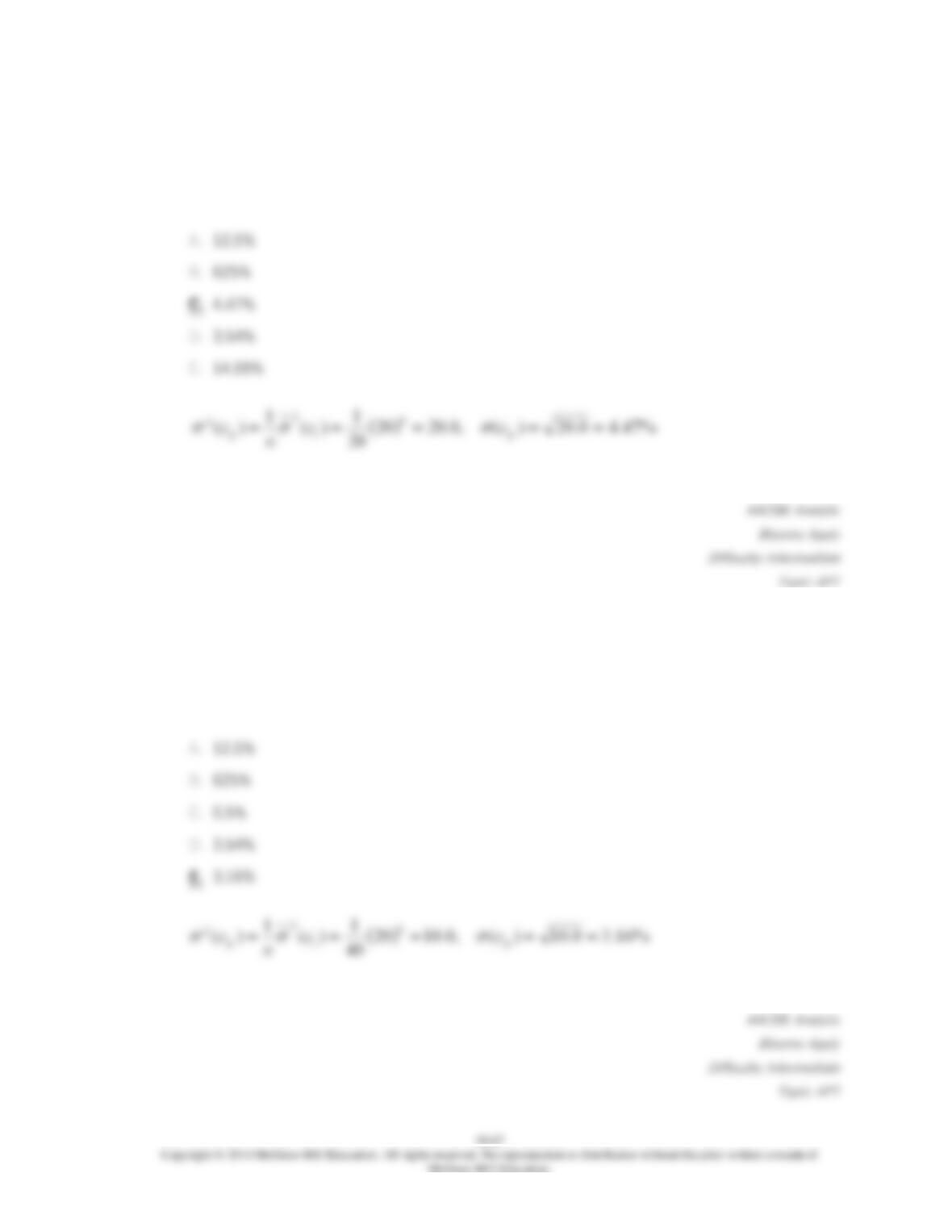
In the APT model, what is the nonsystematic standard deviation of an equally weighted
portfolio that has an average value of σ(
ei
) equal to 25% and 50 securities?
50.
In the APT model, what is the nonsystematic standard deviation of an equally weighted
portfolio that has an average value of σ(
ei
) equal to 20% and 20 securities?
51.
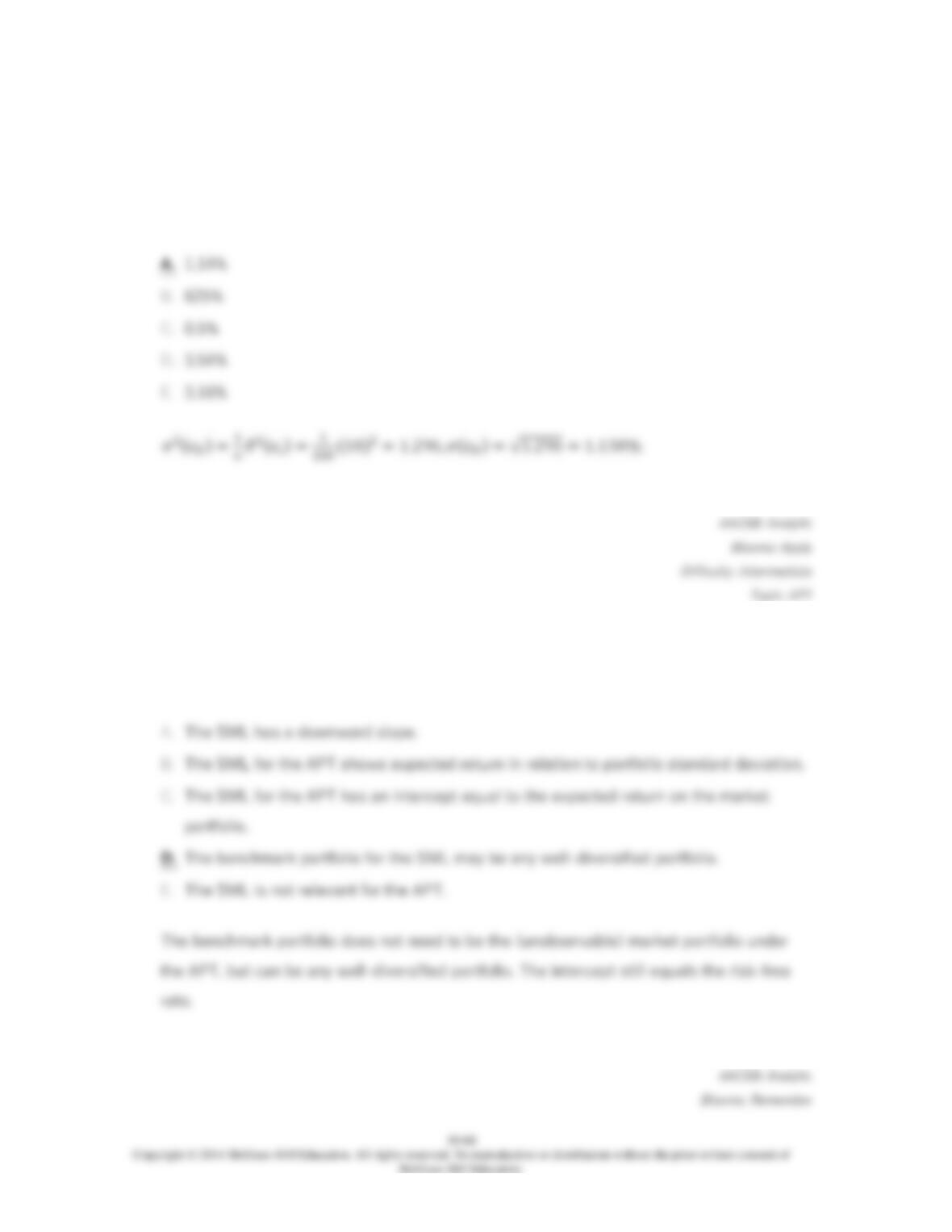
In the APT model, what is the nonsystematic standard deviation of an equally weighted
portfolio that has an average value of σ(
ei
) equal to 20% and 40 securities?
52.
In the APT model, what is the nonsystematic standard deviation of an equally weighted
portfolio that has an average value of σ(
ei
) equal to 18% and 250 securities?
53.
Which of the following is true about the security market line (SML) derived from the APT?
54.
Which of the following is false about the security market line (SML) derived from the
APT?
55.
If arbitrage opportunities are to be ruled out, each well-diversified portfolio’s expected
excess return must be
p
Q
56.
Suppose you are working with two factor portfolios, portfolio 1 and portfolio 2. The
portfolios have expected returns of 15% and 6%, respectively. Based on this information,
what would be the expected return on well-diversified portfolio A, if A has a beta of 0.80
on the first factor and 0.50 on the second factor? The risk-free rate is 3%.