Chapter 10 Arbitrage Pricing Theory and Multifactor Models of Risk
and Return Answer Key
Multiple Choice Questions
1.
___________ a relationship between expected return and risk.
2.
Consider the multifactor APT with two factors. Stock A has an expected return of 17.6%, a
beta of 1.45 on factor 1, and a beta of .86 on factor 2. The risk premium on the factor 1
portfolio is 3.2%. The risk-free rate of return is 5%. What is the risk-premium on factor 2 if
no arbitrage opportunities exist?
3.
In a multifactor APT model, the coefficients on the macro factors are often called
4.
In a multifactor APT model, the coefficients on the macro factors are often called
5.
In a multifactor APT model, the coefficients on the macro factors are often called
6.
Which pricing model provides no guidance concerning the determination of the risk
premium on factor portfolios?
7.
An arbitrage opportunity exists if an investor can construct a __________ investment
portfolio that will yield a sure profit.
8.
The APT was developed in 1976 by
9.
A _________ portfolio is a well-diversified portfolio constructed to have a beta of 1 on one
of the factors and a beta of 0 on any other factor.
10.
The exploitation of security mispricing in such a way that risk-free economic profits may
be earned is called
11.
In developing the APT, Ross assumed that uncertainty in asset returns was a result of
12.
The ____________ provides an unequivocal statement on the expected return-beta
relationship for all assets, whereas the _____________ implies that this relationship holds
for all but perhaps a small number of securities.
13.
Consider a single factor APT. Portfolio A has a beta of 1.0 and an expected return of 16%.
Portfolio B has a beta of 0.8 and an expected return of 12%. The risk-free rate of return is
6%. If you wanted to take advantage of an arbitrage opportunity, you should take a short
position in portfolio __________ and a long position in portfolio _______.
14.
Consider the single factor APT. Portfolio A has a beta of 0.2 and an expected return of
13%. Portfolio B has a beta of 0.4 and an expected return of 15%. The risk-free rate of
return is 10%. If you wanted to take advantage of an arbitrage opportunity, you should take
a short position in portfolio _________ and a long position in portfolio _________.
15.
Consider the one-factor APT. The variance of returns on the factor portfolio is 6%. The
beta of a well-diversified portfolio on the factor is 1.1. The variance of returns on the well-
diversified portfolio is approximately
Topic: APT
16.
Topic: APT
Consider the one-factor APT. The standard deviation of returns on a well-diversified
portfolio is 18%. The standard deviation on the factor portfolio is 16%. The beta of the
well-diversified portfolio is approximately
17.
Consider the single-factor APT. Stocks A and B have expected returns of 15% and 18%,
respectively. The risk-free rate of return is 6%. Stock B has a beta of 1.0. If arbitrage
opportunities are ruled out, stock A has a beta of
18.
Consider the multifactor APT with two factors. Stock A has an expected return of 16.4%, a
beta of 1.4 on factor 1 and a beta of .8 on factor 2. The risk premium on the factor 1
portfolio is 3%. The risk-free rate of return is 6%. What is the risk-premium on factor 2 if
no arbitrage opportunities exist?
19.
Consider the multifactor model APT with two factors. Portfolio A has a beta of 0.75 on
factor 1 and a beta of 1.25 on factor 2. The risk premiums on the factor 1 and factor 2
portfolios are 1% and 7%, respectively. The risk-free rate of return is 7%. The expected
return on portfolio A is __________ if no arbitrage opportunities exist.
20.
Consider the multifactor APT with two factors. The risk premiums on the factor 1 and
factor 2 portfolios are 5% and 6%, respectively. Stock A has a beta of 1.2 on factor 1, and a
beta of 0.7 on factor 2. The expected return on stock A is 17%. If no arbitrage opportunities
exist, the risk-free rate of return is
Topic: APT
21.
Topic: APT
Consider a one-factor economy. Portfolio A has a beta of 1.0 on the factor and portfolio B
has a beta of 2.0 on the factor. The expected returns on portfolios A and B are 11% and
17%, respectively. Assume that the risk-free rate is 6% and that arbitrage opportunities
exist. Suppose you invested $100,000 in the risk-free asset, $100,000 in portfolio B, and
sold short $200,000 of portfolio A. Your expected profit from this strategy would be
22.
Consider the one-factor APT. Assume that two portfolios, A and B, are well diversified. The
betas of portfolios A and B are 1.0 and 1.5, respectively. The expected returns on
portfolios A and B are 19% and 24%, respectively. Assuming no arbitrage opportunities
exist, the risk-free rate of return must be
23.
Consider the multifactor APT. The risk premiums on the factor 1 and factor 2 portfolios are
5% and 3%, respectively. The risk-free rate of return is 10%. Stock A has an expected
return of 19% and a beta on factor 1 of 0.8. Stock A has a beta on factor 2 of
24.
Consider the single factor APT. Portfolios A and B have expected returns of 14% and 18%,
respectively. The risk-free rate of return is 7%. Portfolio A has a beta of 0.7. If arbitrage
opportunities are ruled out, portfolio B must have a beta of
25.
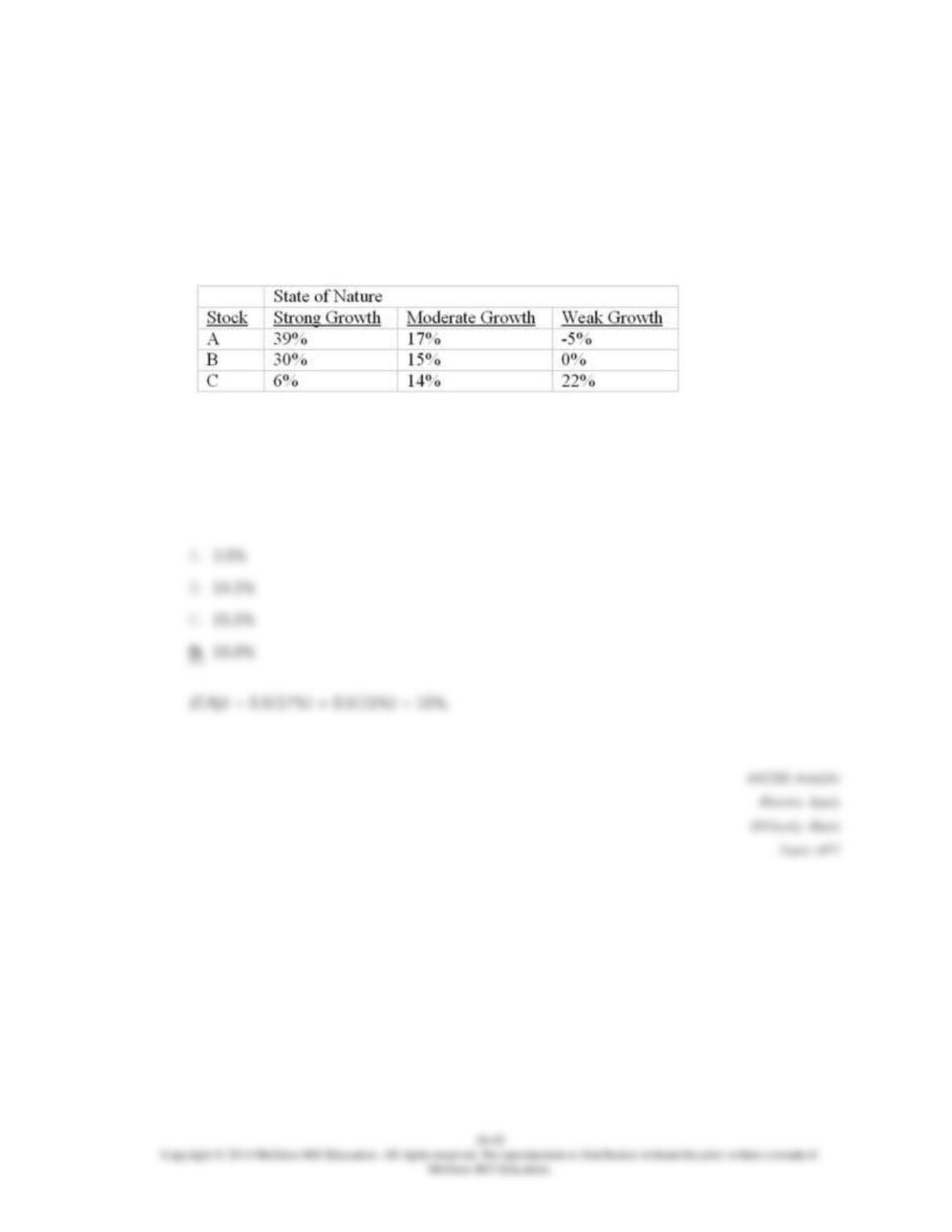
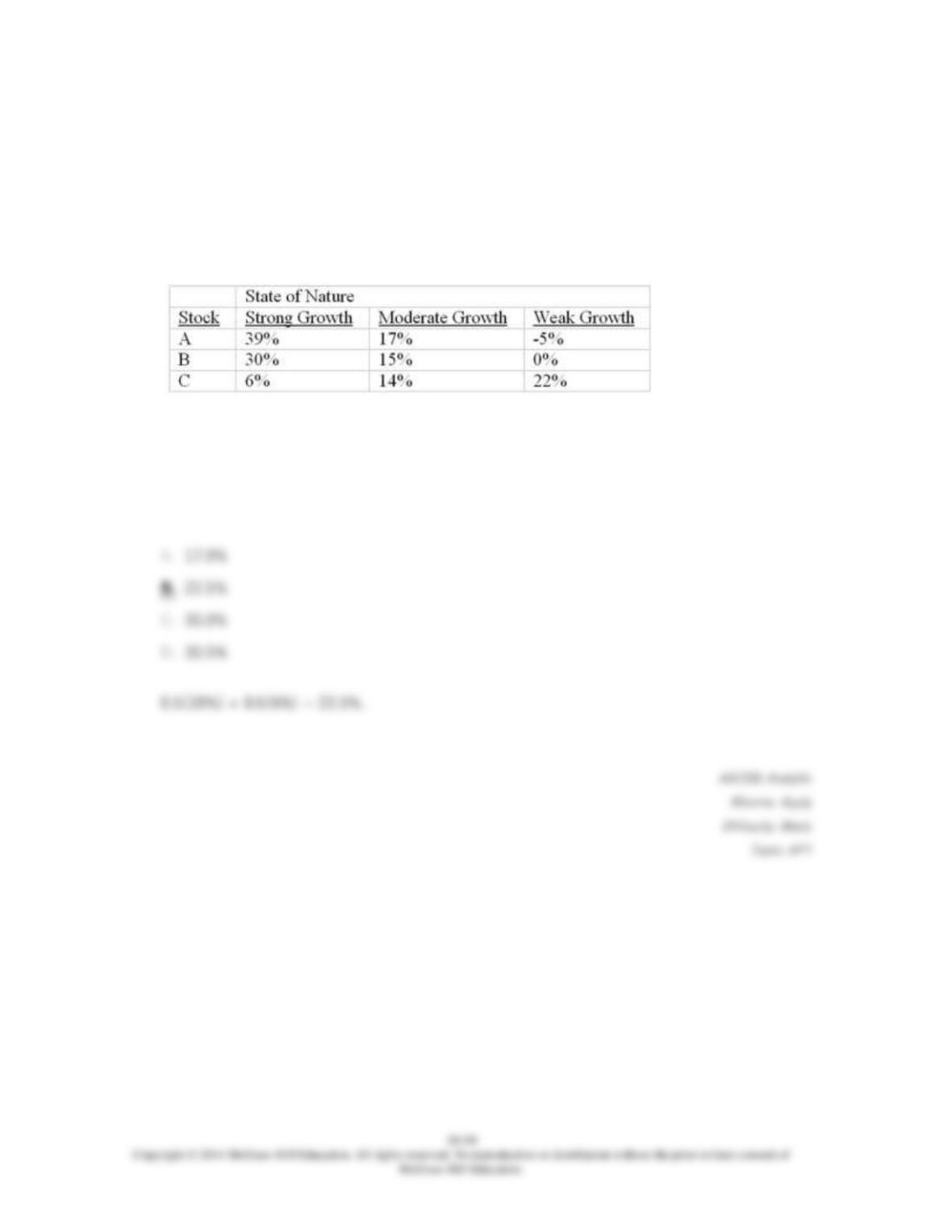
There are three stocks, A, B, and C. You can either invest in these stocks or short sell
them. There are three possible states of nature for economic growth in the upcoming year
(each equally likely to occur); economic growth may be strong, moderate, or weak. The
returns for the upcoming year on stocks A, B, and C for each of these states of nature are
given below:
If you invested in an equally weighted portfolio of stocks A and B, your portfolio return
would be ___________ if economic growth were moderate.
26.
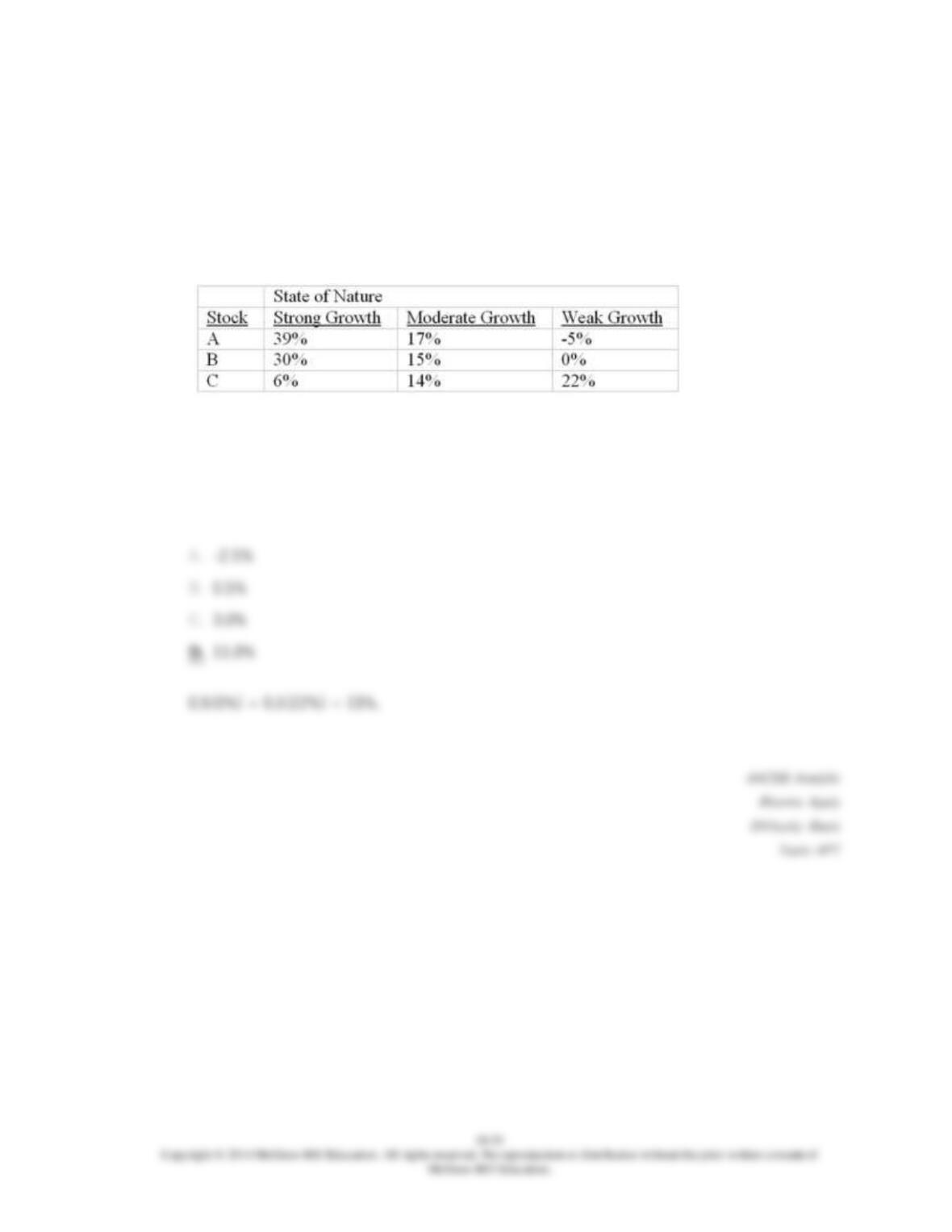
There are three stocks, A, B, and C. You can either invest in these stocks or short sell
them. There are three possible states of nature for economic growth in the upcoming year
(each equally likely to occur); economic growth may be strong, moderate, or weak. The
returns for the upcoming year on stocks A, B, and C for each of these states of nature are
given below:
If you invested in an equally weighted portfolio of stocks A and C, your portfolio return
would be ____________ if economic growth was strong.
27.
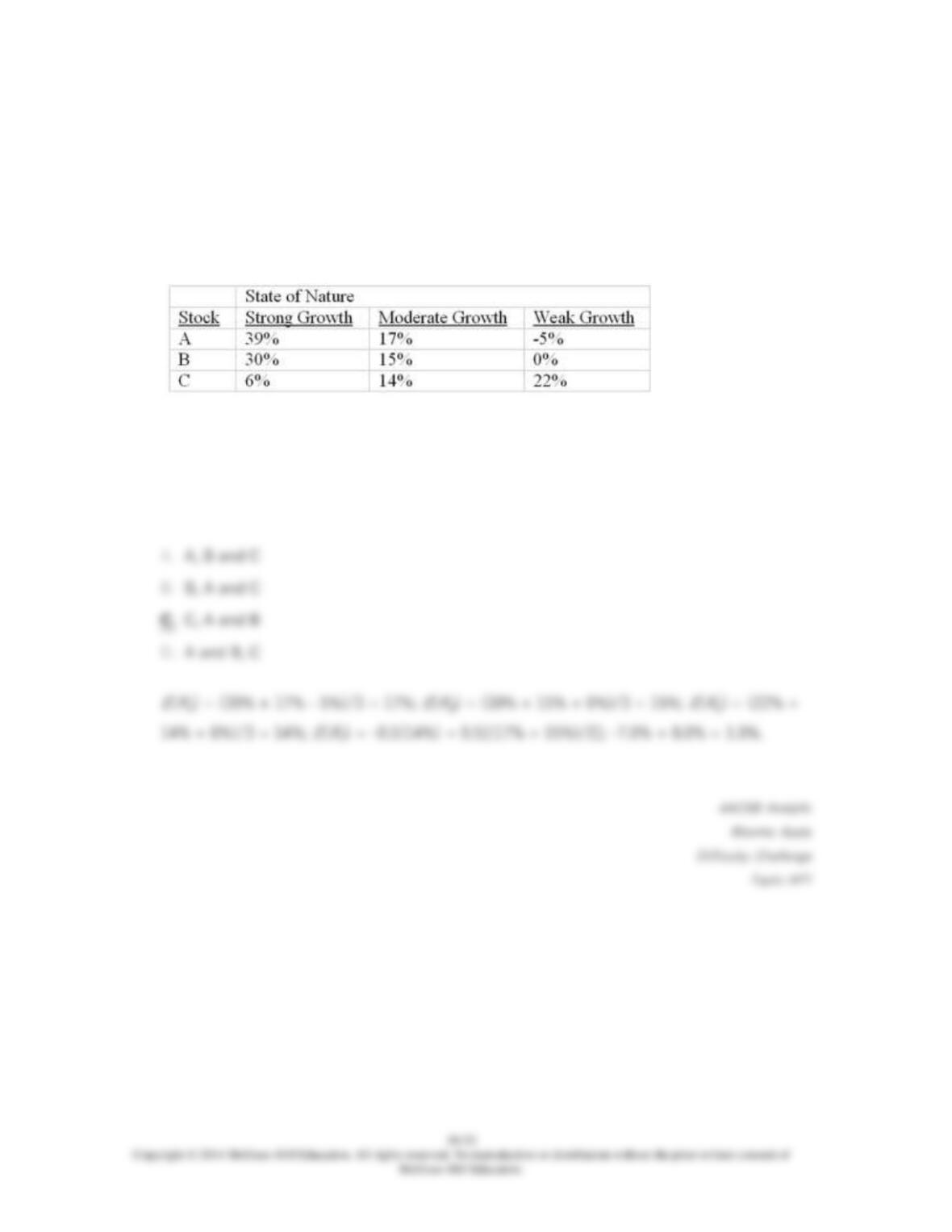
There are three stocks, A, B, and C. You can either invest in these stocks or short sell
them. There are three possible states of nature for economic growth in the upcoming year
(each equally likely to occur); economic growth may be strong, moderate, or weak. The
returns for the upcoming year on stocks A, B, and C for each of these states of nature are
given below:
If you invested in an equally weighted portfolio of stocks B and C, your portfolio return
would be _____________ if economic growth was weak.
28.
There are three stocks, A, B, and C. You can either invest in these stocks or short sell
them. There are three possible states of nature for economic growth in the upcoming year
(each equally likely to occur); economic growth may be strong, moderate, or weak. The
returns for the upcoming year on stocks A, B, and C for each of these states of nature are
given below:
If you wanted to take advantage of a risk-free arbitrage opportunity, you should take a
short position in _________ and a long position in an equally weighted portfolio of _______.
29.
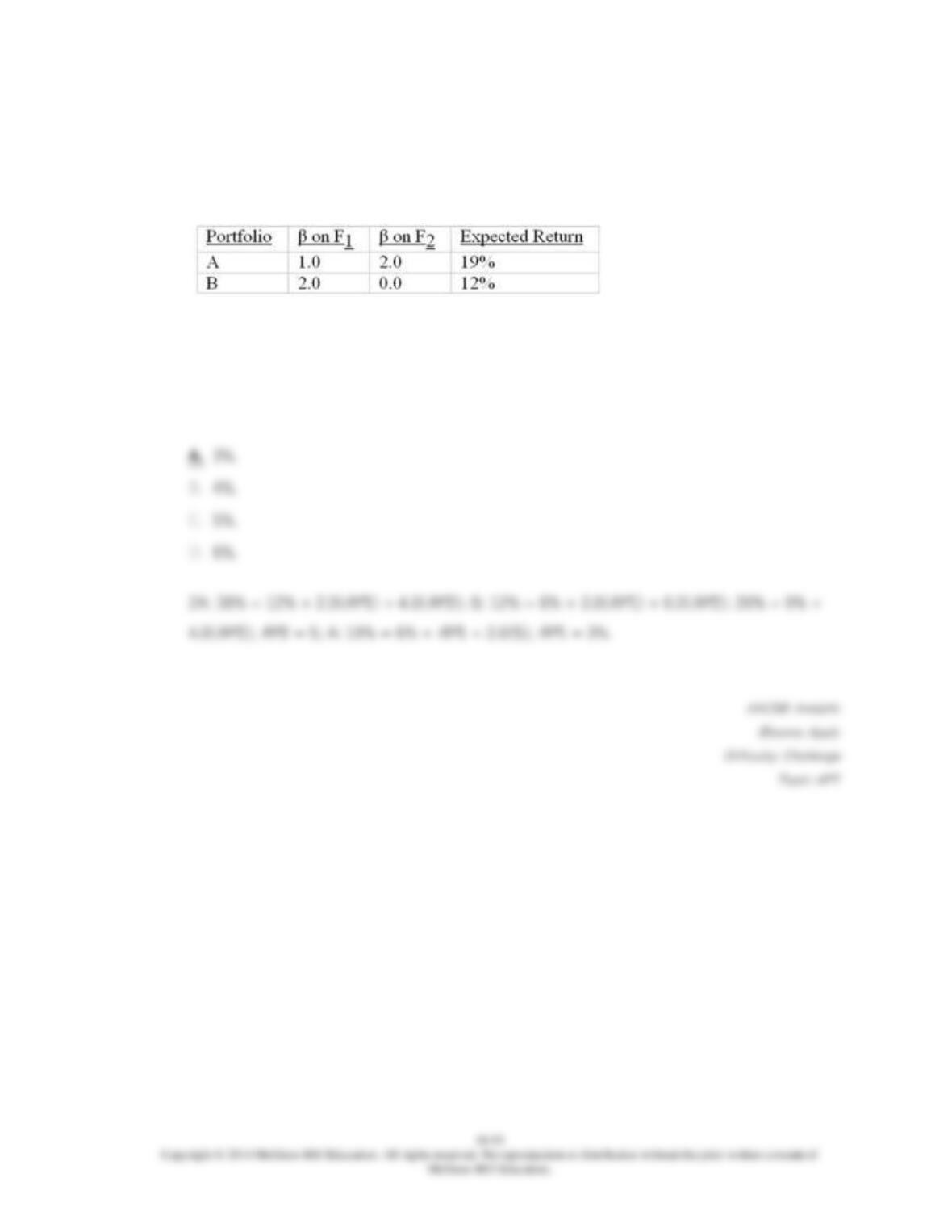
Consider the multifactor APT. There are two independent economic factors,
F
1 and
F
2. The
risk-free rate of return is 6%. The following information is available about two well-
diversified portfolios:
Assuming no arbitrage opportunities exist, the risk premium on the factor
F
1 portfolio
should be