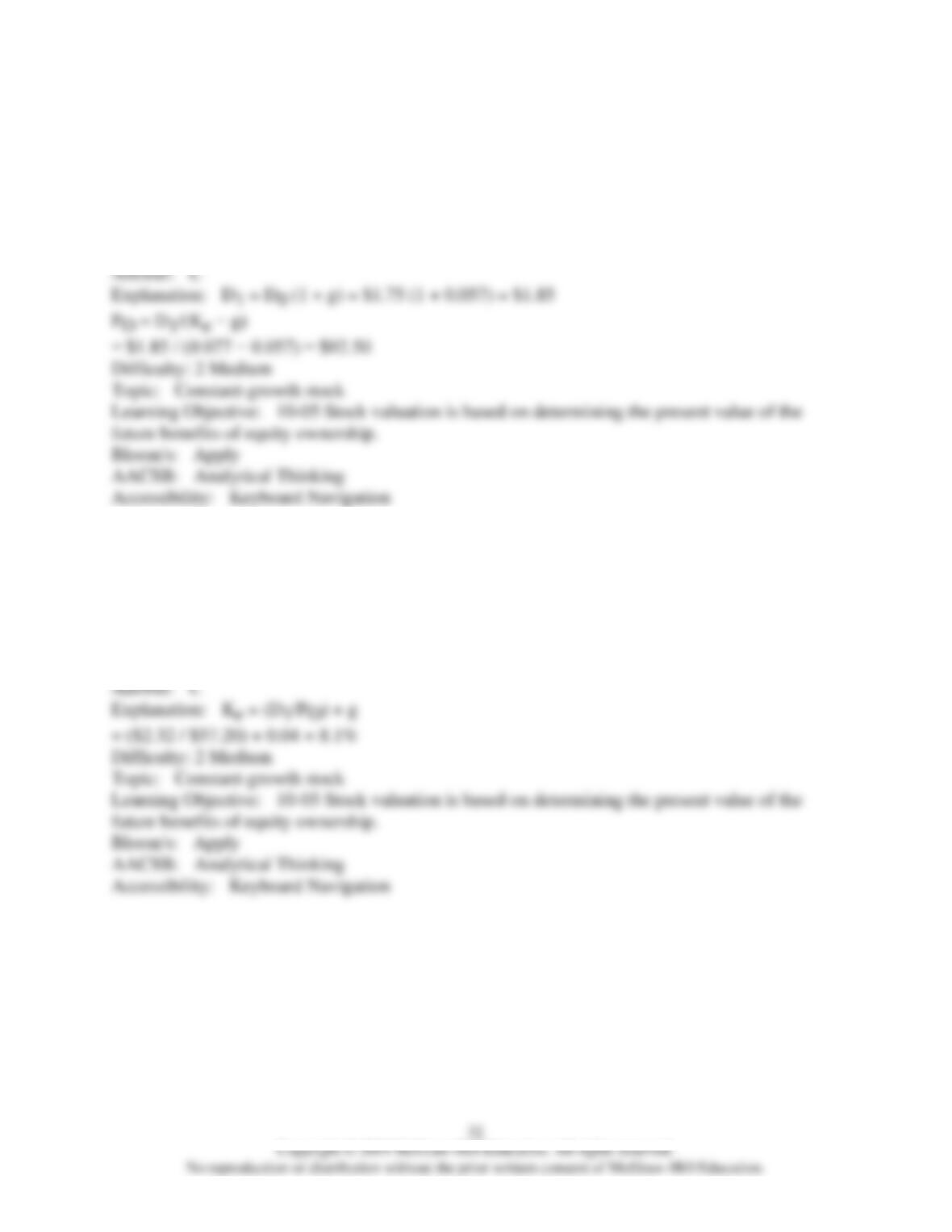
91) An issue of common stock’s most recent dividend is $1.75. Its growth rate is 5.7%. What is
its price if the market’s rate of return is 7.7%?
A) $24.63
B) $87.50
C) $92.50
D) None of these options are correct
92) An issue of common stock is selling for $57.20. The year-end dividend is expected to be
$2.32, assuming a constant growth rate of 4%. What is the required rate of return?
A) 10.3%
B) 10.1%
C) 8.1%
D) None of these options are correct
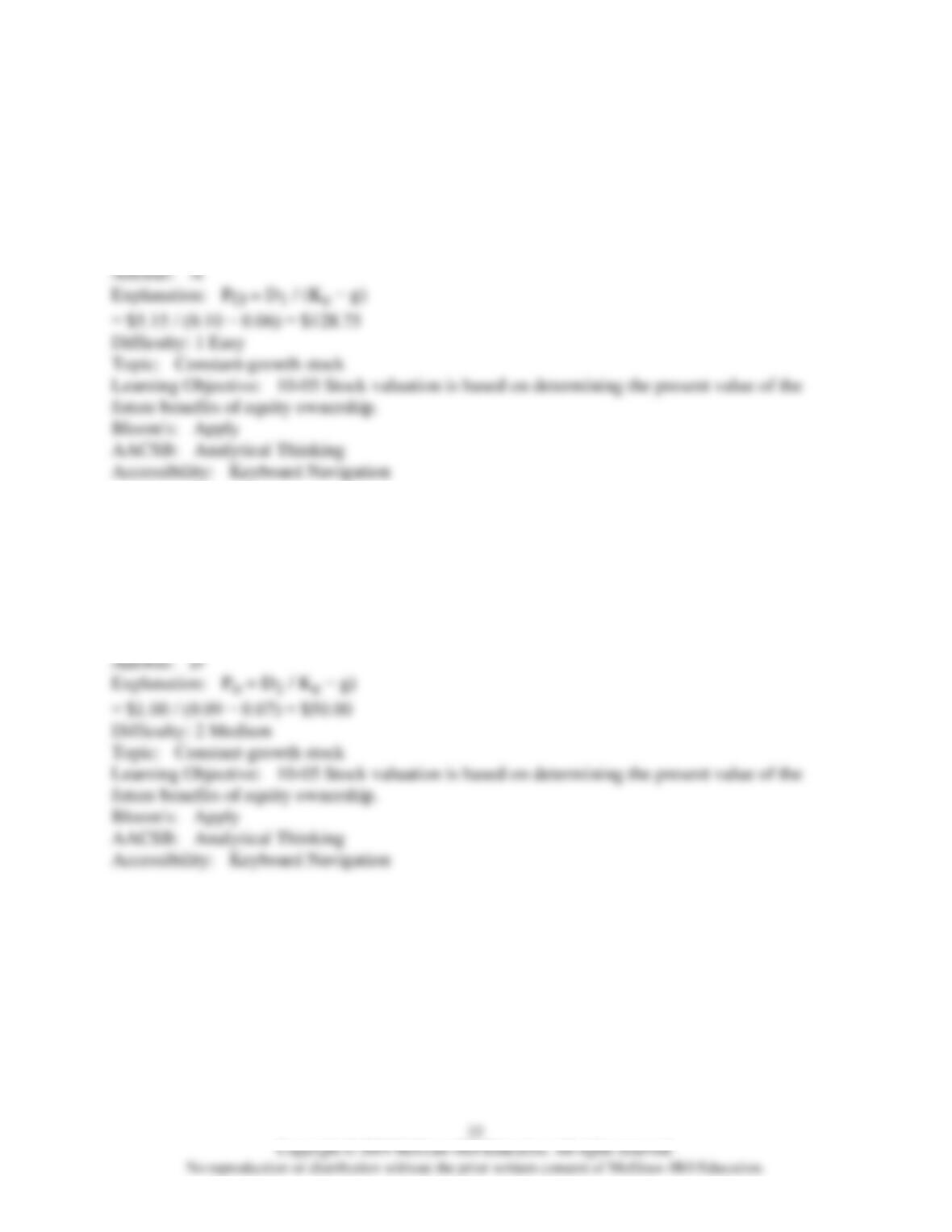
93) An issue of common stock is expected to pay a dividend of $5.15 at the end of the year. Its
growth rate is equal to 6%. If the required rate of return is 10%, what is its current price?
A) $128.75
B) $36.92
C) $96.00
D) None of these options are correct
94) If expected dividends grow at 7% and the appropriate discount rate is 9%, what is the value
of a stock with an expected dividend one year from now of $1.00?
A) $62.88
B) $19.41
C) $29.12
D) $50.00
95) Stock valuation models are dependent upon
A) expected dividends, future dividend growth, and an appropriate discount rate.
B) past dividends, flotation costs, and bond yields.
C) historical dividends, historical growth, and an appropriate discount rate.
D) All of these options are true.
96) If a company’s stock price (P0) goes up, and nothing else changes, Ke (the required rate of
return) should
A) go up.
B) go down.
C) remain unchanged.
D) More information is needed for an answer.
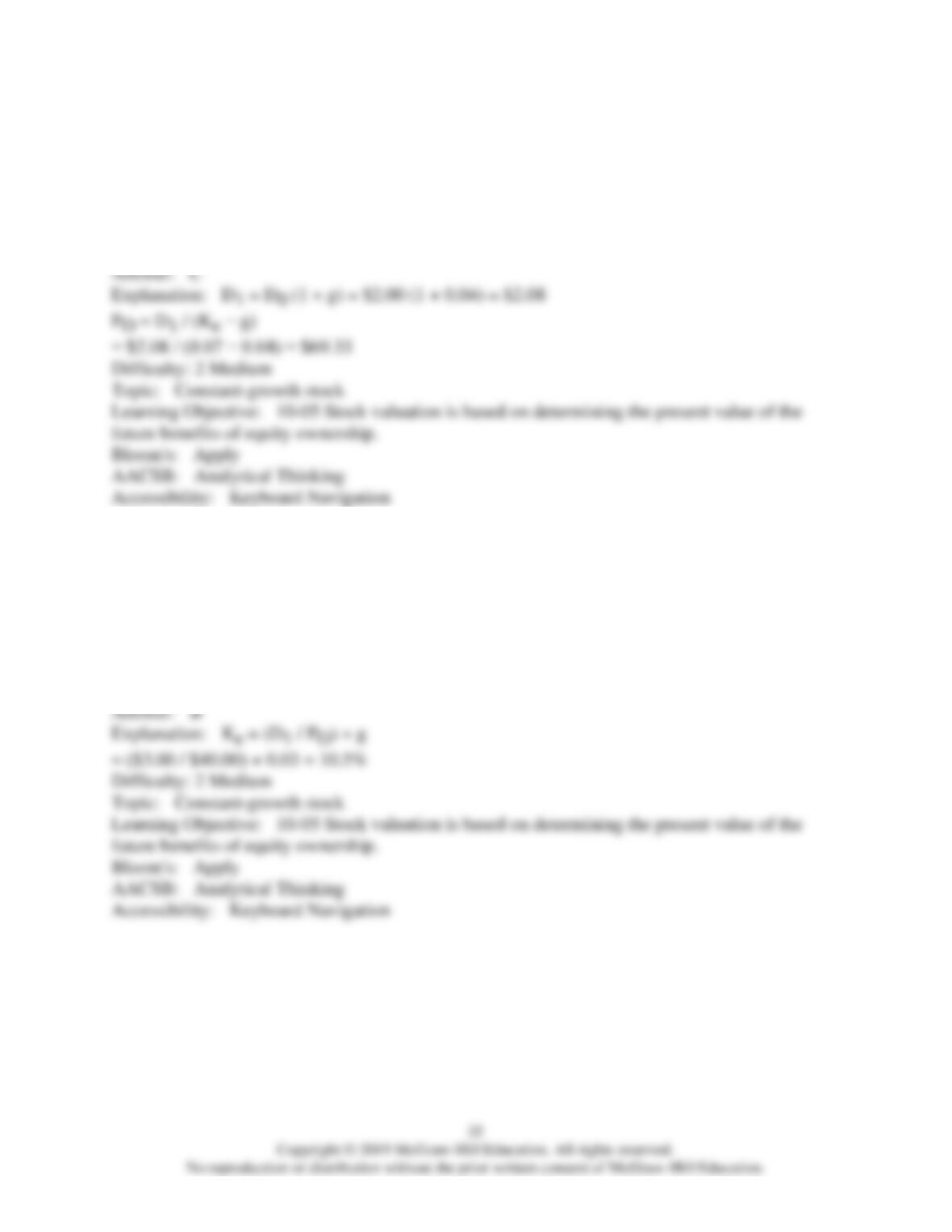
97) An issue of common stock has just paid a dividend of $2.00. Its growth rate is equal to 4%. If
the required rate of return is 7%, what is its current price?
A) $19.04
B) $80.00
C) $69.33
D) None of these options are correct
98) An issue of common stock is expected to pay a dividend of $3 at the end of the year. Its
growth rate is equal to 3%, and the current share price is $40. What is the required rate of return
on the stock?
A) Between 7% and 10%
B) Between 10% and 12%
C) Between 12% and 14%
D) Between 14% and 17%
36
Copyright © 2019 McGraw-Hill Education. All rights reserved.
No reproduction or distribution without the prior written consent of McGraw-Hill Education.
99) The Required Rate of Return for common stock is Ke = (D1/P0) + g. What are the
assumptions of the model?
A) Growth (g) is constant to infinity.
B) The price earnings ratio stays the same.
C) The firm must pay a dividend to use this model.
D) All of these options are assumptions of the model.
Answer: D
Difficulty: 2 Medium
Topic: Stock returns and yields
Learning Objective: 10-05 Stock valuation is based on determining the present value of the
future benefits of equity ownership.
Bloom’s: Understand
AACSB: Analytical Thinking
Accessibility: Keyboard Navigation
100) The required return by investors is directly influenced by all of the following except:
A) Inflation
B) U.S. Treasury rates
C) Dividends
D) Risk
101) The required return by investors is important to financial managers except for which of the
following reasons?
A) It influences the firm’s cost of financing.
B) It influences their stock price.
C) It is the primary driver of their financial ratios.
D) It helps when pricing new issues of securities.
102) The market allocates capital to firms based on all of the following except:
A) Higher risk requires lower returns due to higher expectations
B) The level of efficiency
C) Expected returns
D) The degree of past performance
103) Market Enterprises would like to issue $1,000 bonds and needs to determine the
approximate rate it would need to pay investors. A firm with similar risk recently issued bonds
which currently have the following features: a 5% coupon rate, 10 years until maturity, and a
current price of $1,170.50. At what rate would Market Enterprises expect to issue bonds,
assuming annual interest payments? Please round to the closest answer. (Solve this problem
using either Excel’s “Goal Seek” function, plug into tvm tables, or a financial calculator.)
A) 6%
B) 3%
C) 5%
D) 4%
104) Star Corp. issued bonds two years ago with a 7% coupon rate. The bonds are currently
trading for $928 in the market. Which of the following most likely has occurred since the time of
issue?
A) Interest yields decreased
B) Inflation increased
C) Risk decreased
D) Real rates of return decreased
105) As a bond approaches its maturity date, its sales price approaches
A) the price of comparable bonds.
B) U.S. Treasury bond prices.
C) the par value.
D) the par adjusted for yield to maturity.
106) Two years ago, Maple Enterprises issued 4%, 20-year bonds, and Temple Corp issued 4%,
10-year bonds. Since their time of issue, interest rates have increased. Which of the following
statements is true of each firm’s bond prices in the market, assuming they have equal risk?
A) Maple’s decreased more than Temple’s.
B) Temple’s decreased more than Maple’s.
C) Maple’s increased more than Temple’s.
D) They are both priced the same.
107) All of the following adjustments must be made when interest is paid semiannually versus
annually EXCEPT:
A) Annual interest rate divided by 2
B) Total number of years divided by 2
C) Annual yield to maturity divided by 2
D) Annual coupon payment divided by 2
108) Doug has been approached by his broker to purchase a $1,000 bond for $795. He believes
the bond should yield 8%. The bond pays a 5% annual coupon rate and has 10 years left until
maturity. What should Doug’s analysis of the bond indicate to him? Use annual analysis. Use
time value of money tables in Appendix B and Appendix D.
A) The bond is undervalued; he should purchase it.
B) The bond is undervalued; he should not purchase it.
C) The bond is overvalued; he should purchase it.
D) The bond is overvalued; he should not purchase it.
109) Which of the following regarding preferred stock is true?
A) If the price decreases, the required rate of return has decreased.
B) If the required rate of return increases, the price decreases.
C) If the required rate of return increases, the price increases.
D) The price in the market remains at par.
110) Which of the following is an asset that is usually valued using time value of money?
A) Plant property and equipment
B) Investment
C) Accounts receivable
D) Inventory