Chapter 10 – Arbitrage Pricing Theory and Multifactor Models of Risk and Return
10–19
44. Imposing the no-arbitrage condition on a single-factor security market implies which of
the following statements?
I) the expected return-beta relationship is maintained for all but a small number of well-
diversified portfolios.
II) the expected return-beta relationship is maintained for all well-diversified portfolios.
III) the expected return-beta relationship is maintained for all but a small number of
individual securities.
IV) the expected return-beta relationship is maintained for all individual securities.
A. I and III are correct.
B. I and IV are correct.
Difficulty: Moderate
45. Consider a well-diversified portfolio, A, in a two-factor economy. The risk-free rate is
6%, the risk premium on the first factor portfolio is 4% and the risk premium on the second
factor portfolio is 3%. If portfolio A has a beta of 1.2 on the first factor and .8 on the second
factor, what is its expected return?
A. 7.0%
B. 8.0%
Difficulty: Moderate
Chapter 10 – Arbitrage Pricing Theory and Multifactor Models of Risk and Return
10–20
46. The term “arbitrage” refers to
A. buying low and selling high.
B. short selling high and buying low.
Difficulty: Easy
47. To take advantage of an arbitrage opportunity, an investor would
I) construct a zero investment portfolio that will yield a sure profit.
II) construct a zero beta investment portfolio that will yield a sure profit.
III) make simultaneous trades in two markets without any net investment.
IV) short sell the asset in the low-priced market and buy it in the high-priced market.
A. I and IV
Difficulty: Difficult
Chapter 10 – Arbitrage Pricing Theory and Multifactor Models of Risk and Return
10–21
48. The factor F in the APT model represents
A. firm-specific risk.
B. the sensitivity of the firm to that factor.
Difficulty: Moderate
49. In the APT model, what is the nonsystematic standard deviation of an equally-weighted
portfolio that has an average value of (ei) equal to 25% and 50 securities?
A. 12.5%
B. 625%
Difficulty: Moderate
50. In the APT model, what is the nonsystematic standard deviation of an equally-weighted
portfolio that has an average value of (ei) equal to 20% and 20 securities?
A. 12.5%
B. 625%
Difficulty: Moderate
Chapter 10 – Arbitrage Pricing Theory and Multifactor Models of Risk and Return
10–22
51. In the APT model, what is the nonsystematic standard deviation of an equally-weighted
portfolio that has an average value of (ei) equal to 20% and 40 securities?
A. 12.5%
Difficulty: Moderate
52. In the APT model, what is the nonsystematic standard deviation of an equally-weighted
portfolio that has an average value of (ei) equal to 18% and 250 securities?
E. 3.16%
Difficulty: Moderate
Chapter 10 – Arbitrage Pricing Theory and Multifactor Models of Risk and Return
10–23
53. Which of the following is true about the security market line (SML) derived from the
APT?
A. The SML has a downward slope.
B. The SML for the APT shows expected return in relation to portfolio standard deviation.
Difficulty: Moderate
54. Which of the following is false about the security market line (SML) derived from the
APT?
A. The SML has a downward slope.
B. The SML for the APT shows expected return in relation to portfolio standard deviation.
Difficulty: Moderate
55. If arbitrage opportunities are to be ruled out, each well-diversified portfolio’s expected
excess return must be
A. inversely proportional to the risk-free rate.
B. inversely proportional to its standard deviation.
Difficulty: Moderate
Chapter 10 – Arbitrage Pricing Theory and Multifactor Models of Risk and Return
10–24
56. Suppose you are working with two factor portfolios, Portfolio 1 and Portfolio 2. The
portfolios have expected returns of 15% and 6%, respectively. Based on this information,
what would be the expected return on well-diversified portfolio A, if A has a beta of 0.80 on
the first factor and 0.50 on the second factor? The risk-free rate is 3%.
A. 15.2%
Difficulty: Moderate
57. Which of the following is (are) true regarding the APT?
I) The Security Market Line does not apply to the APT.
II) More than one factor can be important in determining returns.
III) Almost all individual securities satisfy the APT relationship.
IV) It doesn’t rely on the market portfolio that contains all assets.
D. I, II, and IV
E. I, II, III, and IV
Difficulty: Moderate
Chapter 10 – Arbitrage Pricing Theory and Multifactor Models of Risk and Return
10–25
58. In a factor model, the return on a stock in a particular period will be related to
A. factor risk.
B. non-factor risk.
Difficulty: Moderate
59. Which of the following factors did Chen, Roll and Ross not include in their multifactor
model?
A. Change in industrial production
B. Change in expected inflation
Difficulty: Moderate
60. Which of the following factors did Chen, Roll and Ross include in their multifactor
model?
A. Change in industrial waste
B. Change in expected inflation
Difficulty: Moderate
Chapter 10 – Arbitrage Pricing Theory and Multifactor Models of Risk and Return
10–26
61. Which of the following factors were used by Fama and French in their multi-factor
model?
A. Return on the market index
B. Excess return of small stocks over large stocks.
Difficulty: Moderate
62. Which of the following factors did Merton not suggest as a likely source of uncertainty
that might affect security returns?
A. uncertainties in labor income.
B. prices of important consumption goods.
Difficulty: Moderate
63. Which of the following factors did Merton suggest as a likely source of uncertainty that
might affect security returns?
A. uncertainties in labor income.
B. prices of important consumption goods.
Difficulty: Moderate
Chapter 10 – Arbitrage Pricing Theory and Multifactor Models of Risk and Return
10–27
64. Black argues that past risk premiums on firm-characteristic variables, such as those
described by Fama and French, are problematic because ________.
D. they are more appropriate for a single-factor model.
E. they are macroeconomic factors.
Difficulty: Moderate
65. Multifactor models seek to improve the performance of the single-index model by
A. modeling the systematic component of firm returns in greater detail.
B. incorporating firm-specific components into the pricing model.
Difficulty: Easy
Chapter 10 – Arbitrage Pricing Theory and Multifactor Models of Risk and Return
10–28
66. Multifactor models such as the one constructed by Chen, Roll, and Ross, can better
describe assets’ returns by
D. using only stocks with relatively stable returns.
E. ignoring firm-specific risk.
Difficulty: Moderate
67. Consider the multifactor model APT with three factors. Portfolio A has a beta of 0.8 on
factor 1, a beta of 1.1 on factor 2, and a beta of 1.25 on factor 3. The risk premiums on the
factor 1, factor 2, and factor 3 are 3%, 5% and 2%, respectively. The risk-free rate of return is
3%. The expected return on portfolio A is __________ if no arbitrage opportunities exist.
A. 13.5%
Difficulty: Moderate
Chapter 10 – Arbitrage Pricing Theory and Multifactor Models of Risk and Return
10–29
68. Consider the multifactor APT. The risk premiums on the factor 1 and factor 2 portfolios
are 6% and 4%, respectively. The risk-free rate of return is 4%. Stock A has an expected
return of 16% and a beta on factor 1 of 1.3. Stock A has a beta on factor 2 of ________.
A. 1.33
Difficulty: Moderate
69. Consider a well-diversified portfolio, A, in a two-factor economy. The risk-free rate is
5%, the risk premium on the first factor portfolio is 4% and the risk premium on the second
factor portfolio is 6%. If portfolio A has a beta of 0.6 on the first factor and 1.8 on the second
factor, what is its expected return?
A. 7.0%
B. 8.0%
Difficulty: Moderate
Chapter 10 – Arbitrage Pricing Theory and Multifactor Models of Risk and Return
10–30
70. Consider a single factor APT. Portfolio A has a beta of 2.0 and an expected return of 22%.
Portfolio B has a beta of 1.5 and an expected return of 17%. The risk-free rate of return is 4%.
If you wanted to take advantage of an arbitrage opportunity, you should take a short position
in portfolio __________ and a long position in portfolio _______.
A. A, A
B. A, B
Difficulty: Moderate
71. Consider the single factor APT. Portfolio A has a beta of 0.5 and an expected return of
12%. Portfolio B has a beta of 0.4 and an expected return of 13%. The risk-free rate of return
is 5%. If you wanted to take advantage of an arbitrage opportunity, you should take a short
position in portfolio _________ and a long position in portfolio _________.
A. A, A
Difficulty: Moderate
Chapter 10 – Arbitrage Pricing Theory and Multifactor Models of Risk and Return
10–31
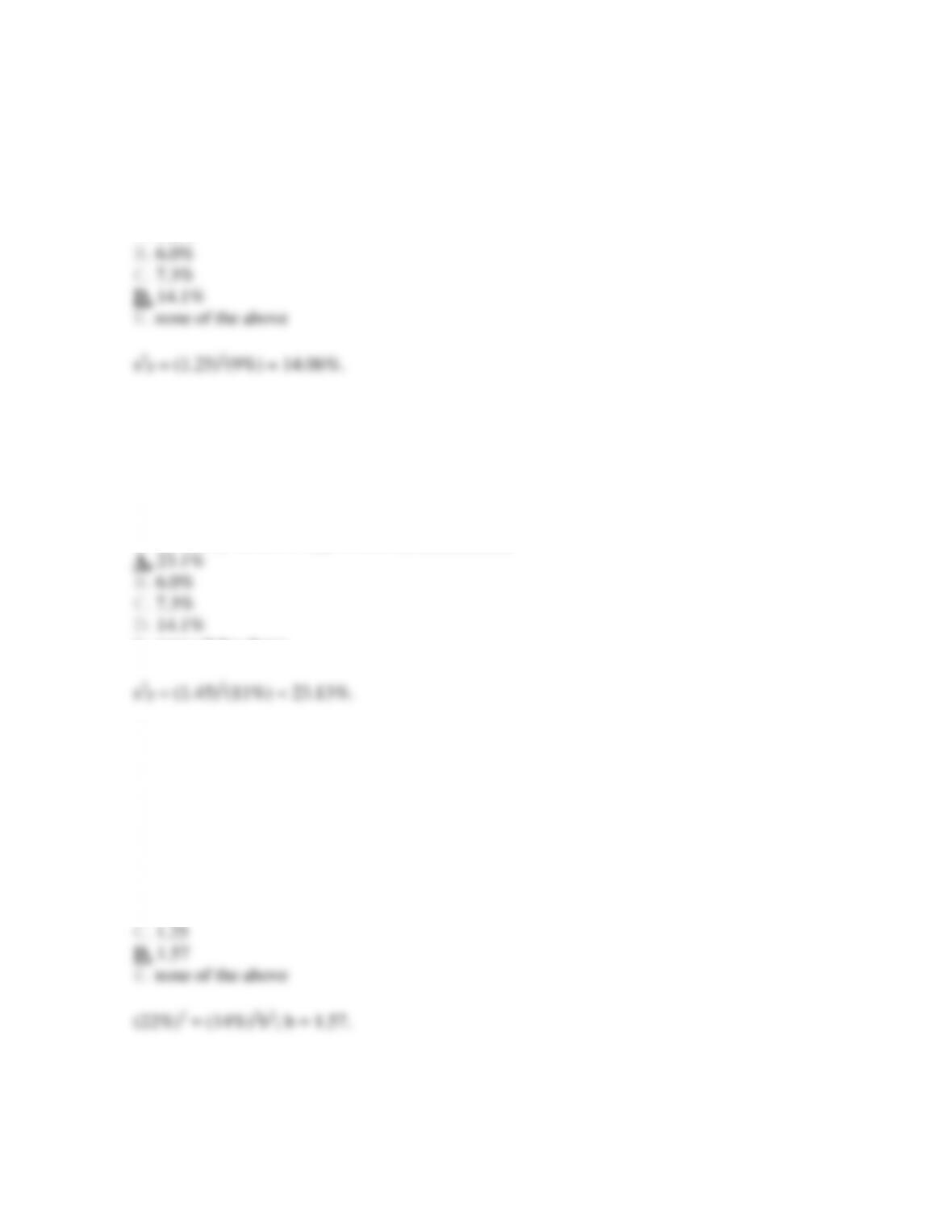
72. Consider the one-factor APT. The variance of returns on the factor portfolio is 9%. The
beta of a well-diversified portfolio on the factor is 1.25. The variance of returns on the well-
diversified portfolio is approximately __________.
A. 3.6%
Difficulty: Moderate
73. Consider the one-factor APT. The variance of returns on the factor portfolio is 11%. The
beta of a well-diversified portfolio on the factor is 1.45. The variance of returns on the well-
diversified portfolio is approximately __________.
E. none of the above
Difficulty: Moderate
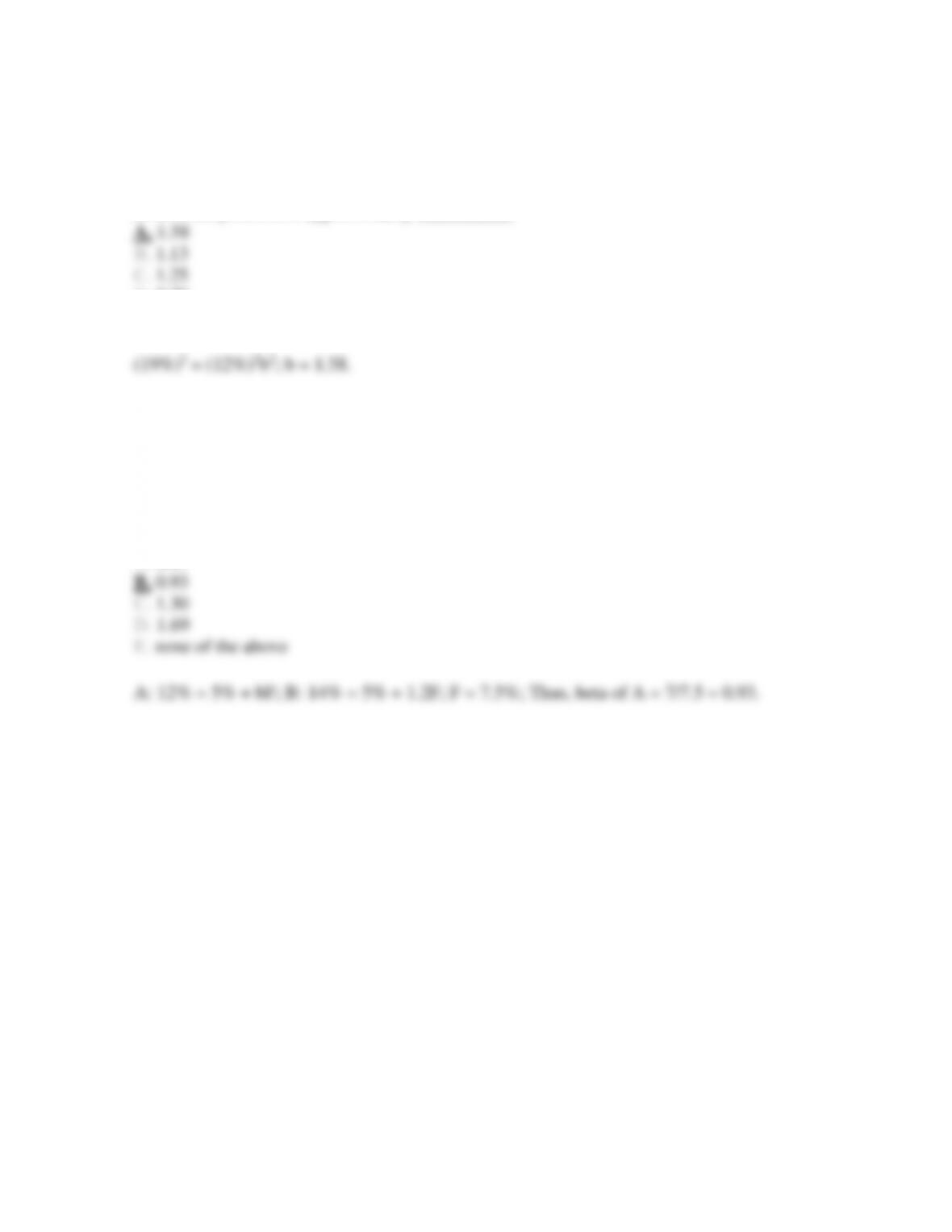
74. Consider the one-factor APT. The standard deviation of returns on a well-diversified
portfolio is 22%. The standard deviation on the factor portfolio is 14%. The beta of the well-
diversified portfolio is approximately __________.
A. 0.80
B. 1.13
Difficulty: Moderate
Chapter 10 – Arbitrage Pricing Theory and Multifactor Models of Risk and Return
10–32
75. Consider the one-factor APT. The standard deviation of returns on a well-diversified
portfolio is 19%. The standard deviation on the factor portfolio is 12%. The beta of the well-
diversified portfolio is approximately __________.
D. 0.76
E. none of the above
Difficulty: Moderate
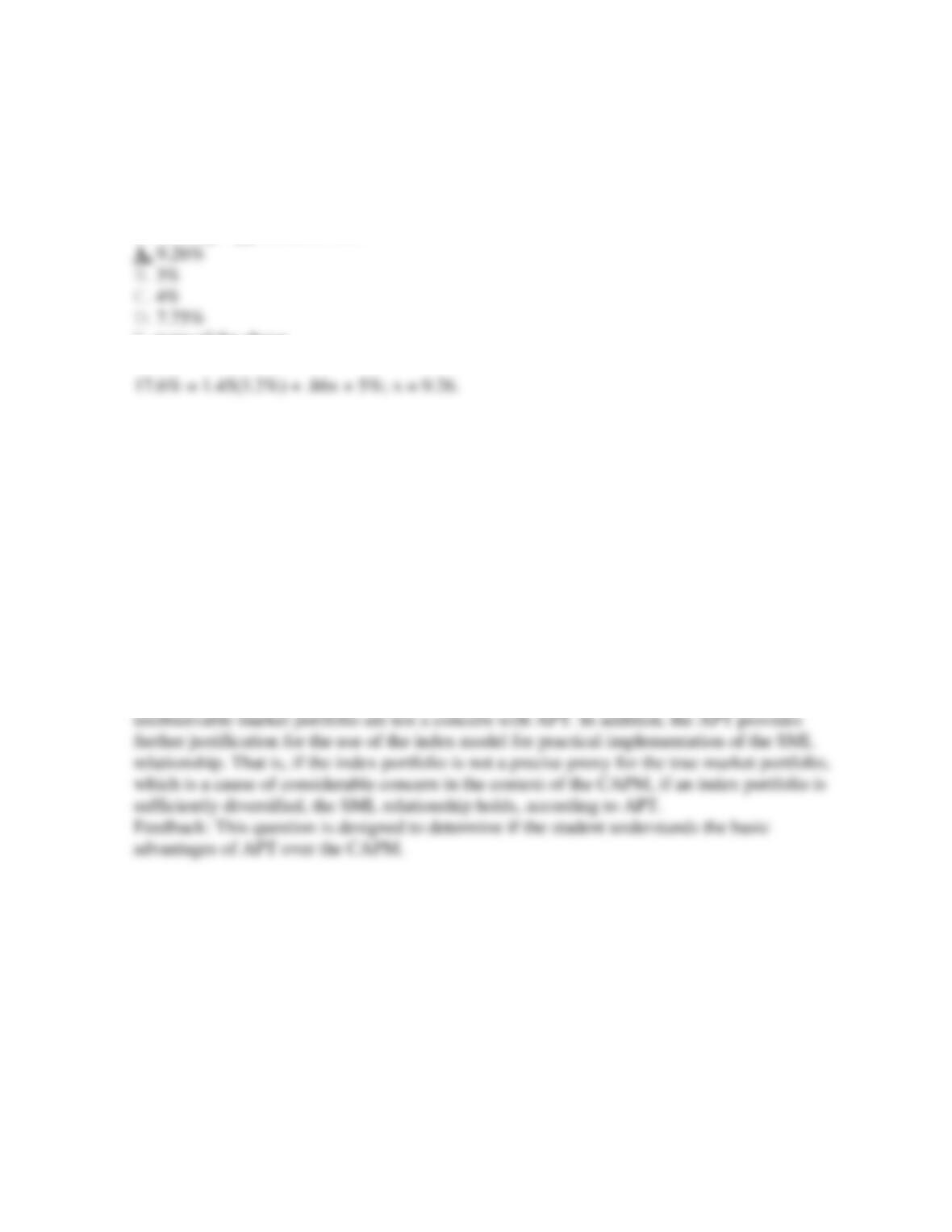
76. Consider the single-factor APT. Stocks A and B have expected returns of 12% and 14%,
respectively. The risk-free rate of return is 5%. Stock B has a beta of 1.2. If arbitrage
opportunities are ruled out, stock A has a beta of __________.
A. 0.67
Difficulty: Moderate
Chapter 10 – Arbitrage Pricing Theory and Multifactor Models of Risk and Return
10–33
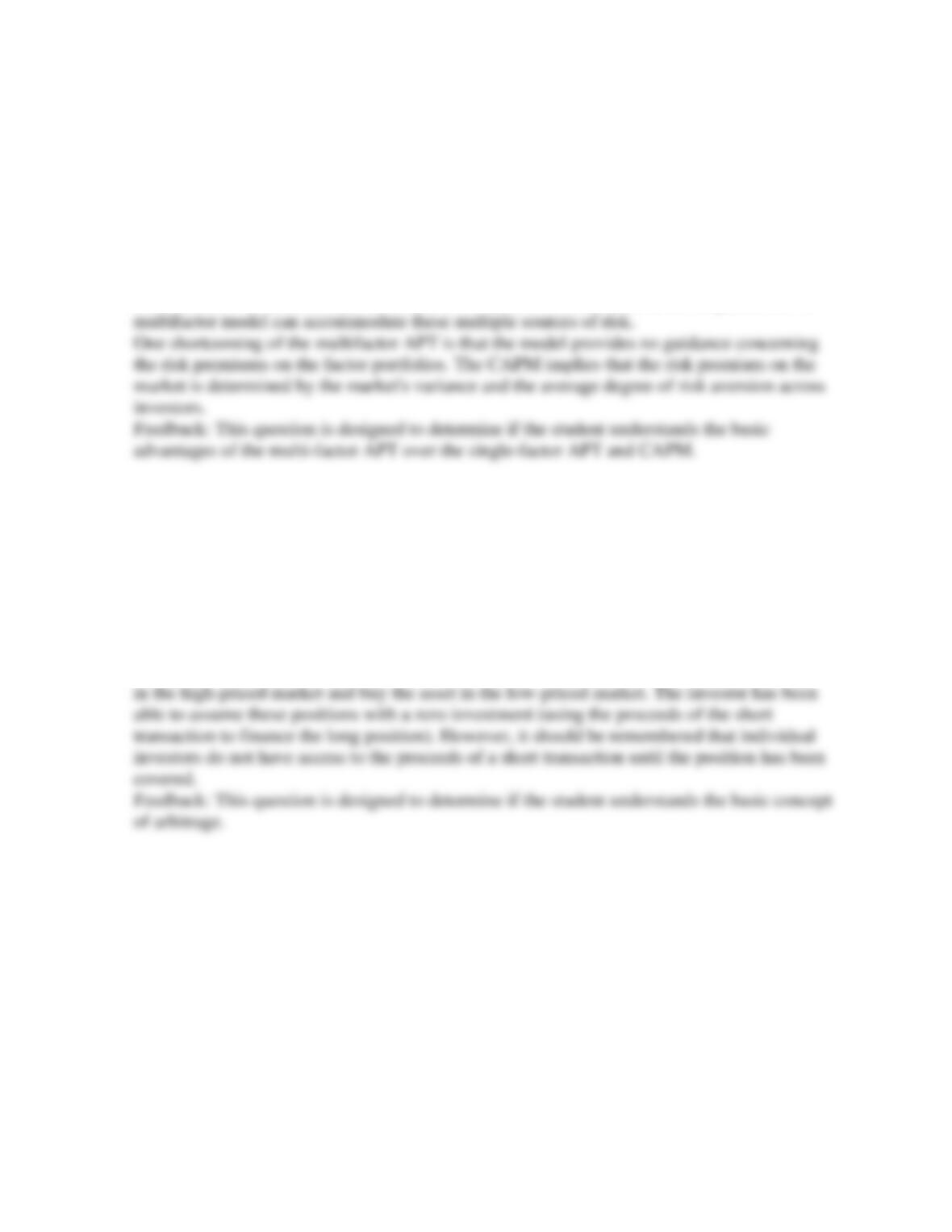
77. Consider the multifactor APT with two factors. Stock A has an expected return of 17.6%,
a beta of 1.45 on factor 1 and a beta of .86 on factor 2. The risk premium on the factor 1
portfolio is 3.2%. The risk-free rate of return is 5%. What is the risk-premium on factor 2 if
no arbitrage opportunities exit?
E. none of the above
Difficulty: Difficult
Short Answer Questions
78. Discuss the advantages of arbitrage pricing theory (APT) over the capital asset pricing
model (CAPM) relative to diversified portfolios.
The APT does not require that the benchmark portfolio in the SML relationship be the true
market portfolio. Any well-diversified portfolio lying on the SML may serve as a benchmark
portfolio. Thus, the APT has more flexibility than the CAPM, as problems associated with an
Difficulty: Moderate
Chapter 10 – Arbitrage Pricing Theory and Multifactor Models of Risk and Return
10–34
79. Discuss the advantages of the multifactor APT over the single factor APT and the CAPM.
What is one shortcoming of the multifactor APT and how does this shortcoming compare to
CAPM implications?
The single factor APT and the CAPM assume that there is only one systematic risk factor
affecting stock returns. However, obviously several factors may affect stock returns. Some of
these factors are: business cycles, interest rate fluctuations, inflation rates, oil prices, etc. A
Difficulty: Moderate
80. Discuss arbitrage opportunities in the context of violations of the law of one price.
The law of one price is violated when an asset is trading at different prices in two markets. If
the price differential exceeds the transactions costs, a simultaneous trade in the two markets
can produce a sure profit with a zero investment. That is, the investor can sell short the asset
Difficulty: Easy
Chapter 10 – Arbitrage Pricing Theory and Multifactor Models of Risk and Return
10–35
81. Discuss the similarities and the differences between the CAPM and the APT with regard
to the following factors: capital market equilibrium, assumptions about risk aversion, risk-
return dominance, and the number of investors required to restore equilibrium.
Both the CAPM and the APT are market equilibrium models, which examine the factors that
affect securities’ prices. In equilibrium, there are no overpriced or underpriced securities. In
both models, mispriced securities can be identified and purchased or sold as appropriate to
earn excess profits.
Difficulty: Difficult
82. Security A has a beta of 1.0 and an expected return of 12%. Security B has a beta of 0.75
and an expected return of 11%. The risk-free rate is 6%. Explain the arbitrage opportunity that
exists; explain how an investor can take advantage of it. Give specific details about how to
form the portfolio, what to buy and what to sell.
An arbitrage opportunity exists because it is possible to form a portfolio of security A and the
risk-free asset that has a beta of 0.75 and a different expected return than security B. The
Difficulty: Moderate
Chapter 10 – Arbitrage Pricing Theory and Multifactor Models of Risk and Return
10–36
83. Name three variables that Chen, Roll, and Ross used to measure the impact of
macroeconomic factors on security returns. Briefly explain the reasoning behind their model.
The factors they considered were IP (the % change in industrial production), EI (the % change
in expected inflation), UI (the % change in unanticipated inflation), CG (excess return of
long-term corporate bonds over long-term government bonds), and GB (excess return of long-
Difficulty: Difficult