CHAPTER 6—EFFICIENT CAPITAL MARKETS TRUE/FALSE Question: Prices in
efficient capital markets fully reflect all available information and rapidly adjust to new
information. Answer:
Question: An efficient market requires a large number of profit-maximizing investors.
Answer:
Question: If the efficient market hypothesis is true price changes are independent and
biased. Answer:
Question: The random walk hypothesis contends that stock prices occur randomly.
Answer:
Question: In his original article, Fama divided the efficient market hypothesis into two
subhypotheses. Answer:
Question: The weak form of the efficient market hypothesis contends that stock prices
fully reflect all public and private information. Answer:
Question: The weak form of the efficient market hypothesis contends that technical trading

rules are of little value. Answer:
Question: Tests have shown that if small filters are used in simulating trading rules, these
trading rules have produced above average returns after transactions costs are factored in.
Answer:
Question: In tests of the semi-strong form EMH, it is not necessary to use risk-adjusted
rates of return. Answer:
Question: Results of initial public offering (IPOs) studies tend to support the semi-strong
EMH, because it appears that prices adjusted rapidly after initial underpricing. Answer:
Question: Results from studies on the effects of unexpected world events have consistently
indicated that the price change is so rapid, that it takes place between the close of one day
and the opening of the next day. Answer:
Question: Studies concerning quarterly earnings reports indicate that information in
quarterly statements is of value and can provide an above-average risk-adjusted return.
Answer:

Question: Results of studies concerning corporate insider trading indicate that corporate
insiders generally enjoy above-average returns. Answer:
Question: The strong form of the efficient market hypothesis contends that only insiders
can earn abnormal returns. Answer:
Question: Technical analysis and the efficient market hypothesis have a consistent set of
assumptions concerning stock market behavior. Answer:
Question: Even when fees and costs are considered most mutual fund managers
outperform the aggregate market. Answer:
Question: When considering markets in Europe, it is inappropriate to assume a level of
efficiency similar to that for U.S. markets. Answer:
Question: The weak-form efficient market hypothesis assumes all publicly available
information is reflected in current stock prices. Answer:
Question: Studies examining stock splits support the semi-strong form efficient market
hypothesis. Answer:

Question: There is little evidence from studies examining initial public offerings (IPOs)
that suggest markets are semi-strong form efficient. Answer:
Question: Which of the following would be inconsistent with an efficient market?
Answer:
Question: Fusion investing is the integration of the following elements of investment
valuation:

Answer:
Question: The weak form of the efficient market hypothesis states that
Answer:
Question: Which statement is true concerning alternative efficient market hypothesis?

Answer:
Question: If statistical tests of stock returns over time support the efficient market
hypothesis the resulting correlations should be
Answer:
Question: A “runs test” on successive stock price changes which supports the efficient
market hypothesis would show the actual number of runs

Answer:
Question: A trading rule which signals purchase of a stock if it rises X percent and sale of a
stock if it falls X percent is known as a
Answer:
Question: Which of the following has not been involved in a direct test of the semi-strong
form of the efficient market hypothesis?
Answer:

Question: Examples of anomalies providing contrary evidence to the semi-strong efficient
market hypothesis include studies of all of the following except
Answer:
Question: The opportunity to take advantage of the downward pressure on stock prices that
result from end-of-the-year tax selling is known as
Answer:
Question: Banz and Reinganum found that small firms consistently outperformed large
firms. This anomaly is referred to as the

Answer:
Question: The performance of four major groups of investors has been studied in
connection with tests of the strong-form of the efficient market hypothesis. These include
all of the following except
Answer:
Question: Abnormal returns associated with rankings by a major advisory service are
associated with
Answer:

Question: The implication of efficient capital markets and a lack of superior analysts have
led to the introduction of
Answer:
Question: Superior analysts are encouraged to concentrate their efforts in “middle tier”
stocks. This is recommended because

Answer:
Question: A portfolio manager without superior analytical skills should
Answer:
Question: Which is not an implication of the EMH?

Answer:
Question: Some studies have attempted to determine whether it is possible to predict future
returns for a stock based on publicly available quarterly earnings reports. The results of
these studies indicate

Answer:
Question: The results of studies that have looked at the relationship between PEG ratios
and subsequent stock returns
Answer:

Question: The strongest explanations for the size anomaly are
Answer:
Question: Fama and French examined the relationship between the Book Value to Market
Value ratio and average stock returns and found
Answer:

Question: Investigators have tested the strong form EMH by examining the performance of
the following type of investor
Answer:
Question: Escalation bias refers to the situation where
Answer:

Question: Confirmation bias refers to the situation where
Answer:
Question: According to prospect theory

Answer:
Question: Behavioral finance differs from the standard model of finance because
behavioral finance
Answer:
Question: Studies of the relationship between P/E ratios and stock returns have found that

Answer:
Question: The January anomaly refers to the phenomenon where stock prices
Answer:
Question: Researchers have found a positive relationship between default spread and stock
returns in the long run because a large default spread implies

Answer:
Question: The results of return prediction studies have found
Answer:
Question: In tests of the semi-strong form efficient market hypothesis, an adjustment for
market effects is carried out by

Answer:
Question: In an event study the objective is to
Answer:
Question: In order to confirm the weak-form efficient market hypothesis you could
develop trading rules that consider,

Answer:
Question: In order to confirm the weak-form efficient market hypothesis, an examination
of stock price runs over time would reveal that stock price changes over time were
Answer:
Question: According to the strong-form efficient market hypothesis, stock prices fully
reflect

Answer:
Question: According to the semi-strong form efficient market hypothesis, which of the
following types of information are fully reflected in stock prices?
Answer:
Question: According to the weak-form efficient market hypothesis, which of the following
types of information are fully reflected in stock prices?

Answer:
Question: Which of the following assumptions imply capital markets will be efficient?
Answer:

Question: Autocorrelation and runs tests are used to test the
Answer:
Question: Event studies are used to test the
Answer:
Question: Evidence supporting the strong form efficient market hypothesis (EMH) resulted
from examining

Answer:
Question: Which of the following behaviors is consistent with escalation bias?
Answer:
Question: Fusion investing refers to the combination of

Answer:
USE THE FOLLOWING INFORMATION FOR THE NEXT PROBLEM(S)
Rit = return for stock i during period t Rmt = return for the aggregate market during period
t NARREND Question: Refer to Exhibit 6-1. What is the abnormal rate of return for Stock
C during period t using only the aggregate market return (ignore differential systematic
risk)?
Answer:
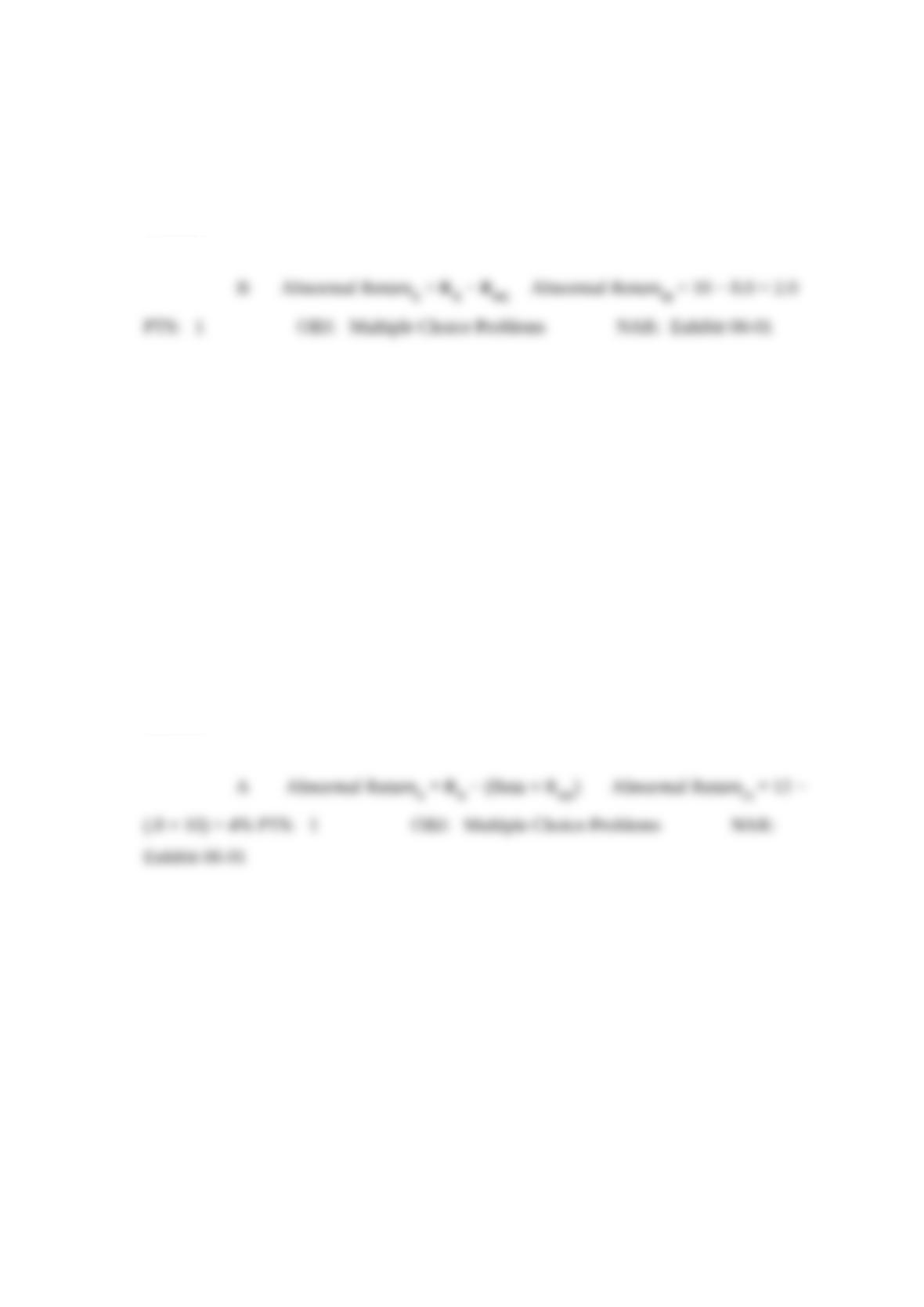
Question: Refer to Exhibit 6-1. What is the abnormal rate of return for Stock E during
period t using only the aggregate market return (ignore differential systematic risk)?
Answer:
Question: Refer to Exhibit 6-1. What is the abnormal rate of return for Stock C when you
consider its systematic risk measure (beta)?
Answer:
Question: Refer to Exhibit 6-1. What is the abnormal rate of return for Stock E when you
consider its systematic risk measure (beta)?
Answer:
USE THE FOLLOWING INFORMATION FOR THE NEXT PROBLEM(S)
Rit = return for stock i during period t Rmt = return for the aggregate market during period
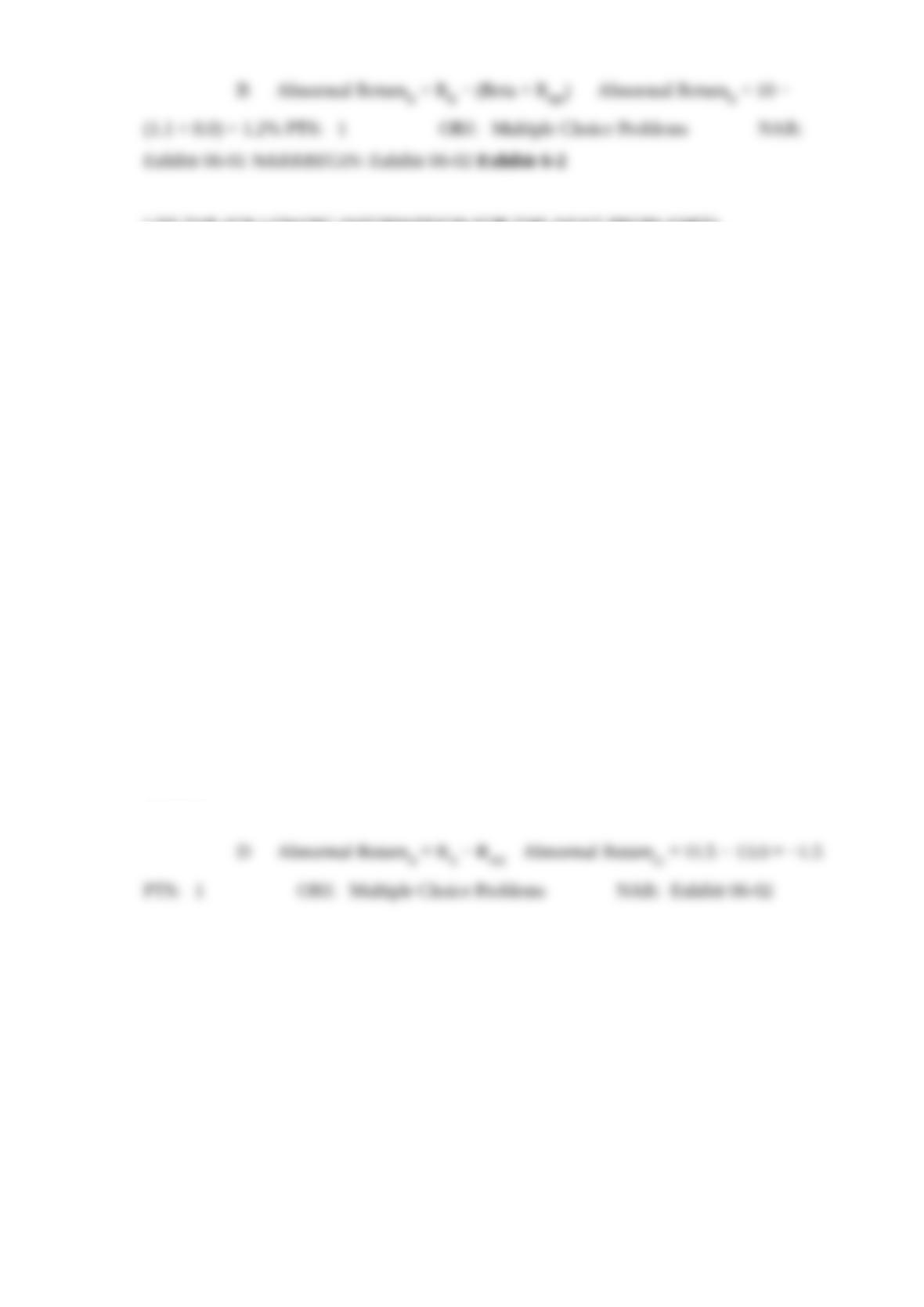
t NARREND Question: Refer to Exhibit 6-2. What is the abnormal rate of return for Stock
ABC during period t using only the aggregate market return (ignore differential systematic
risk)?
Answer:
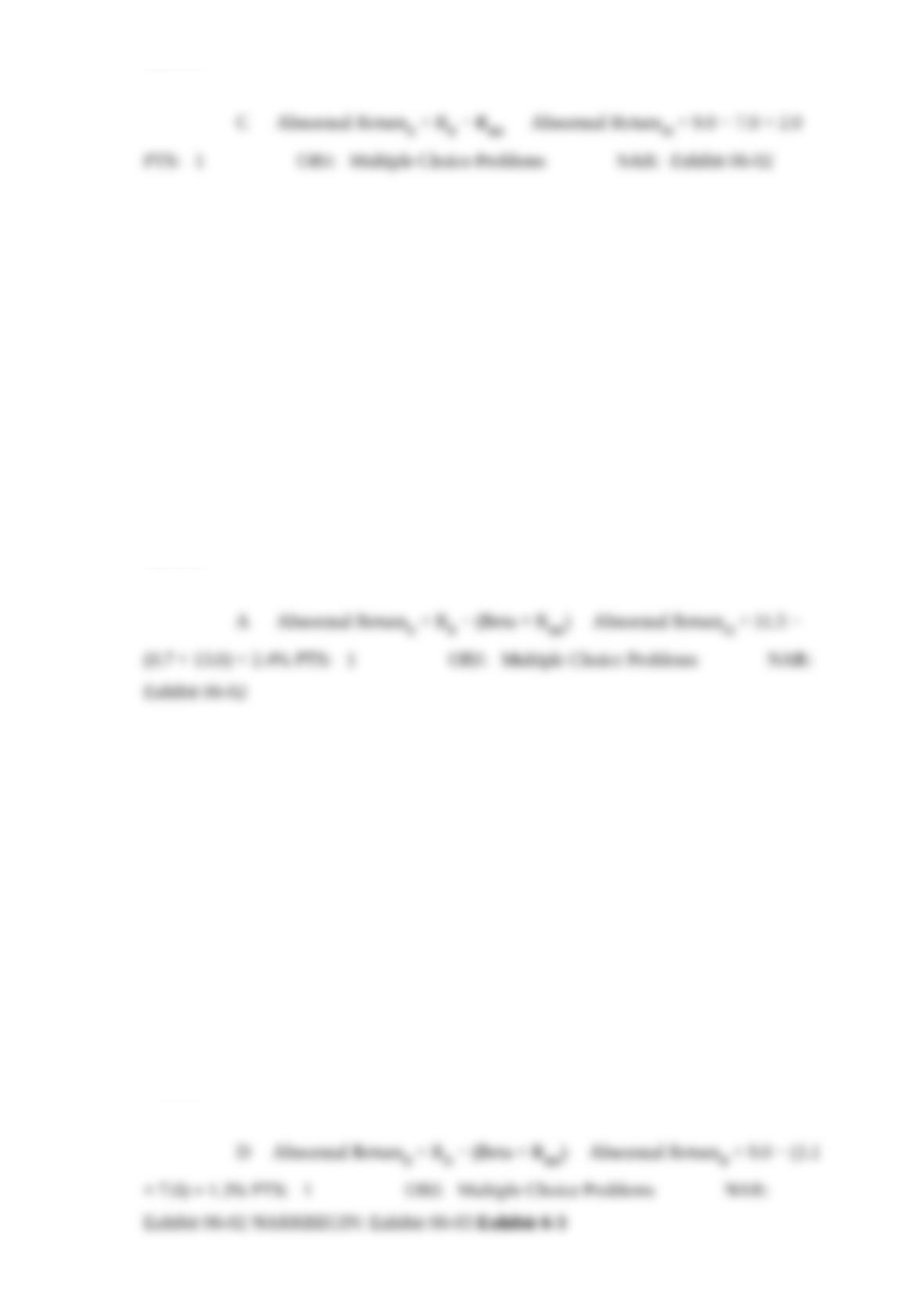
Question: Refer to Exhibit 6-2. What is the abnormal rate of return for Stock XYZ during
period t using only the aggregate market return (ignore differential systematic risk)?
Answer:
Question: Refer to Exhibit 6-2. What is the abnormal rate of return for Stock ABC when
you consider its systematic risk measure (beta)?
Answer:
Question: Refer to Exhibit 6-2. What is the abnormal rate of return for Stock XYZ when
you consider its systematic risk measure (beta)?
Answer:
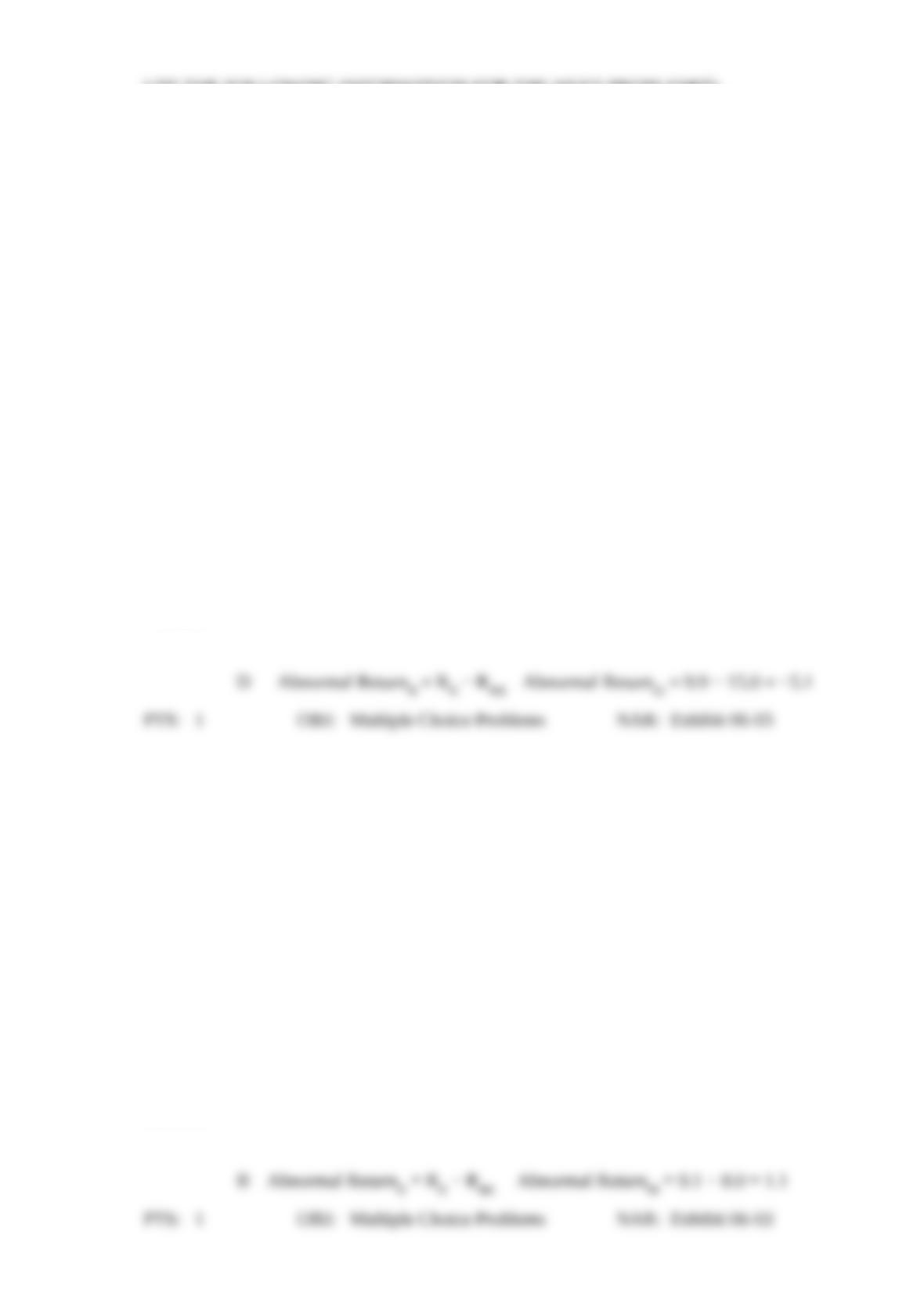
USE THE FOLLOWING INFORMATION FOR THE NEXT PROBLEM(S)
Rit = return for stock i during period t Rmt = return for the aggregate market during period
t NARREND Question: Refer to Exhibit 6-3. What is the abnormal rate of return for Elliot
during period t using only the aggregate market return (ignore differential systematic risk)?
Answer:
Question: Refer to Exhibit 6-3. What is the abnormal rate of return for Hemlick during
period t using only the aggregate market return (ignore differential systematic risk)?
Answer:
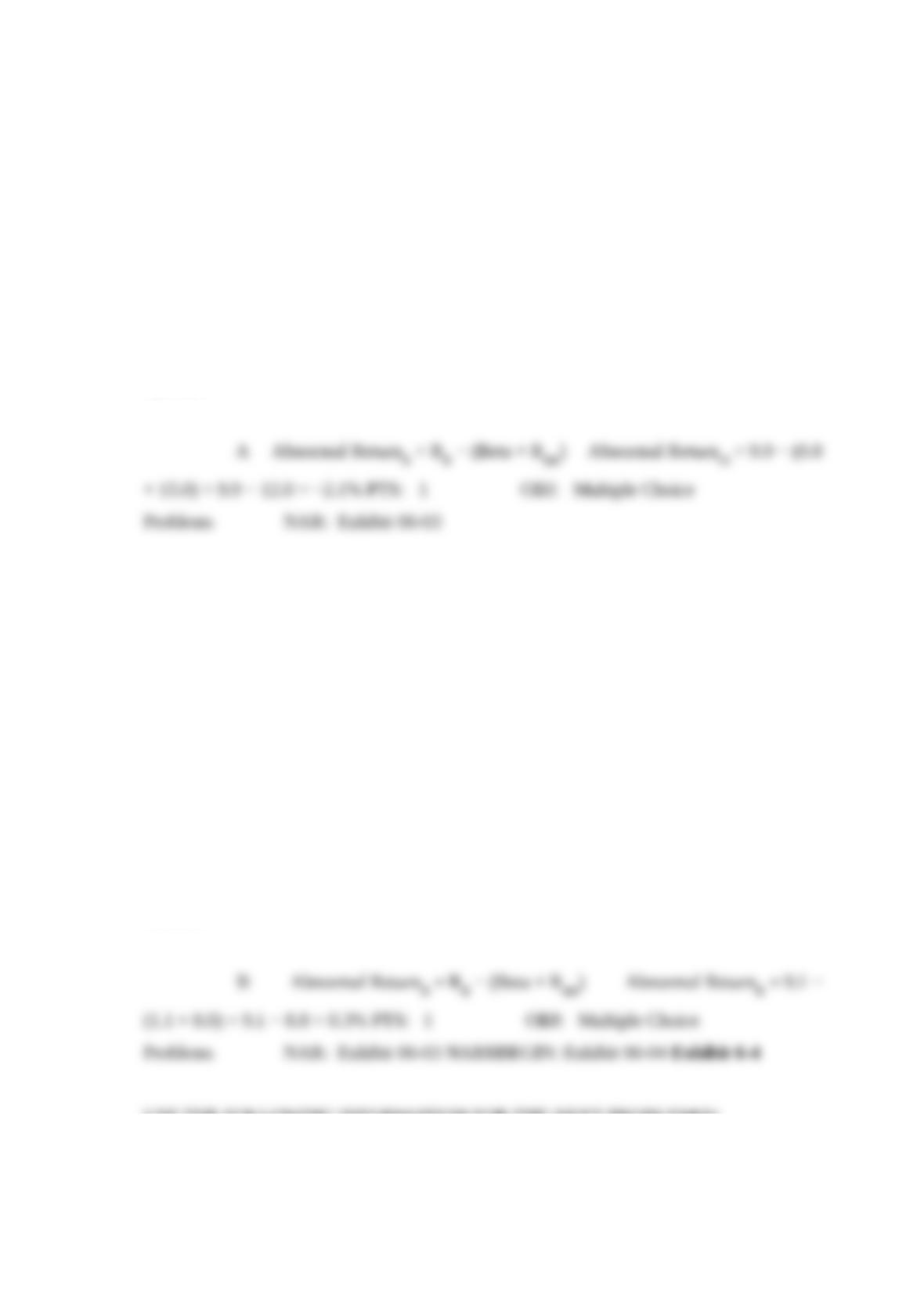
Question: Refer to Exhibit 6-3. What is the abnormal rate of return for Elliot when you
consider its systematic risk measure (beta)?
Answer:
Question: Refer to Exhibit 6-3. What is the abnormal rate of return for Hemlick when you
consider its systematic risk measure (beta)?
Answer:
USE THE FOLLOWING INFORMATION FOR THE NEXT PROBLEM(S)
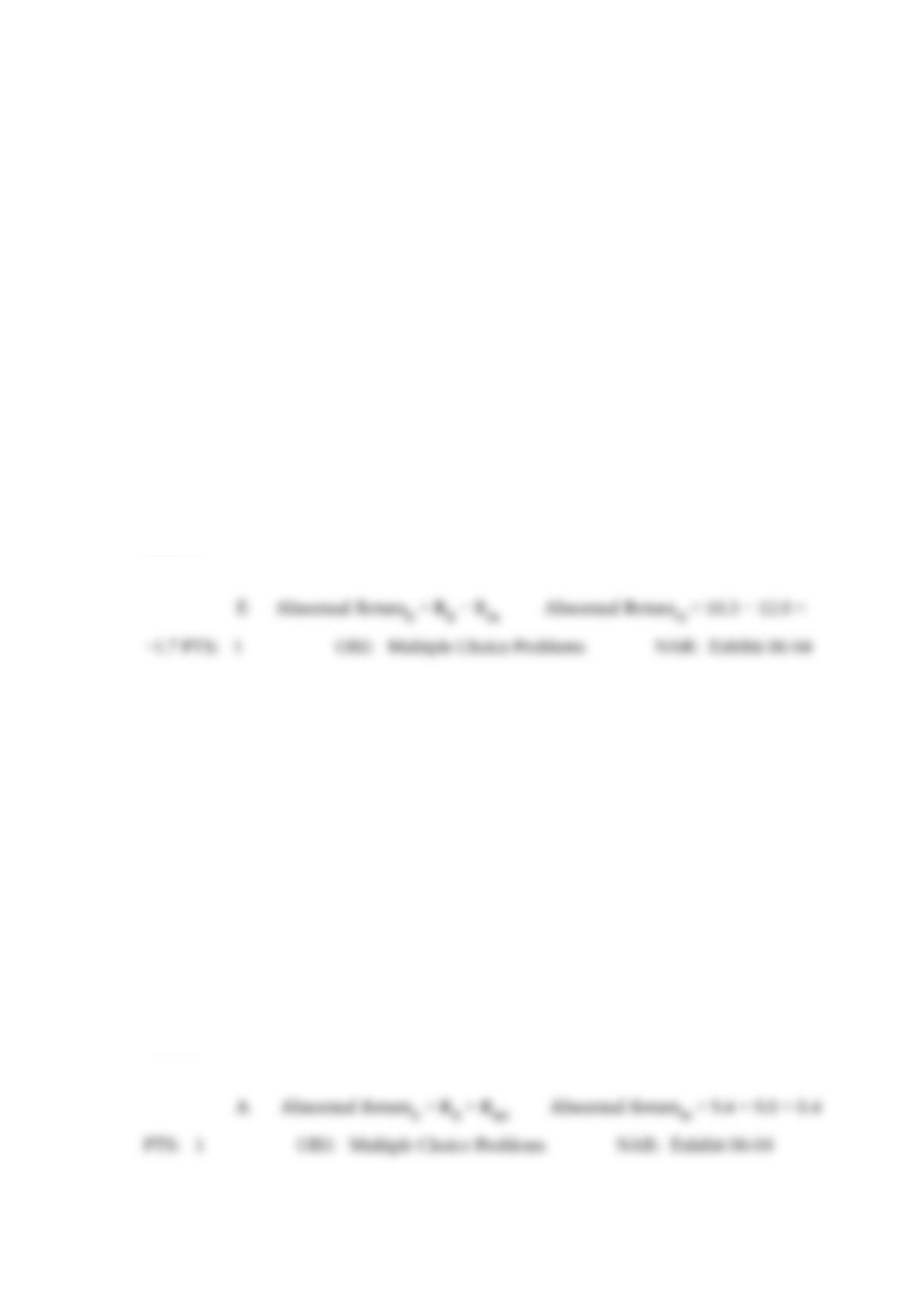
Rit = return for stock i during period t Rmt = return for the aggregate market during period
t NARREND Question: Refer to Exhibit 6-4. What is the abnormal rate of return for Stock
A during period t using only the aggregate market return (ignore differential systematic
risk)?
Answer:
Question: Refer to Exhibit 6-4. What is the abnormal rate of return for Stock B during
period t using only the aggregate market return (ignore differential systematic risk)?
Answer:
Question: Refer to Exhibit 6-4. What is the abnormal rate of return for Stock A when you
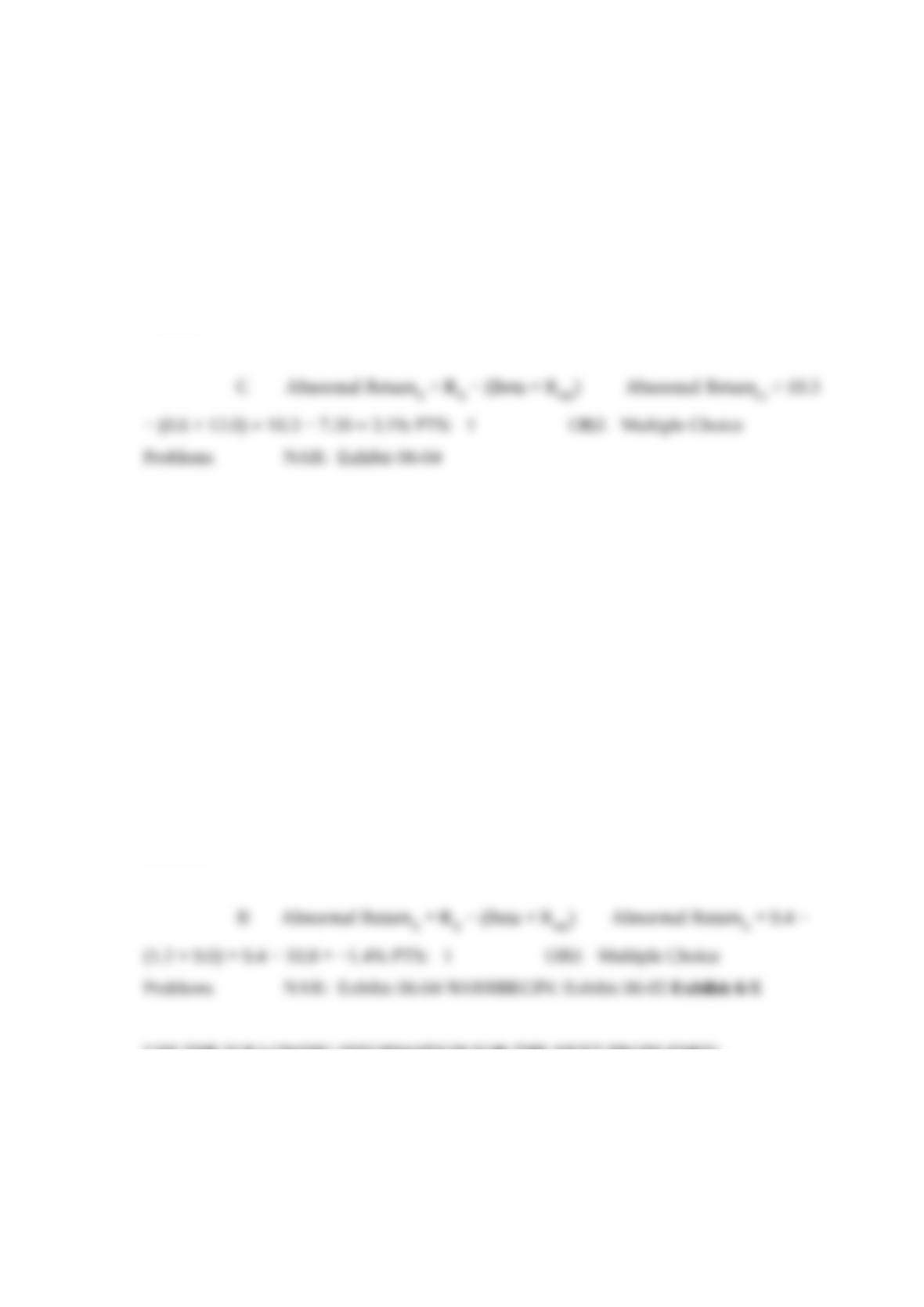
consider its systematic risk measure (beta)?
Answer:
Question: Refer to Exhibit 6-4. What is the abnormal rate of return for Stock B when you
consider its systematic risk measure (beta)?
Answer:
USE THE FOLLOWING INFORMATION FOR THE NEXT PROBLEM(S)
Rit = return for stock i during period t Rmt = return for the aggregate market during period
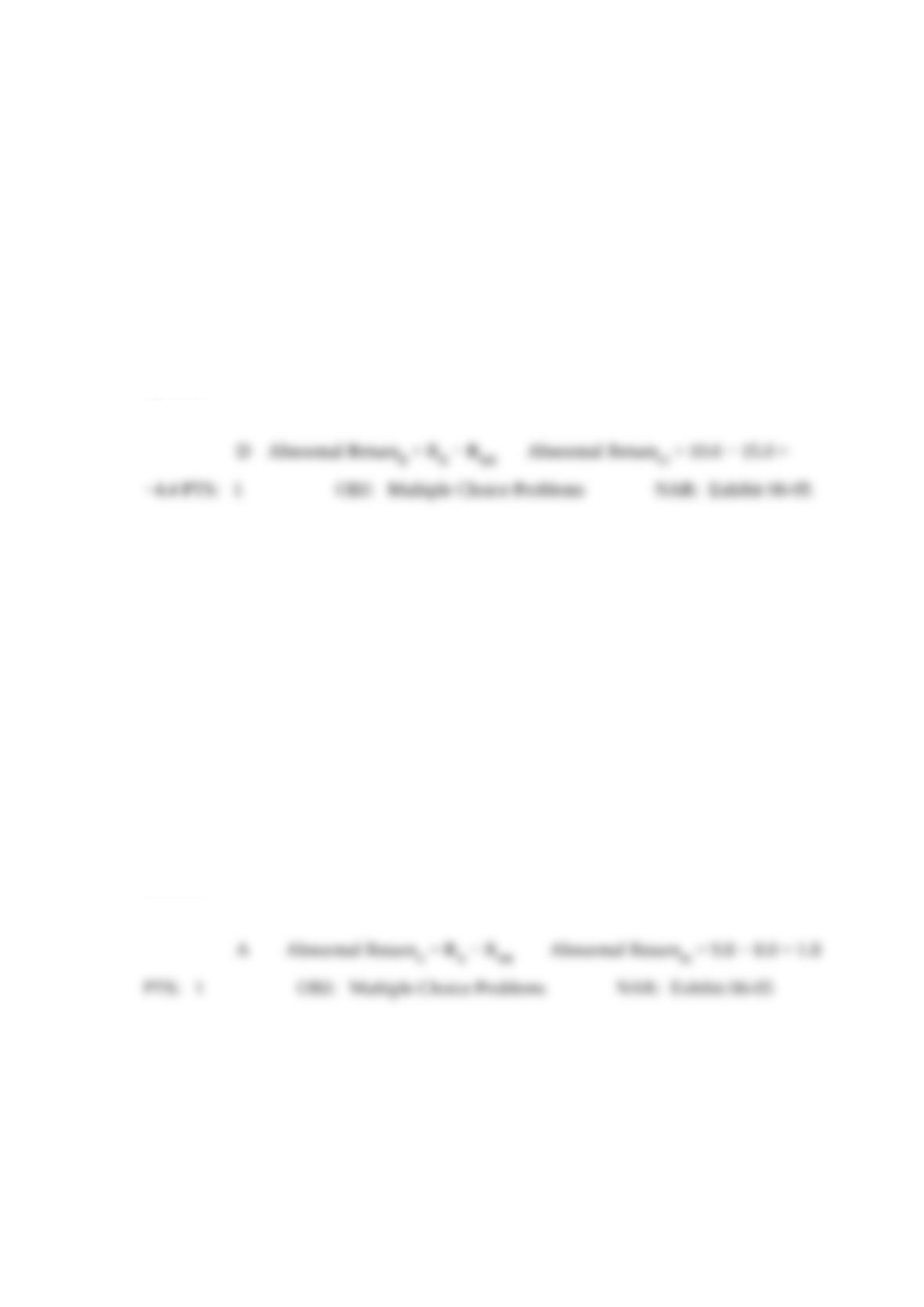
t NARREND Question: Refer to Exhibit 6-5. What is the abnormal rate of return for Stock
A during period t using only the aggregate market return (ignore differential systematic
risk)?
Answer:
Question: Refer to Exhibit 6-5. What is the abnormal rate of return for Stock Z during
period t using only the aggregate market return (ignore differential systematic risk)?
Answer:
Question: Refer to Exhibit 6-5. What is the abnormal rate of return for Stock A when you
consider its systematic risk measure (beta)?
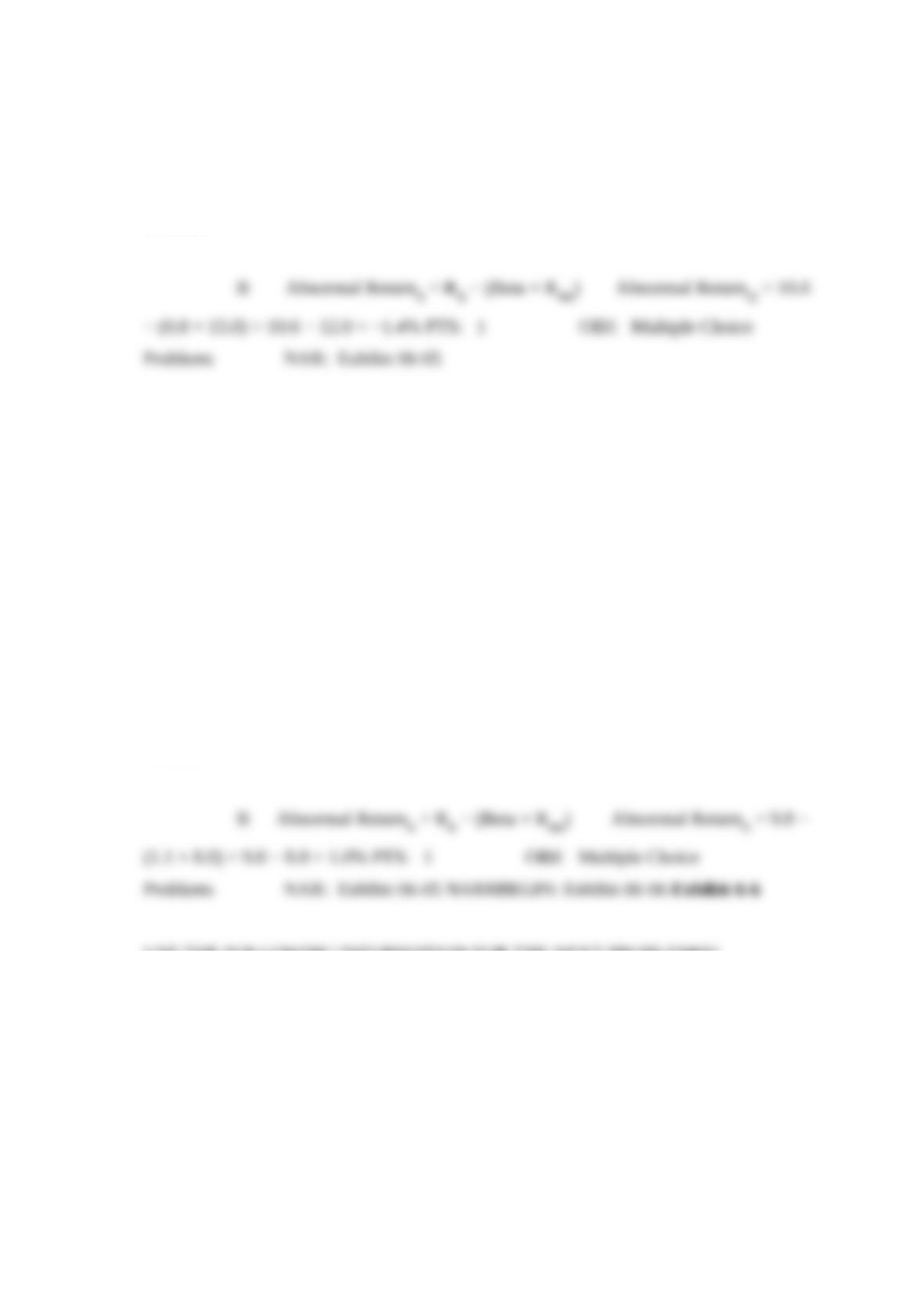
Answer:
Question: Refer to Exhibit 6-5. What is the abnormal rate of return for Stock Z when you
consider its systematic risk measure (beta)?
Answer:
USE THE FOLLOWING INFORMATION FOR THE NEXT PROBLEM(S)
Rit = return for stock i during period t Rmt = return for the aggregate market during period
t NARREND Question: Refer to Exhibit 6-6. What is the abnormal rate of return for Stock
A during period t using only the aggregate market return (ignore differential systematic
risk)?
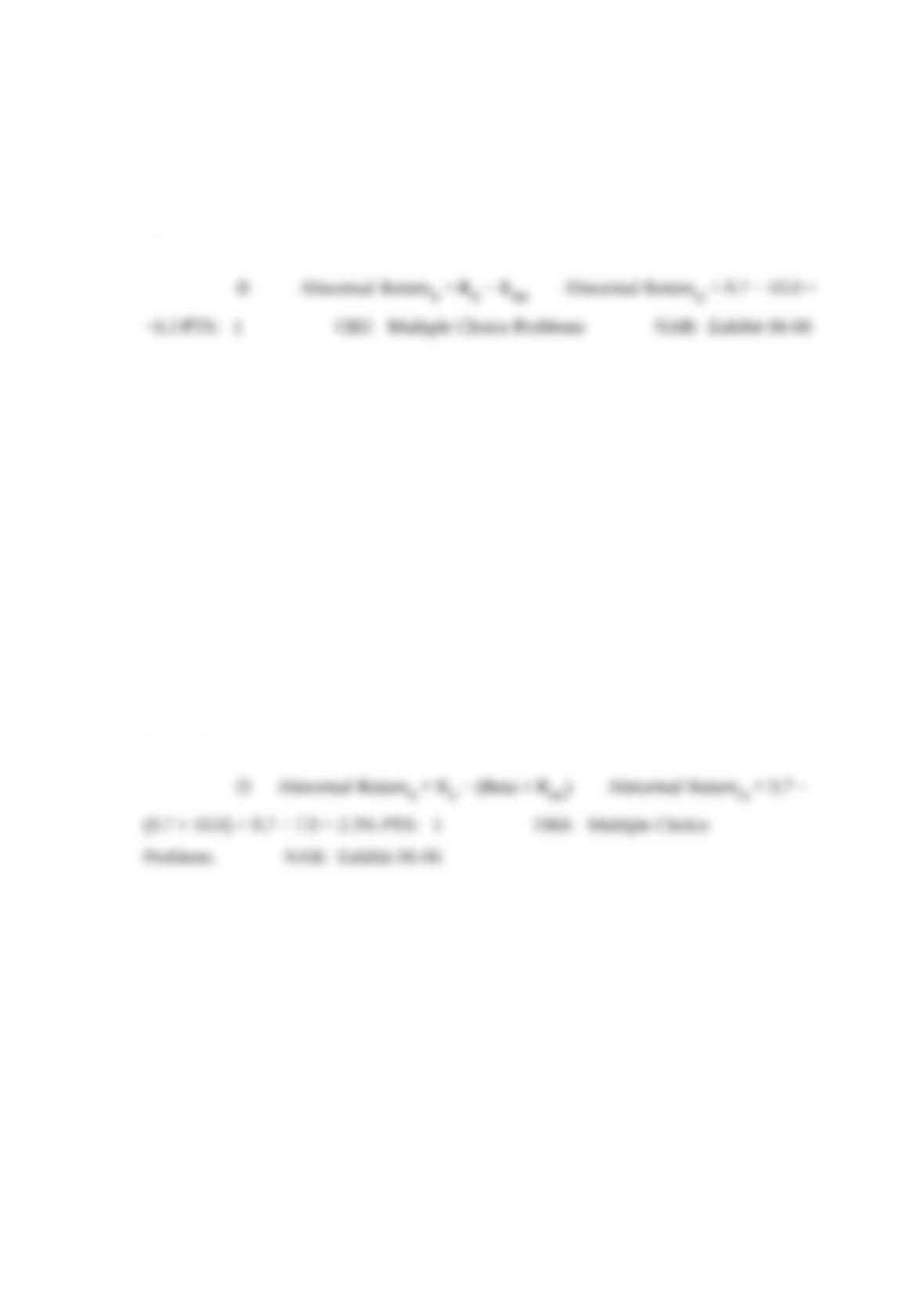
Answer:
Question: Refer to Exhibit 6-6. What is the abnormal rate of return for Stock A when you
consider its systematic risk measure (beta)?
Answer:
Question: Refer to Exhibit 6-6. What is the abnormal rate of return for Stock B when you
consider its systematic risk measure (beta)?
Answer: