
CHAPTER 5—SECURITY-MARKET INDEXES TRUE/FALSE Question: The
general purpose of a market indicator series is to provide an overall indication of aggregate
market changes or movements. Answer:
Question: An aggregate market index can be used as a benchmark to judge the
performance of professional money managers. Answer:
Question: A price weighted series is disproportionately influenced by larger capitalization
companies. Answer:
Question: The Dow Jones Industrial Average is a value weighted average. Answer:
Question: A two for one stock split causes the divisor in a price-weighted series to decline.
Answer:
Question: The Dow Jones Industrial Average has been criticized for being blue-chip
biased. Answer:
Question: Unlike the Dow Jones Industrial Average, the Nikkei-Dow Jones Average is
price weighted. Answer:

Question: A value weighted index automatically adjusts for stock splits. Answer:
Question: The New York Stock Exchange Index is based on a sample of all of the New
York Stock Exchange stocks. Answer:
Question: An equally weighted indicator series is also known as an unweighted indicator
series. Answer:
Question: Bond-market indicator series have been around much longer than stock-market
indicator series. Answer:
Question: It is easier to construct an indicator series for bonds because of their relatively
stable returns pattern. Answer:
Question: The major U.S. stock indexes are highly correlated. Answer:

Question: To solve comparability problems across countries, global equity indexes with
consistent sample selection, weighting and computational procedure have been developed.
Answer:
Question: There are no composite series currently available that will measure the
performance of all securities (i.e. stocks and bonds) in a given country. Answer:
Question: The NYSE series should have higher rates of return and risk measures than the
AMEX and OTC series. Answer:
Question: There is a high correlation between the Wilshire 5000 index and the alternative
NYSE series (S&P 500 and the NYSE), representing the substantial influence of large
NYSE stocks on the Wilshire 5000 index. Answer:
Question: The low correlations between the U.S. and Japan, confirm the benefit of global
diversification. Answer:
Question: The correlations among the U.S. investment-grade-bond series were very high
because all rates of return for investment-grade bonds over time are impacted by common
macroeconomic variables. Answer:

Question: A bond market index is easier to create than a stock market index because the
universe of bonds is much broader than that of stocks. Answer:
Question: The Standard & Poors 500 index is an example of a value weighted index.
Answer:
Question: The Standard & Poors International Index consists of 3 international, 19
national, and 38 international industry indexes. Answer:
Question: Which of the following is not a use of security market indicator series?
Answer:

Question: A properly selected sample for use in constructing a market indicator series will
consider the samples source, size and
Answer:
Question: In a price weighted average stock market indicator series, the following type of
stock has the greatest influence
Answer:
Question: What effect does a stock substitution or stock split have on a price-weighted
series?

Answer:
Question: Which of the following is not a value-weighted series?
Answer:
Question: An example of a value weighted stock market indicator series is the

Answer:
Question: In a value weighted index
Answer:
Question: Of the following indices, which includes the most comprehensive list of stocks?

Answer:
Question: The Value Line Composite Average is calculated using the ____ of percentage
price changes.
Answer:
Question: Which of the following is not a global equity indicator series?

Answer:
Question: The Ryan Treasury Index is an example of a
Answer:
Question: Studies of correlations among monthly equity price index returns have found:

Answer:
Question: Which of the following is true of the various market index series?
Answer:

Question: Which of the following are factors that make it difficult to create and maintain a
bond index?
Answer:
Question: Which of the following is not a U.S. investment-grade bond index?
Answer:
Question: The following are examples of Style Indexes

Answer:
Question: Studies of correlations among monthly U.S. bond price index returns have
found:
Answer:
Question: Index movements are influenced by differential prices of the components in a

Answer:
Question: Which index is created by first deriving the initial total market value of all
stocks used in the index?
Answer:
Question: The actual index movements are typically based on the arithmetic mean of the
percent changes in price or value for the stocks in the
Answer:
USE THE FOLLOWING INFORMATION FOR THE NEXT PROBLEM(S)
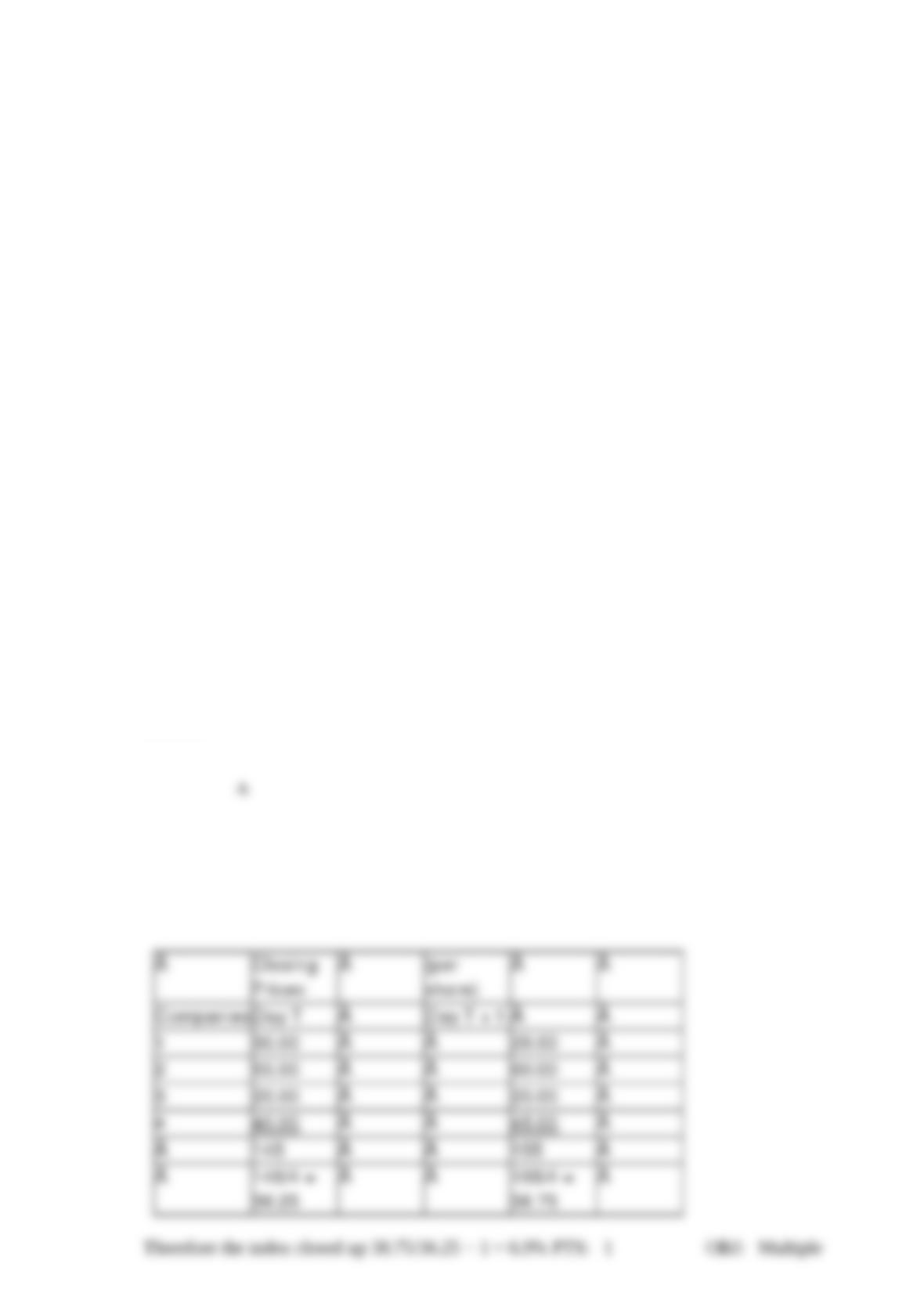
NARREND Question: Refer to Exhibit 5-1. Assume that a stock price-weighted indicator
consisted of the four issues with their prices. What are the values of the stock indicator for
Day T and T + 1 and what is the percentage change?
Answer:
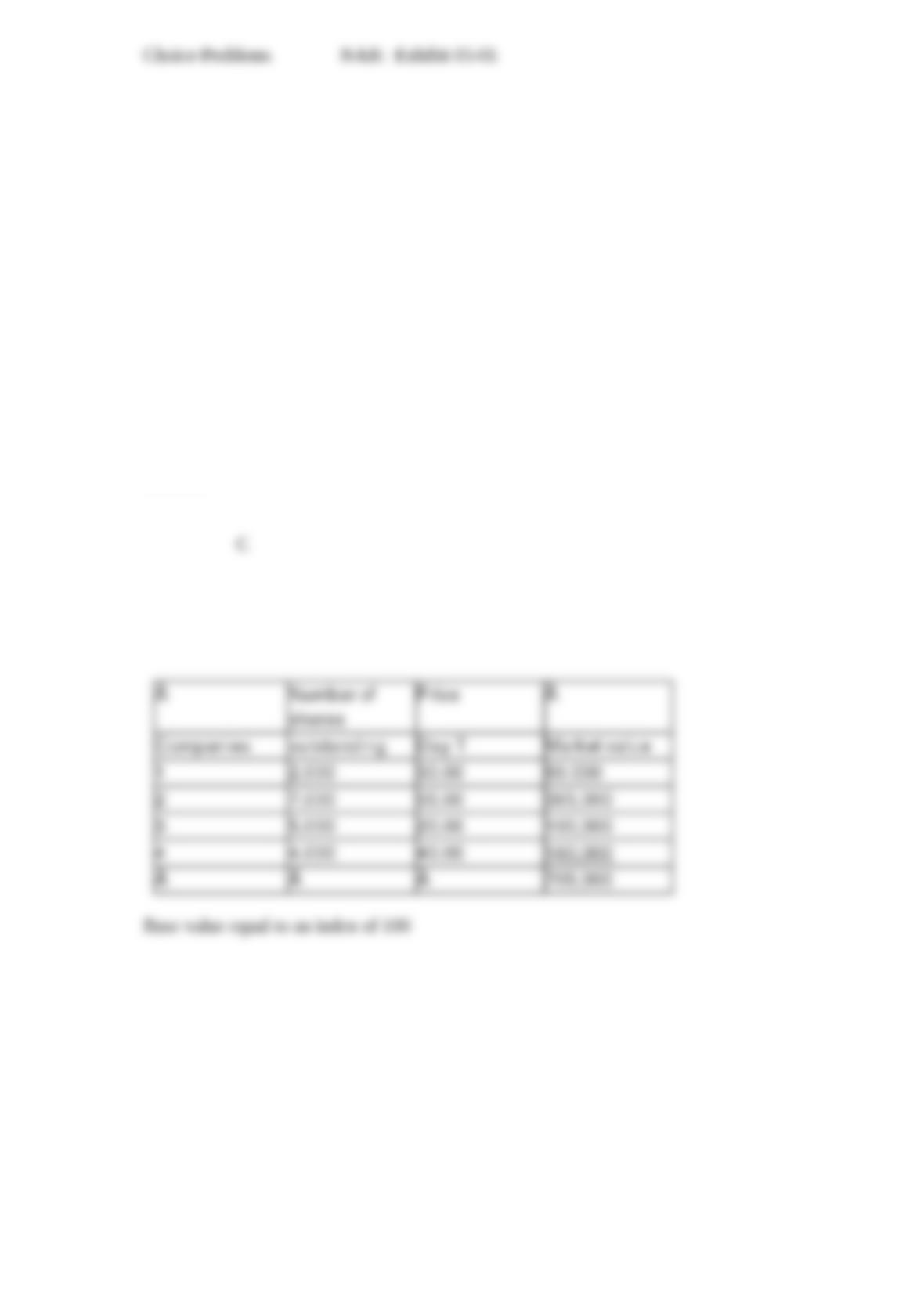
Question: Refer to Exhibit 5-1. For a value-weighted series, assume that Day T is the base
period and the base value is 100. What is the new index value for Day T + 1 and what is
the percentage change in the index from Day T?
Answer:
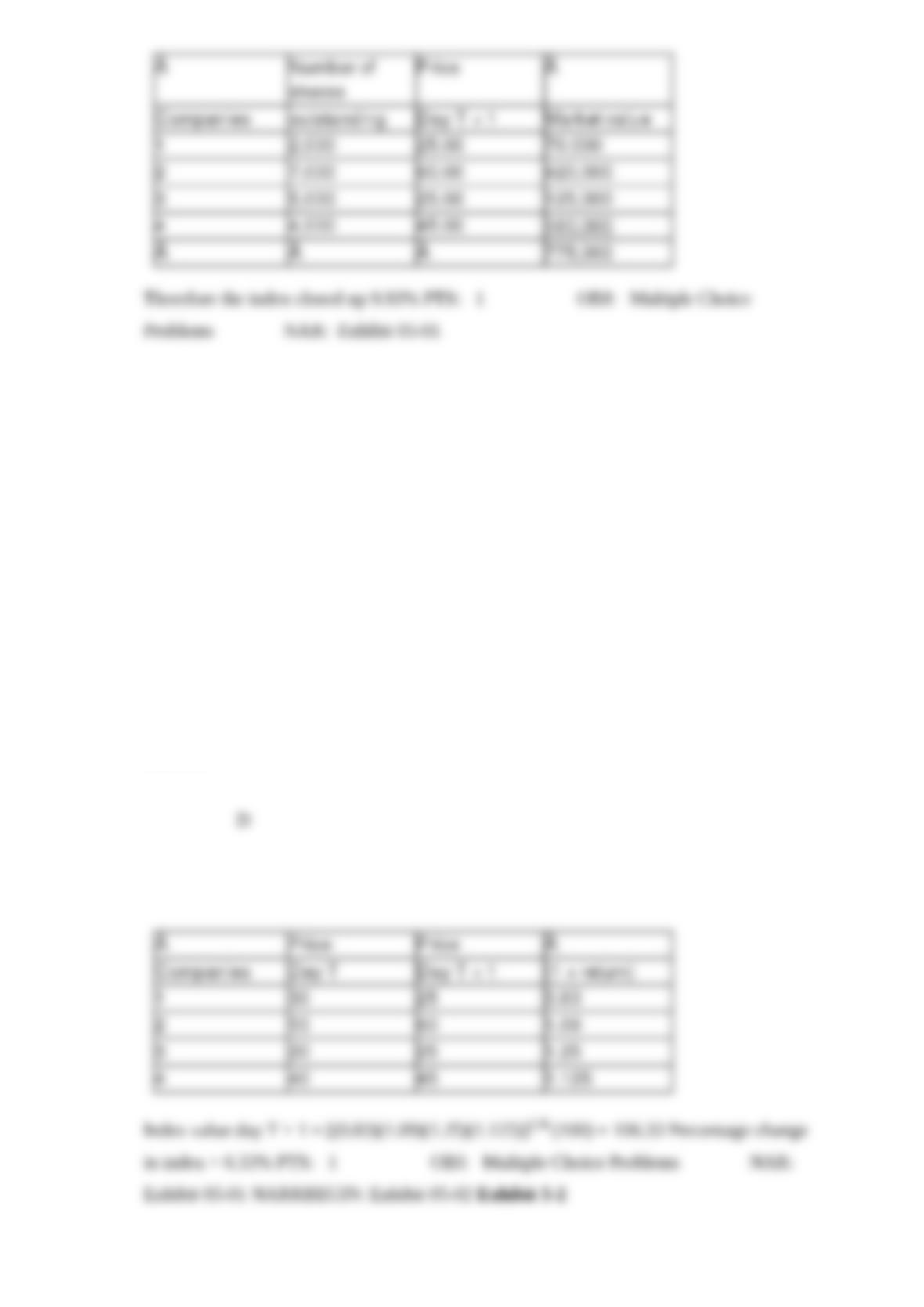
Question: Refer to Exhibit 5-1. Compute an unweighted price indicator series, using
geometric means. What is the percentage change in the index from Day T to Day T + 1?
Assume a base index value of 100 on Day T.
Answer:

USE THE FOLLOWING INFORMATION FOR THE NEXT PROBLEM(S)
*2:1 Split on Stock Z after Close on Jan. 13, 2005 **3:1 Split on Stock X after Close on
Jan. 15, 2005 The base date for index calculations is January 13, 2005 NARREND
Question: Refer to Exhibit 5-2. Calculate a price weighted average for January 13th.
Answer:
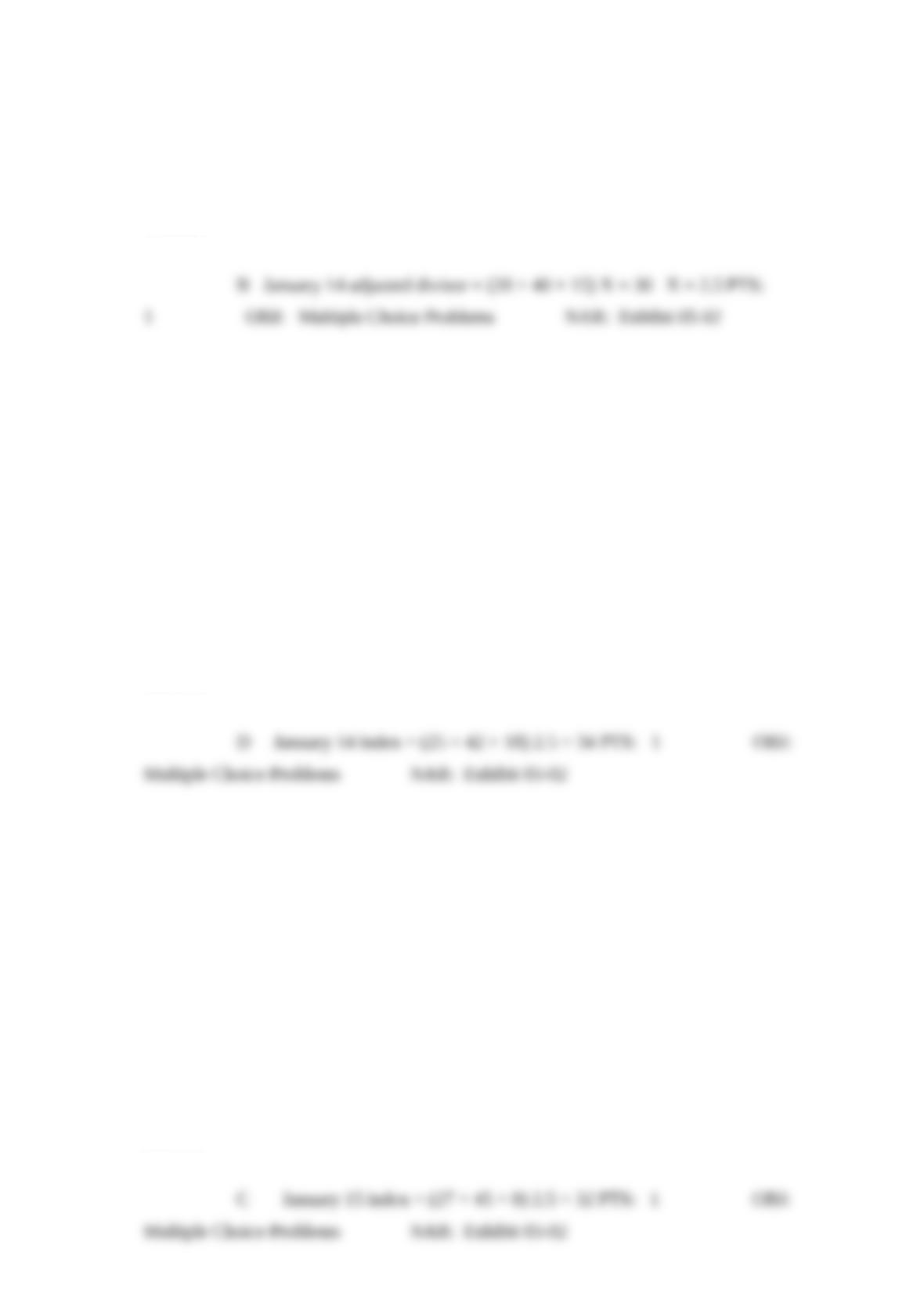
Question: Refer to Exhibit 5-2. What is the divisor at the beginning of January 14th?
Answer:
Question: Refer to Exhibit 5-2. Calculate a price weighted average for January 14th.
Answer:
Question: Refer to Exhibit 5-2. Calculate a price weighed average for January 15th.
Answer:
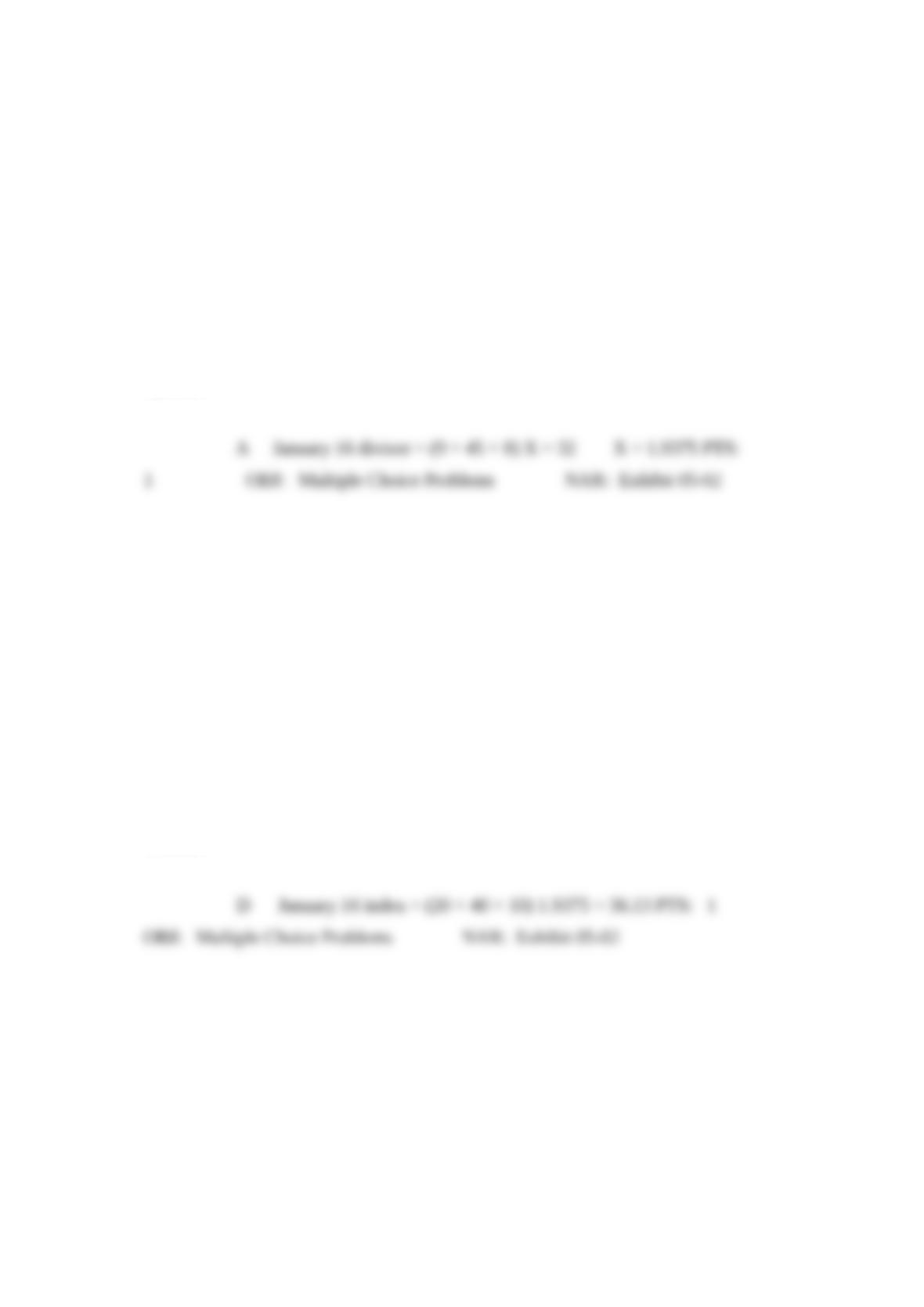
Question: Refer to Exhibit 5-2. What is the divisor at the beginning of January 16th?
Answer:
Question: Refer to Exhibit 5-2. Calculate a price weighted average for January 16th.
Answer:
Question: Refer to Exhibit 5-2. Calculate a value weighted index for Jan. 13th if the initial
index value is 100.
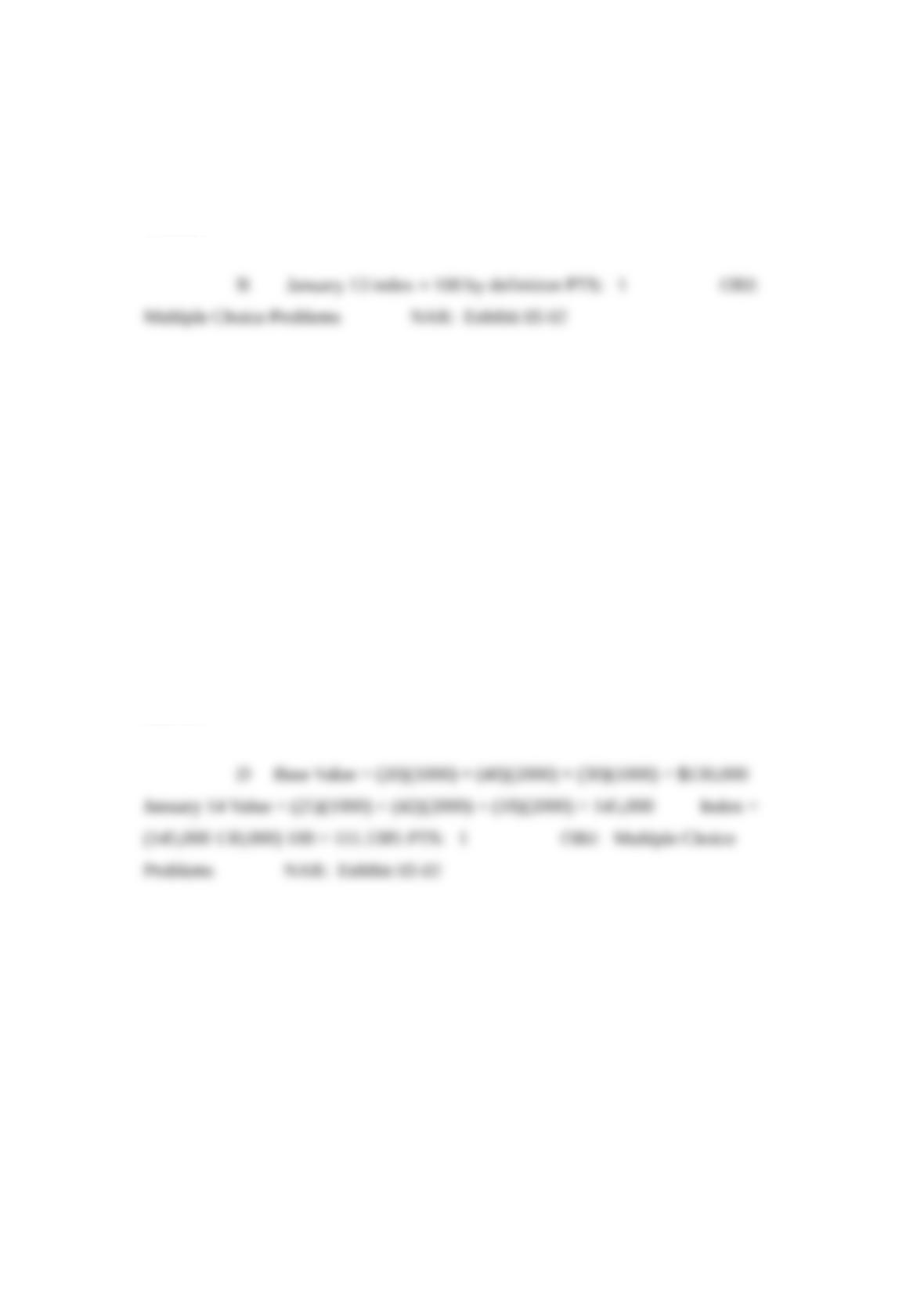
Answer:
Question: Refer to Exhibit 5-2. Calculate a value weighted index for Jan. 14th if the initial
index value is 100.
Answer:
Question: Refer to Exhibit 5-2. Calculate a value weighted index for January 15th if the
initial index value is 100.
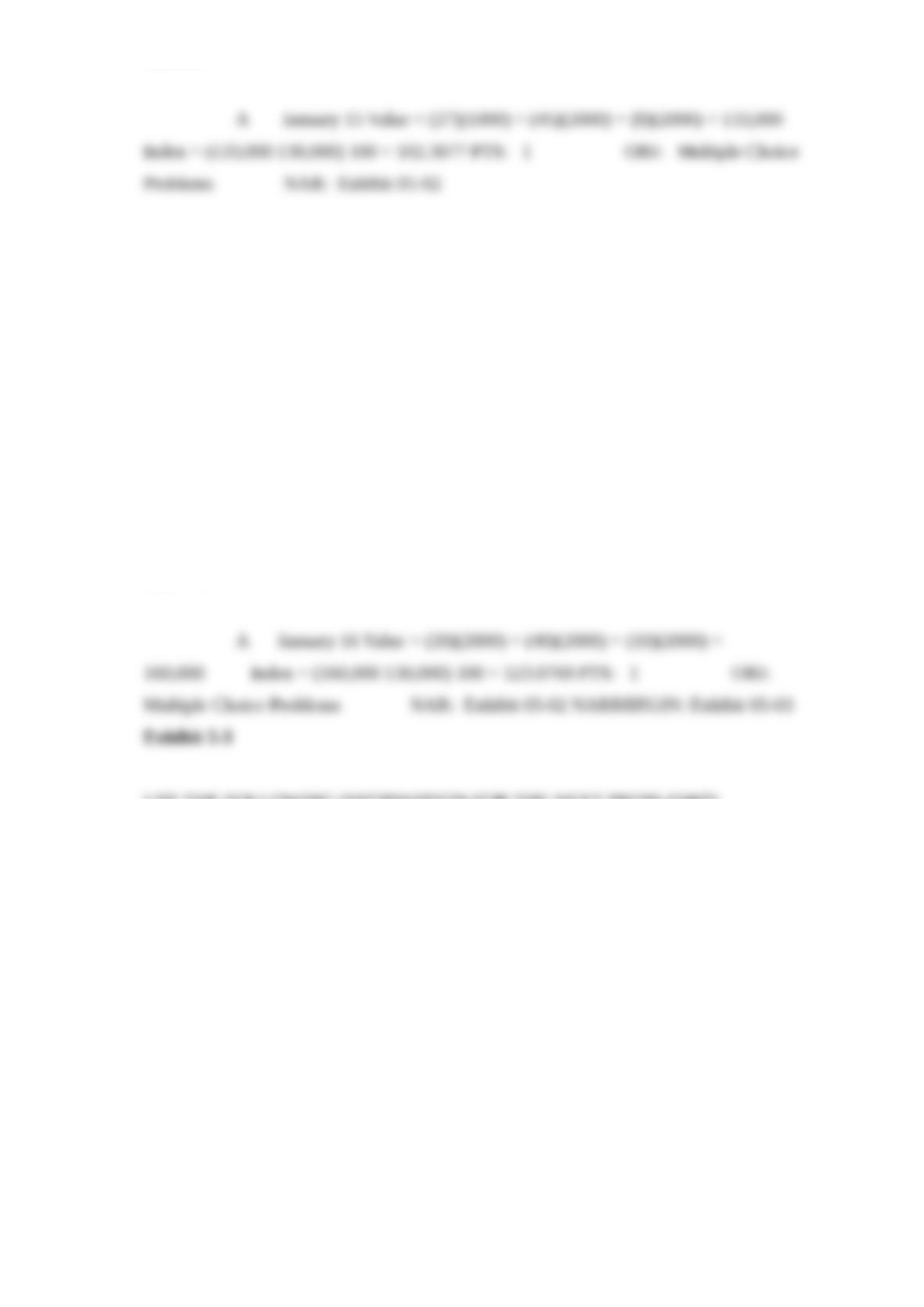
Answer:
Question: Refer to Exhibit 5-2. Calculate a value weighted index for January 16th if the
initial index value is 100.
Answer:
USE THE FOLLOWING INFORMATION FOR THE NEXT PROBLEM(S)
NARREND Question: Refer to Exhibit 5-3. Calculate the average annual rate of change
for GB Industries for the 5 year period using the arithmetic mean.
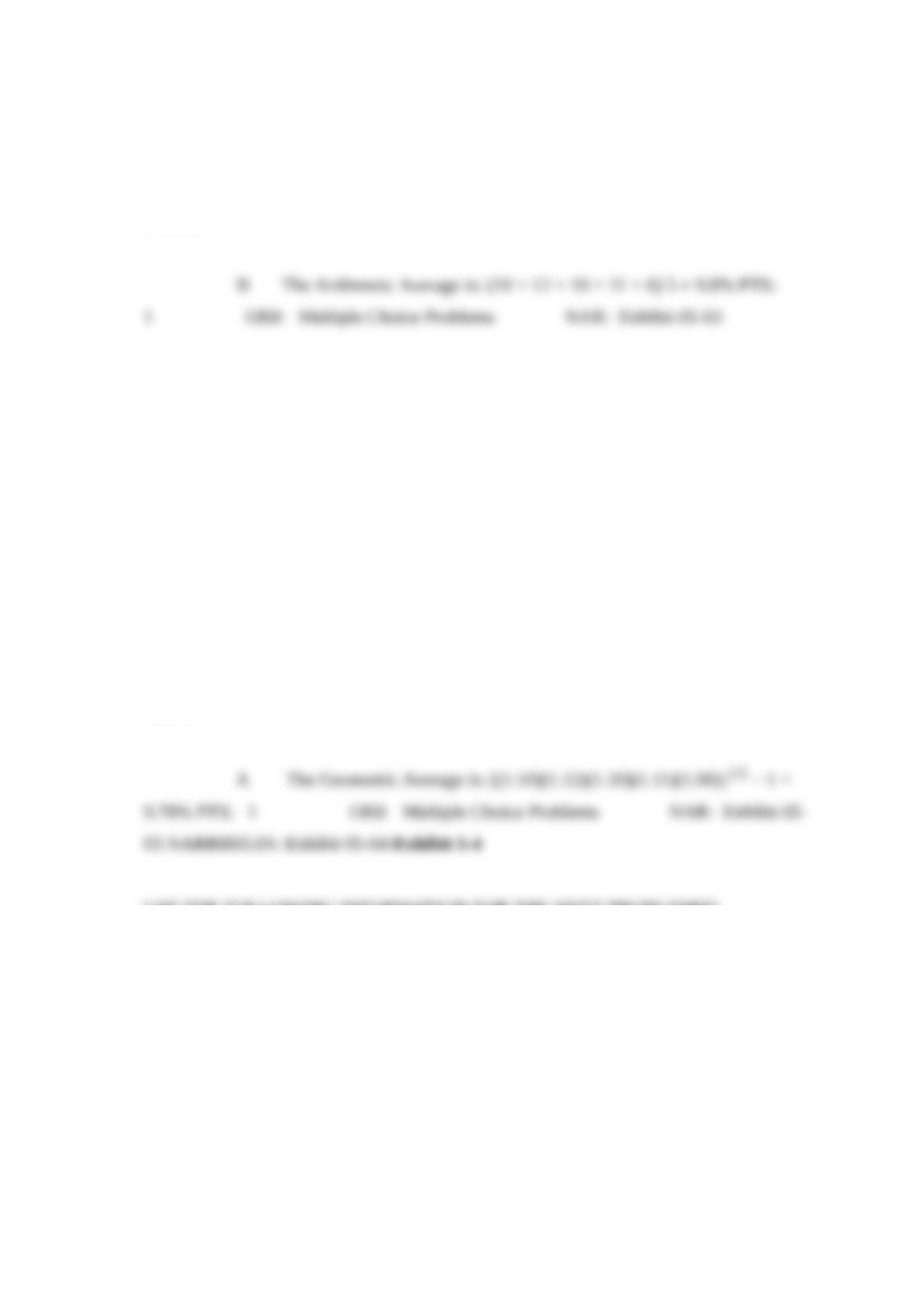
Answer:
Question: Refer to Exhibit 5-3. Calculate the average annual rate of change for GB
Industries for the 5 year period using the geometric mean.
Answer:
USE THE FOLLOWING INFORMATION FOR THE NEXT PROBLEM(S)
NARREND Question: Refer to Exhibit 5-4. Calculate the average annual rate of change
for this index for the 5 year period using the arithmetic mean.
Answer:
Question: Refer to Exhibit 5-4. Calculate the average annual rate of change for this index
for the 5 year period using the geometric mean.
Answer:
USE THE FOLLOWING INFORMATION FOR THE NEXT PROBLEM(S)
Stocks W and X had 2 for 1 splits after the close on Dec 31, 2003. NARREND Question:
Refer to Exhibit 5-5. Calculate the price weighted series for Dec 31, 2003, prior to the
splits.
Answer:
Question: Refer to Exhibit 5-5. Calculate the price weighted series for Dec 31, 2003, after
the splits.
Answer:
Question: Refer to Exhibit 5-5. Calculate the price weighted series for Dec 31, 2004.
Answer:
Question: Refer to Exhibit 5-5. Calculate the percentage return in the price weighted series
for the period Dec 31, 2000, to Dec 31, 2004.
Answer:
Question: Refer to Exhibit 5-5. Calculate the value weighted index for Dec 31, 2003, prior
to the splits. Assume a base index value of 100. The base year is Dec 31, 2003.
Answer:
Question: Refer to Exhibit 5-5. Calculate the value weighted index for Dec 31, 2003, after
the splits. Assume a base index value of 100. The base year is Dec 31, 2003.
Answer:
Question: Refer to Exhibit 5-5. Calculate the value weighted index for Dec 31, 2004.
Assume a base index value of 100. The base year is Dec 31, 2003.
Answer:
Question: Refer to Exhibit 5-5. Calculate the percentage return in the value weighted index
for the period Dec 31, 2003, to Dec 31, 2004.
Answer:
Question: Refer to Exhibit 5-5. Calculate the unweighted index for Dec 31, 2003, prior to
the splits. Assume a base index value of 100. The base year is Dec 31, 2003.
Answer:
Question: Refer to Exhibit 5-5. Calculate the unweighted index for Dec 31, 2003, after the
splits. Assume a base index value of 100. The base year is Dec 31, 2003.
Answer:
Question: Refer to Exhibit 5-5. Calculate the unweighted index (geometric mean) for Dec
31, 2004. Assume a base index value of 100. The base year is Dec 31, 2003.
Answer:
Question: Refer to Exhibit 5-5. Calculate the percentage return in the unweighted index
(geometric mean) for the period Dec 31, 2003, to Dec 31, 2004. Assume a base index
value of 100. Base year is Dec 31, 2003.
Answer:
USE THE FOLLOWING INFORMATION FOR THE NEXT PROBLEM(S)
NARREND Question: Refer to Exhibit 5-6. Calculate a price weighted average for Day T.
Answer:
Question: Refer to Exhibit 5-6. Calculate a value weighted average for Day T + 1. Assume
a base index value of 100 on Day T.
Answer:
Question: Refer to Exhibit 5-6. If an equal-weighted index is constructed on Day T with
$10,000 in each stock, what is the percentage change in wealth for this index on Day T +
1? Assume a base index value of 100 on Day T.
Answer:
Question: Refer to Exhibit 5-6. Compute the arithmetic mean of the price change of Stocks
Q, R, and S from days T to T + 1.
Answer:
Question: Refer to Exhibit 5-6. Compute the geometric mean of the price change of Stocks
Q, R, and S from days T to T + 1.
Answer: