CHAPTER 22—OPTION CONTRACTS TRUE/FALSE Question: The Chicago Board
Options Exchange has the largest share of stock option trading. Answer:
Question: Index options are settled by delivery of the stocks that make up the index.
Answer:
Question: In index options, the aggregate market takes the place of the individual stock
issues being traded, as in stock options. Answer:
Question: Risk management is the driving force behind the futures options market.
Answer:
Question: The longer the time to expiration, the greater the value of a call option. Answer:
Question: There is an inverse relationship between the market interest rate and the value of
a call option. Answer:
Question: Credit risk in the options market is only a concern to the option seller. Answer:
Question: The standardization of option contracts and the creation of the Options Clearing
Corporation are two important results of the opening of the Chicago Board of Options
Exchange. Answer:
Question: Stock options expire on the Sunday following the third Saturday of the
designated month. Answer:
Question: A price spread (or vertical spread) involves buying and selling an option for the
same stock and expiration date but with different exercise prices. Answer:
Question: A portfolio containing a share of stock and a put option will have the same value
as a portfolio containing a call option and the risk-free discount bond. Answer:
Question: A strip is a call option on a stock that is written by someone that owns the stock.
Answer:
Question: The buyer of a straddle expects stock prices to move strongly in either direction.
Answer:
Question: A long strip position indicates that an investor is bullish but conservative.
Answer:
Question: Index options can only be settled in cash. Answer:
Question: Unlike stock options, futures options require the holder to enter into a futures
contract. Answer:
Question: It is a violation of the securities laws to combine option contracts to achieve a
customized payoff. Answer:
Question: European options can only be exercised on the expiration date. Answer:
Question: The owner of a call option on a futures contract has the obligation to buy the
futures contract at a predetermined strike price during a specified time period. Answer:
Question: Options on futures expire at the same time the futures contract expires. Answer:
Question: The underlying stock price and the value of the put option are factors that impact
the value of an American call option. Answer:
Question: The binomial option pricing model approximates the price of an option obtained
using the Black-Scholes option pricing model as the number of subintervals increases.
Answer:
Question: Investors should purchase market index put options if they anticipate an increase
in the index value. Answer:
Question: The Options Clearing Corporation (OCC) acts as the guarantor of each Chicago
Board Options Exchange (CBOE) traded contract. Answer:
Question: It is always theoretically possible to use options as a perfect hedge against
fluctuations in value of the underlying asset. Answer:
Question: The most important input the investor must provide in determining option values
is the strike price. Answer:
Question: The binomial model is a continuous method for valuing options. Answer:
Question: The creation of the CBOE led to all the following innovations in options except
Answer:
Question: A calendar spread requires the purchase and sale of two calls or two puts in the
same stock
Answer:
Question: In a money spread, an investor would
Answer:
Question: A money spread involves buying and selling call options in the same stock with
Answer:
Question: If you were to purchase an October option with an exercise price of 50 for 8 and
simultaneously sell an October option with an exercise price of 60 for 2, you would be
Answer:
Question: You own a stock that has risen from $10 per share to $32 per share. You wish to
delay taking the profit but you are troubled about the short run behavior of the stock
market. An effective action on your part would be to
Answer:
Question: If you were to purchase an October option with an exercise price of 50 for $8
and simultaneously sell an October option with an exercise price of 60 for $2, you would
be
Answer:
Question: A vertical spread involves buying and selling call options in the same stock with
Answer:
Question: Which of the following is not a factor needed to calculate the value of an
American call option?
Answer:
Question: Buying a bear spread is equivalent to
Answer:
Question: A currency call is like being ____ in the currency futures.
Answer:
Question: A straddle is the simultaneous purchase (or sale) of a put and call option with the
same underlying asset,
Answer:
Question: In the Black-Scholes option pricing model, an increase in security price (S) will
cause
Answer:
Question: In the Black-Scholes option pricing model, an increase in exercise price (X) will
cause
Answer:
Question: In the Black-Scholes option pricing model, an increase in time to expiration (T)
will cause
Answer:
Question: In the Black-Scholes option pricing model, an increase in the risk free rate
(RFR) will cause
Answer:
Question: In the Black-Scholes option pricing model, an increase in security volatility ()
will cause
Answer:
Question: The value of a call option is positively related to:
Answer:
Question: The value of a call option is inversely related to:
Answer:
Question: If the hedge ratio is 0.50, this indicates that the portfolio should hold
Answer:
Question: Options can be used to
Answer:
Question: The Black-Scholes model assumes that stock price movements can be described
by
Answer:
Question: Which of the following is not a variable required to determine an options value
in the Black-Scholes valuation model?
Answer:
Question: In the Black-Scholes model N(d1) represents the
Answer:
Question: The calculation of a weighted average of the implied volatility estimates from
options on the Standard & Poors 500 index using a wide range of exercise prices is known
as
Answer:
USE THE FOLLOWING INFORMATION FOR THE NEXT PROBLEM(S)
NARREND Question: Refer to Exhibit 22-1. How much must an investor pay for one call
option contract?
Answer:
Question: Refer to Exhibit 22-1. How much must an investor pay for one put option
contract?
Answer:
Question: Refer to Exhibit 22-1. If the spot rate at expiration is $0.90 and the call option
was purchased, what is the dollar gain or loss?
Answer:
Question: Refer to Exhibit 22-1. If the spot rate at expiration is $0.80 and the call option
was purchased, what is the dollar gain or loss?
Answer:
Question: Refer to Exhibit 22-1. If the spot rate at expiration is $0.85 and the put option
was purchased, what is the dollar gain or loss?
Answer:
Question: Refer to Exhibit 22-1. If the spot rate at expiration is $0.75 and the put option
was purchased, what is the dollar gain or loss?
Answer:
USE THE FOLLOWING INFORMATION FOR THE NEXT PROBLEM(S)
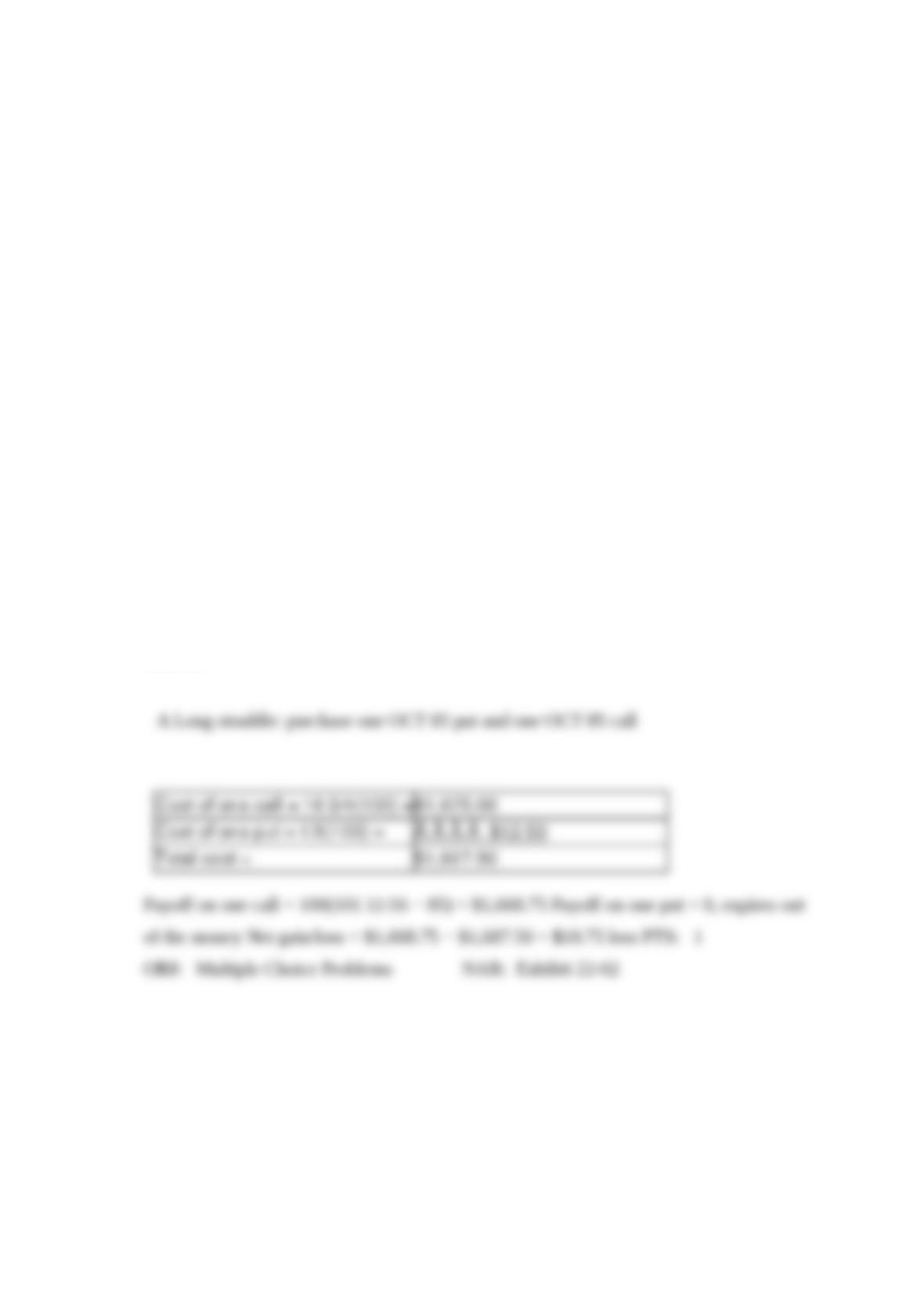
NARREND Question: Refer to Exhibit 22-2. If you establish a long straddle using the
options with an 85 exercise price, what is your dollar gain or loss if at expiration XYZ is
still trading at 101 11/16?
Answer:
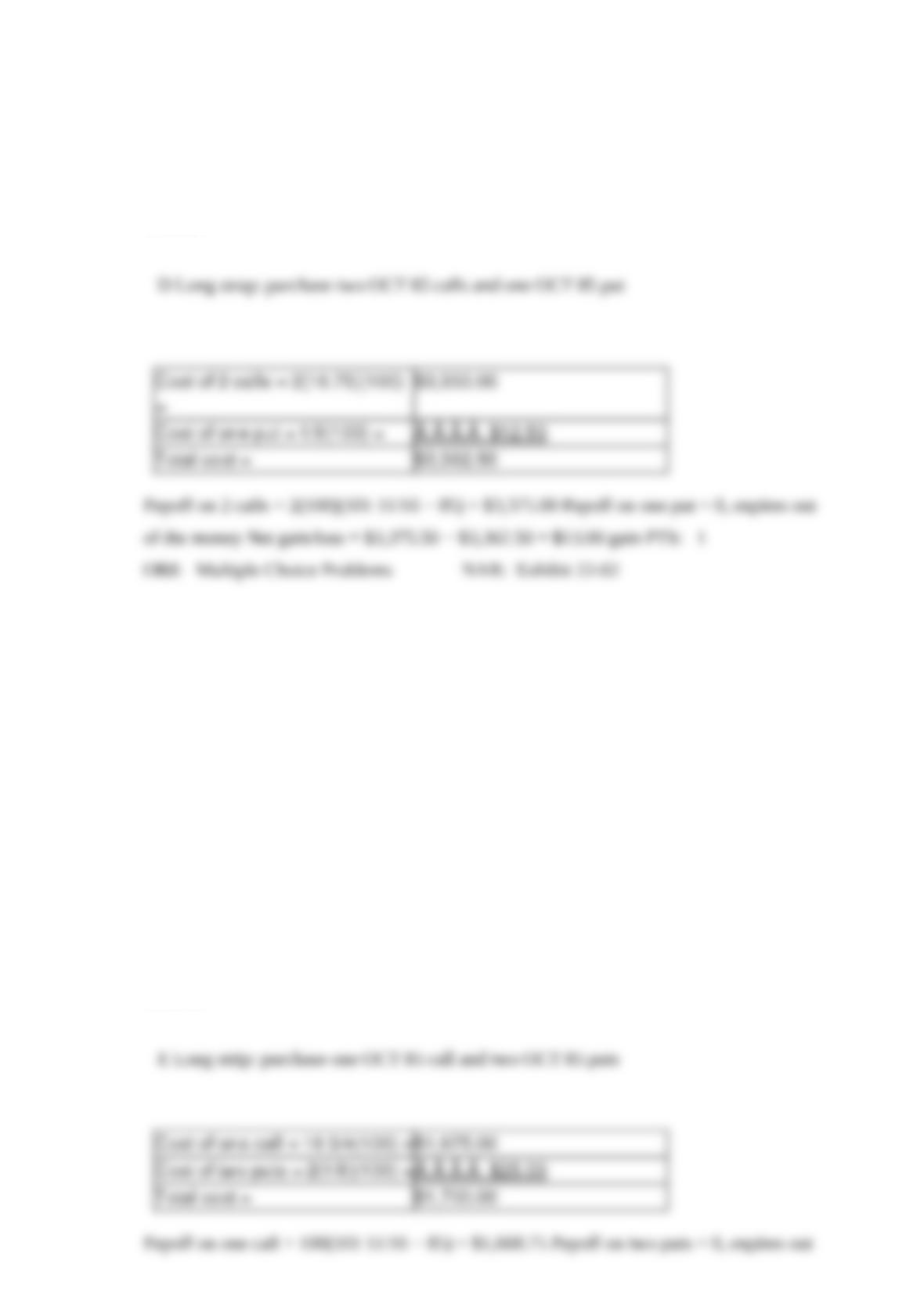
Question: Refer to Exhibit 22-2. If you establish a long strap using the options with an 85
exercise price, what is your dollar gain or loss if at expiration XYZ is still trading at 101
11/16?
Answer:
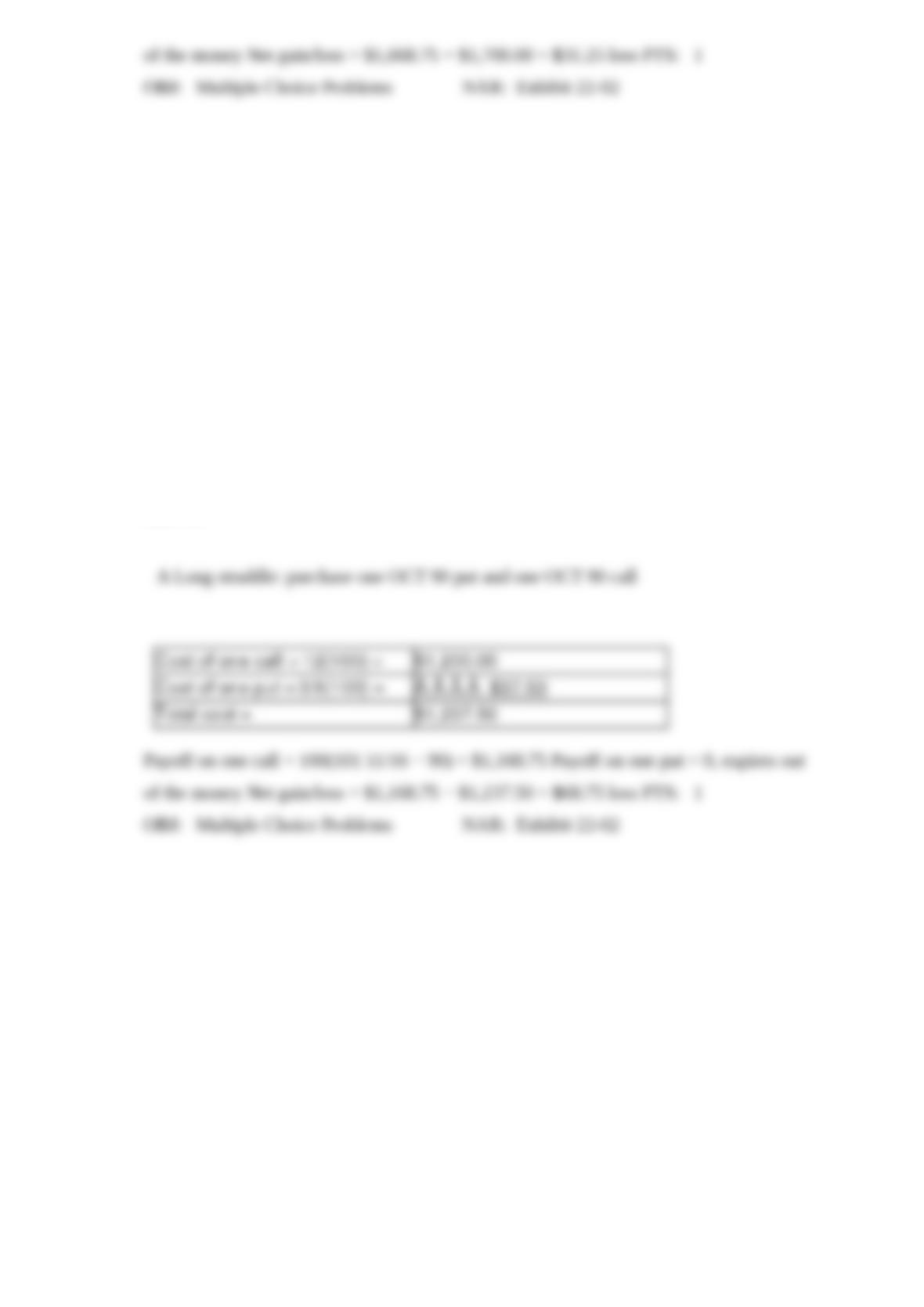
Question: Refer to Exhibit 22-2. If you establish a long strip using the options with an 85
exercise price, what is your dollar gain or loss if at expiration XYZ is still trading at 101
11/16?
Answer:
Question: Refer to Exhibit 22-2. If you establish a long straddle using the options with an
90 exercise price, what is your dollar gain or loss if at expiration XYZ is still trading at
101 11/16?
Answer:
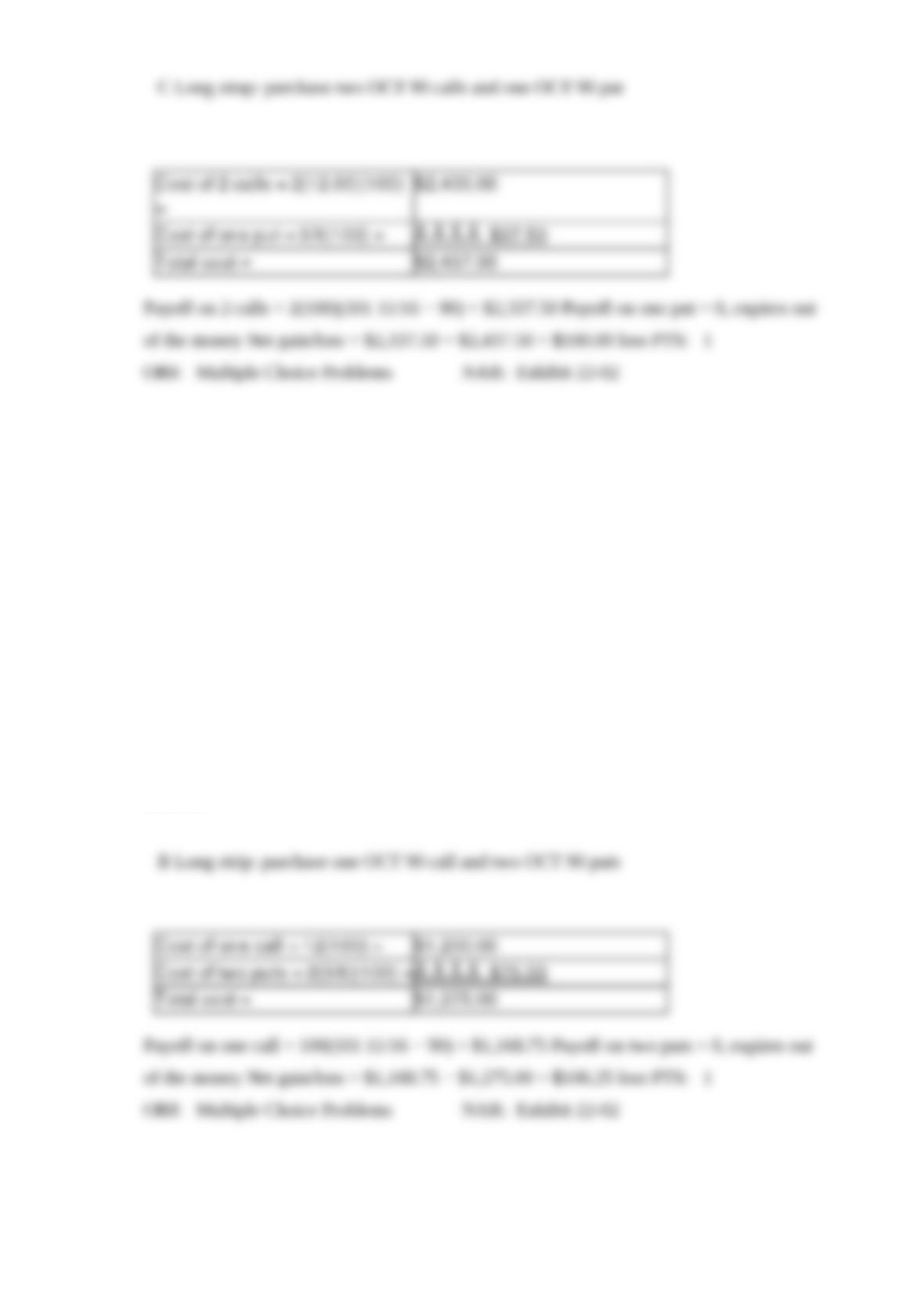
Question: Refer to Exhibit 22-2. If you establish a long strap using the options with an 90
exercise price, what is your dollar gain or loss if at expiration XYZ is still trading at 101
11/16?
Answer:
Question: Refer to Exhibit 22-2. If you establish a long strip using the options with an 90
exercise price, what is your dollar gain or loss if at expiration XYZ is still trading at 101
11/16?
Answer:
Question: Refer to Exhibit 22-2. If you establish a long straddle using the options with an
95 exercise price, what is your dollar gain or loss if at expiration XYZ is still trading at
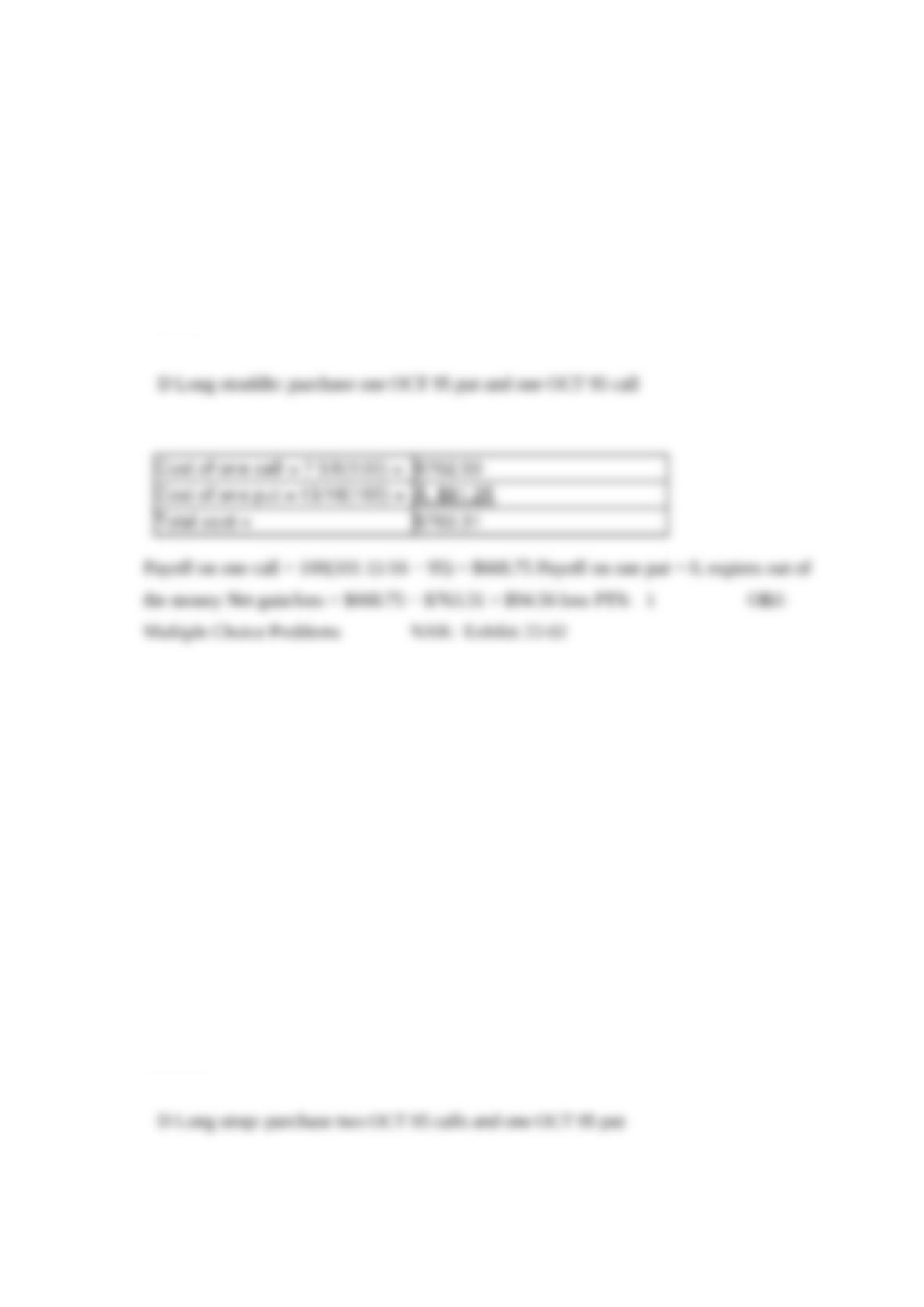
101 11/16?
Answer:
Question: Refer to Exhibit 22-2. If you establish a long strap using the options with an 95
exercise price, what is your dollar gain or loss if at expiration XYZ is still trading at 101
11/16?
Answer:
Question: Refer to Exhibit 22-2. If you establish a long strip using the options with a 95
exercise price, what is your dollar gain or loss if at expiration XYZ is still trading at 101
11/16?
Answer:
Question: Refer to Exhibit 22-2. If XYZ were trading at $90/share and you formed a bull
money spread, what is your profit if XYZ is trading at $110 at expiration?
Answer:
Question: Refer to Exhibit 22-3. Use the Black-Scholes option pricing model to calculate
the price of a call option.
Answer:
Question: Refer to Exhibit 22-3. Calculate the price of the put option.
Answer:
Question: Assume that you have just sold a stock for a loss at a price of $75, for tax
purposes. You still wish to maintain exposure to the sold stock. Suppose that you buy a call
with a strike price of $70 and a price of $6.75. Calculate the effective price paid to
repurchase the stock if the price after 35 days is $65.
Answer:
Question: Assume that you have just sold a stock for a loss at a price of $75, for tax
purposes. You still wish to maintain exposure to the sold stock. Suppose that you buy a call
with a strike price of $70 and a price of $6.75. Calculate the effective price paid to
repurchase the stock if the price after 35 days is $80.
Answer:
Question: Assume that you have just sold a stock for a loss at a price of $75, for tax
purposes. You still wish to maintain exposure to the sold stock. Suppose that you sell a put
with a strike price of $80 and a price of $7.25. Calculate the effective price paid to
repurchase the stock if the price after 35 days is $70.
Answer:
Question: Assume that you have just sold a stock for a loss at a price of $75, for tax
purposes. You still wish to maintain exposure to the sold stock. Suppose that you sell a put
with a strike price of $80 and a price of $7.25. Calculate the effective price paid to
repurchase the stock if the price after 35 days is $85.
Answer:
USE THE FOLLOWING INFORMATION FOR THE NEXT QUESTION(S) Consider the
following information on put and call options for Citigroup
NARREND Question: Refer to Exhibit 22-4. Calculate the net value of a protective put
position at a stock price at expiration of $20, and a stock price at expiration of $45.
Answer:
Question: Refer to Exhibit 22-4. A protective put is an appropriate strategy if
Answer:
Question: Refer to Exhibit 22-4. Calculate the net value of a covered call position at a
stock price at expiration of $20, and a stock price at expiration of $45.
Answer:
Question: Refer to Exhibit 22-4. A covered call is an appropriate strategy if
Answer:
Question: Refer to Exhibit 22-4. Calculate the payoffs of a long straddle at a stock price at
expiration of $20 and a stock price at expiration of $45.
Answer:
Question: Refer to Exhibit 22-4. A long straddle is an appropriate strategy if
Answer:
Question: Refer to Exhibit 22-4. Calculate the payoffs of a short straddle at a stock price at
expiration of $20 and a stock price at expiration of $45.
Answer:
Question: Refer to Exhibit 22-4. A short straddle is an appropriate strategy if
Answer:
Question: Refer to Exhibit 22-4. Calculate the payoffs of a long strap at a stock price at
expiration of $20 and a stock price at expiration of $45.
Answer:
Question: Refer to Exhibit 22-4. A long strap is an appropriate strategy if
Answer:
USE THE FOLLOWING INFORMATION TO ANSWER THE NEXT QUESTION(S)
The information provided is relevant in the context of a one period (one year) binomial
option pricing model. A stock currently trades at $50 per share, a call option on the stock
has an exercise price of $45. The stock is equally likely to rise by 25% or fall by 25%. The
one-year risk free rate is 2%. NARREND Question: Refer to Exhibit 22-5. Calculate the
possible prices of the stock one year from today.
Answer:
Question: Refer to Exhibit 22-5. Estimate n, the number of call options that must be
written.
Answer:
Question: Refer to Exhibit 22-5. Calculate the price of the call option today (C0).
Answer:
USE THE FOLLOWING INFORMATION TO ANSWER THE NEXT QUESTION(S)
The following information is provided in the context of a two period (two six month
periods) binomial option pricing model. A stock currently trades at $60 per share, a call
option on the stock has an exercise price of $65. The stock is equally likely to rise by 15%
or fall by 15% during each six month period. The one-year risk free rate is 3%.
NARREND Question: Refer to Exhibit 22-6. Calculate the possible prices of the stock at
the end of one year.
Answer:
Question: Refer to Exhibit 22-6. Calculate the price of the call option after the stock price
has already moved up in value once (Cu).
Answer:
Question: Refer to Exhibit 22-6. Calculate the price of the call option after the stock price
has already moved down in value once (Cd).
Answer:
Question: Refer to Exhibit 22-6. Calculate the price of the call option today (C0).
Answer:
USE THE FOLLOWING INFORMATION TO ANSWER THE NEXT QUESTION(S) GE
Corporation has a put option selling for $2.90 and a call option selling for $1.95, both with
a strike price of $29.00. NARREND Question: Refer to Exhibit 22-7. What would the net
value of a protective put position be if the stock price at expiration is $35?
Answer:
Question: Refer to Exhibit 22-7. What would the net value of a covered call position be if
the stock price at expiration is $35?
Answer:
Question: Refer to Exhibit 22-7. What would the net value of a long straddle position be if
the stock price at expiration is $35?
Answer:
Question: Refer to Exhibit 22-7. What would the net value of a short straddle position be if
the stock price at expiration is $35?
Answer:
Question: Refer to Exhibit 22-7. What would the net value of a long strap position be if the
stock price at expiration is $35?
Answer:
Question: Refer to Exhibit 22-7. Which strategy is most appropriate for an investor who
expects stock prices to be volatile, but is inclined to be bullish?
Answer: