CHAPTER 20—AN INTRODUCTION TO DERIVATIVE MARKETS AND
SECURITIES TRUE/FALSE Question: A cash or spot contract is an agreement for the
immediate delivery of an asset such as the purchase of stock on the NYSE. Answer:
Question: Forward and future contracts, as well as options, are types of derivative
securities. Answer:
Question: All features of a forward contract are standardized, except for price and number
of contracts. Answer:
Question: Forward contracts are traded over-the-counter and are generally not
standardized. Answer:
Question: The forward market has low liquidity relative to the futures market. Answer:
Question: A futures contract is an agreement between a trader and the clearinghouse of the
exchange for delivery of an asset in the future. Answer:
Question: A primary function of futures markets is to allow investors to transfer risk.
Answer:
Question: The futures market is a dealer market where all the details of the transactions are
negotiated. Answer:
Question: Futures contracts are slower to absorb new information than forward contracts.
Answer:
Question: The initial value of a future contract is the price agreed upon in the contract.
Answer:
Question: A futures contract eliminates uncertainty about the future spot price that an
individual can expect to pay for an asset at the time of delivery. Answer:
Question: Investment costs are generally higher in the derivative markets than in the
corresponding cash markets. Answer:
Question: An option buyer must exercise the option on or before the expiration date.
Answer:
Question: The minimum value of an option is zero. Answer:
Question: An option to sell an asset is referred to as a call, whereas an option to buy an
asset is called a put. Answer:
Question: If an investor wants to acquire the right to buy or sell an asset, but not the
obligation to do it, the best instrument is an option rather than a futures contract. Answer:
Question: Investors buy call options because they expect the price of the underlying stock
to increase before the expiration of the option. Answer:
Question: A call option is in the money if the current market price is above the strike price.
Answer:
Question: A put option is in the money if the current market price is above the strike price.
Answer:
Question: The price at which the stock can be acquired or sold is the exercise price.
Answer:
Question: The minimum amount that must be maintained in an account is called the
maintenance margin. Answer:
Question: A forward contract gives its holder the option to conduct a transaction involving
another security or commodity. Answer:
Question: In the forward market both parties are required to post collateral or margin.
Answer:
Question: The option premium is the price the call buyer will pay to the option seller if the
option is exercised. Answer:
Question: The payoffs to both long and short position in the forward contact are symmetric
around the contract price. Answer:
Question: Which of the following statements is false?
Answer:
Question: Derivative instruments exist because
Answer:
Question: There are a number of differences between forward and futures contracts. Which
of the following statements is false?
Answer:
Question: Futures differ from forward contracts because
Answer:
Question: The price at which a futures contract is set at the end of the day is the
Answer:
Question: Which of the following statements is true?
Answer:
Question: The CBOE brought numerous innovations to the option market. Which of the
following is not such an innovation?
Answer:
Question: Which of the following factors is not considered in the valuation of call and put
options?
Answer:
Question: Which of the following statements is a true definition of an in-the-money
option?
Answer:
Question: The value of a call option just prior to expiration is (where V is the underlying
assets market price and X is the options exercise price)
Answer:
Question: Which of the following is not a factor needed to calculate the value of an
American call option?
Answer:
Question: In the valuation of an option contract, the following statements apply except
Answer:
Question: You own a stock that has risen from $10 per share to $32 per share. You wish to
delay taking the profit but you are troubled about the short run behavior of the stock
market. An effective action on your part would be to
Answer:
Question: A vertical spread involves buying and selling call options in the same stock with
Answer:
Question: The value of a put option at expiration is
Answer:
Question: In the two state option pricing model, which of the following does not influence
the option price?
Answer:
Question: The cost of carry includes all of the following except
Answer:
Question: A call option in which the stock price is higher than the exercise price is said to
be
Answer:
Question: The price paid for the option contract is referred to as the
Answer:
Question: A stock currently sells for $75 per share. A call option on the stock with an
exercise price $70 currently sells for $5.50. The call option is
Answer:
Question: A stock currently sells for $150 per share. A call option on the stock with an
exercise price $155 currently sells for $2.50. The call option is
Answer:
Question: A stock currently sells for $75 per share. A put option on the stock with an
exercise price $70 currently sells for $0.50. The put option is
Answer:
Question: A stock currently sells for $15 per share. A put option on the stock with an
exercise price $15 currently sells for $1.50. The put option is
Answer:
Question: A stock currently sells for $15 per share. A put option on the stock with an
exercise price $20 currently sells for $6.50. The put option is
Answer:
Question: An equity portfolio manager can neutralize the risk of falling stock prices by
entering into a hedge position where the payoffs are
Answer:
Question: The derivative based strategy known as portfolio insurance involves
Answer:
Question: A hedge strategy known as a collar agreement involves the simultaneous
Answer:
Question: A call option differs from a put option in that
Answer:
Question: Which of the following statements is a true definition of an out-of-the-money
option?
Answer:
Question: According to put/call parity
Answer:
Question: Futures contracts are similar to forward contracts in that they both
Answer:
Question: Which of the following statements are true?
Answer:
Question: A buyer of the call option is speculating on the
Answer:
Question: Which of the following is consistent with put-call-spot parity?
Answer:
Question: Holding a put option and the underlying security at the same time is an example
of
Answer:
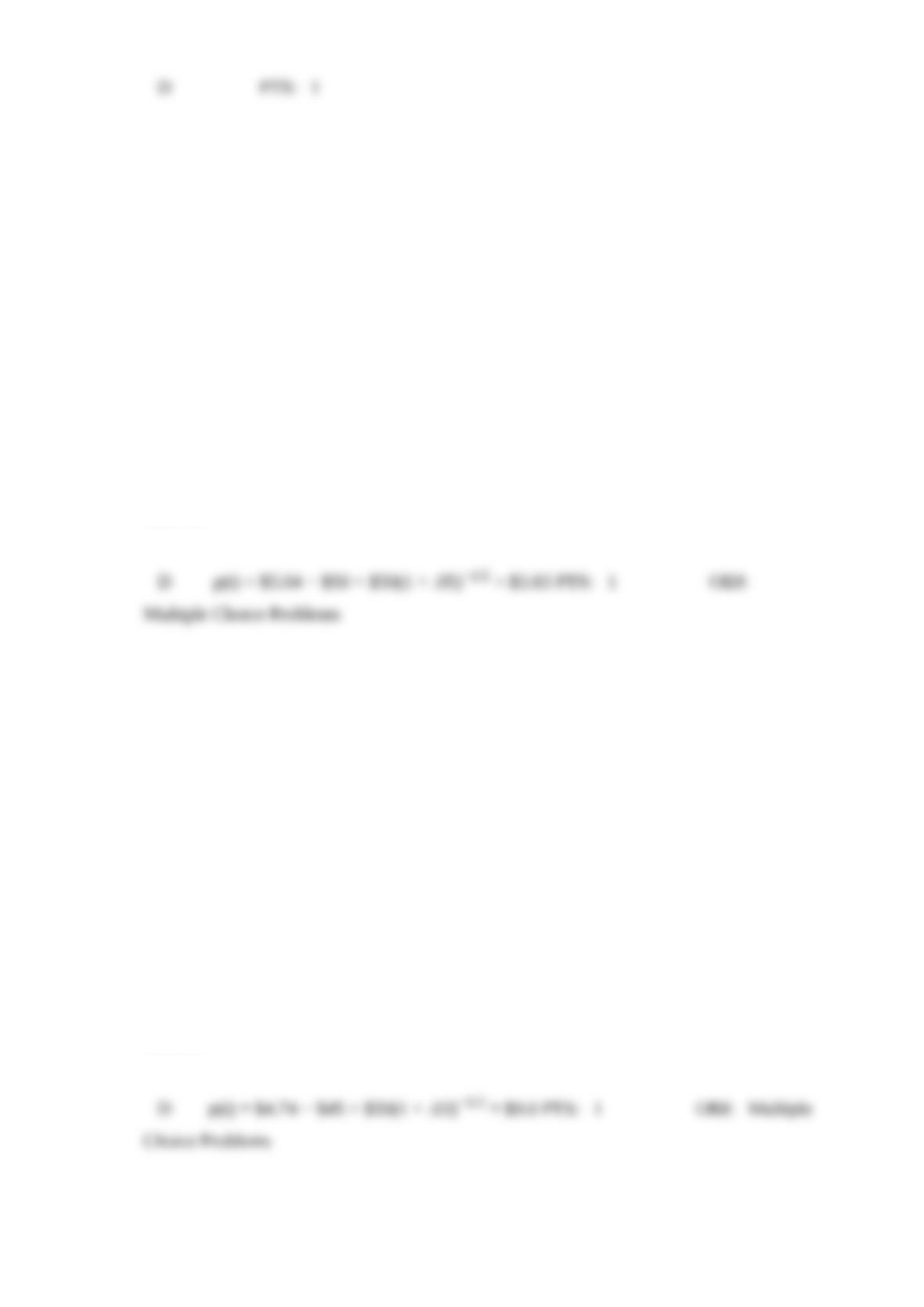
Question: A one year call option has a strike price of 50, expires in 6 months, and has a
price of $5.04. If the risk free rate is 5%, and the current stock price is $50, what should
the corresponding put be worth?
Answer:
Question: A one year call option has a strike price of 50, expires in 6 months, and has a
price of $4.74. If the risk free rate is 3%, and the current stock price is $45, what should
the corresponding put be worth?
Answer:
Question: A one year call option has a strike price of 60, expires in 6 months, and has a
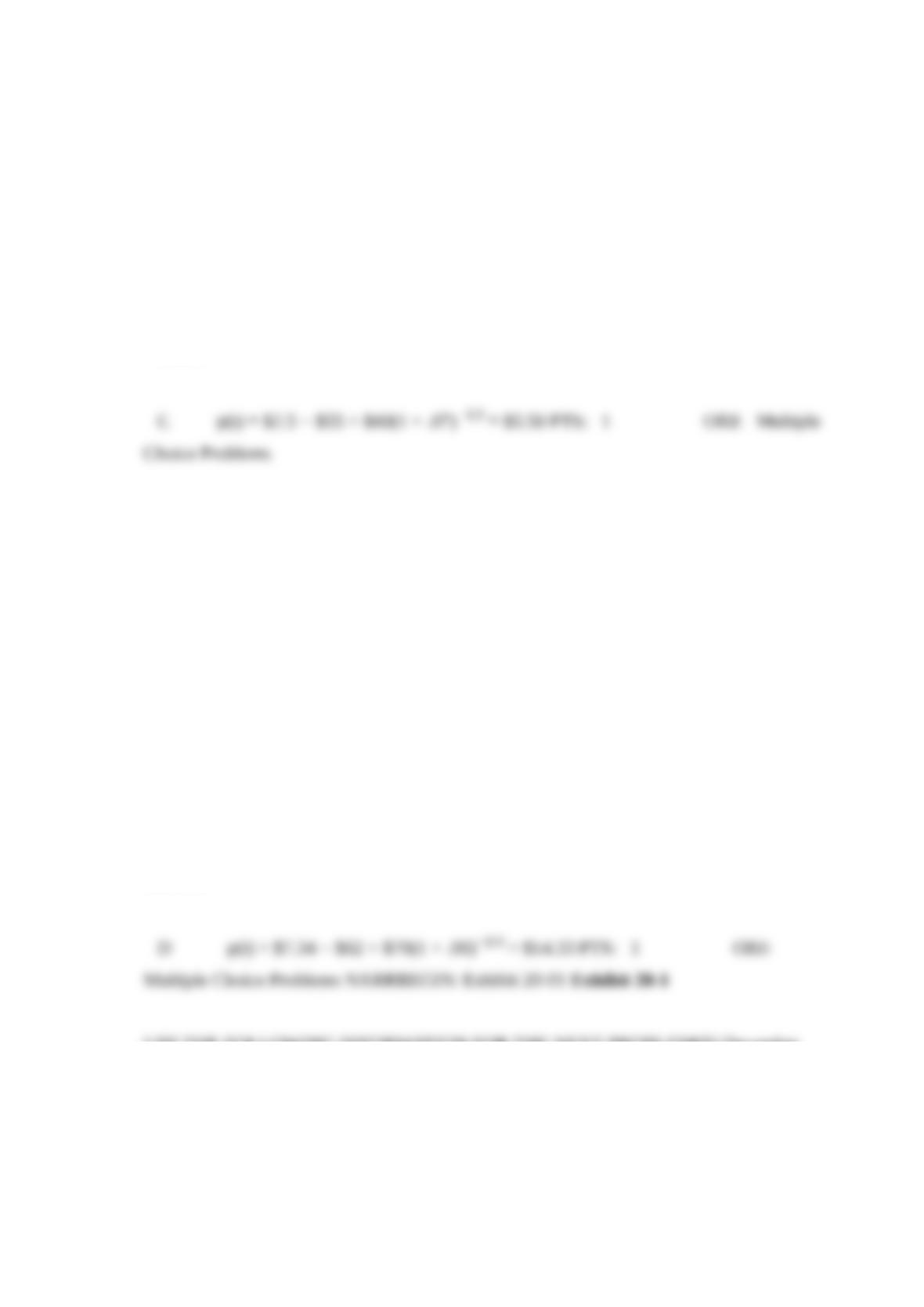
price of $2.5. If the risk free rate is 7%, and the current stock price is $55, what should the
corresponding put be worth?
Answer:
Question: A one year call option has a strike price of 70, expires in 3 months, and has a
price of $7.34. If the risk free rate is 6%, and the current stock price is $62, what should
the corresponding put be worth?
Answer:
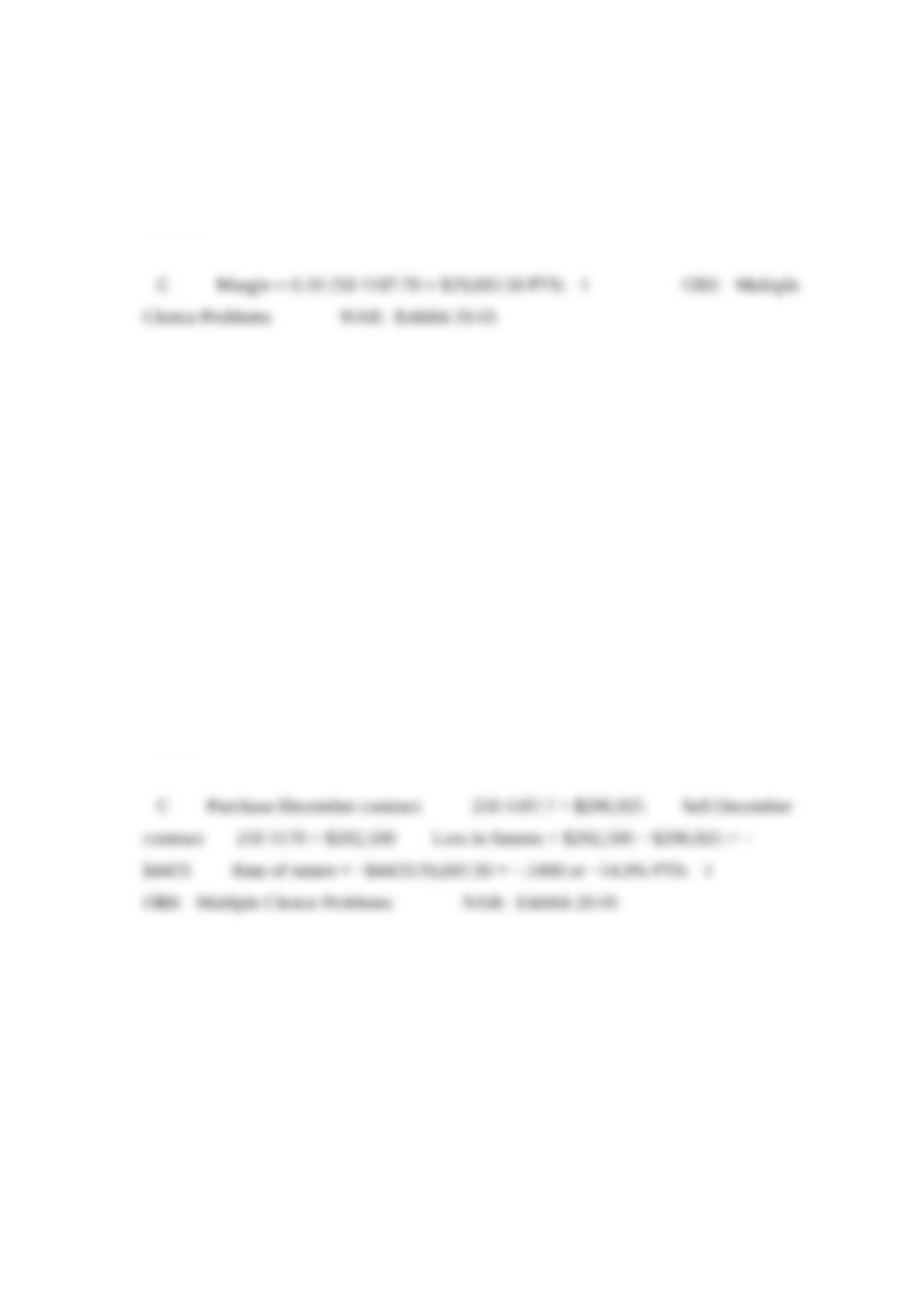
USE THE FOLLOWING INFORMATION FOR THE NEXT PROBLEM(S) December
futures on the S&P 500 stock index trade at 250 times the index value of 1187.70. Your
broker requires an initial margin of 10% percent on futures contracts. The current value of
the S&P 500 stock index is 1178. NARREND Question: Refer to Exhibit 20-1. How much
must you deposit in a margin account if you wish to purchase one contract?
Answer:
Question: Refer to Exhibit 20-1. Suppose at expiration the futures contract price is 250
times the index value of 1170. Disregarding transaction costs, what is your percentage
return?
Answer:
Question: Refer to Exhibit 20-1. Calculate the return on a cash investment in the S&P 500
stock index over the same time period
Answer:
USE THE FOLLOWING INFORMATION FOR THE NEXT PROBLEM(S) A futures
contract on Treasury bond futures with a December expiration date currently trade at
103:06. The face value of a Treasury bond futures contract is $100,000. Your broker
requires an initial margin of 10%. NARREND Question: Refer to Exhibit 20-2. Calculate
the current value of one contract.
Answer:
Question: Refer to Exhibit 20-2. Calculate the initial margin deposit.
Answer:
Question: Refer to Exhibit 20-2. If the futures contract is quoted at 105:08 at expiration,
calculate the percentage return.
Answer:
USE THE FOLLOWING INFORMATION FOR THE NEXT PROBLEM(S) On the last
day of October, Bruce Springsteen is considering the purchase of 100 shares of Olivia
Corporation common stock selling at $37 1/2 per share and also considering an Olivia
option.
NARREND Question: Refer to Exhibit 20-3. If Bruce decides to buy a March call option
with an exercise price of 35, what is his dollar gain (loss) if he closes his position when the
stock is selling at 43 1/2?
Answer:
Question: Refer to Exhibit 20-3. If Bruce buys a March put option with an exercise price
of 40, what is his dollar gain (loss) if he closes his position when the stock is selling at 43
1/2?
Answer:
USE THE FOLLOWING INFORMATION FOR THE NEXT PROBLEM(S) Rick
Thompson is considering the following alternatives for investing in Davis Industries,
which is now selling for $44 per share:
NARREND Question: Refer to Exhibit 20-4. Assuming no commissions or taxes, what is
the annualized percentage gain if the stock reaches $50 in four months and a call was
purchased?
Answer:
Question: Refer to Exhibit 20-4. Assuming no commissions or taxes, what is the
annualized percentage gain if the stock is at $30 in four months and the stock was
purchased?
Answer:
Question: Tom Gettback buys 100 shares of Johnson Walker stock for $87.00 per share and
a 3-month Johnson Walker put option with an exercise price of $105.00 for $20.00. What
is his dollar gain if at expiration the stock is selling for $80.00 per share?
Answer:
Question: Tom Gettback buys 100 shares of Johnson Walker stock for $87.00 per share and
a 3-month Johnson Walker put option with an exercise price of $105.00 for $20.00. What
is Toms dollar gain/loss if at expiration the stock is selling for $105.00 per share?
Answer:
USE THE FOLLOWING INFORMATION FOR THE NEXT PROBLEM(S) Sarah Kling
bought a 6-month Peppy Cola put option with an exercise price of $55 for a premium of
$8.25 when Peppy was selling for $48.00 per share. NARREND Question: Refer to
Exhibit 20-5. If at expiration Peppy is selling for $42.00, what is Sarahs dollar gain or
loss?
Answer:
Question: Refer to Exhibit 20-5. What is Sarahs annualized gain/loss?
Answer:
Question: Refer to Exhibit 20-5. If at expiration Peppy is selling for $47.00, what is Sarahs
dollar gain or loss?
Answer:
Question: Refer to Exhibit 20-5. What is Sarahs annualized gain/loss?
Answer:
Question: A stock currently trades for $25. January call options with a strike price of $30
sell for $6. The appropriate risk free bond has a price of $30. Calculate the price of the
January put option.
Answer:
Question: A stock currently trades for $115. January call options with a strike price of $100
sell for $16, and January put options a strike price of $100 sell for $5. Estimate the price of
a risk free bond.
Answer:
Question: Assume that you have purchased a call option with a strike price $60 for $5. At
the same time you purchase a put option on the same stock with a strike price of $60 for
$4. If the stock is currently selling for $75 per share, calculate the dollar return on this
option strategy.
Answer:
Question: Assume that you purchased shares of a stock at a price of $35 per share. At this
time you purchased a put option with a $35 strike price of $3. The stock currently trades at
$40. Calculate the dollar return on this option strategy.
Answer:
Question: Assume that you purchased shares of a stock at a price of $35 per share. At this
time you wrote a call option with a $35 strike and received a call price of $2. The stock
currently trades at $70. Calculate the dollar return on this option strategy.
Answer:
Question: A stock currently trades at $110. June call options on the stock with a strike
price of $105 are priced at $4. Calculate the arbitrage profit that you can earn.
Answer:
Question: Datacorp stock currently trades at $50. August call options on the stock with a
strike price of $55 are priced at $5.75. October call options with a strike price of $55 are
priced at $6.25. Calculate the value of the time premium between the August and October
options.
Answer:
Question: A stock currently trades at $110. June put options on the stock with a strike price
of $100 are priced at $5.25. Calculate the dollar return on one put contract.
Answer:
Question: A stock currently trades at $110. June call options on the stock with a strike
price of $120 are priced at $5.75. Calculate the dollar return on one call contract.
Answer:
Question: Consider a stock that is currently trading at $65. Calculate the intrinsic value for
a put option that has an exercise price of $55.
Answer:
Question: Consider a stock that is currently trading at $20. Calculate the intrinsic value for
a put option that has an exercise price of $35.
Answer:
Question: Consider a stock that is currently trading at $45. Calculate the intrinsic value for
a call option that has an exercise price of $35.
Answer:
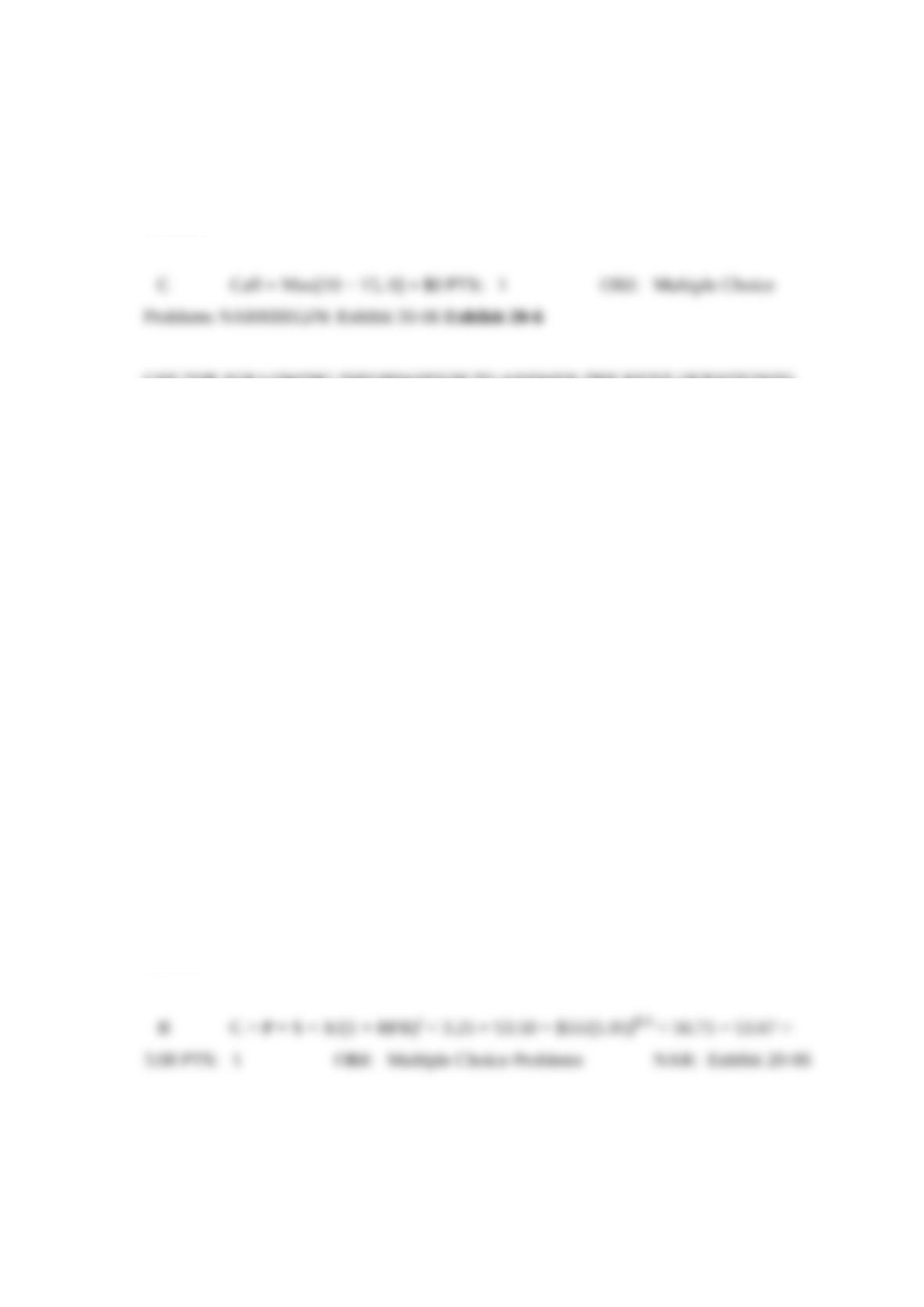
Question: Consider a stock that is currently trading at $10. Calculate the intrinsic value for
a call option that has an exercise price of $15.
Answer:
USE THE FOLLOWING INFORMATION TO ANSWER THE NEXT QUESTION(S)
The current stock price of ABC Corporation is $53.50. ABC Corporation has the following
put and call option prices that expire 6 months from today. The risk-free rate of return is
5% and the expected return on the market is 11%.
NARREND Question: Refer to Exhibit 20-6. What should the price be of a call option that
expires 6 month from today with a exercise price of $55?
Answer:
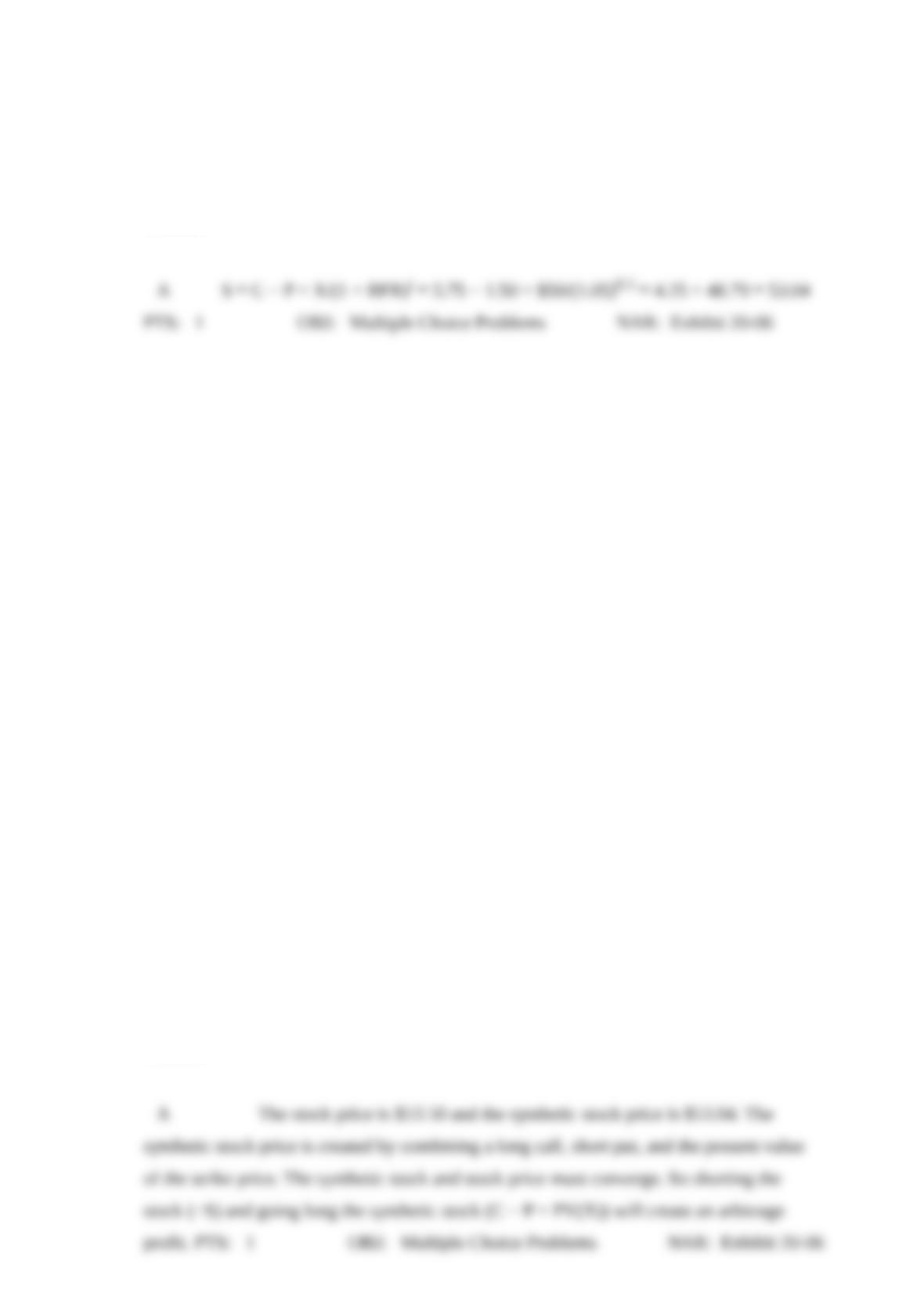
Question: Refer to Exhibit 20-6. What is the value of a synthetic stock created with put and
call options that expire in 6 months with an expiration price of $50?
Answer:
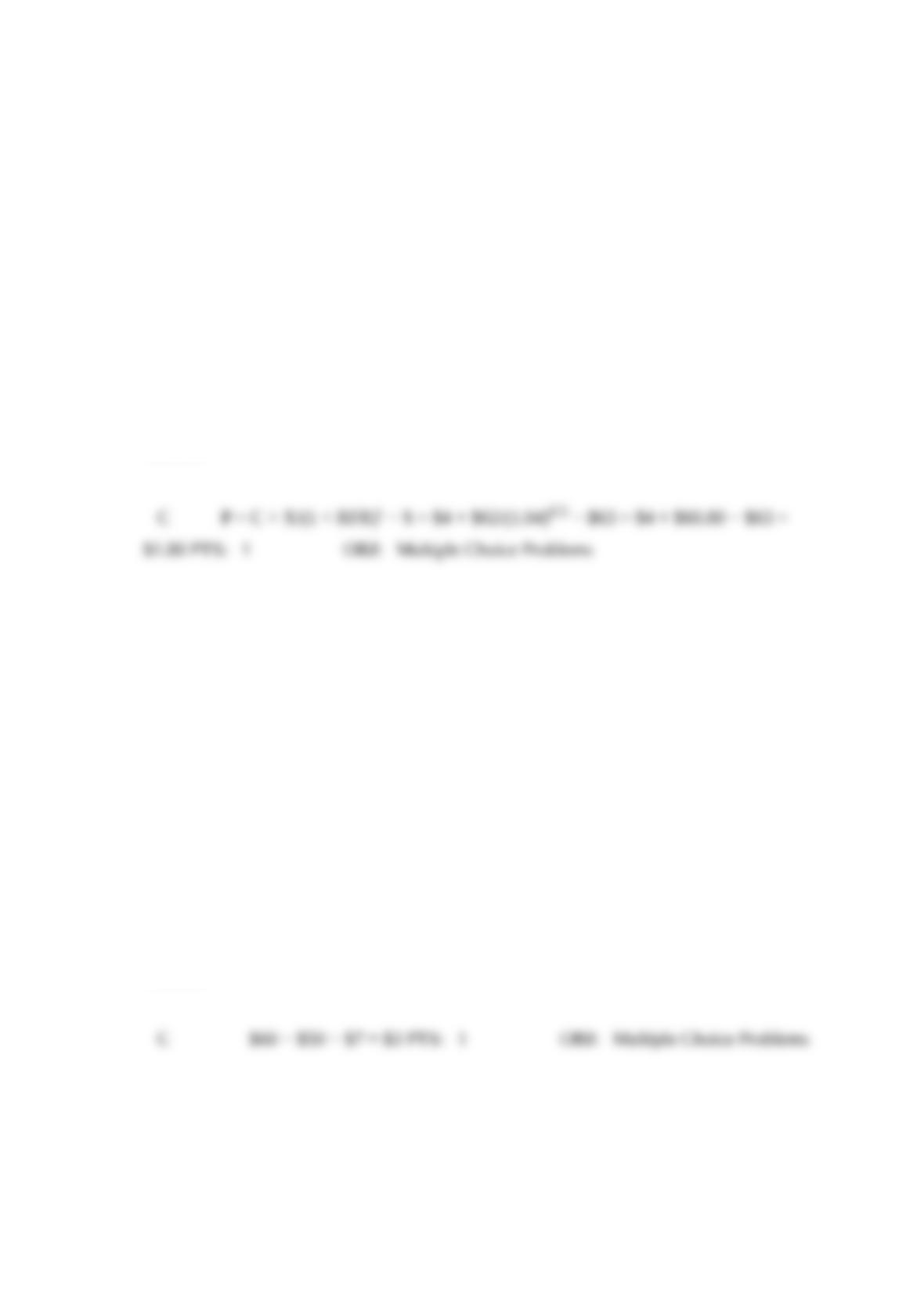
Question: Refer to Exhibit 20-6. How could an investor create arbitrage profits?
Answer:
Question: A stock currently trades for $63. Call options with a strike price of $62 sell for
$4.00 and expire in 6 months. If the risk-free rate is 4%, what should the price of a put
option with an exercise price of $62 be worth?
Answer:
Question: You own a call option and put option that both have the same exercise price of
$50 and their respective prices are $4 and $3. The stock is currently trading at $60.
Calculate the dollar return on this strategy.
Answer: