CHAPTER 2—THE ASSET ALLOCATION DECISION TRUE/FALSE
Question: Experts suggest life insurance coverage should be seven to ten times an
individuals annual salary. Answer:
Question: Term life insurance provides both a death benefit and a savings plan. Answer:
Question: Most experts recommend a cash reserve of at least one years worth of living
expenses. Answer:
Question: The spending phase occurs when investors are relatively young. Answer:
Question: The gifting phase is similar to, and may be concurrent with, the spending phase.
Answer:
Question: Long-term, high-priority goals include some form of financial independence.
Answer:
Question: It is not a good idea to get too specific when constructing your policy statement.
Answer:
Question: Asset allocation is the process of dividing funds into different classes of assets.
Answer:
Question: The typical investors goals rarely change during his/her lifetime. Answer:
Question: Individual security selection is far more important than the asset allocation
decision. Answer:
Question: Return is the only important consideration when establishing investment
objectives. Answer:
Question: In constructing the portfolio, the manager should maximize the investors risk
level. Answer:
Question: Risk tolerance is exclusively a function of an individuals psychological makeup.
Answer:
Question: An appropriate investment objective for a typical 25-year-old investor is a
low-risk strategy, such as capital preservation or current income. Answer:
Question: Investment planning is complicated by the tax code. Answer:
Question: Average tax rate is defined as total tax payment divided by total income.
Answer:
Question: The regular IRA, when compared to the Roth IRA, will consistently give an
investor more after tax dollars at the end of an assumed 20-year time horizon. Answer:
Question: The portfolio mixes of institutional investors around the world are
approximately the same. Answer:
Question: The ability to retire at a certain age is a typical example of a long-term,
lower-priority goal. Answer:
Question: It is essential that both the client and the portfolio manager agree on an
appropriate benchmark portfolio. Answer:
Question: An example of a unique need in an investment policy statement is related to the
legal responsibilities of a fiduciary or trustee. Answer:
Question: Equity allocations of pension funds in Japan and Germany are similar to those in
the United States. Answer:
Question: The current outlay of money to guard against a potentially large future loss is
commonly known as
Answer:
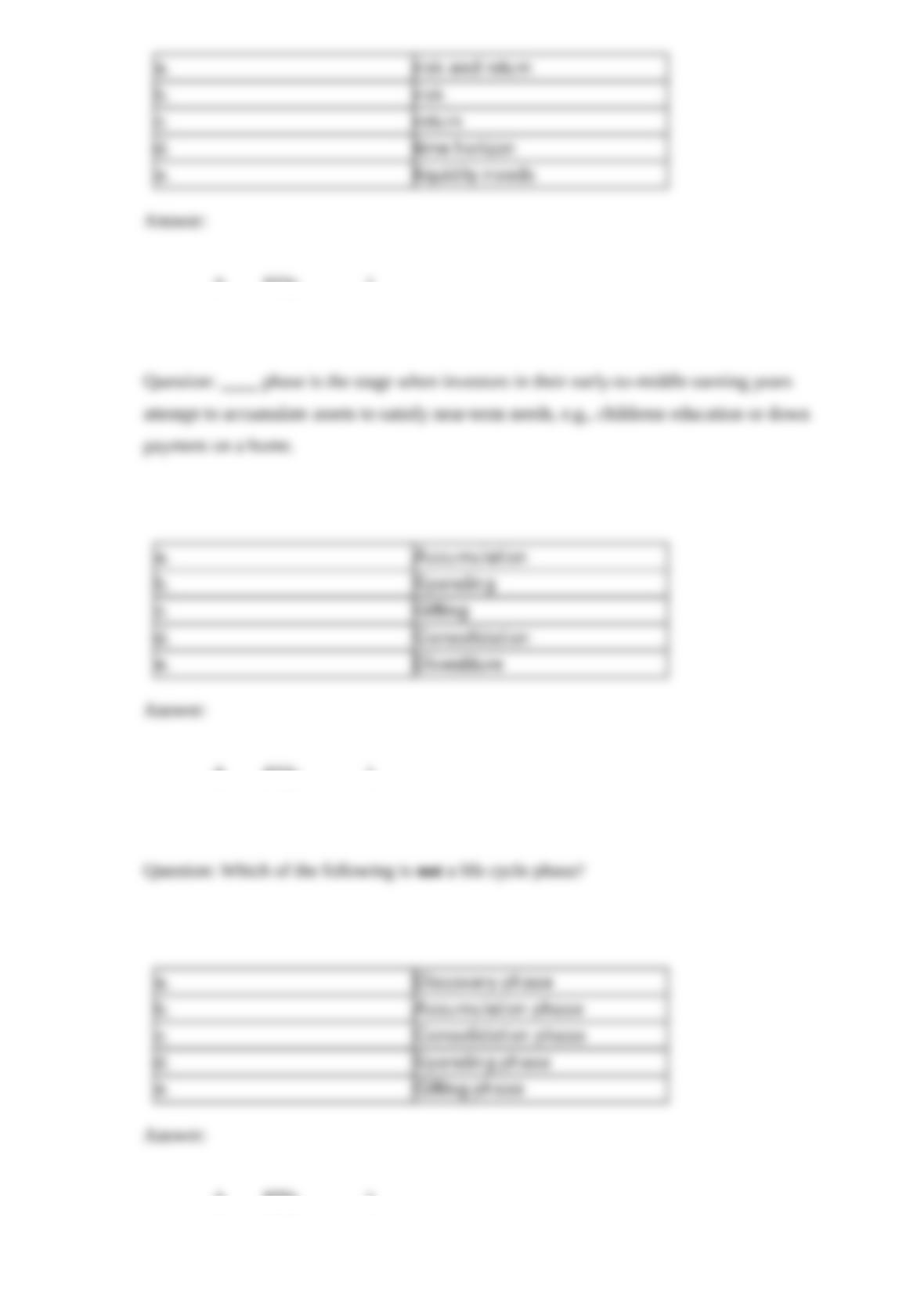
Question: In an investment policy statement the objectives of an investor are expressed in
terms of
Answer:
Question: ____ phase is the stage when investors in their early-to-middle earning years
attempt to accumulate assets to satisfy near-term needs, e.g., childrens education or down
payment on a home.
Answer:
Question: Which of the following is not a life cycle phase?
Answer:
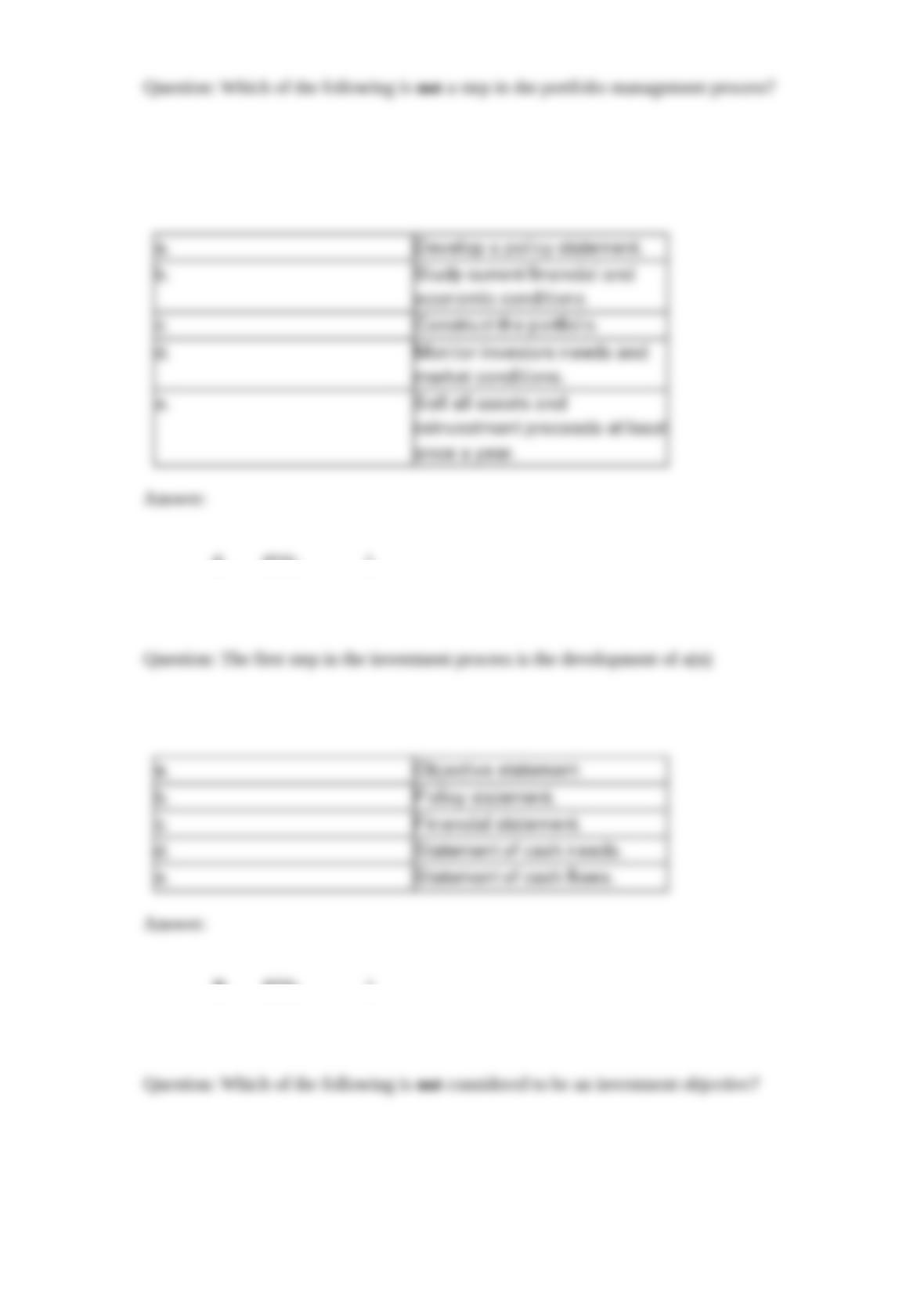
Question: Which of the following is not a step in the portfolio management process?
Answer:
Question: The first step in the investment process is the development of a(n)
Answer:
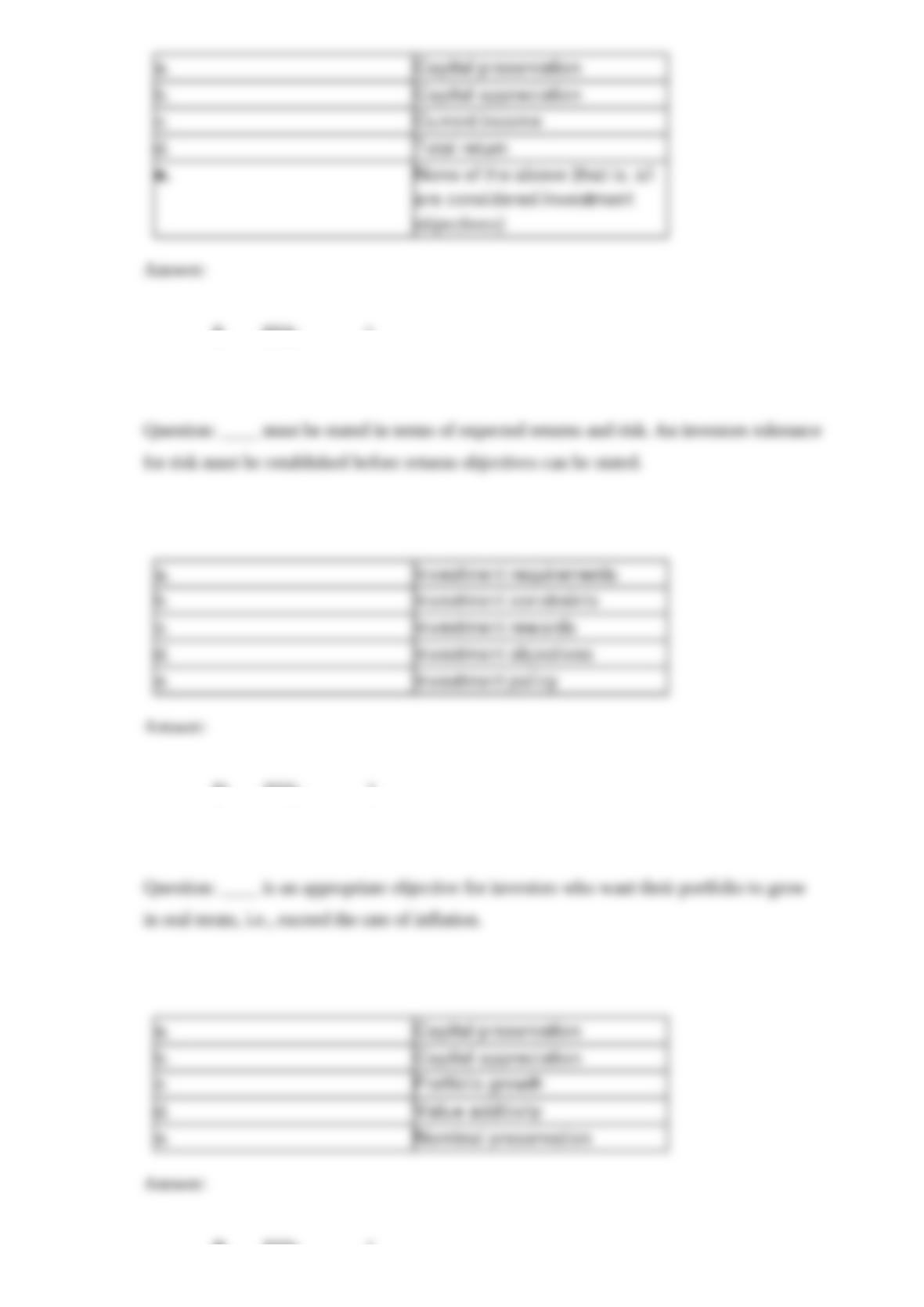
Question: Which of the following is not considered to be an investment objective?
Answer:
Question: ____ must be stated in terms of expected returns and risk. An investors tolerance
for risk must be established before returns objectives can be stated.
Answer:
Question: ____ is an appropriate objective for investors who want their portfolio to grow
in real terms, i.e., exceed the rate of inflation.
Answer:
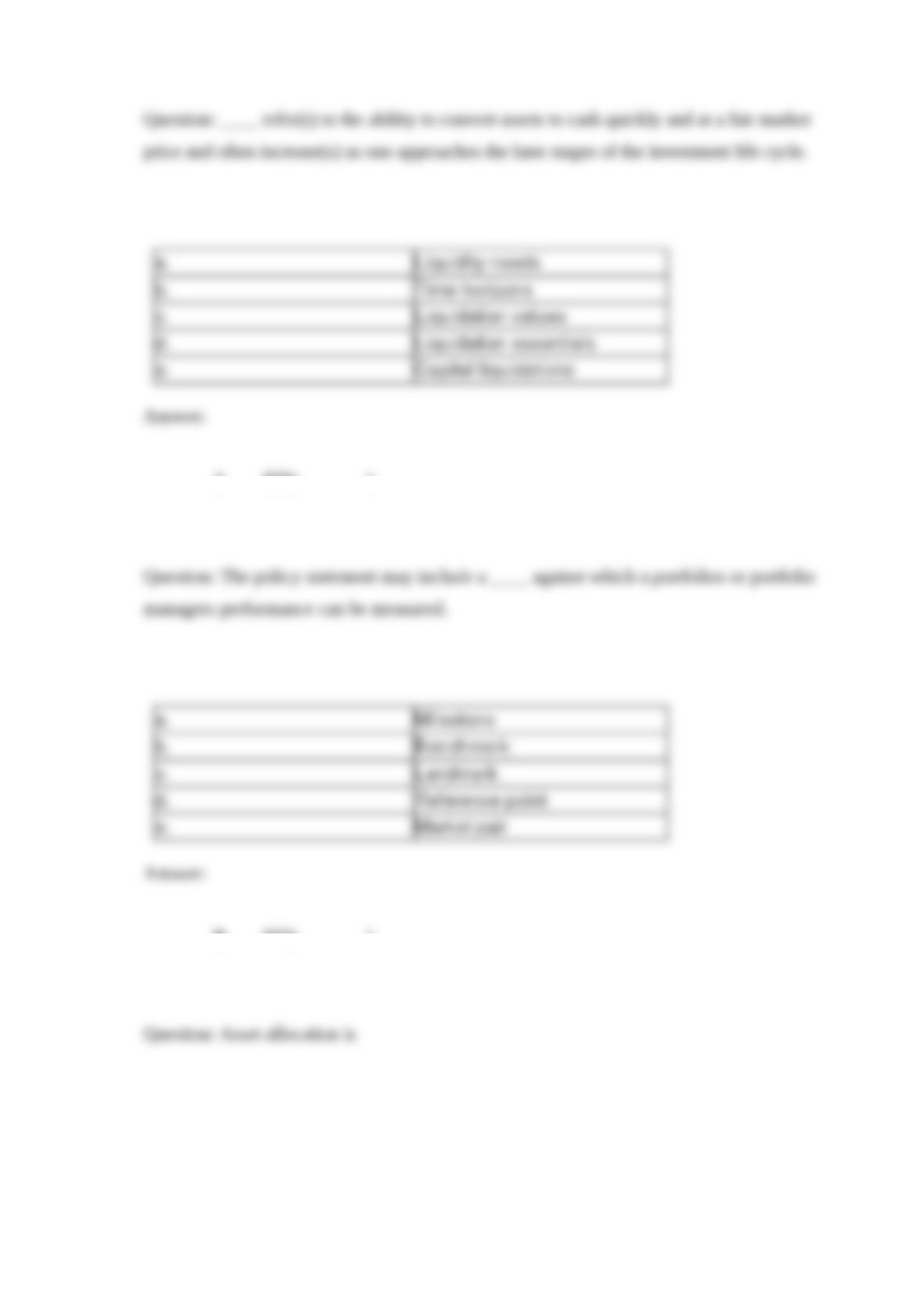
Question: ____ refer(s) to the ability to convert assets to cash quickly and at a fair market
price and often increase(s) as one approaches the later stages of the investment life cycle.
Answer:
Question: The policy statement may include a ____ against which a portfolios or portfolio
managers performance can be measured.
Answer:
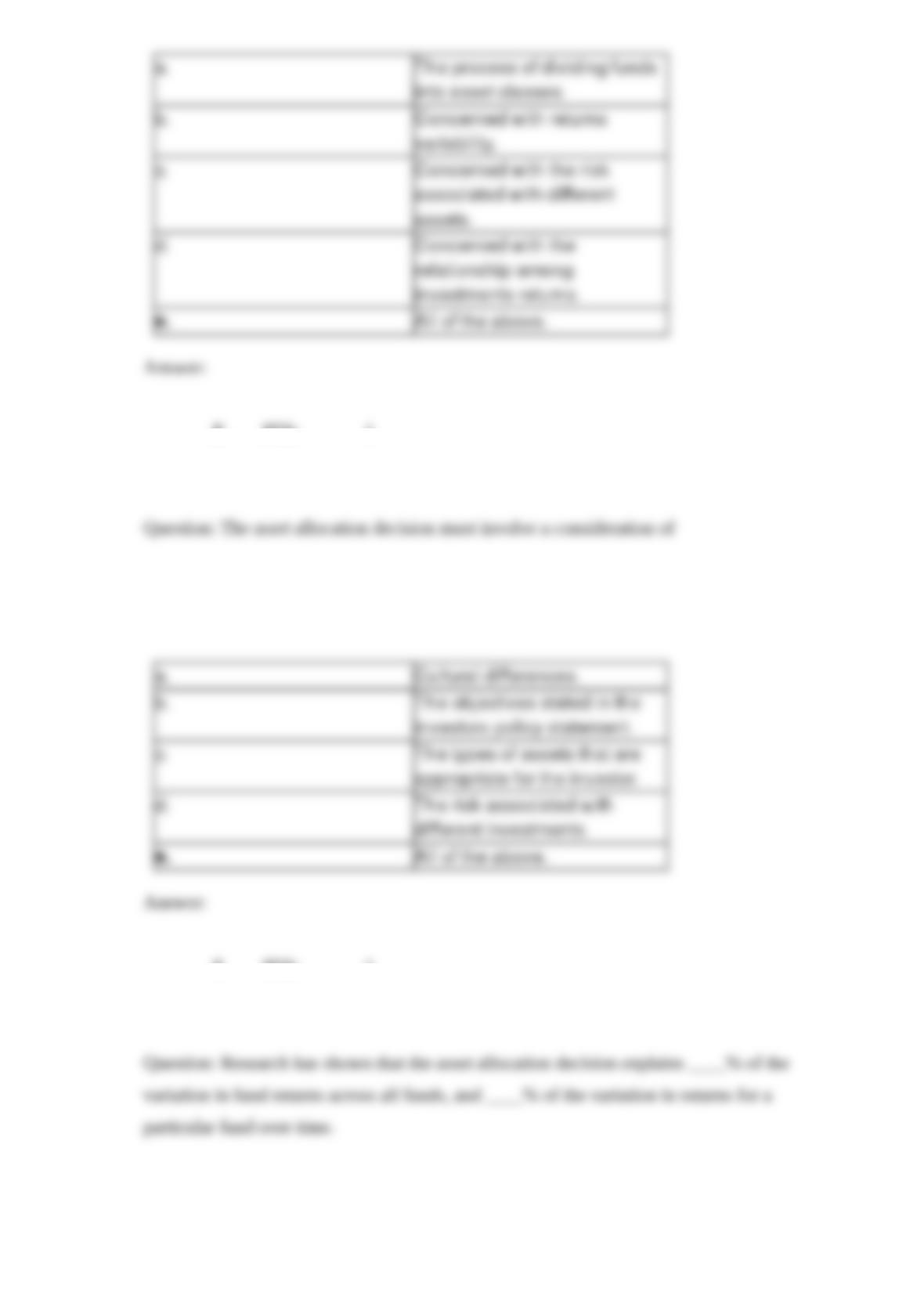
Question: Asset allocation is
Answer:
Question: The asset allocation decision must involve a consideration of
Answer:
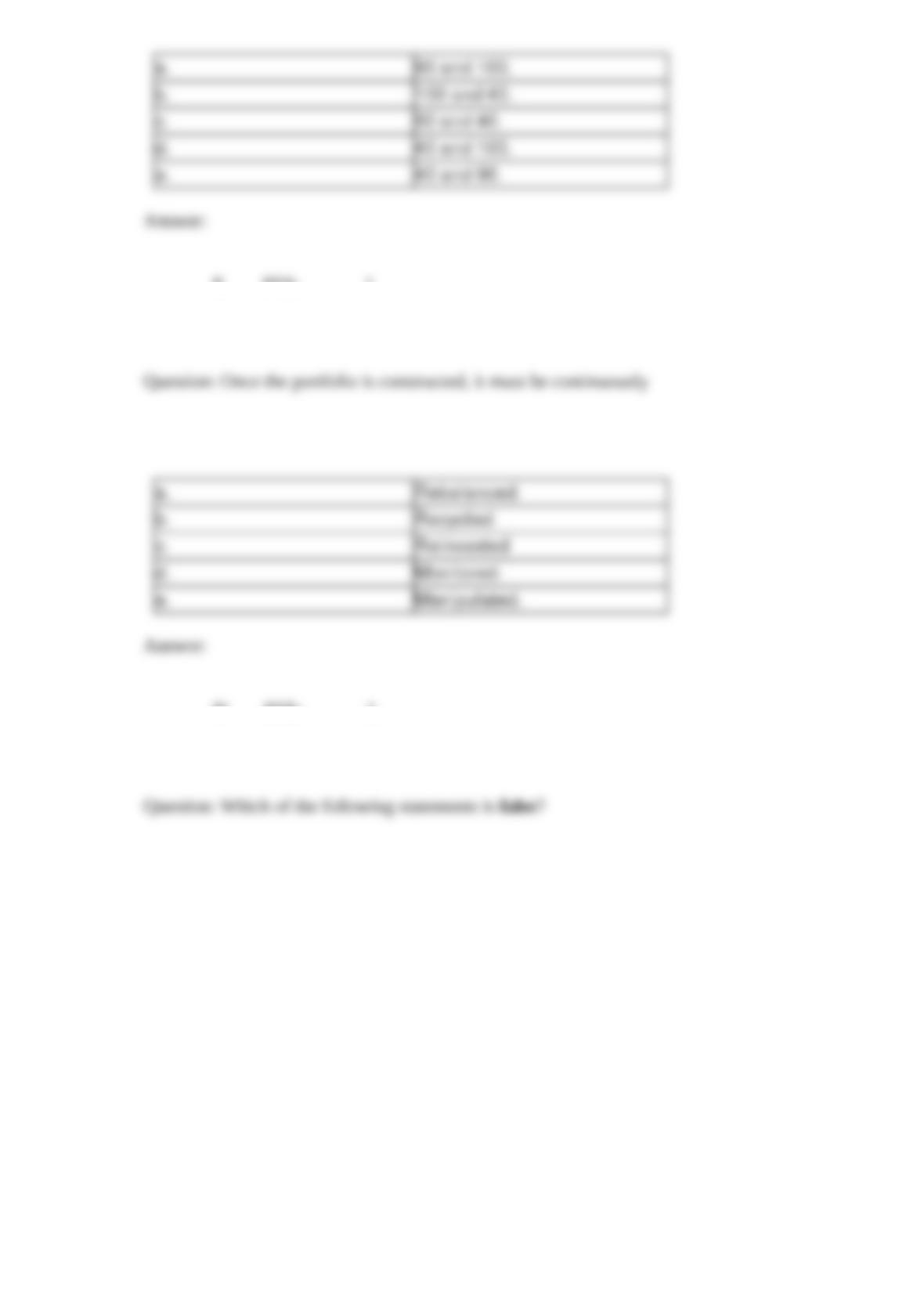
Question: Research has shown that the asset allocation decision explains ____% of the
variation in fund returns across all funds, and ____% of the variation in returns for a
particular fund over time.
Answer:
Question: Once the portfolio is constructed, it must be continuously
Answer:
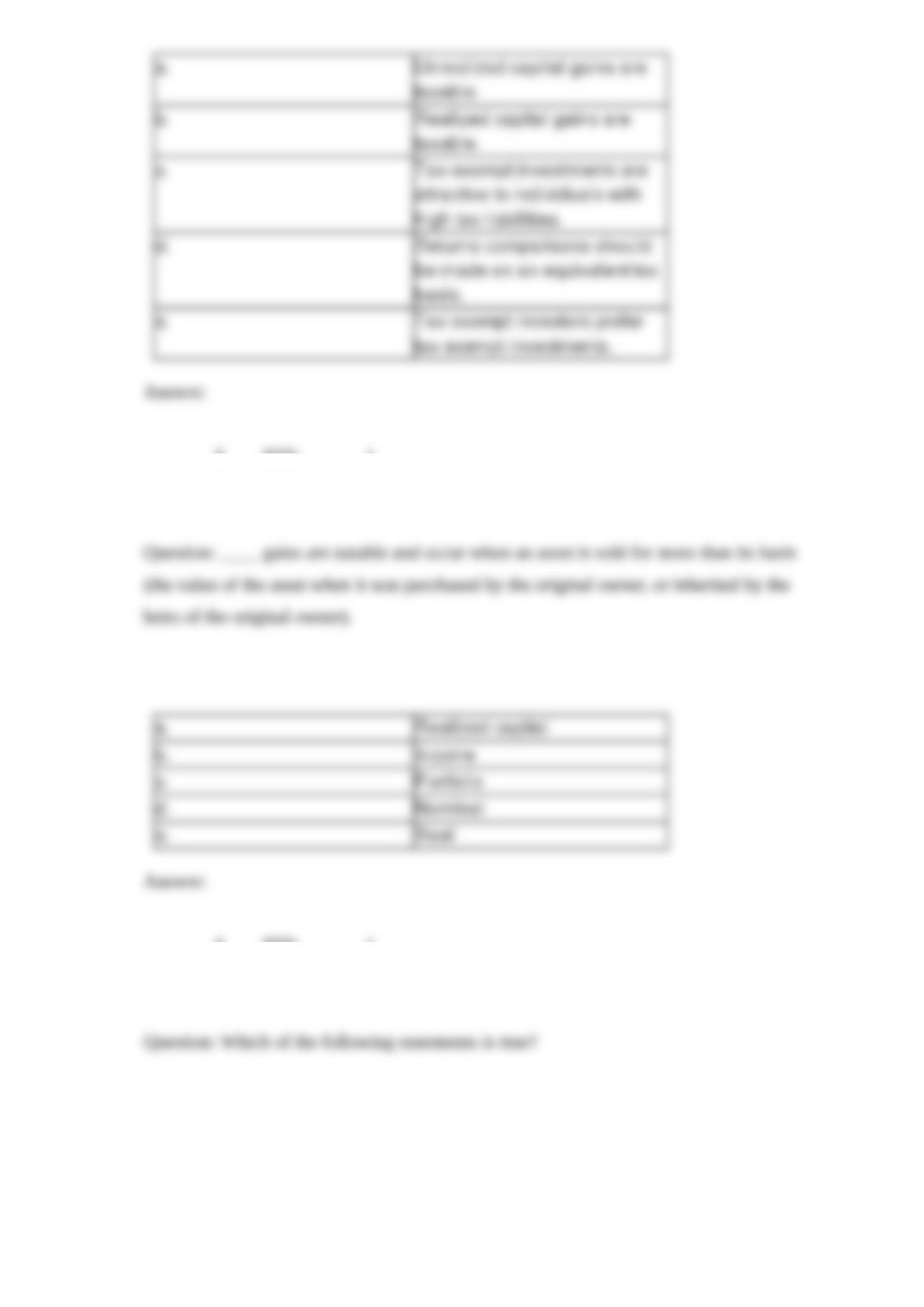
Question: Which of the following statements is false?
Answer:
Question: ____ gains are taxable and occur when an asset is sold for more than its basis
(the value of the asset when it was purchased by the original owner, or inherited by the
heirs of the original owner).
Answer:
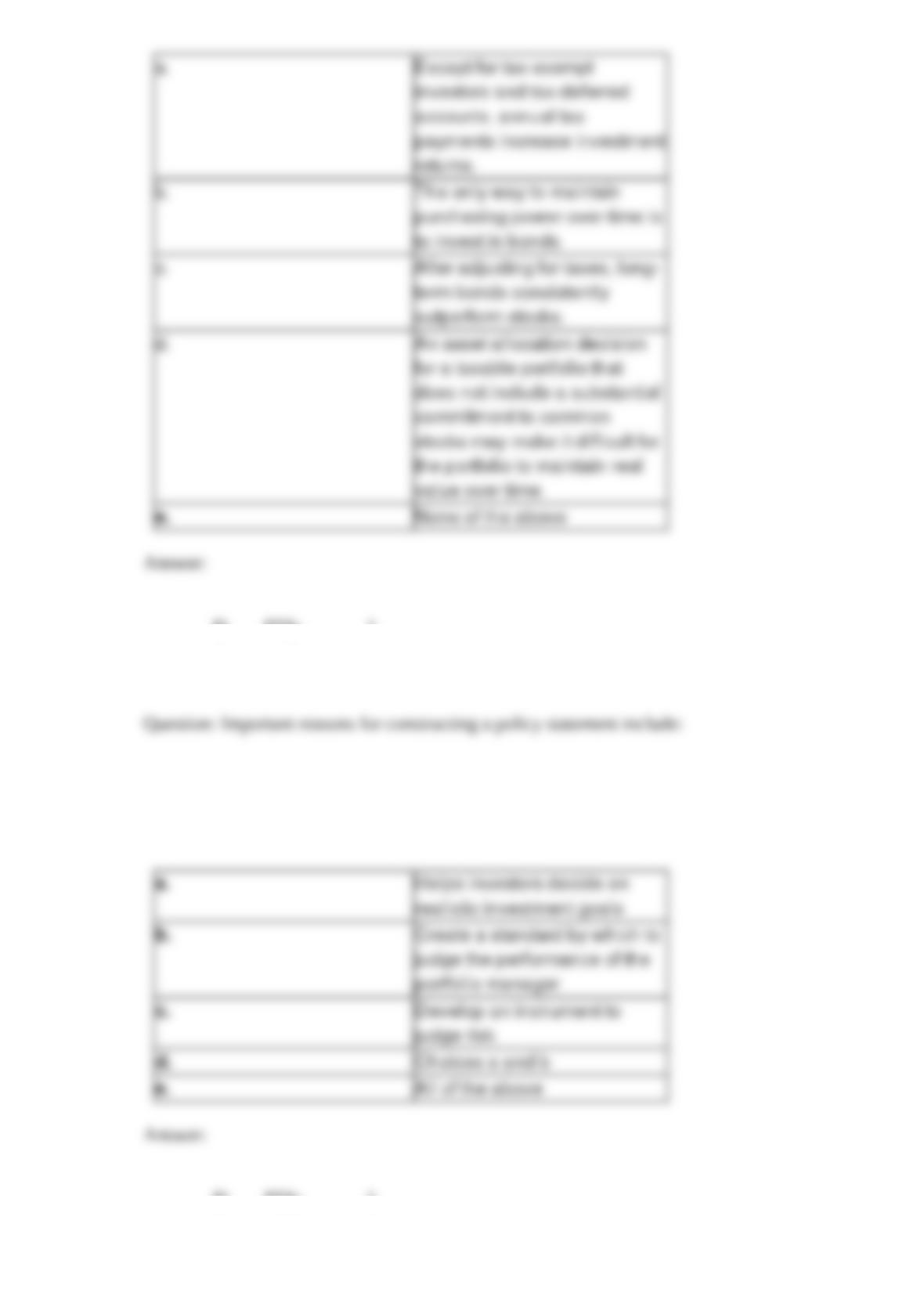
Question: Which of the following statements is true?
Answer:
Question: Important reasons for constructing a policy statement include:
Answer:
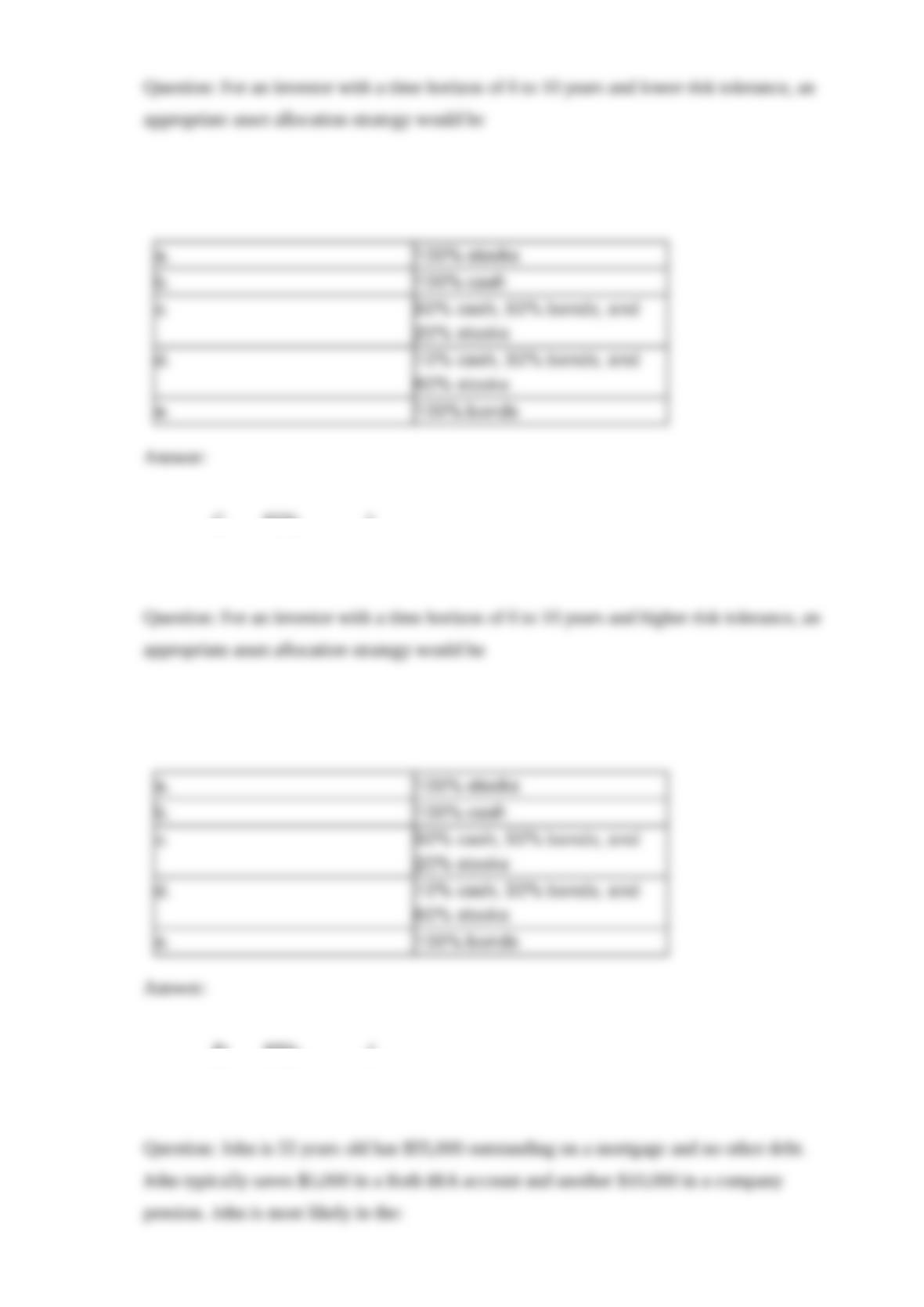
Question: For an investor with a time horizon of 6 to 10 years and lower risk tolerance, an
appropriate asset allocation strategy would be
Answer:
Question: For an investor with a time horizon of 6 to 10 years and higher risk tolerance, an
appropriate asset allocation strategy would be
Answer:
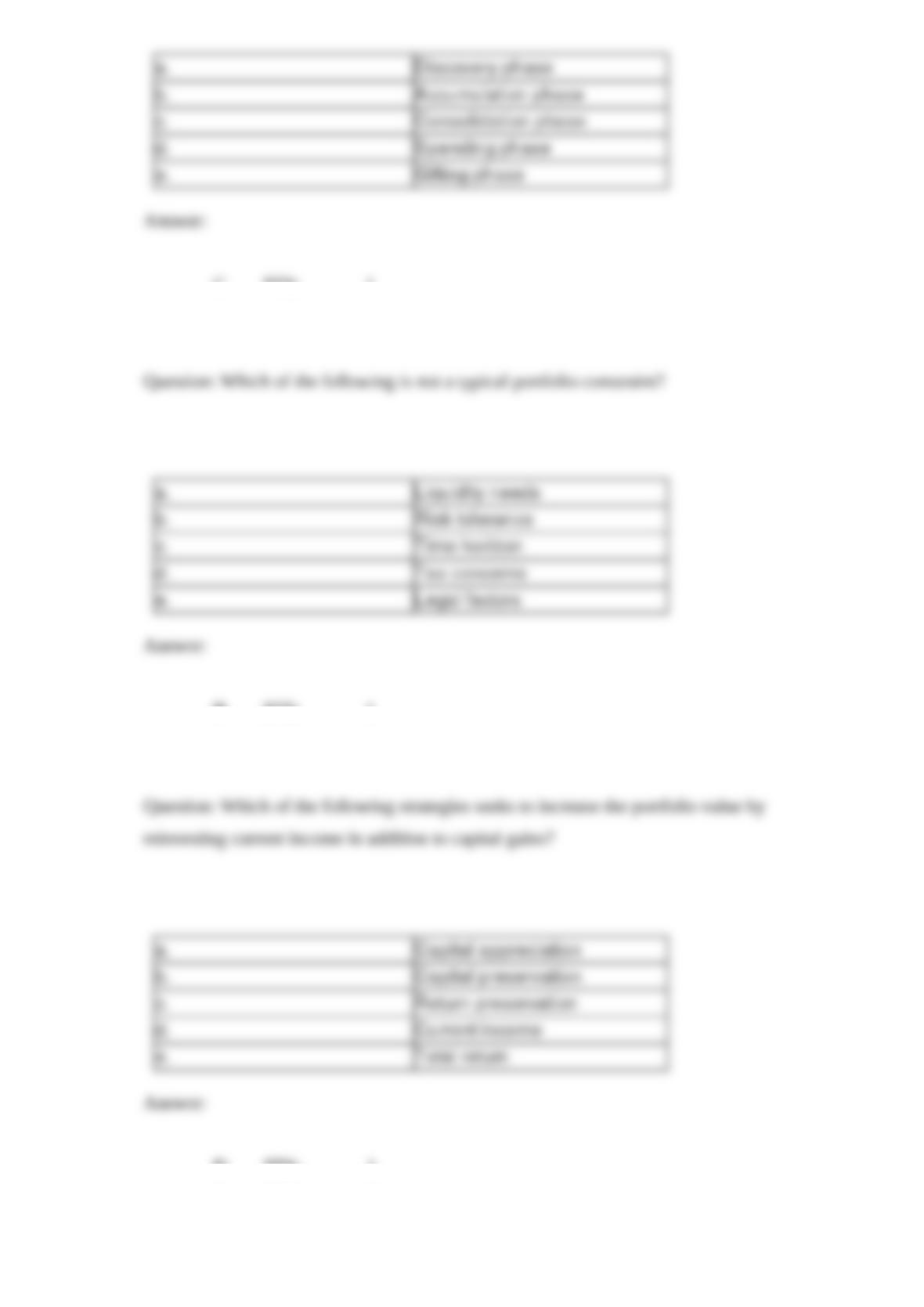
Question: John is 55 years old has $55,000 outstanding on a mortgage and no other debt.
John typically saves $5,000 in a Roth IRA account and another $10,000 in a company
pension. John is most likely in the:
Answer:
Question: Which of the following is not a typical portfolio constraint?
Answer:
Question: Which of the following strategies seeks to increase the portfolio value by
reinvesting current income in addition to capital gains?
Answer:
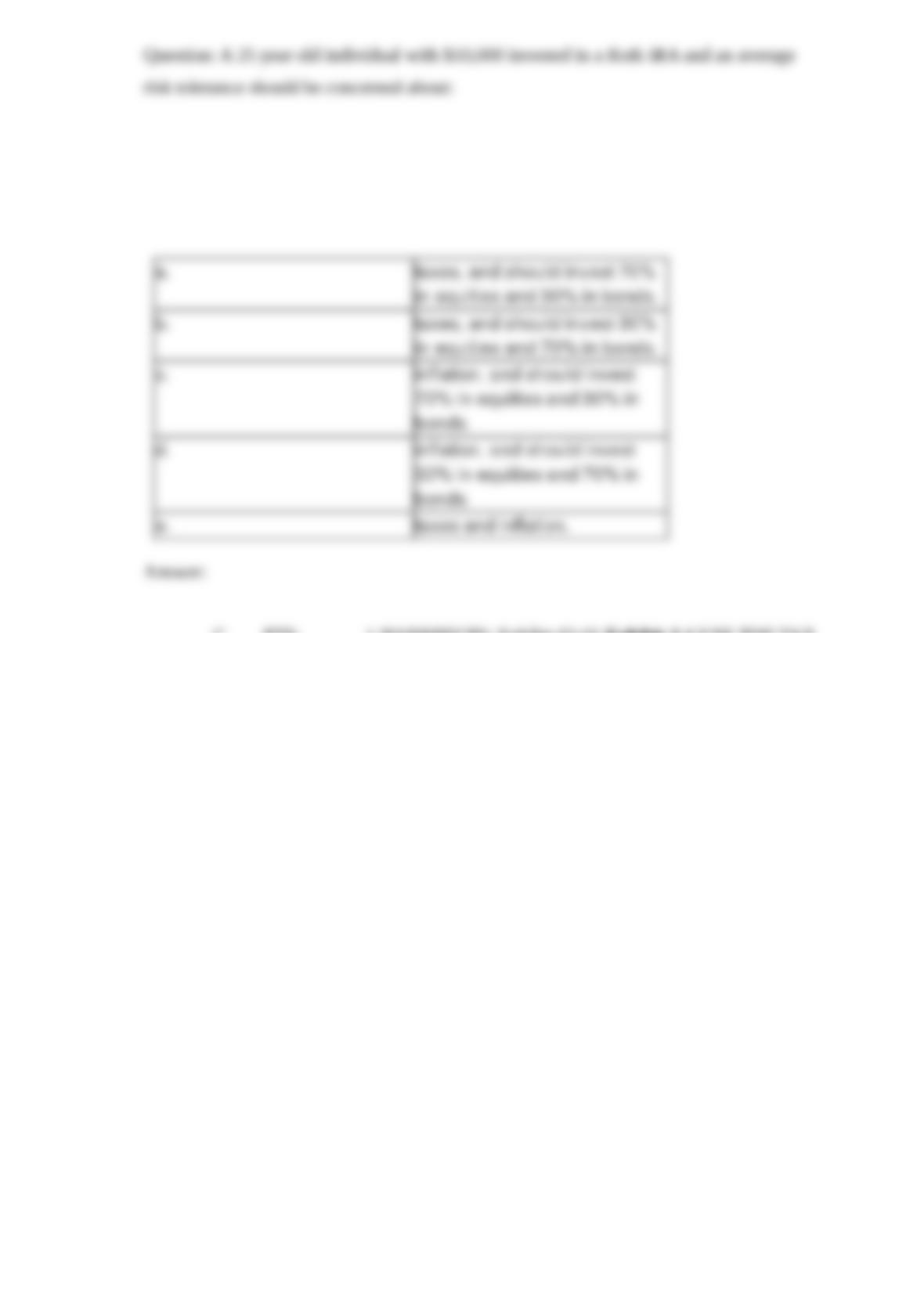
Question: A 25 year old individual with $10,000 invested in a Roth IRA and an average
risk tolerance should be concerned about:
Answer:
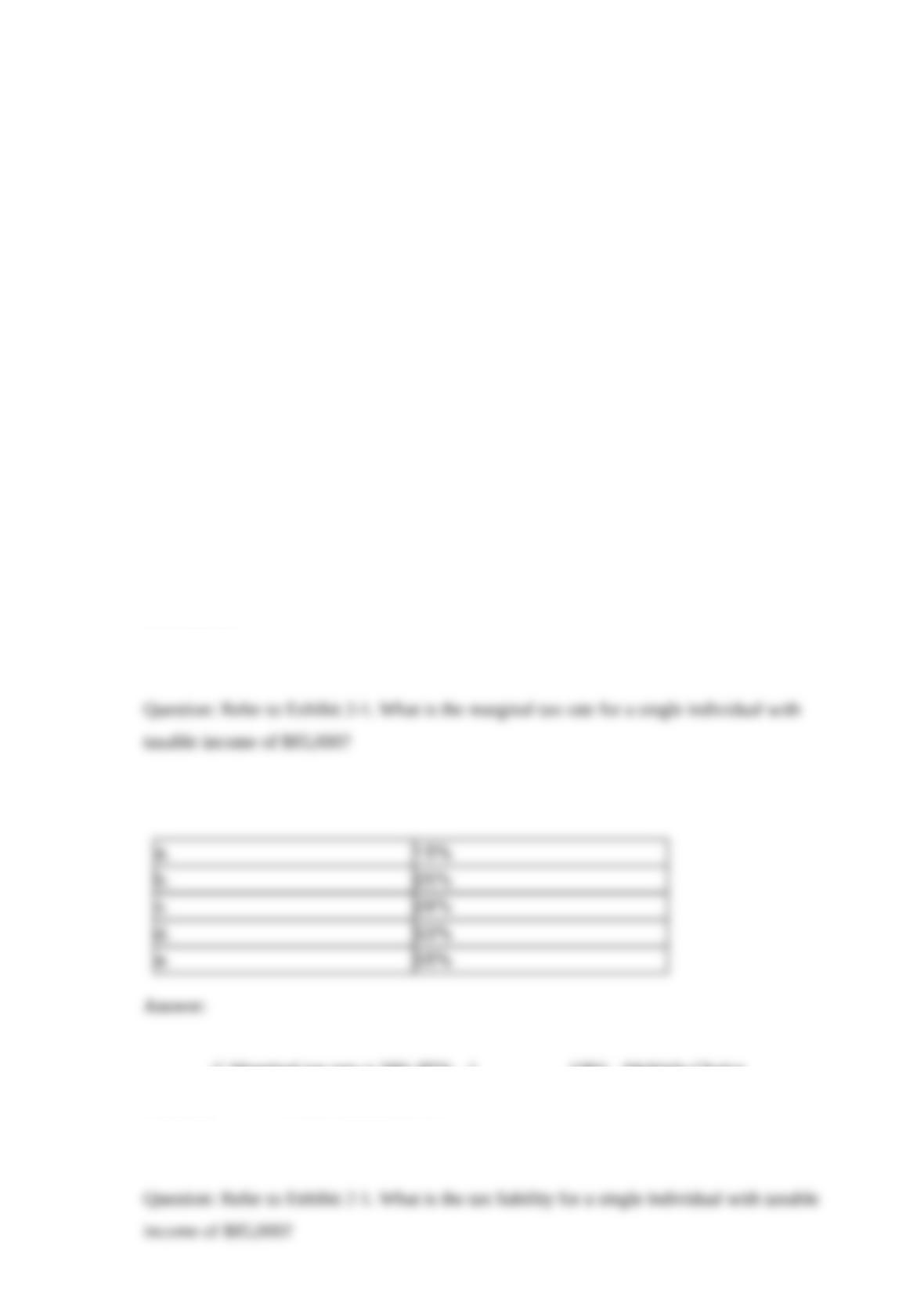
Question: Refer to Exhibit 2-1. What is the marginal tax rate for a single individual with
taxable income of $85,000?
Answer:
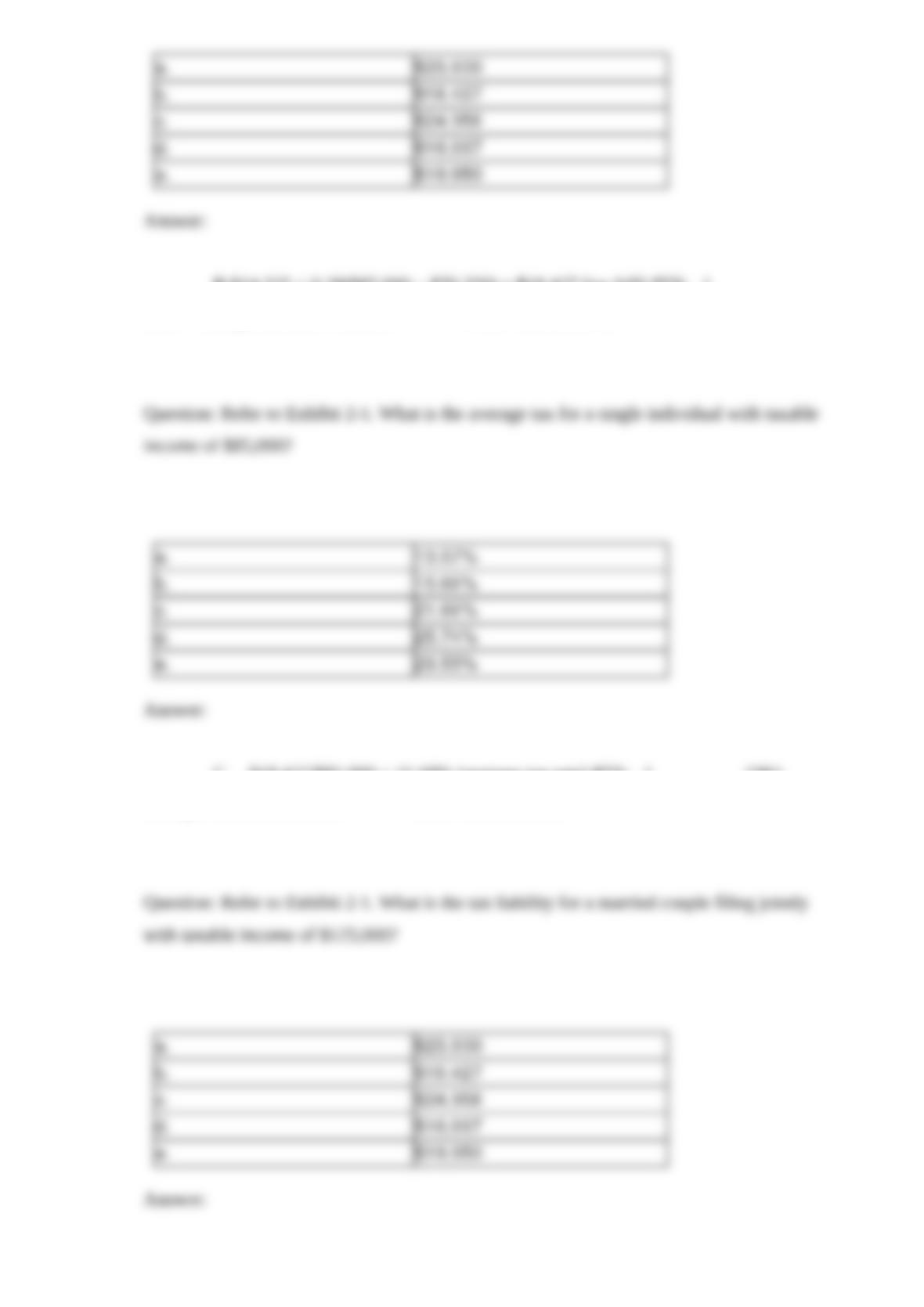
Question: Refer to Exhibit 2-1. What is the tax liability for a single individual with taxable
income of $85,000?
Answer:
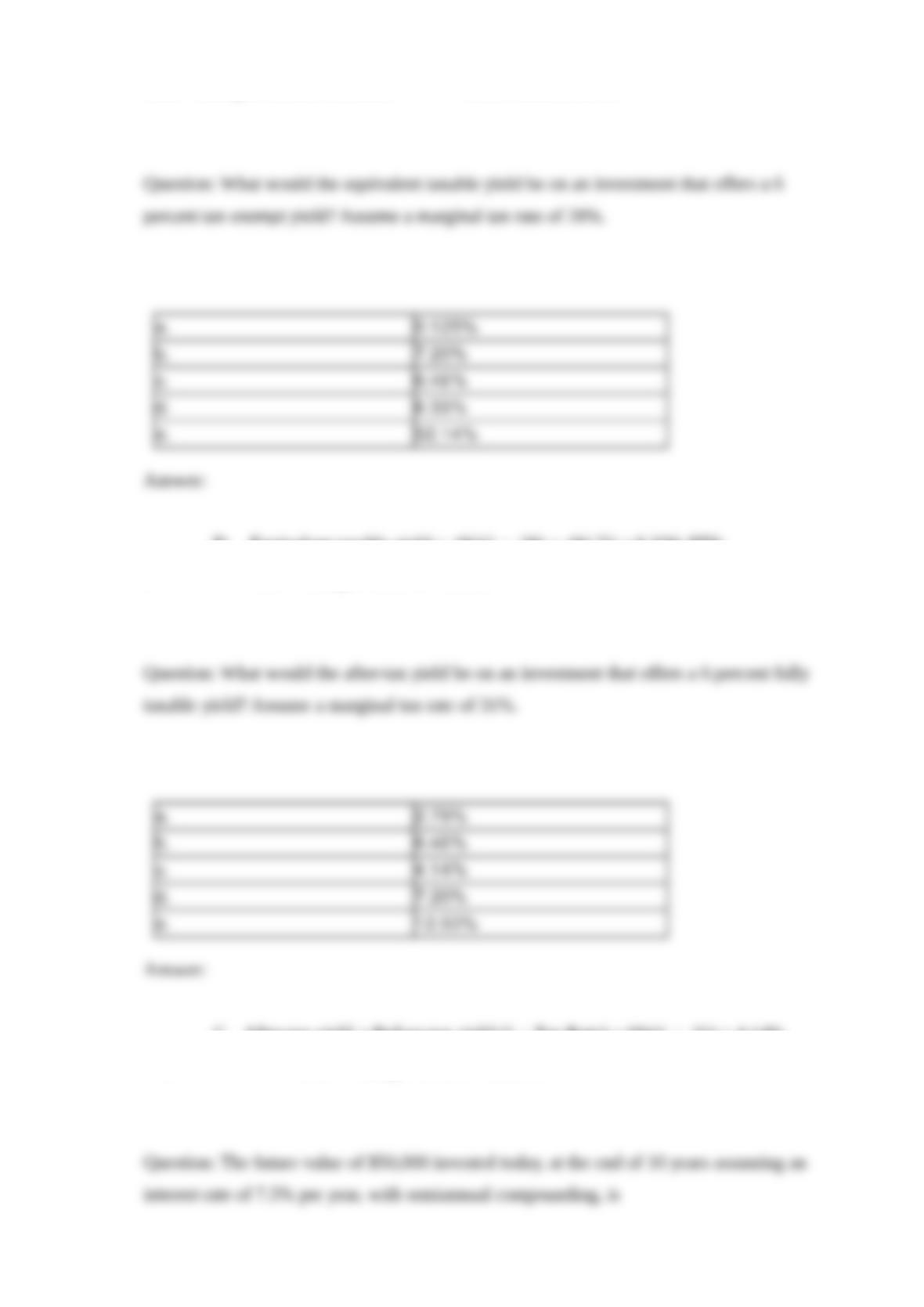
Question: Refer to Exhibit 2-1. What is the average tax for a single individual with taxable
income of $85,000?
Answer:
Question: Refer to Exhibit 2-1. What is the tax liability for a married couple filing jointly
with taxable income of $125,000?
Answer:
Question: What would the equivalent taxable yield be on an investment that offers a 6
percent tax exempt yield? Assume a marginal tax rate of 28%.
Answer:
Question: What would the after-tax yield be on an investment that offers a 6 percent fully
taxable yield? Assume a marginal tax rate of 31%.
Answer:
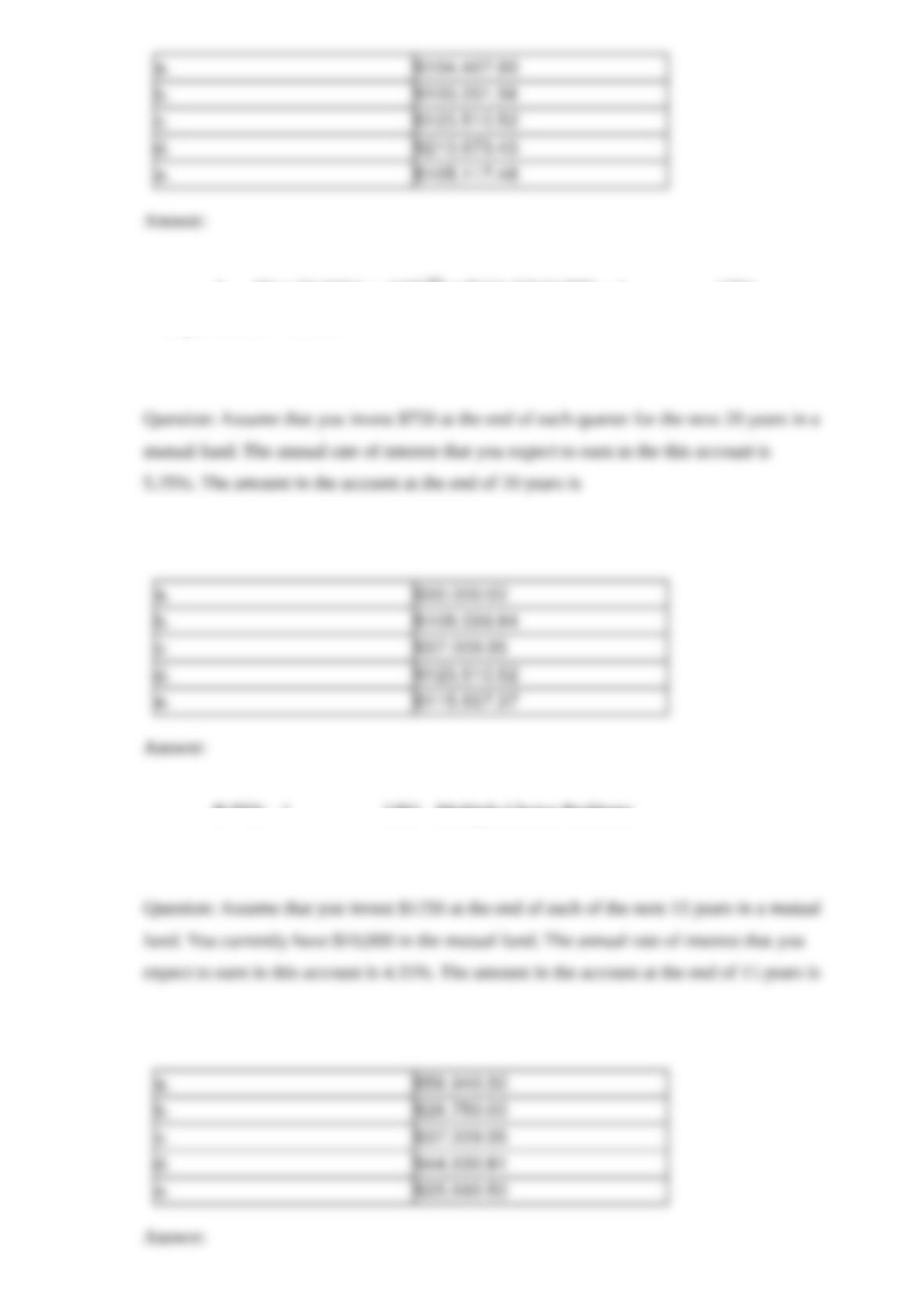
Question: The future value of $50,000 invested today, at the end of 10 years assuming an
interest rate of 7.5% per year, with semiannual compounding, is
Answer:
Question: Assume that you invest $750 at the end of each quarter for the next 20 years in a
mutual fund. The annual rate of interest that you expect to earn in the this account is
5.25%. The amount in the account at the end of 20 years is
Answer:
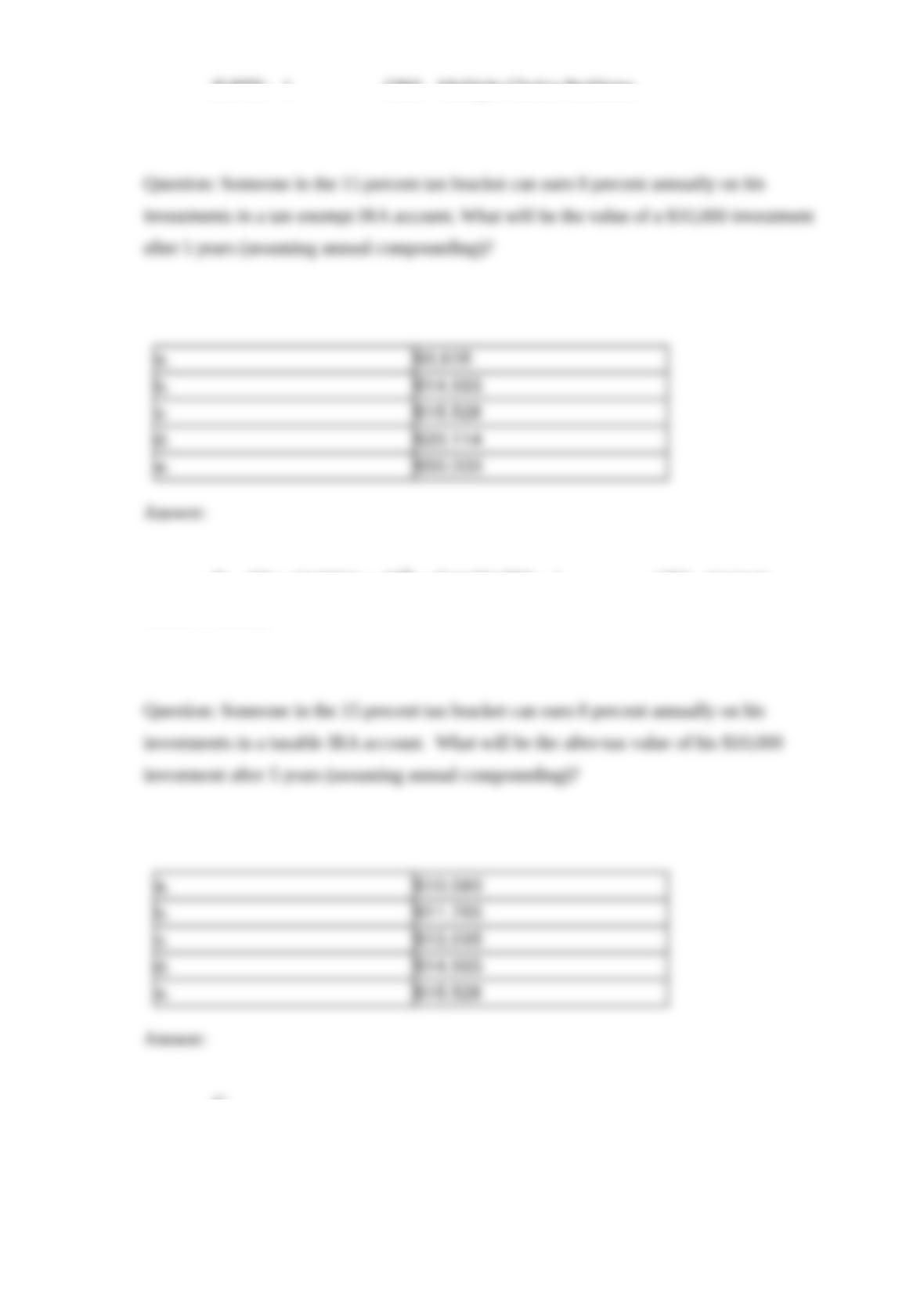
Question: Assume that you invest $1250 at the end of each of the next 15 years in a mutual
fund. You currently have $10,000 in the mutual fund. The annual rate of interest that you
expect to earn in this account is 4.35%. The amount in the account at the end of 15 years is
Answer:
Question: Someone in the 15 percent tax bracket can earn 8 percent annually on his
investments in a tax-exempt IRA account. What will be the value of a $10,000 investment
after 5 years (assuming annual compounding)?
Answer:
Question: Someone in the 15 percent tax bracket can earn 8 percent annually on his
investments in a taxable IRA account. What will be the after-tax value of his $10,000
investment after 5 years (assuming annual compounding)?
Answer:
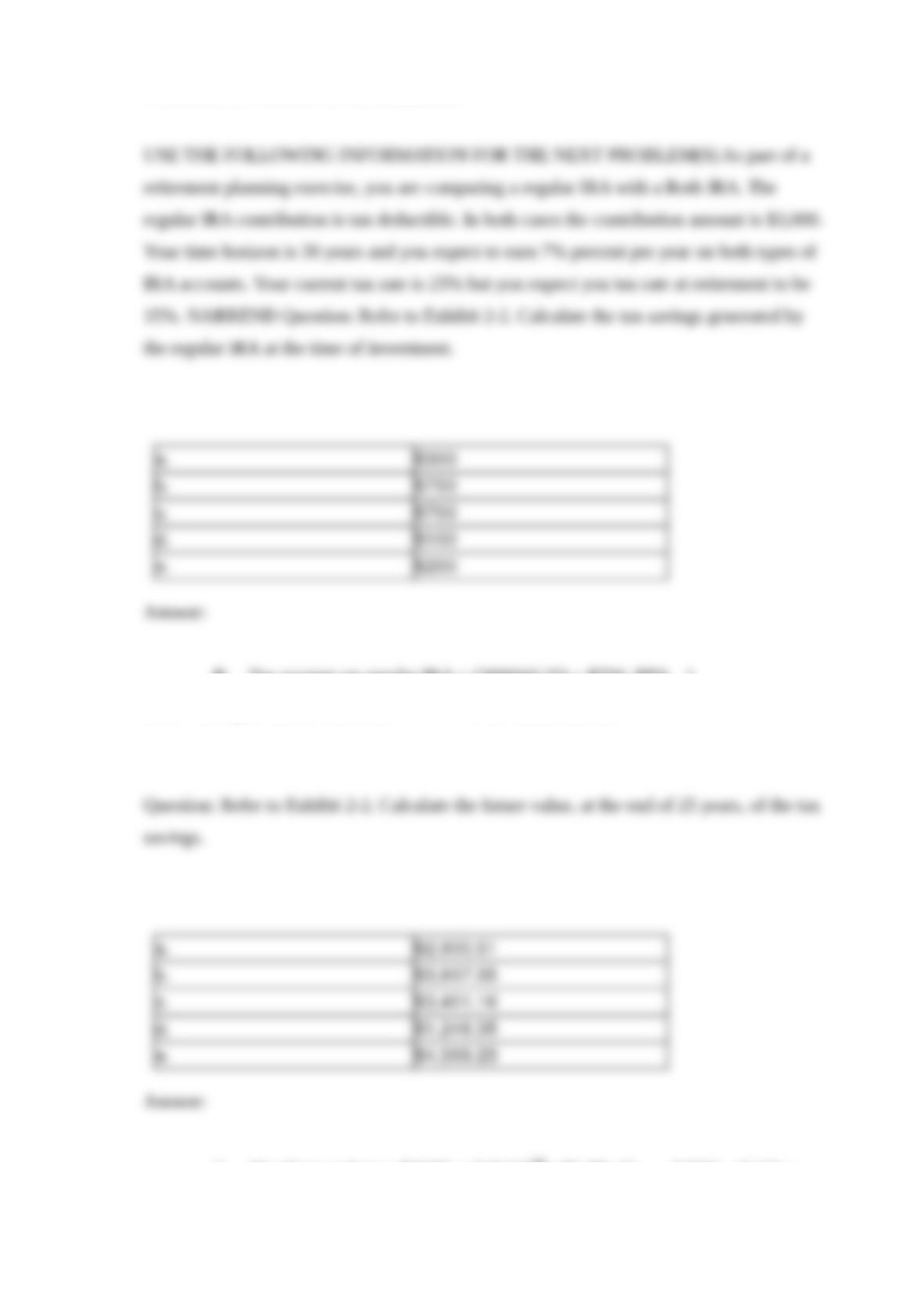
USE THE FOLLOWING INFORMATION FOR THE NEXT PROBLEM(S) As part of a
retirement planning exercise, you are comparing a regular IRA with a Roth IRA. The
regular IRA contribution is tax deductible. In both cases the contribution amount is $3,000.
Your time horizon is 30 years and you expect to earn 7% percent per year on both types of
IRA accounts. Your current tax rate is 25% but you expect you tax rate at retirement to be
15%. NARREND Question: Refer to Exhibit 2-2. Calculate the tax savings generated by
the regular IRA at the time of investment.
Answer:
Question: Refer to Exhibit 2-2. Calculate the future value, at the end of 25 years, of the tax
savings.
Answer:
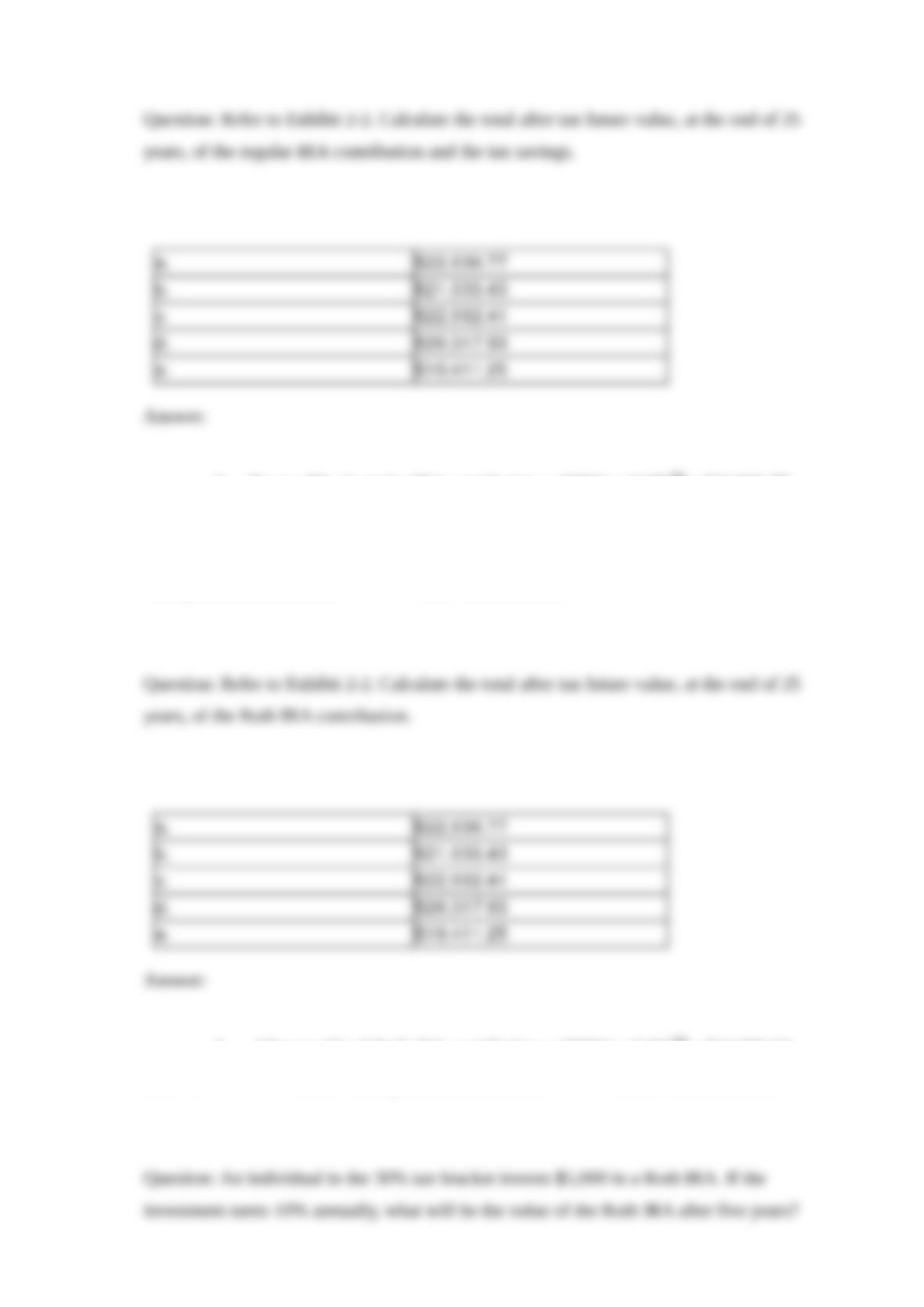
Question: Refer to Exhibit 2-2. Calculate the total after tax future value, at the end of 25
years, of the regular IRA contribution and the tax savings.
Answer:
Question: Refer to Exhibit 2-2. Calculate the total after tax future value, at the end of 25
years, of the Roth IRA contribution.
Answer:
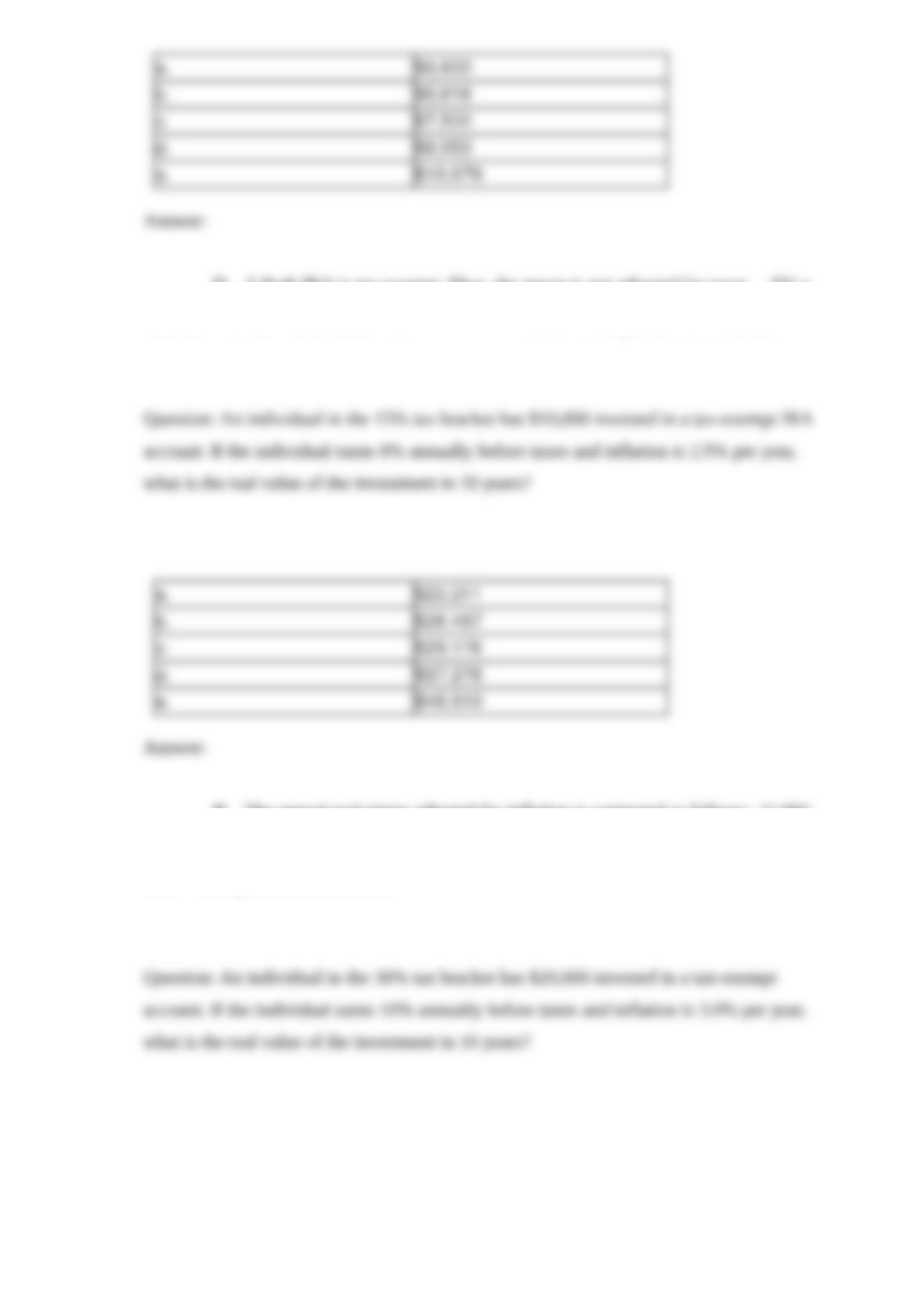
Question: An individual in the 36% tax bracket invests $5,000 in a Roth IRA. If the
investment earns 10% annually, what will be the value of the Roth IRA after five years?
Answer:
Question: An individual in the 15% tax bracket has $10,000 invested in a tax-exempt IRA
account. If the individual earns 8% annually before taxes and inflation is 2.5% per year,
what is the real value of the investment in 20 years?
Answer:
Question: An individual in the 36% tax bracket has $20,000 invested in a tax-exempt
account. If the individual earns 10% annually before taxes and inflation is 3.0% per year,
what is the real value of the investment in 10 years?

Answer: