
CHAPTER 19—BOND PORTFOLIO MANAGEMENT STRATEGIES
TRUE/FALSE
Question: A bond portfolio is immunized from interest rate risk if the modified duration of
the portfolio is always equal to the desired investment horizon.
Answer:
Question: Interest rate anticipation is the most conservative management strategy.
Answer:
Question: In valuation analysis, undervalued bonds are bonds where the expected YTMs
are lower than the prevailing YTM.
Answer:
Question: A bond swap involves liquidating a current bond position, and later investing in
a similar issue under more favorable conditions.
Answer:
Question: A pure yield pickup swap involves a switch from a low-coupon bond to a
higher-coupon bond of similar quality and maturity.
Answer:

Question: A substitution swap relies heavily on interest rate expectations.
Answer:
Question: When applying active management techniques to a global portfolio the
additional concern is expectations regarding exchange rates between countries.
Answer:
Question: The bond management strategy intended to eliminate interest rate risk is
immunization.
Answer:
Question: A portfolio of bonds is immunized from interest rate risk if the duration of the
portfolio is always equal to the desired investment horizon.
Answer:
Question: The duration of a perpetual bond is always equal to its term to maturity.
Answer:

Question: In a buy-and-hold strategy, bonds are purchased in light of the investors
objectives and constraints and then held until maturity.
Answer:
Question: Indexing is an active portfolio management strategy that seeks to copy the
composition and performance of a selected market index.
Answer:
Question: Interest rate anticipation is one of the matched funding techniques that matches
anticipated interest rates with the required rates on a portfolio.
Answer:
Question: In a ladder strategy, funds are invested equally among a wide range of
maturities.
Answer:
Question: Credit analysis and core-plus management are examples of active bond portfolio
management.
Answer:

Question: A manager following an interest rate anticipation strategy would shorten
portfolio duration if interest rates were expected to increase.
Answer:
Question: When applying active management techniques to a global portfolio the
additional concern is expectations regarding exchange rates between countries.
Answer:
Question: With a matched funding technique portfolio managers try to match specific
liability obligations due at specific times to a portfolio of bonds that minimize the
portfolios interest rate risk.
Answer:
Question: Investment horizon is the future time when an investor must begin an investment
program to generate the required funds for a future liability.
Answer:

Question: The components of interest rate risk are: price risk and maturity risk.
Answer:
Question: Altman-Nammacher (1987) create a modified Z-score model using a multiple
regression analysis technique.
Answer:
Question: The substitution swap is generally long term and relies heavily on interest rate
expectations.
Answer:
Question: Which of the following is a passive bond portfolio strategy?
Answer:

Question: The active strategies for bond management include all of the following, except
Answer:
Question: Which of the following is a matched funding technique?
Answer:
Question: For a bond investor selecting a buy-and-hold strategy, which of the following
would be the least important consideration?

Answer:
Question: Junk bonds are high yield bond bonds rated below
Answer:
Question: Contingent immunization strategies:

Answer:
Question: Which of the following would not normally be a reason for a bond swap?
Answer:

Question: If an investor swaps identical issues to establish a loss, the loss is disallowed and
the transaction is known as a
Answer:
Question: The term dedication, used to describe portfolio management techniques, is
referring to servicing a prescribed set of
Answer:
Question: Coupon reinvestment risk arises because the yield to maturity computation
implicitly assumes that all coupon flows will be reinvested at the

Answer:
Question: Assuming no change in interest rates the duration of a coupon bond
Answer:
Question: In core-plus bond management

Answer:
Question: A tax swap involves swapping out of a

Answer:
Question: A substitution pickup swap involves swapping out of a
Answer:

Question: A pure yield pickup swap involves swapping out of a
Answer:
Question: In a barbell strategy

Answer:
Question: In a ladder strategy

Answer:
Question: An example of an active strategy for bond management would be
Answer:
Question: A portfolio manager that attempts to select bonds based on their intrinsic value
would be carrying out

Answer:
Question: Which factors indicate that in-depth credit analysis of high-yield bonds is
important.
Answer:
Question: In classical immunization the effect of a change in interest rates is effectively
neutralized because?

Answer:
Question: Horizon matching is a combination of
Answer:
Question: Interest rate risk is comprised of which of the following risks?

Answer:
Question: Which of the following statements is true?
Answer:
Question: Horizon matching is a combination of

Answer:
USE THE FOLLOWING INFORMATION FOR THE NEXT PROBLEM(S)
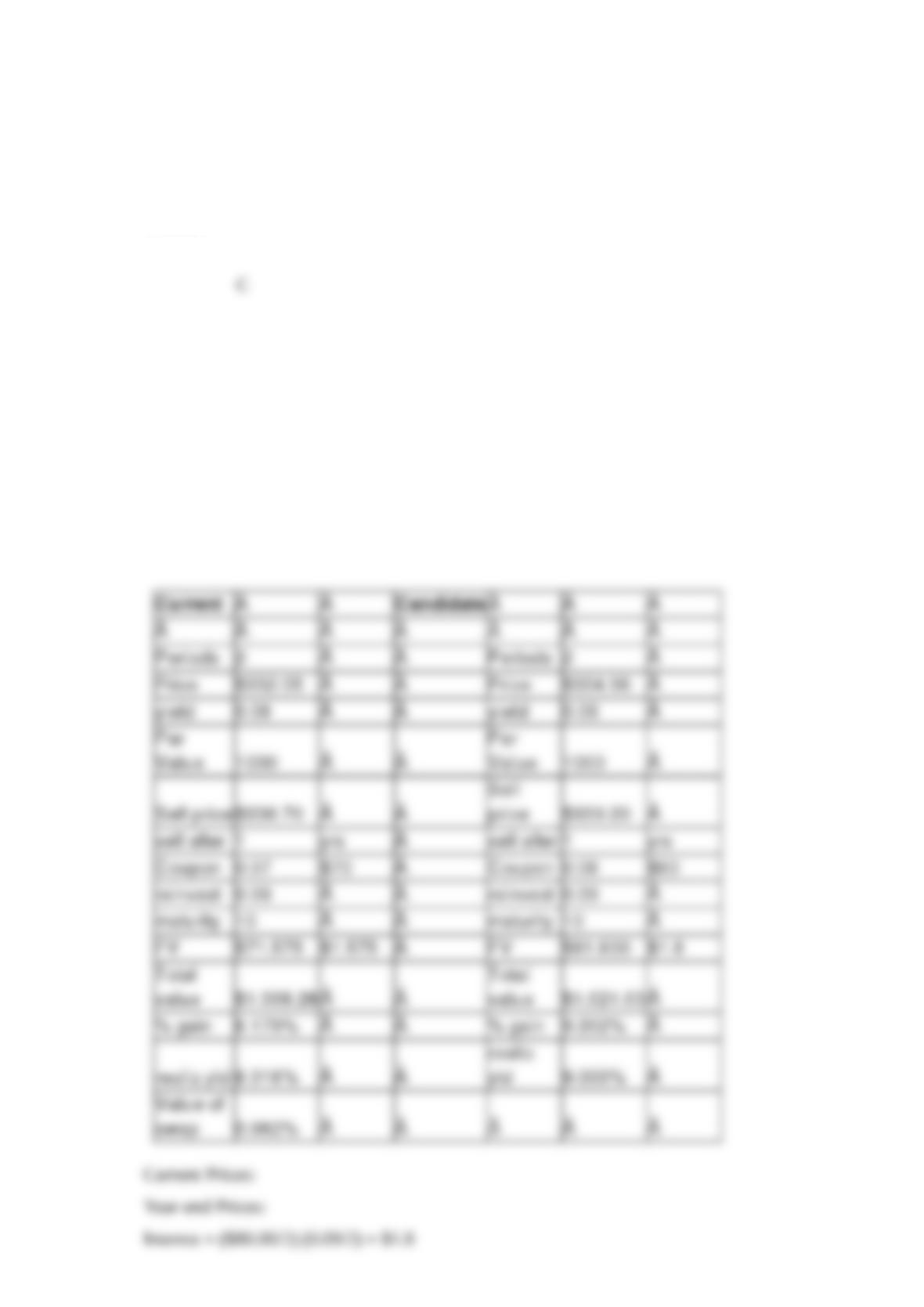
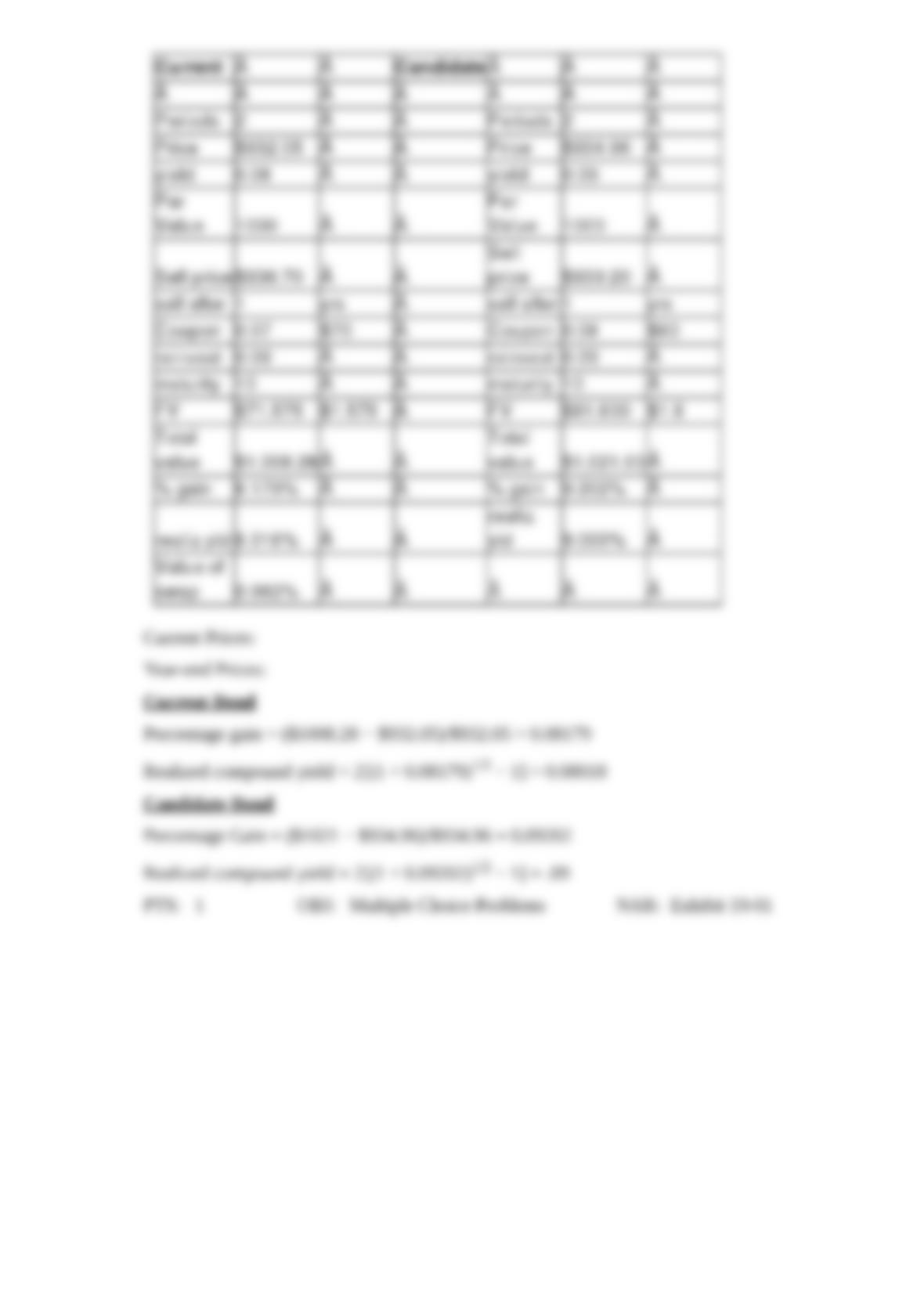
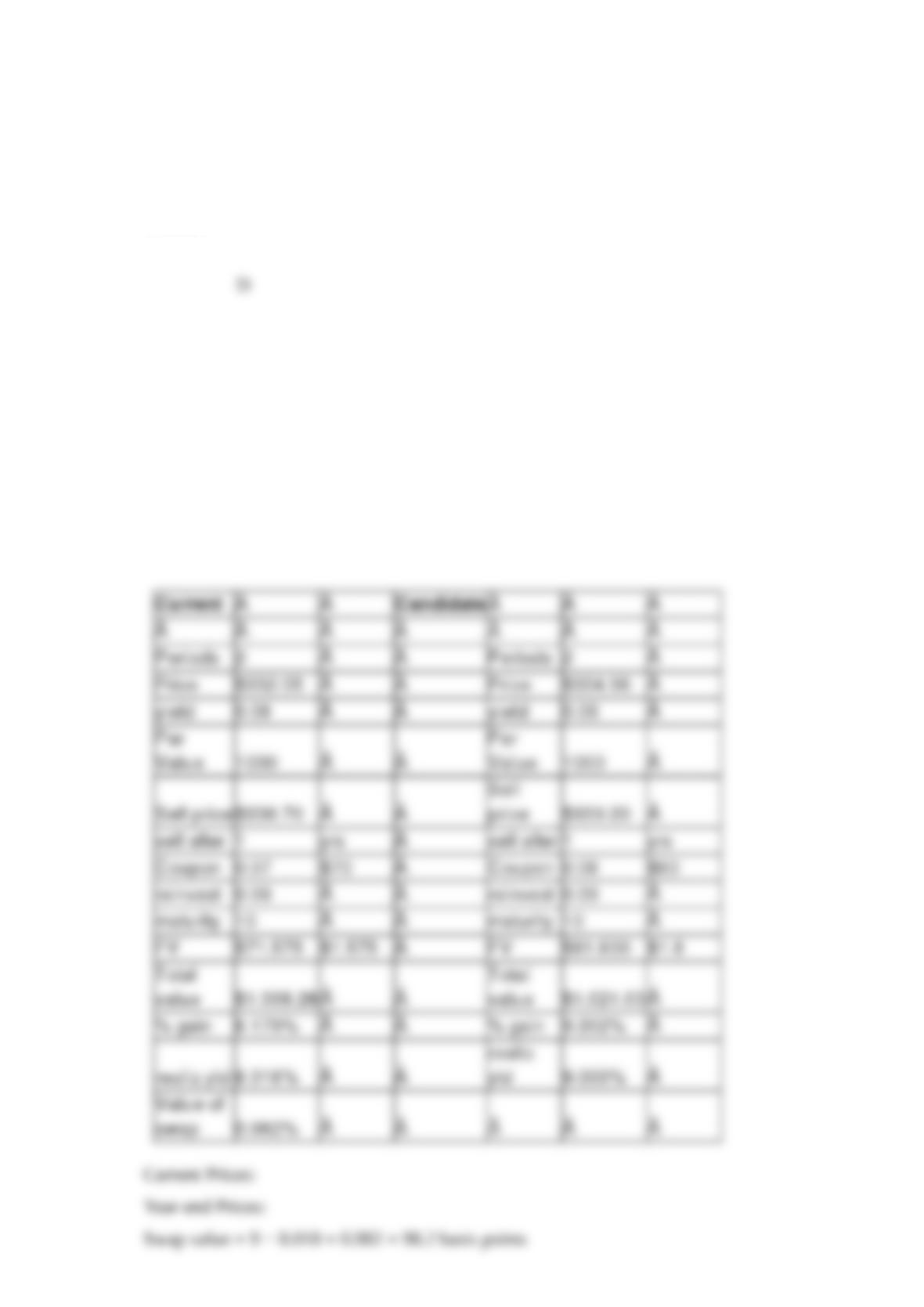
The following information is given concerning a pure yield pick-up swap: You currently
hold a 10 year, 7 percent coupon bond priced to yield 8 percent. As a swap candidate you
are considering a 10 year, 8 percent coupon bond priced to yield 9 percent. Assume a
reinvestment at 9 percent, semiannual compounding, and a one-year workout period.
NARREND
Question: Refer to Exhibit 19-1. The interest on one coupon for the candidate bond is
Answer:

Question: Refer to Exhibit 19-1. The realized compound yield on the candidate bond is
Answer:
Question: Refer to Exhibit 19-1. The value of the swap is ____ basis points in one year.
Answer:

USE THE FOLLOWING INFORMATION FOR THE NEXT PROBLEM(S)
The following information is given concerning a substitution swap: You currently hold a
15 year, 7 percent coupon bond priced to yield 8 percent. As a swap candidate you are
considering a 15 year, 7 percent coupon bond priced to yield 8.5 percent. Assume a
reinvestment rate of 8.5 percent, semiannual compounding, and a one-year workout period.
NARREND
Question: Refer to Exhibit 19-2. The dollar investment in the candidate bond is
Answer:
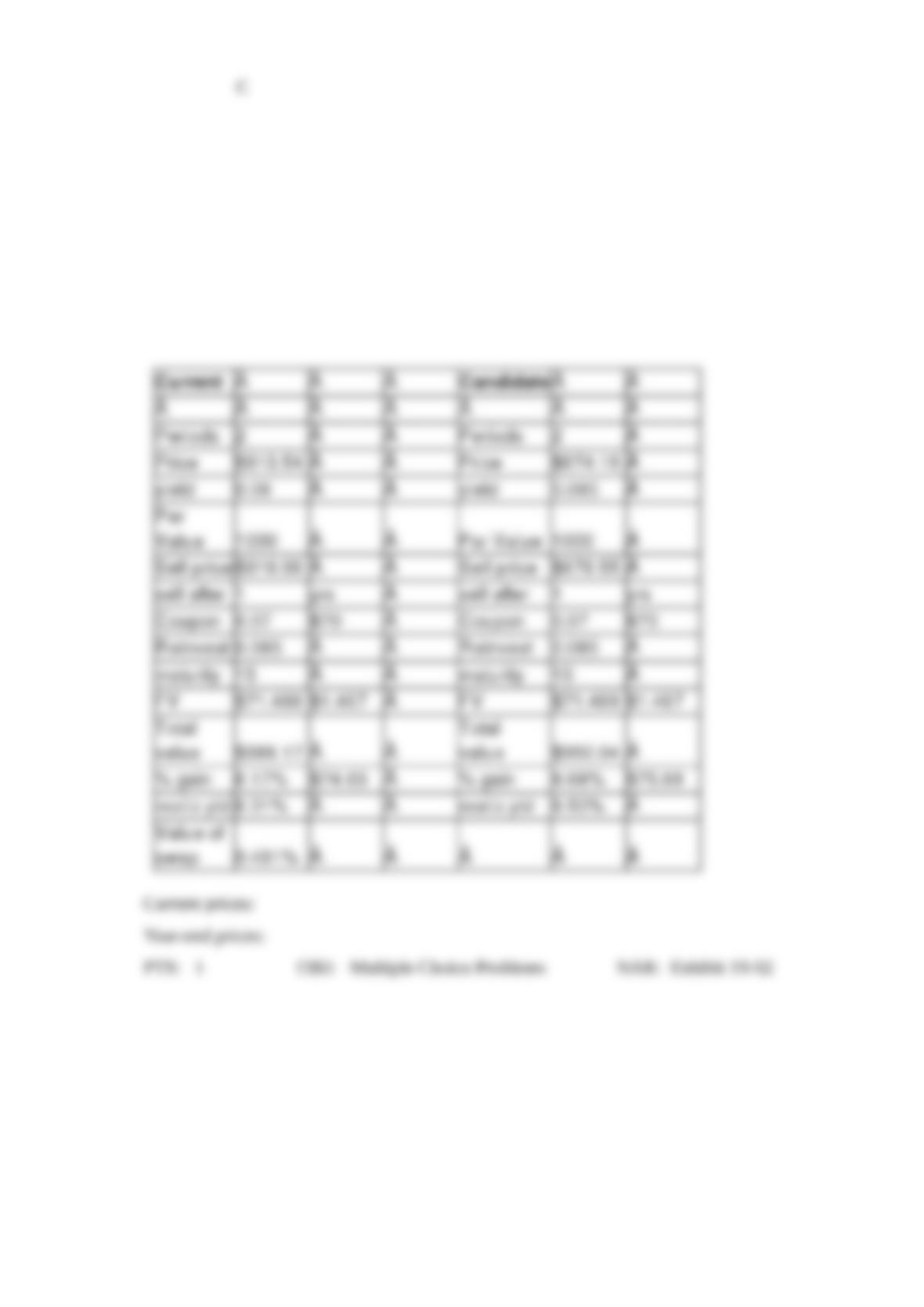
Question: Refer to Exhibit 19-2. The realized compound yield on the current bond is
Answer:
Question: Refer to Exhibit 19-2. The value of the swap is ____ basis points in one year.
Answer:
USE THE FOLLOWING INFORMATION FOR THE NEXT PROBLEM(S)
The following information is given concerning a pure yield pick-up swap: You currently
hold a 20 year, Aa 8 percent coupon bond priced to yield 10 percent. As a swap candidate
you are considering a 20 year, Aa 10 percent coupon bond priced to yield 10.75 percent.
Assume a reinvestment rate of 12.00 percent, semiannual compounding, and a one-year
workout period.
NARREND
Question: Refer to Exhibit 19-3. The interest on one coupon for the candidate bond is
Answer:
Question: Refer to Exhibit 19-3. The value of the swap is ____ basis points in one year
Answer:
USE THE FOLLOWING INFORMATION FOR THE NEXT PROBLEM(S)
The following information is given concerning a substitution swap: You currently hold a
25 year, Aa 8 percent coupon bond priced to yield 10 percent. As a swap candidate you are
considering a 25 year, Aa 8 percent coupon bond priced to yield 10.50 percent. Assume a
reinvestment rate of 10 percent, semiannual compounding, and a one-year workout period.
NARREND
Question: Refer to Exhibit 19-4. The dollar investment in the candidate bond is
Answer:
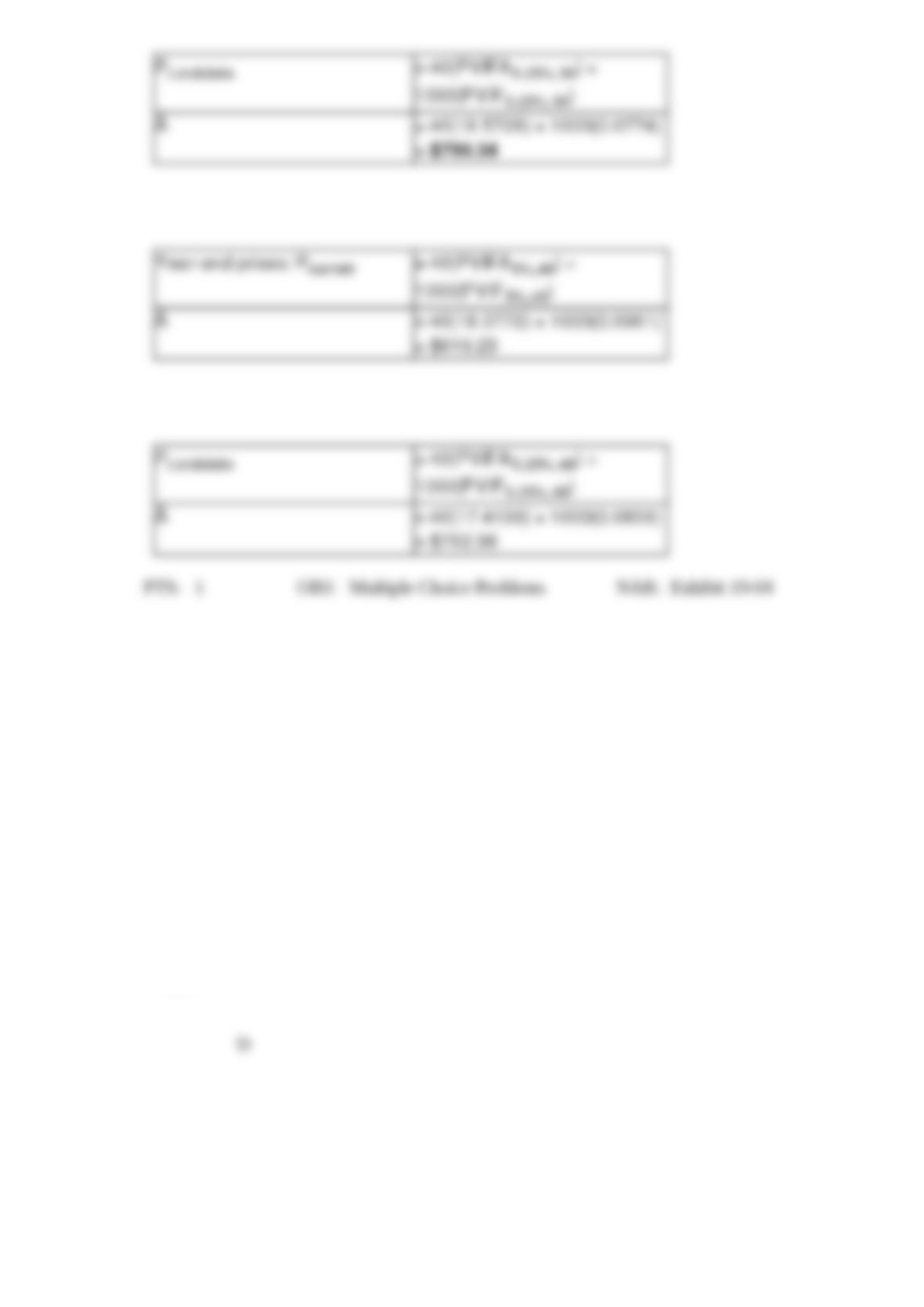
Question: Refer to Exhibit 19-4. The realized compound yield on the current bond is
Answer:
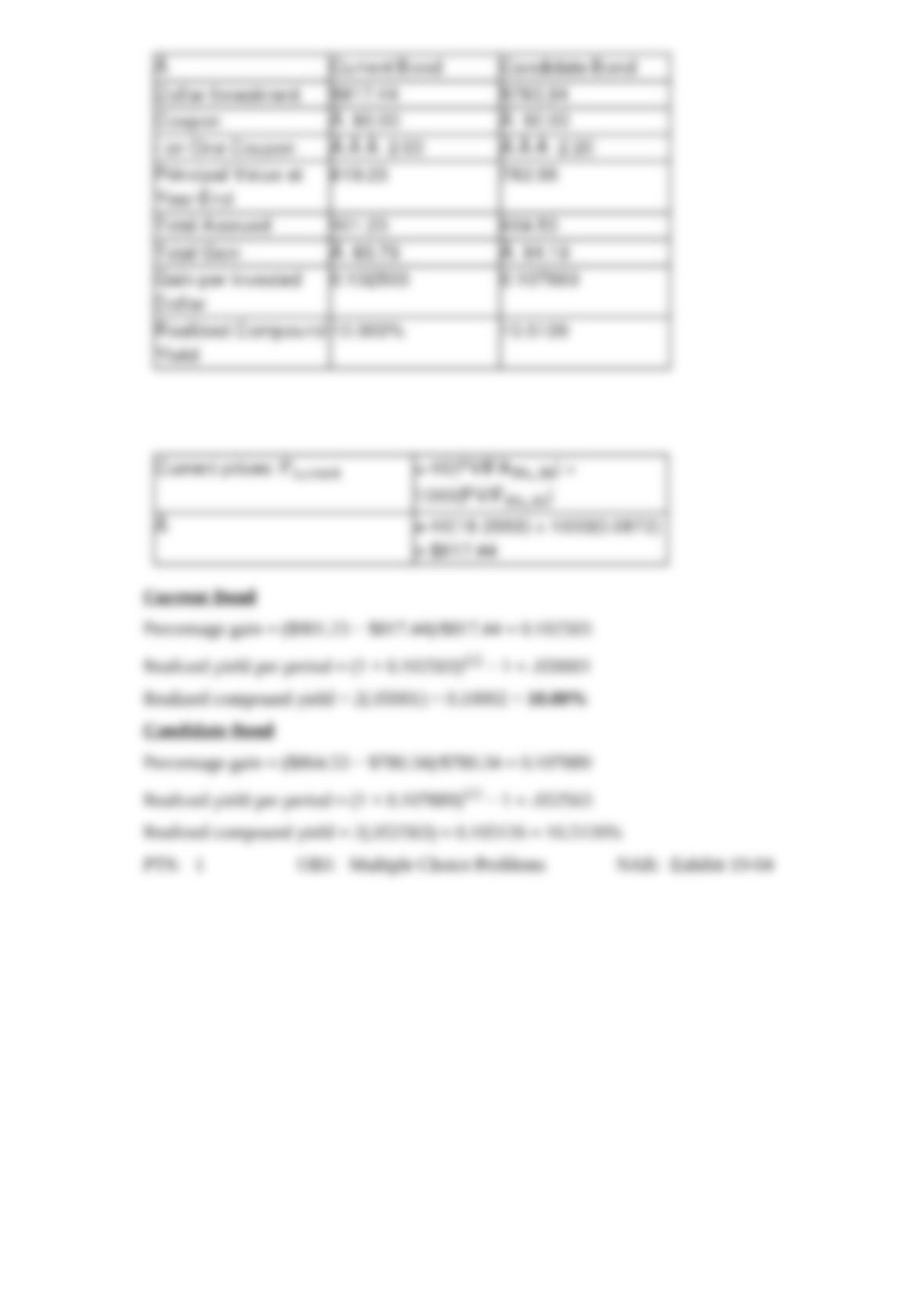
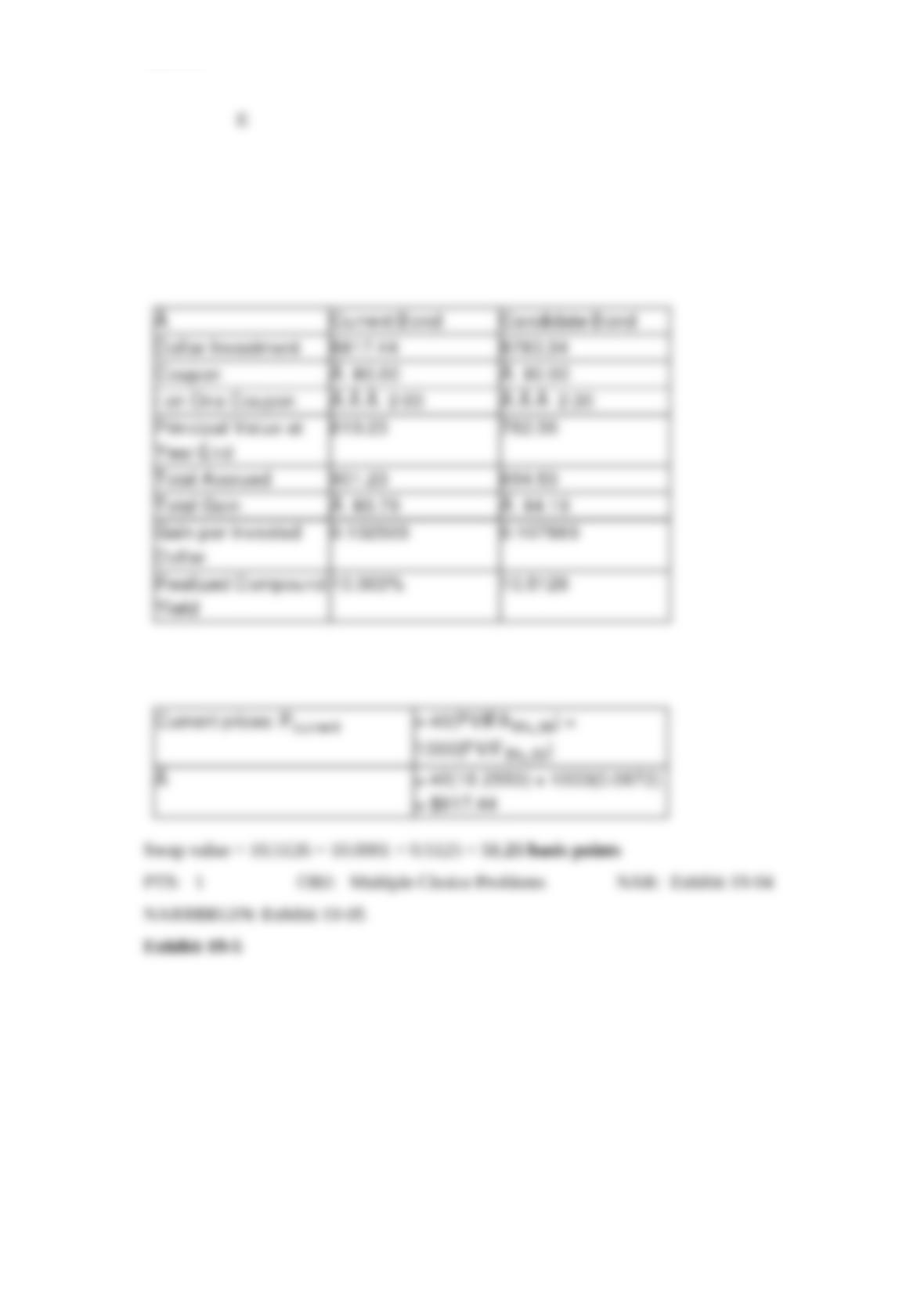
Question: Refer to Exhibit 19-4. The value of the swap is ____ basis points in one year.
Answer:
USE THE FOLLOWING INFORMATION FOR THE NEXT PROBLEM(S)
The following information is given concerning a pure yield pick-up swap: You currently
hold a 20 year, Aa 2 percent coupon bond priced to yield 9.5 percent. As a swap candidate
you are considering a 20 year, Aa 14 percent coupon bond priced to yield 10.00. Assume a
reinvestment rate of 11 percent, semiannual compounding, and a one-year workout period.
NARREND
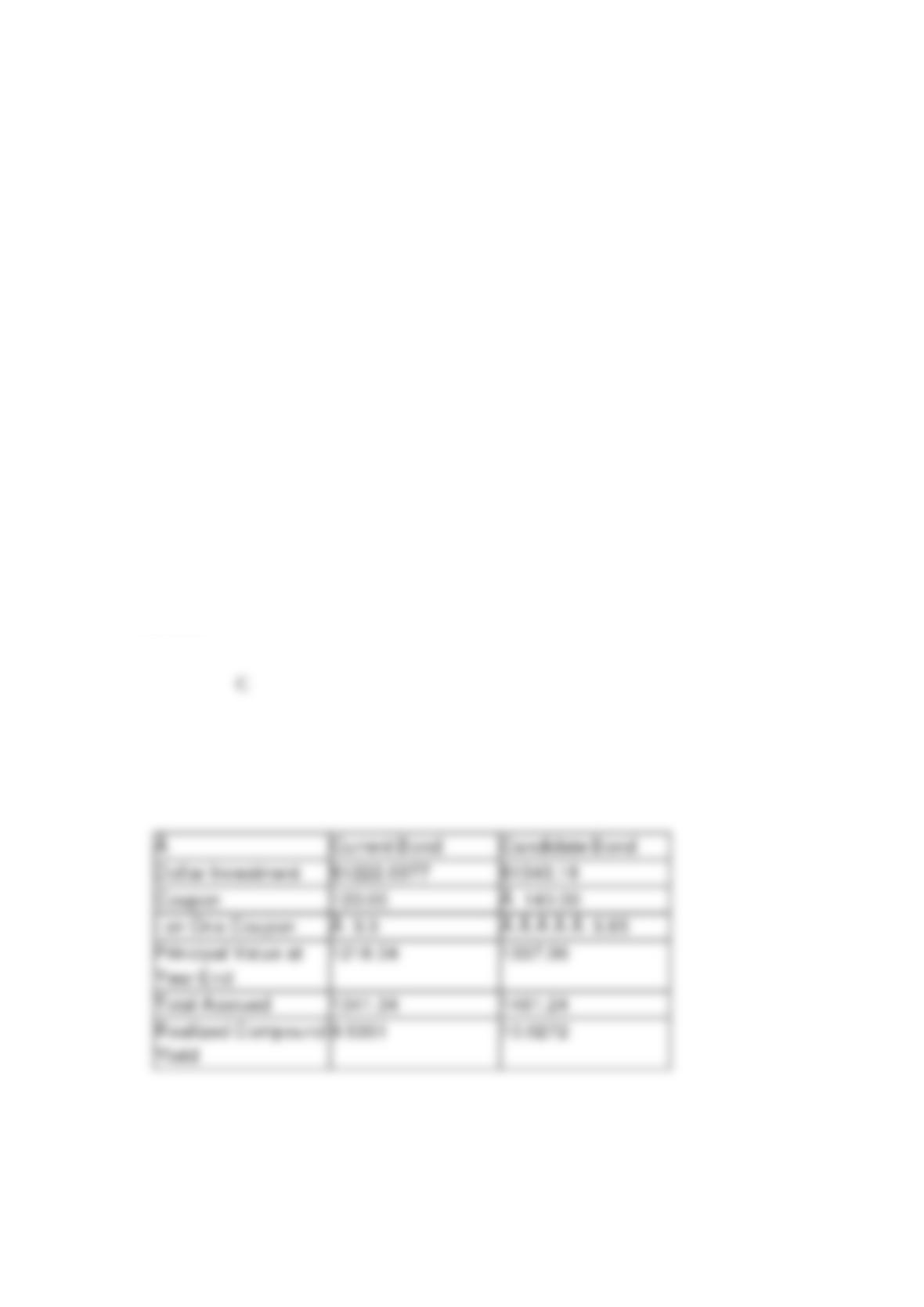
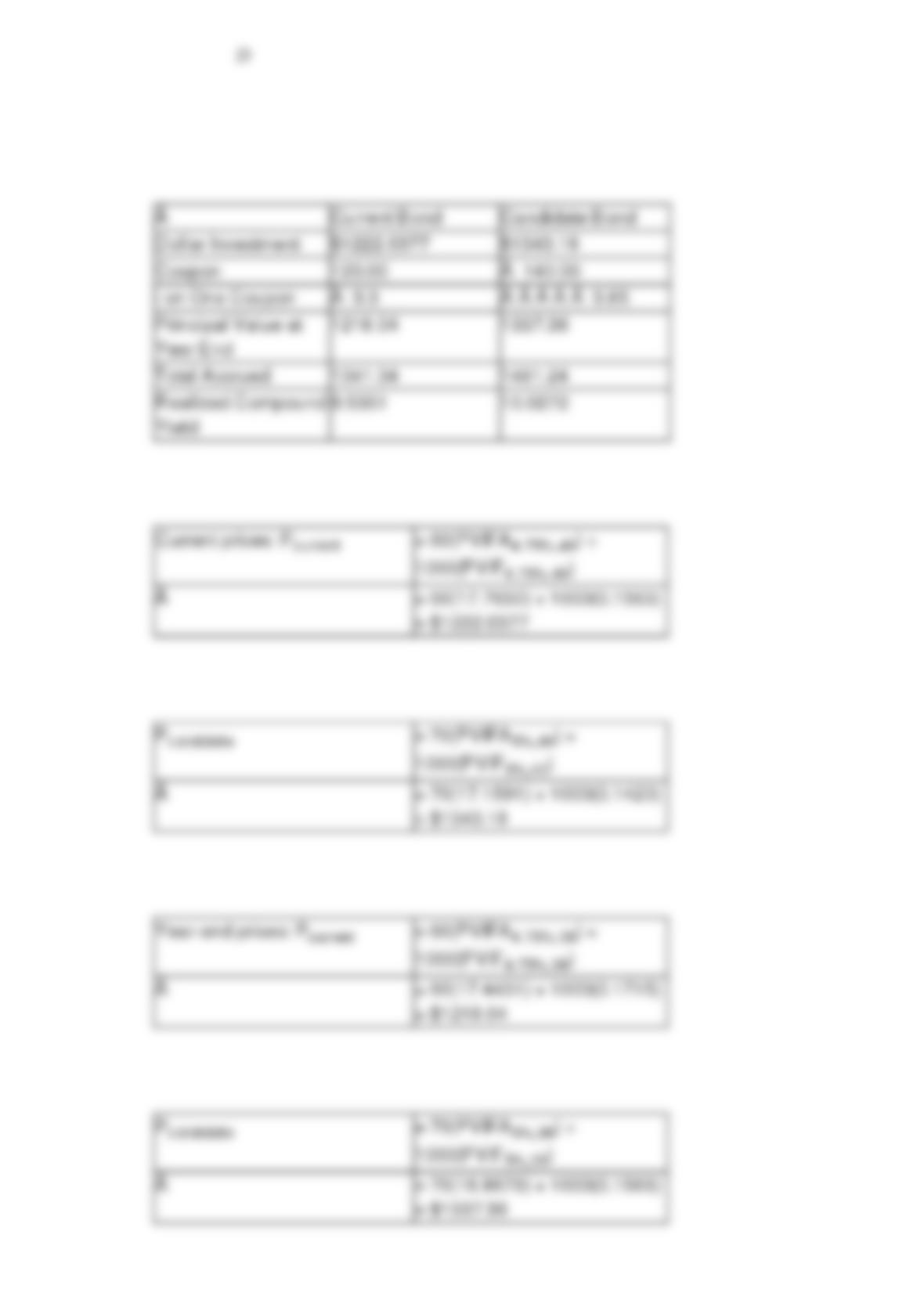
Question: Refer to Exhibit 19-5. The interest on one coupon for the candidate bond is
Answer:
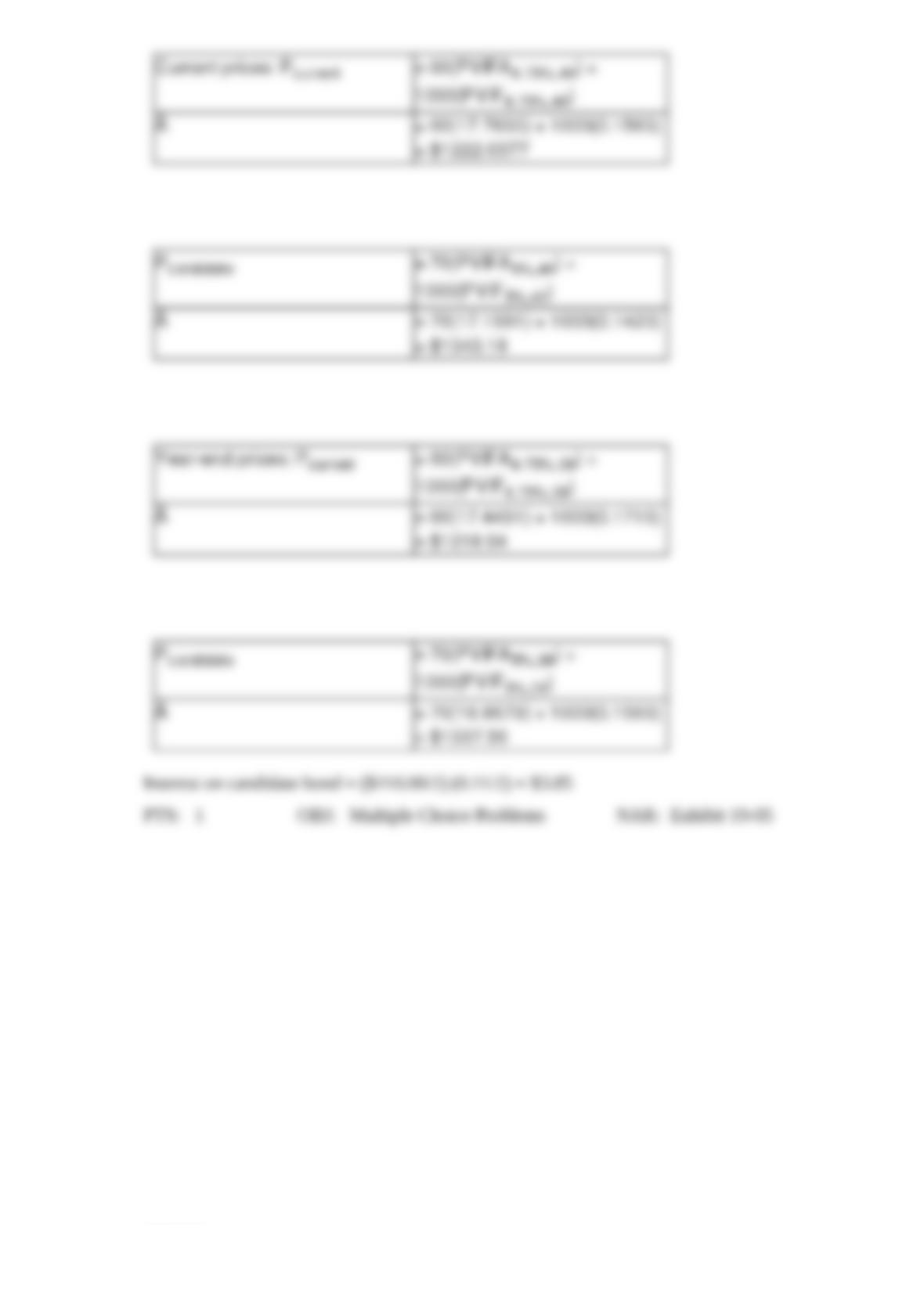
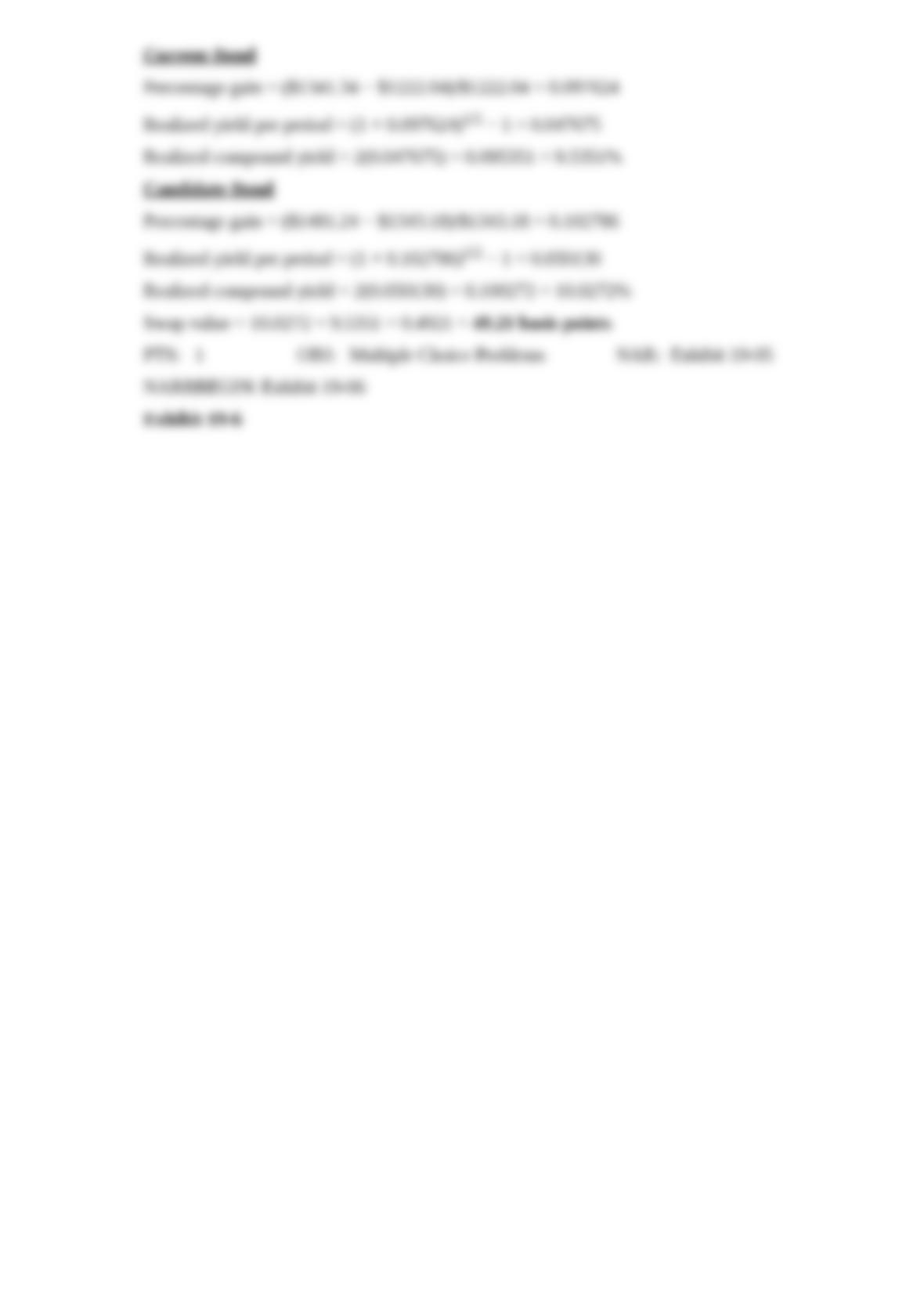
Question: Refer to Exhibit 19-5. The value of the swap is ____ basis points in one year
Answer:
USE THE FOLLOWING INFORMATION FOR THE NEXT PROBLEM(S)
The following information is given concerning a substitution swap: You currently hold a
25 year, Aa 10 percent coupon bond priced to yield 12 percent. As a swap candidate you
are considering a 25 year, Aa 10 percent coupon bond priced to yield 13 percent. Assume a
reinvestment rate of 12 percent, semiannual compounding, and a one-year workout period.
NARREND
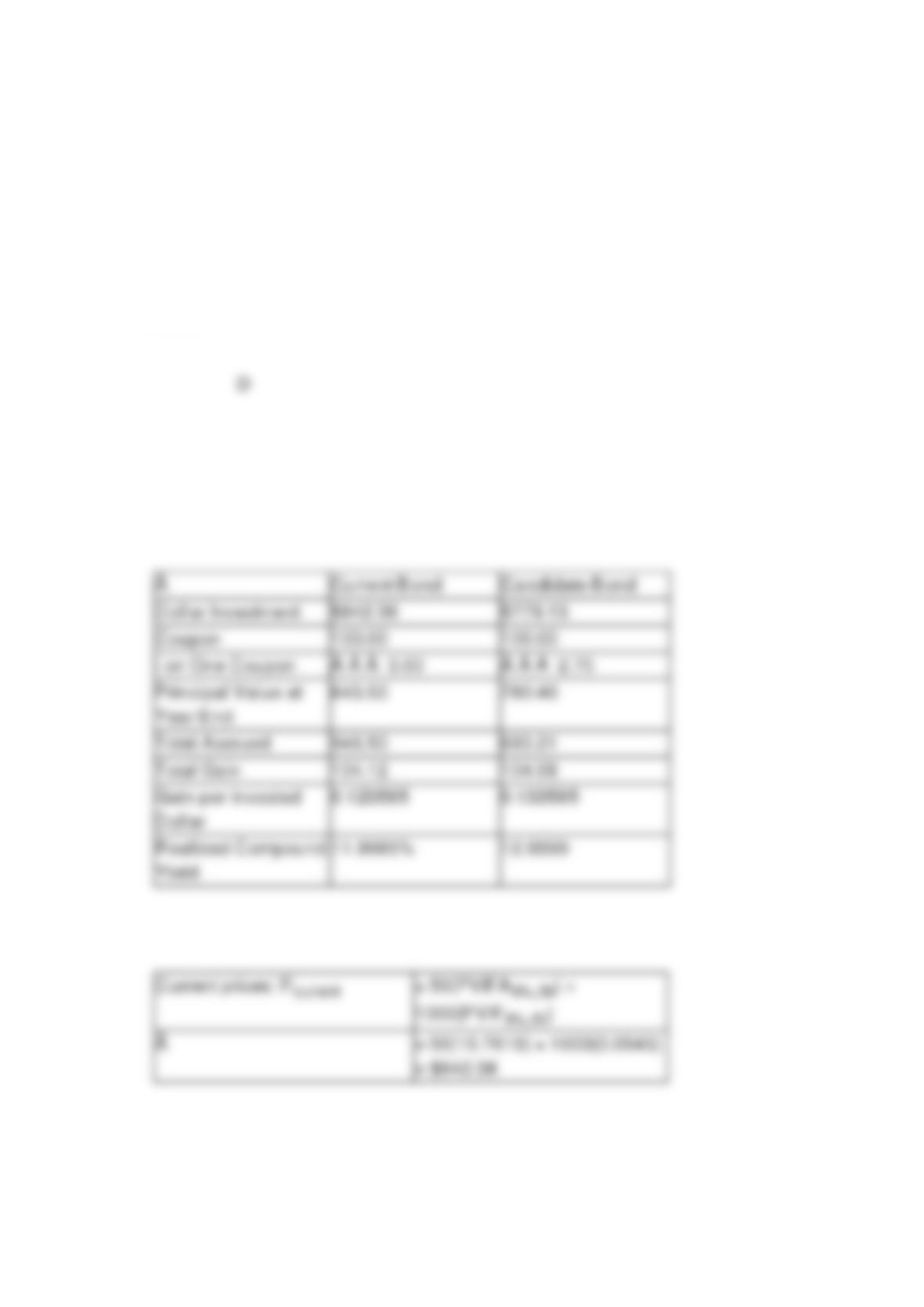
Question: Refer to Exhibit 19-6. The dollar investment in the candidate bond is
Answer:
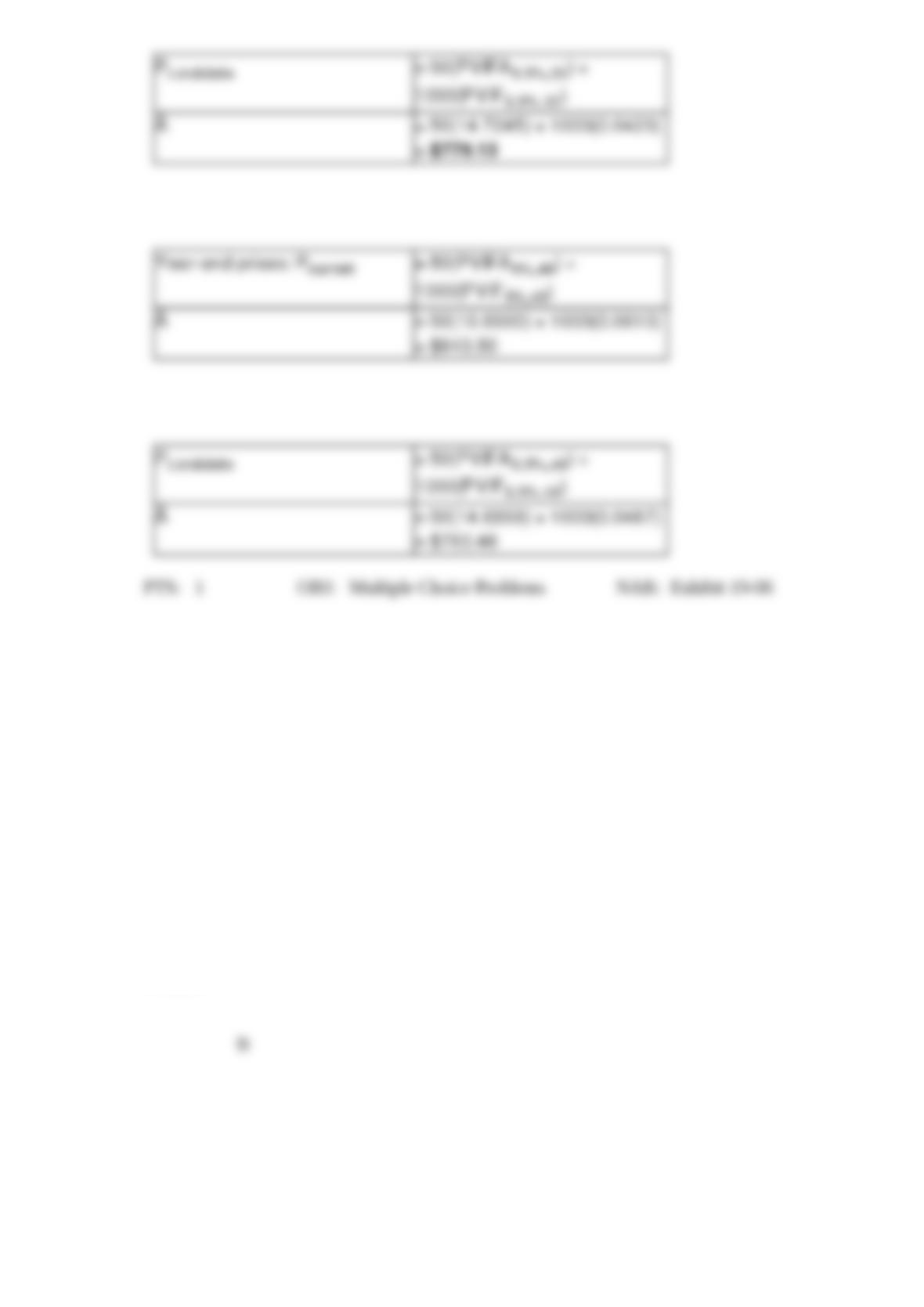
Question: Refer to Exhibit 19-6. The realized compound yield on the current bond is
Answer:
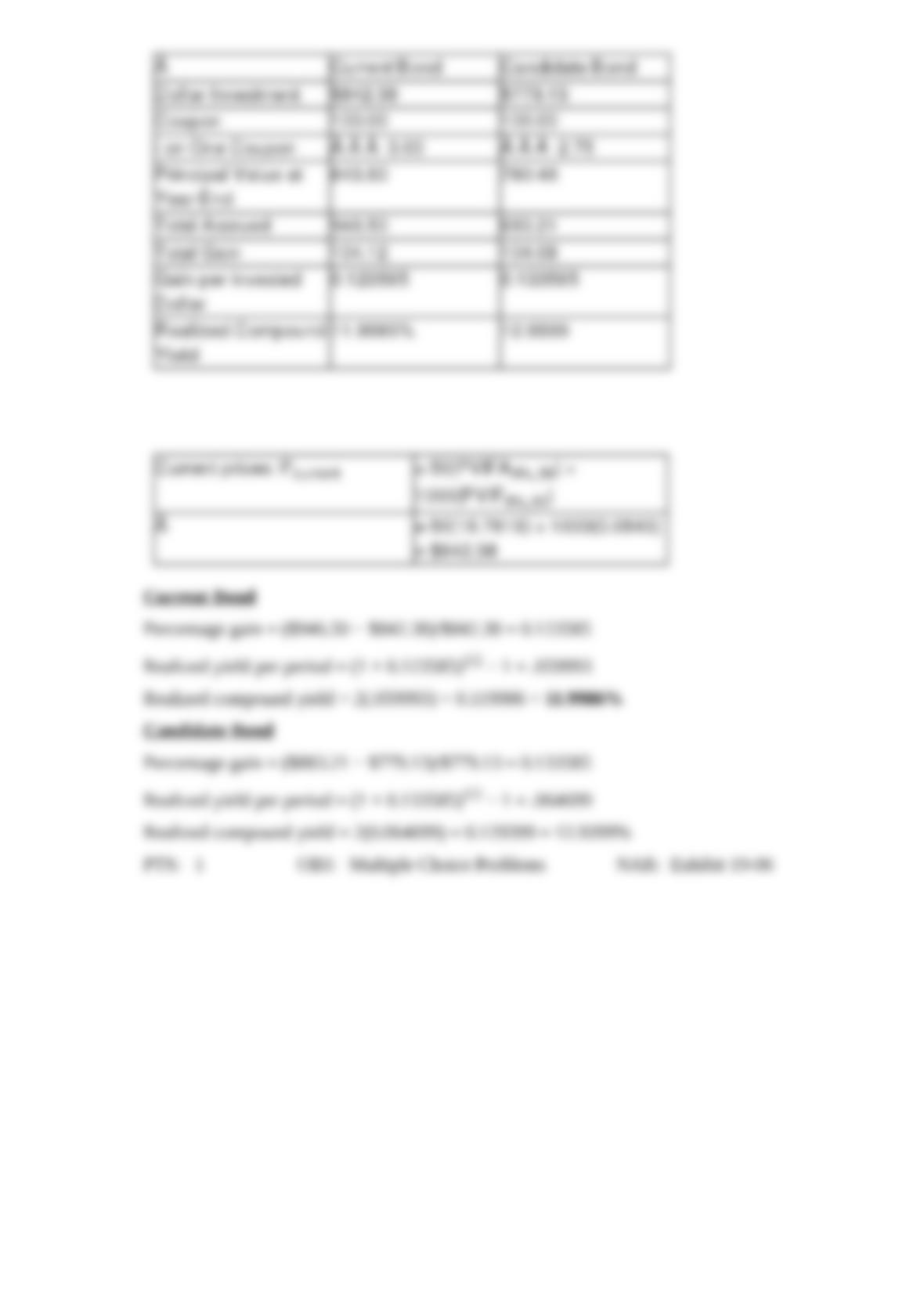
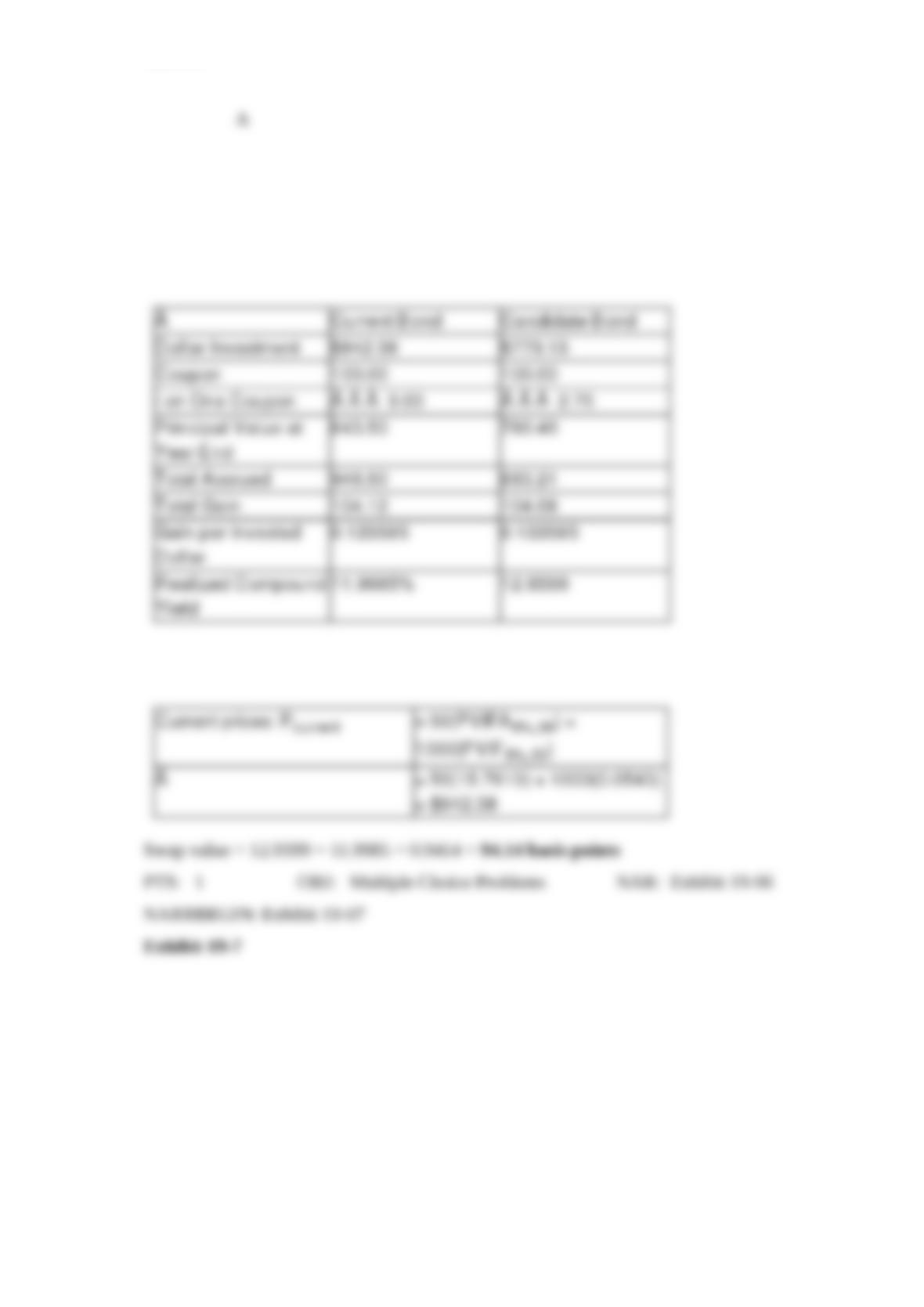
Question: Refer to Exhibit 19-6. The value of the swap is ____ basis points in one year.
Answer:
USE THE FOLLOWING INFORMATION FOR THE NEXT PROBLEM(S)
Consider two bonds, both pay semiannual interest. Bond A has a coupon of 8% per year,
maturity of 30 years, yield to maturity of 9% per year, and a face value of $1000. Bond B
has a coupon of 8% per year, maturity of 30 years, yield to maturity of 9.5% per year, and
a face value of $1000.
NARREND

Question: Refer to Exhibit 19-7. Calculate the percentage gain per invested dollar for Bond
A assuming a one year horizon, and a reinvestment rate of 9% per year.
Answer:
Question: Refer to Exhibit 19-7. Calculate the percentage gain per invested dollar for Bond
B assuming a one year horizon, and a reinvestment rate of 9.5% per year.
Answer:
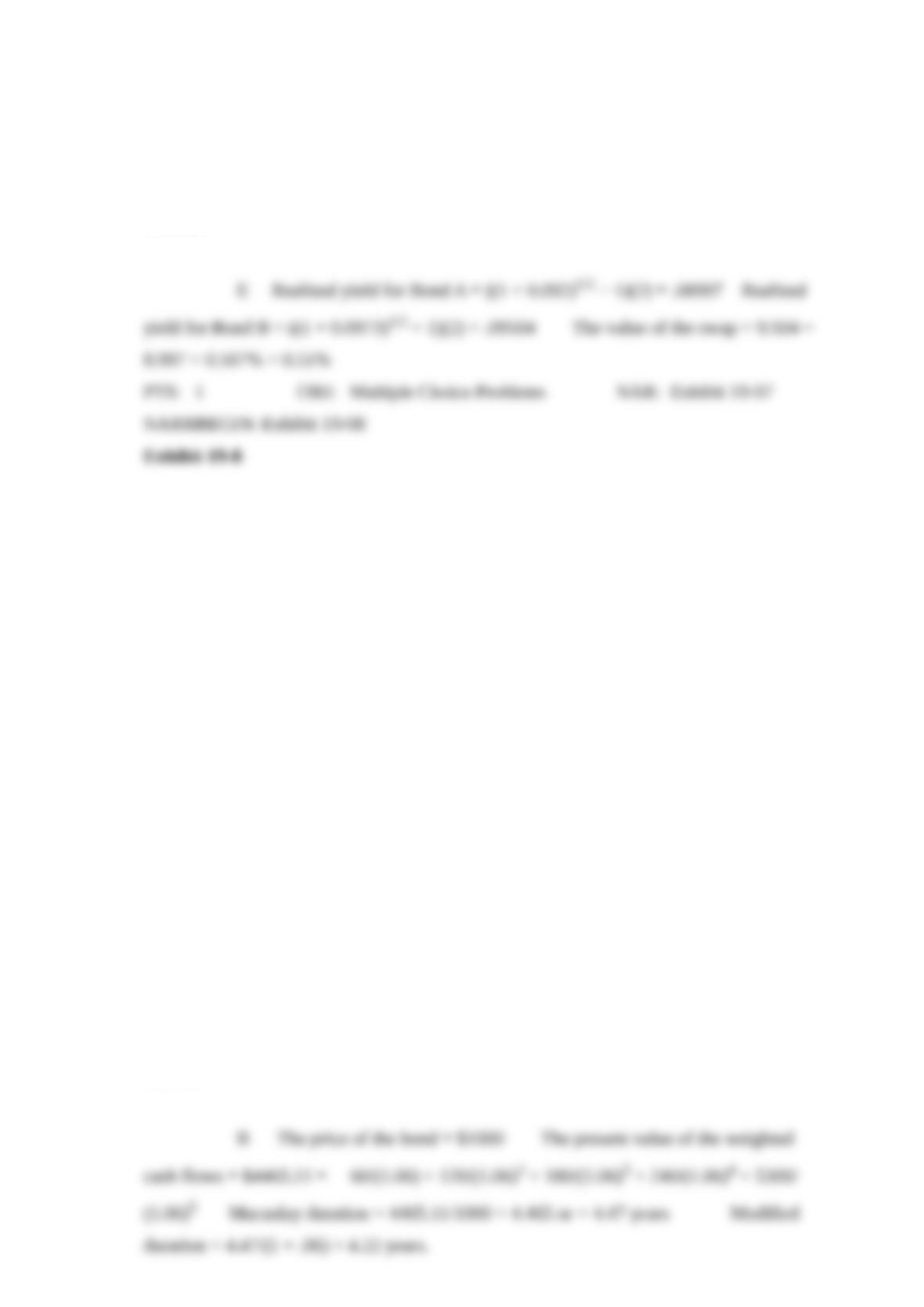
Question: Refer to Exhibit 19-7. Calculate the value of swap out of Bond A into Bond B.
Answer:
USE THE FOLLOWING INFORMATION FOR THE NEXT PROBLEM(S)
Consider two bonds, both pay annual interest. Bond C has a coupon of 6% per year,
maturity of 5 years, yield to maturity of 6% per year, and a face value of $1000. Bond D
has a coupon of 8% per year, maturity of 15 years, yield to maturity of 6% per year, and a
face value of $1000.
NARREND
Question: Refer to Exhibit 19-8. Calculate the modified duration for Bond C.
Answer:
Question: Refer to Exhibit 19-8. Calculate the modified duration for Bond D.
Answer:
Question: Refer to Exhibit 19-8. Assume that your investment horizon is 6 years and your
portfolio consists only of Bond C and Bond D. Indicate the proportions invested in each
bond, so that the portfolio is immunized.
Answer:
USE THE FOLLOWING INFORMATION FOR THE NEXT PROBLEM(S)
Consider two bonds, both pay annual interest. Bond Y has a coupon of 6% per year,
maturity of 5 years, yield to maturity of 6% per year, and a face value of $1000. Bond X
has a coupon of 7% per year, maturity of 10 years, yield to maturity of 4% per year, and a
face value of $1000.
NARREND
Question: Refer to Exhibit 19-9. Calculate the modified duration for Bond Y.
Answer:
Question: Refer to Exhibit 19-9. Calculate the modified duration for Bond X.
Answer:
Question: Refer to Exhibit 19-9. Assume that your investment horizon is 5 years and your
portfolio consists only of Bond Y and Bond X. Indicate the proportions invested in each
bond, so that the portfolio is immunized.
Answer:

USE THE FOLLOWING INFORMATION FOR THE NEXT PROBLEM(S)
You are creating a portfolio that consists of the following two bonds. Bond A pays an
annual 7% coupon, matures in two years, has a yield to maturity of 8%, and a face value of
$1,000. Bond B pays an annual 8% coupon, matures in three years, has a yield to maturity
of 9%, and a face value of $1,000.
NARREND
Question: Refer to Exhibit 19-10. Calculate the price of Bond A.
Answer:
Question: Refer to Exhibit 19-10. Calculate the price of Bond B.
Answer:

Question: Refer to Exhibit 19-10. Calculate the Macaulay Duration for Bond A.
Answer:
Question: Refer to Exhibit 19-10. Calculate the Macaulay Duration for Bond B.
Answer:
Question: Refer to Exhibit 19-10. Calculate the Modified Duration for Bond A.
Answer:
Question: Refer to Exhibit 19-10. Calculate the Modified Duration for Bond B.
Answer:
Question: Refer to Exhibit 19-10. Assume that your investment horizon is 2 years and your
portfolio consists only of bonds A and B. What proportion should be invested in each bond
to immunize the portfolio?
Answer: