
CHAPTER 13—INDUSTRY ANALYSIS TRUE/FALSE Question: Complete
consistency over time for different industries would indicate that industry analysis is not
necessary after market analysis. Answer:
Question: Studies of industries indicate that their past performance can be useful in
predicting future performance. Answer:
Question: While there is substantial dispersion in industry risk over periods of time, there
is consistency in the industry risk during a period of time. Answer:
Question: The fact that all firms in an industry do not move together negates the value of
industry analysis. Answer:
Question: The micro approach to estimating the industry multiple would entail examining
specific variables such as: dividend payout ratios, required rates of return, and expected
growth rates of dividends and earnings. Answer:
Question: Structural changes occur when the economy undergoes a major organizational
change or how it functions. Answer:

Question: “Downsizing” of corporate America in the 1990s is an example of structural
change. Answer:
Question: Switching from one industry group to another over the course of a business
cycle is known as a rotation strategy. Answer:
Question: Assuming the U.S. dollar is strong relative to the German DM, it will be easier
for the U.S. paper industry to export to Germany. Answer:
Question: When considering inputs, you would evaluate an industrys prospects based on
those of its raw material suppliers, labor force, etc. Answer:
Question: The relationship between an economic series such as disposable personal
income and industry sales is usually stronger in an industry that is more specialized.
Answer:
Question: Input-output analysis would be useful to indicate the long run relationship
between industries. Answer:
Question: In the rapid accelerating growth stage, profit margins are typically very high.

Answer:
Question: The industry life cycle can be rejuvenated at any stage by product innovations
that attract new customers or convince existing customers to buy the new product. Answer:
Question: The relationship between an economic series such as disposable personal
income and retail sales is usually stronger in an industry that has become more specialized.
Answer:
Question: Global industry analysis must evaluate the effects not only of world supply,
demand and cost components for an industry, but also different valuation levels due to
accounting conventions and the impact of exchange rates. Answer:
Question: The way to reduce the rivalry between existing competitors in an industry is to
reduce the barrier to entry to the industry. Answer:
Question: When the government introduces a licensing requirement for an industry, it
reduces the barriers to entry for the industry. Answer:
Question: In the rapid accelerating growth stage, profit margins are typically very high.

Answer:
Question: Because all firms in an industry do not move together there is little value in
industry analysis. Answer:
Question: While there is substantial dispersion in industry risk over periods of time, there
is consistency in the industry risk during a period of time. Answer:
Question: The rates of returns for firms within an industry vary which indicates that
company analysis is necessary after industry analysis. Answer:
Question: Risk measures for different industries remain fairly constant over time so
historical risk analysis can be useful when estimating future risk. Answer:
Question: Structural changes do have a cyclical pattern. Answer:
Question: Switching industry groups over the course of a business cycle is known as a
cyclical strategy. Answer:

Question: Cyclical industries are attractive investments during the early stages of an
economic recovery. Answer:
Question: The capital goods industry typically outperforms other sectors during a
recession. Answer:
Question: Country risk is the uncertainty of earnings due to changes in exchange rates
faced by firms in this industry that sell outside the United States. Answer:
Question: In analyzing risk levels among industries, studies have found that risk levels
varied among different industries.
Answer:

Question: Which of the following statements about the business cycle is false?
Answer:
Question: A number of economic variables affect both the economy and industries. Which

of the following statements is false?
Answer:
Question: Which of the following is not considered a structural influence on the economy
and industry?

Answer:
Question: What might cause an industrys sales to decline?
Answer:
Question: All of the following are industries with a strong, consistent industry component
except
Answer:
Question: Which of the following is not a stage in the industrial life cycle?

Answer:
Question: In which industrial life cycle stage does sales correlate highly with an economic
series or the economy in general?
Answer:
Question: During which stage of the industrial life cycle is the product or service
recognized as viable and the demand substantial?

Answer:
Question: At what stage in the industrial life cycle is there an influx of competition?
Answer:
Question: Which of the following is not a competitive force suggested by Porter?
Answer:
Question: Which of the following statements concerning the competitive environment is
true?

Answer:
Question: The financial risk for the retail store industry is difficult to judge because of
Answer:
Question: When compared to the overall market P/E, the retail store P/E was estimated to
be ____ and near the ____ of the range.

Answer:
Question: When forecasting industry sales it can be useful to
Answer:
Question: The ____ of an industry is a function of retention rate and return on equity.
Answer:

Question: Toward the end of a recession,
Answer:
Question: At the initial stage of an economic recovery,

Answer:
Question: Once it becomes clear the economy is recovering,

Answer:
Question: Toward the business cycle peak

Answer:
Question: During a recession,

Answer:
Question: Which of the following statement is not true?

Answer:
Question: Which of the following statements about industry analysis is true?
Answer:

Question: If the economic outlook was such that you expected corporate earnings to
decline, consumers have excessive levels of debt, and there is significant overcapacity in
the technology sector, then an appropriate asset allocation policy would be to:
Answer:
Question: Which of the following economic variables does not have an impact on industry
analysis?

Answer:
Question: A number of factors affect the cash flow and risk prospects of different
industries. Which of the following is not such a factor?
Answer:
Question: Analysts should identify and monitor

Answer:
Question: Which of the following is not considered a basic competitive force?
Answer:
Question: Which of the following is not characteristic of the “growth” phase in the
industry life cycle?

Answer:
Question: Which of the following is not characteristic of the “decline” phase of the
industry life cycle?
Answer:
Question: Which of the following statements regarding cyclical industries is true?

Answer:
Question: During which industry life cycle stage do firms experience low rates of return on
capital and investors begin to seek alternative uses of capital?
Answer:
Question: Which of the following are not typically considered a threat of new entrants to
an industry?

Answer:
Question: Which of the following statements regarding global industry analysis is true?
Answer:

Question: Which of the following statements is false?
Answer:
USE THE FOLLOWING INFORMATION FOR THE NEXT PROBLEM(S) Assume that
you are an analyst for the U.S. Autoparts industry. Consider the following information that
you propose to use to obtain an estimate of year 2002 EPS for the U.S. Autoparts Industry

In addition a regression analysis indicates the following relationship between growth in
industry sales per share and personal consumption expenditures (PCE) growth is % Sales
per share = 0.02 + 1.5(% PCE) NARREND Question: Refer to Exhibit 13-1. Calculate
personal consumption expenditures for the year 2004.
Answer:
Question: Refer to Exhibit 13-1. Estimate the industry growth rate in sales per share.

Answer:
Question: Refer to Exhibit 13-1. Estimate the industry sales per share for the year 2004.
Answer:
Question: Refer to Exhibit 13-1. Calculate the industry year 2004 EBITDA per share.
Answer:

Question: Refer to Exhibit 13-1. Obtain an estimate of the per share depreciation charge
for the year 2004.
Answer:
Question: Refer to Exhibit 13-1. Calculate the per share EBIT for the year 2004.
Answer:
Question: Refer to Exhibit 13-1. Calculate industry Total Assets per share for the year
2004.

Answer:
Question: Refer to Exhibit 13-1. Calculate industry level of debt for the year 2004.
Answer:
Question: Refer to Exhibit 13-1. Calculate the per share interest rate charge for the year
2004.
Answer:

Question: Refer to Exhibit 13-1. Calculate the industry EBT per share for the year 2004.
Answer:
Question: Refer to Exhibit 13-1. Calculate industry EPS for the year 2004.
Answer:
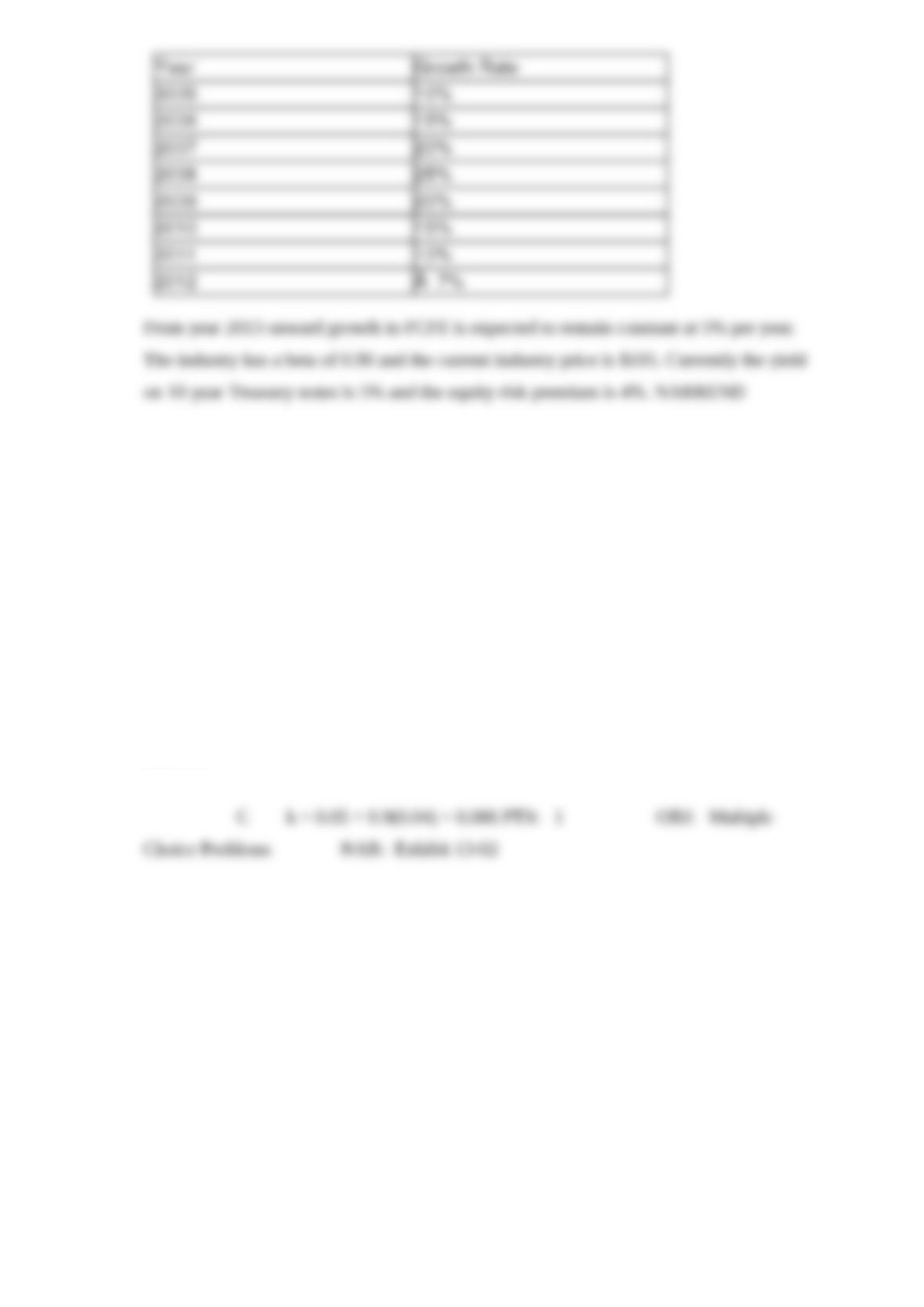
Question: Refer to Exhibit 13-2. Calculate the required rate of return on equity.
Answer:
Question: Refer to Exhibit 13-2. Calculate the present value now (Year 2004) of FCFE
during the period of increasing growth (that is for years 2005 to 2008).
Answer:
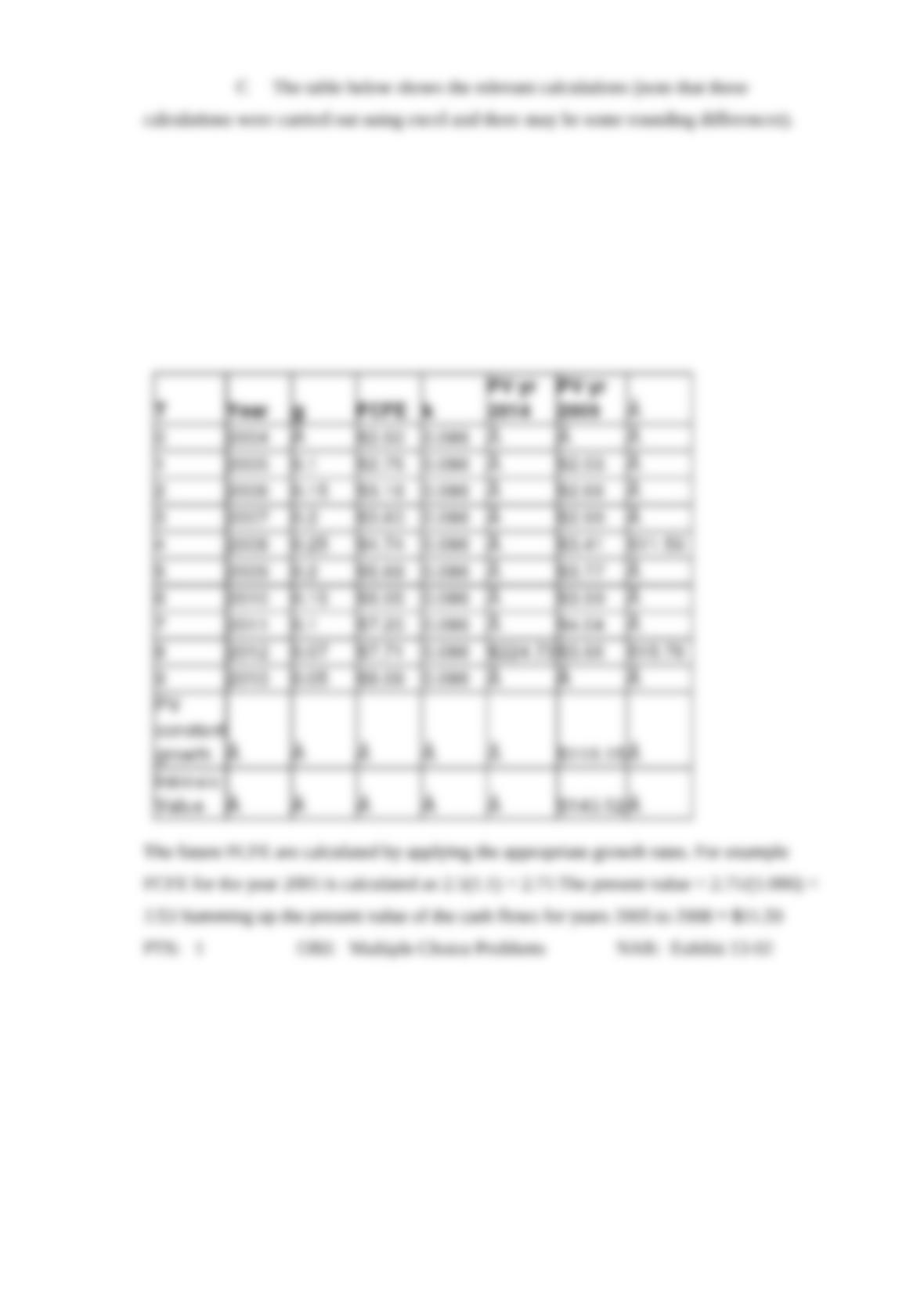
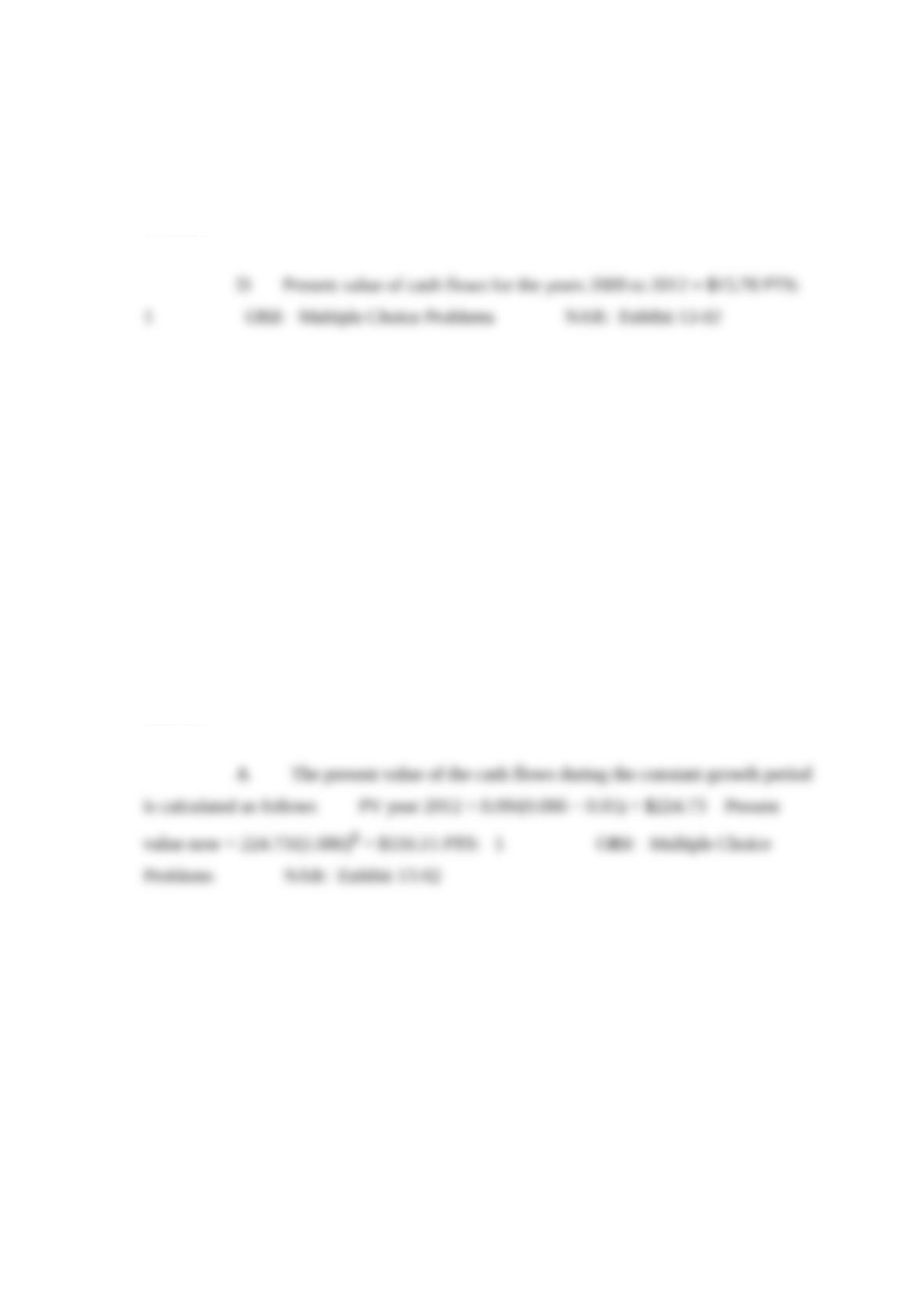
Question: Refer to Exhibit 13-2. Calculate the present value now (Year 2004) of FCFE
during the period of declining growth (that is for years 2009 to 2012).
Answer:
Question: Refer to Exhibit 13-2. Calculate the present value now (Year 2004) of FCFE
during the period of constant growth (that is for years 2013 onwards).
Answer:
Question: Refer to Exhibit 13-2. Calculate the intrinsic value of the industry now (Year
2004).

Answer:
Exhibit 13-3 THE FOLLOWING INFORMATION IS FOR THE NEXT PROBLEM(S)
The Home Appliance Industry had free cash flow to equity (FCFE) of $87 for the year
ending December 31, 2007. The industry anticipates a growth rate of 8% for the next three
years due to favorable economic conditions. However, the growth rate is expected to
decline to 4% after three years and remain at that level indefinitely. The required rate of
return is 12% for this industry. NARREND Question: Refer to Exhibit 13-3. Calculate the
FCFE at the end of the 8% growth period three years from now.
Answer:
Question: Refer to Exhibit 13-3. Calculate the intrinsic value of the Home Appliance
Industry at the end of the 8% growth period three years from now.
Answer:

Question: Refer to Exhibit 13-3. Calculate the intrinsic value of the Home Appliance
Industry today.
Answer: