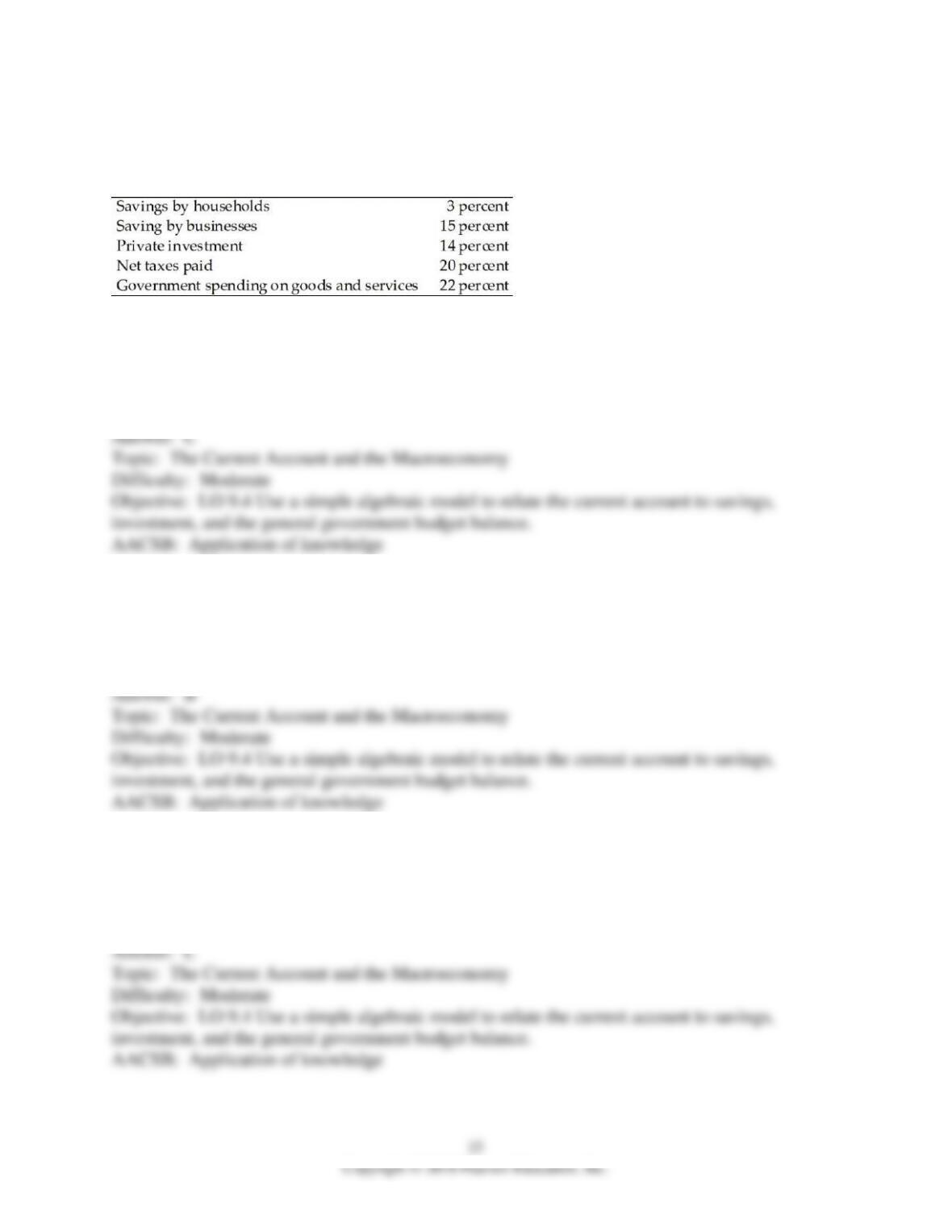
Use the following table to answer the next question(s). All values are measured as a percent of
GNP.
Table 9.2
9) Based on Table 9.2, total savings, private plus public, is equal to
A) 3 percent of GNP.
B) 18 percent of GNP.
C) 16 percent of GNP.
D) 20 percent of GNP.
10) Based on Table 9.2, the current account balance is
A) -2 percent of GNP.
B) +2 percent of GNP.
C) +4 percent of GNP.
D) -4 percent of GNP.
11) All other things equal, an increase in government spending that is NOT funded by taxes will
A) have an undetermined effect on the current account.
B) have no effect on the current account.
C) increase the current account deficit.
D) decrease the current account deficit.
12) National savings is important for all of the following reasons EXCEPT
A) it can be used to consume additional foreign goods.
B) it can be used to fund private investment.
C) it can be used to fund government investment.
D) it can be used to fund foreign investment.
13) The U.S. current account deficit improved slightly from 2007 to 2010 because
A) spending on imports fell due to an overall fall in consumption.
B) state, local, and federal government budget deficits increased.
C) worldwide economic growth spurred U.S. exports.
D) capital controls restricted capital inflow.
14) Global capital flows have completely broken the link between domestic savings and
domestic investment.
15) An increase in government budget deficits will necessarily be associated with an worsening
of the current account balance.
16) Your text considers both the low savings and high savings nations and concludes what about
the relationship between government budgets and the current account?
17) What is the difference between the U.S. current account deficits of the 1980s and the 1990s?
18) What does a current account deficit do that is positive for a nation?
19) The government budget deficit and the trade deficit are often called the “twin deficits.”
Explain why this name applies, and why it is not always accurate.
20) Explain why current account deficits may or may not be harmful to a country.
9.4 International Debt
1) Which of the following is an example of external debt for the United States?
A) A purchase of Apple stock by a person in Canada
B) A loan made in yen to a company in the United States
C) A loan made by Citibank to the government of Mexico
D) A purchase of U.S. Treasury bills by the Bank of Japan
2) Debt service
A) is rarely an issue for high-income countries.
B) always makes a country worse off for having borrowed.
C) is a problem when the amount of debt is small relative to the size of the economy.
D) tends to benefit low- and middle-income countries at the expense of high-income countries.
3) Unsustainable debt may occur for all of the following reasons EXCEPT
A) when countries are dependent on one or two key export commodities, and there is a sudden
drop in the price of those commodities.
B) when natural disasters occur.
C) when civil conflicts are resolved and a peace dividend occurs.
D) when there are corrupt politicians and practices.
4) Which of the following is NOT a problem with excessive debt?
A) It worsens the central government’s budget position by adding large debt service payments to
other budget items.
B) It reduces the quantity of resources available to invest in economic development.
C) If debt service is substantial, schools, health clinics, roads, ports, other infrastructure, and
social needs are less likely to be addressed.
D) It can reduce the chance of a crisis.
5) Which of the following is FALSE about the Highly Indebted Poor Countries initiative?
A) Most of the countries included are in sub-Saharan Africa.
B) Countries qualify for debt relief partly based on their level of poverty.
C) Countries do not have to have established a past track record of economic reform in order to
qualify as long as they make future commitments.
D) External debt levels must be high relative to exports in order to qualify.
6) Critics of debt relief make all of the following arguments EXCEPT
A) it would be wasted money since the conditions that caused the debt would be likely to persist.
B) debt relief can quickly fuel a new round of borrowing that simply restores debt to prior levels.
C) debt relief will encourage other nations to borrow excessively with the hope that their debts
may be forgiven in the future.
D) the cost of debt relief to the most severely indebted countries is too large for the high income
countries to afford.
7) Which of the following is FALSE?
A) Current account deficits must be financed through inflows of capital.
B) Loans from abroad add to a country’s stock of external debt and generate debt service.
C) Borrowed funds are always used in a manner that contributes to the expansion of the country’s
productive capability.
D) Debt service can become an unsustainable burden that holds back development.
8) External debt is not usually a problem for high-income countries for which of the following
reasons?
A) High-income countries take out loans denominated in their own currency.
B) High-income countries do not need to borrow.
C) High-income countries are too large to default on loans.
D) High-income countries use loans to build infrastructure and create economic growth.
9) Suppose that Mexico has external debt, and the value of the country’s currency, the peso, falls.
Which of the following is true?
A) The peso value of the loans will decrease as well.
B) Mexico will find it easier to pay off its external debt.
C) Mexico will declare bankruptcy.
D) The cost of debt service will be higher.
10) For countries such as the United States and the United Kingdom, it is important to have trade
surpluses in order to service their external debts.
11) Ultimate solutions to the problems of unsustainable debt must take into account the
incentives for lenders to make loans.
12) It is important to compare debt levels of low- and middle-income countries to exports
because countries must earn foreign exchange in order to service their debts.
13) Total debt is more important in figuring out the ability of a country to service its debt than
are debt to GDP and debt to export ratios.
14) There are debt relief programs currently available for highly indebted poor countries.
15) An example of odious debt would be debts on the part of a nation that were incurred by a
dictator for the well-being of his family.
16) Between 1972 and 1999, the majority of loans to HIPC countries went to regimes considered
“not free,” and between 1985 and 1995, to places that were considered “corrupt” by international
organizations.
17) Borrowing money from other countries is rarely a good idea.
18) Borrowing from other countries can lead to economic growth.
19) Carefully explain the pros and cons of borrowing from other countries.
20) What is odious debt, and how is the Democratic Republic of the Congo (DRC) an example of
this?
9.5 The International Investment Position
1) The international investment position is defined as
A) the total of all domestic assets owned by foreigners minus the total of all foreign assets owned
by residents of the home country.
B) the total of all domestic assets owned by foreigners plus the total of all foreign assets owned
by residents of the home country.
C) the total of all foreign assets owned by residents of the home country minus the total of all
domestic assets owned by foreigners.
D) the total of all foreign assets owned by residents of the home country times the total of all
domestic assets owned by foreigners.
2) The international investment position of the United States is negative. This means that
A) the U.S. current account balance is positive.
B) foreigners own more U.S. assets than domestic residents own foreign assets.
C) foreigners own fewer U.S. assets than domestic residents own foreign assets.
D) the U.S. current account balance is negative.
3) Negative current account balances are usually associated with
A) a shrinking of the international investment position.
B) an improvement of the international investment position.
C) a decrease in external debt.
D) an increase in external debt.
4) Technology transfer
A) is not encouraged by low-income countries.
B) is not beneficial to high-income countries.
C) is a consequence of direct investment.
D) is a consequence of all foreign investment.
5) Capital inflows in the form of direct investment can provide ________; this is a ________ of
capital inflows.
A) access to political power; cost
B) access to political power; benefit
C) increases in external debt; cost
D) decreases in external debt; benefit
6) Which of the following is an example of direct foreign investment?
A) A U.S. citizen buys stock in a Mexican company.
B) The Bank of China buys U.S. Treasury bonds.
C) Apple builds a plant in Ireland.
D) A company in England buys inputs to production from a German company.
7) If the current account balance of a country is positive, the country’s international investment
position
A) is positive.
B) is zero.
C) is negative.
D) could be positive, negative, or zero.
8) For the United States, U.S. direct foreign investment abroad is more significant than foreign
investment in U.S. securities and currency.
9) Capital inflows that take the form of direct investment may be particularly beneficial if they
bring new technologies, new management techniques, and new ideas to the host country.
10) Technology transfer comes only from nations importing new capital goods in the current
account.
11) Technology transfer is not valuable to high-income countries.
12) The United States international investment position is negative.
13) Describe the technology transfer benefit of capital flows into low-income countries.
14) Describe the political power cost of large capital flows into low-income countries.
15) Use the U.S. current account balance and international investment position to explain the
relationship between the current account balance and the international investment position.