International Economics, 7e (Gerber)
Chapter 9 Trade and the Balance of Payments
9.1 Introduction: The Current Account
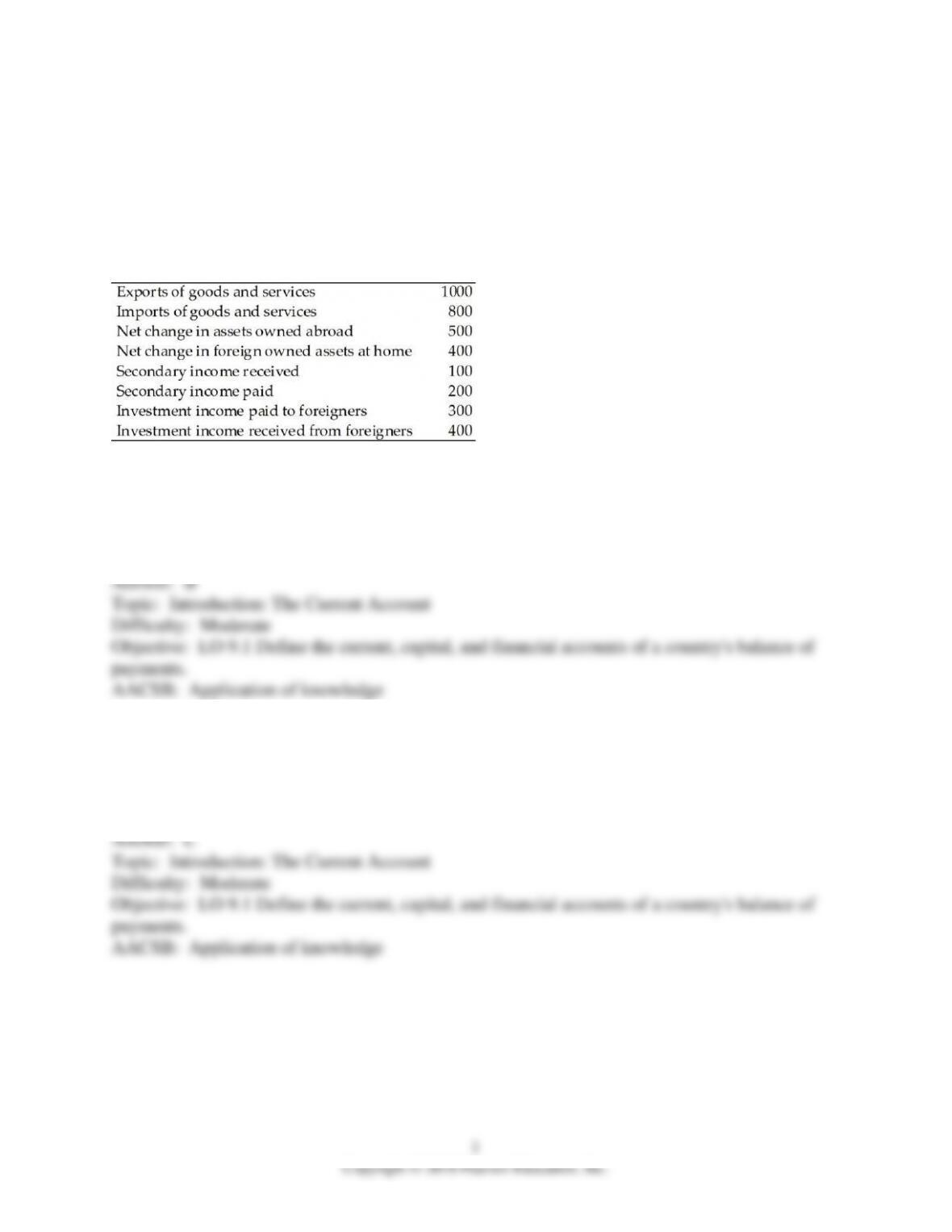
Use the information in the following table to answer the following question(s).
Table 9.1
1) Based on Table 9.1, the balance on the current account is
A) +100.
B) +200.
C) -100.
D) -200.
2) Based on Table 9.1, the balance on the financial account is
A) +100.
B) +200.
C) -100.
D) -200.
3) Based on Table 9.1, the statistical discrepancy is
A) +100.
B) 0.
C) -100.
D) -200.
4) Based on Table 9.1, if the information in the table is typical of current and financial account
values over a long period, then it would be reasonable to infer that
A) the net international investment position is negative.
B) the net international investment position is positive.
C) national savings are less than domestic investment.
D) government accounts are in deficit.
5) If the residents of a country receive income from their foreign investments, it is counted as a
A) credit in the current account.
B) debit in the current account.
C) credit in the capital account.
D) debit in the capital account.
6) Which of the following is NOT part of the current account?
A) Dividends received on a foreign investment
B) Purchase of a plane ticket on a foreign airline
C) Shipment of food aid to a poor country
D) Purchase of a foreign bond
7) Which of the following is FALSE?
A) In 2002, the United States imported more goods and services from foreign suppliers than it
exported to foreign purchasers.
B) Services are almost one-third of total exports and are a growing part of U.S. and world trade.
C) The U.S. trade balance in services is in deficit.
D) With the exception of the Gulf War period in 1991, the U.S. current account has been in
deficit since the 1980s.
8) The current account balance of the United States began to deteriorate in
A) the early 1970s.
B) the early 1980s.
C) the late 1980s.
D) the early 1990s.
9) People sometimes worry that American trade with other countries will lead to large U.S. trade
deficits and the movement of massive amounts of American capital out of the country. This
worry is unfounded because countries cannot
A) increase savings at the same time that a trade deficit grows.
B) spend more than they earn.
C) invest more than they save.
D) have both current account and financial account deficits at the same time.
10) A current account deficit implies that
A) the financial account is negative.
B) the financial account is in surplus.
C) exports of goods and services exceed imports of goods and services.
D) secondary income is positive.
11) Which of the following transactions would be recorded in the current account?
A) U.S. investors purchase bonds from Germany.
B) A person living in the United States sends money home to her family in Cuba.
C) The Fed increases its holdings of yen.
D) The U.S. transfers a military base to another country.
12) Which of the following transactions would be recorded in the capital account?
A) U.S. investors purchase bonds from Germany.
B) The Fed increases its holdings of yen.
C) The U.S. transfers a military base to another country.
D) A U.S. firm sells a machine to a business in another country.
13) Which of the following transactions would be recorded in the financial account?
A) U.S. investors purchase bonds from Germany.
B) A person living in the United States sends money home to her family in Cuba.
C) The Fed increases its holdings of yen.
D) The U.S. transfers a military base to another country.
14) If there is a trade deficit, which of the following is true?
A) The current account balance could be positive, negative, or zero.
B) There will be a current account deficit.
C) There will be a current account surplus.
D) There will be a financial account surplus.
15) Which of the following transactions would be recorded as a CREDIT in the current account?
A) A U.S. citizen purchases goods from Ireland.
B) A U.S. company pays dividends on its stock. Some of the dividends go to foreign owners of
the stock.
C) The U.S. sells wheat to Mexico.
D) A person living in the United States sends money home to her family in Cuba.
16) Purchases of stocks and bonds are recorded in the capital account.
17) If the trade balance is negative, the current account balance will be negative.
18) Briefly describe the factors that contributed to the U.S. current account deficits of the 1990s.
19) How do recent current account deficits compare to GNP and to past ratios?
20) What were some of the consequences of the large current account deficits that the U.S. ran
from the 1990s to 2007?
21) Explain the difference between primary and secondary income.
9.2 Introduction to the Financial Account
1) Which of the following is an example of a financial derivative?
A) An option to purchase stock in the future
B) A share of stock in Microsoft
C) A U.S. government bond
D) Monetary gold
2) All of the following are true about foreign direct investment (FDI) and portfolio investment
EXCEPT
A) increases in the flow of portfolio investments increase the likelihood of financial crisis.
B) both portfolio investments and FDI are the same in that they both give their holders a claim
on the future output of the foreign economy.
C) FDI is relatively illiquid compared to portfolio investment.
D) portfolio investments have been on the decline in recent years (or decades).
3) Capital controls are most often aimed at slowing or eliminating movements of
A) reserve assets.
B) foreign direct investment.
C) foreign portfolio investment.
D) nonreserve government assets.
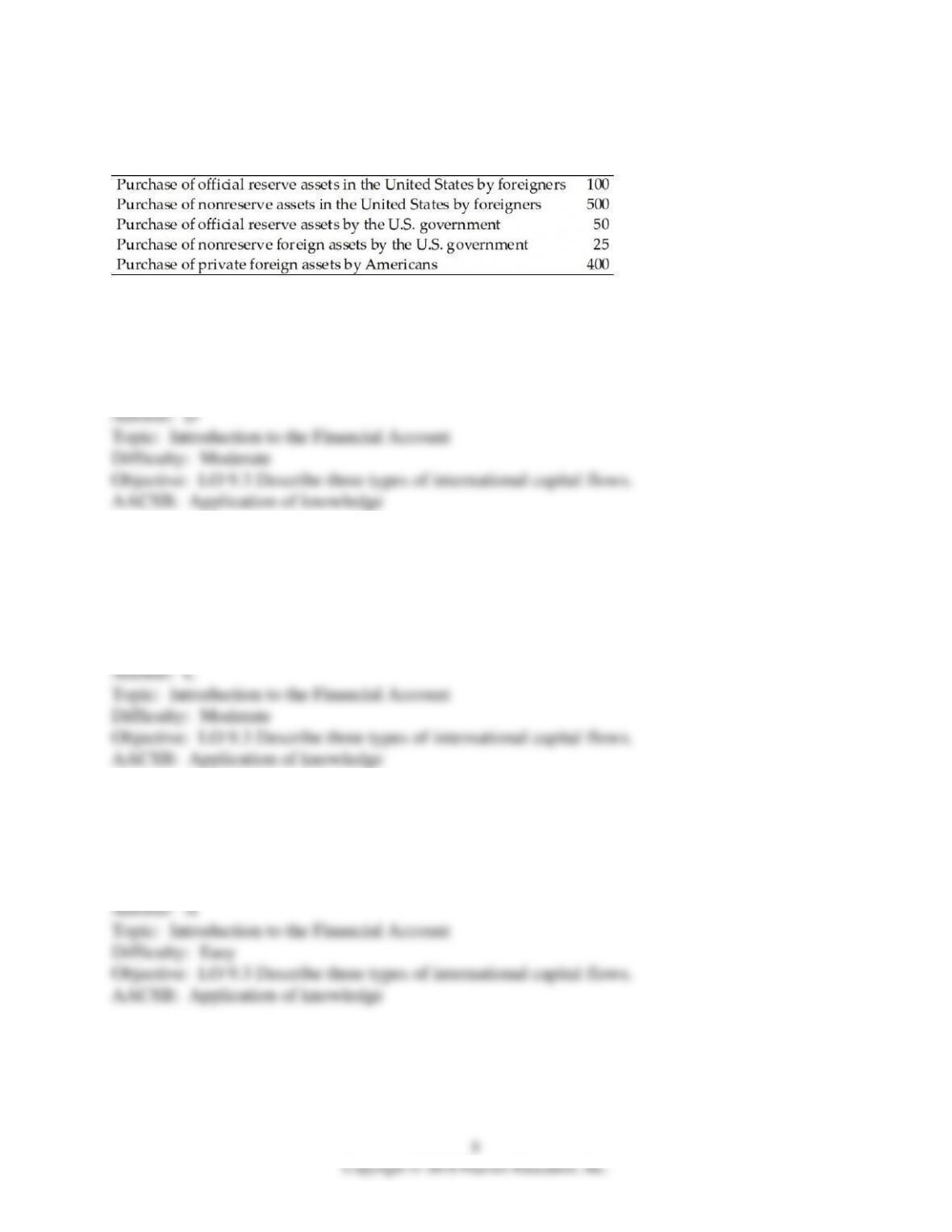
Use the following table to answer the next question(s). All values are net.
Table 9.3
4) Based on Table 9.3, the capital account balance is equal to
A) +25.
B) -25.
C) -125.
D) +125.
5) Based on Table 9.3, if values in the table are amended to reflect a net increase in U.S. foreign
direct investment of 100, then the new balance for the capital account balance becomes
A) -75.
B) -25.
C) +25.
D) +75.
6) Which of the following is an example of foreign direct investment?
A) Toyota builds an automobile plant in Ohio.
B) The Bank of Japan buys dollars.
C) A citizen of Japan buys stock in Microsoft.
D) A citizen of Japan buys a U.S. government bond.
7) Which of the following is an example of portfolio investment?
A) Toyota builds an automobile plant in Ohio.
B) The Bank of Japan buys dollars.
C) A citizen of Japan buys stock in Microsoft.
D) A citizen of Japan buys an option to purchase Microsoft stock in the future.
8) Which of the following is an example of a change in reserve assets?
A) Toyota builds an automobile plant in Ohio.
B) The Bank of Japan buys dollars.
C) A citizen of Japan buys stock in Microsoft.
D) A citizen of Japan buys a U.S. government bond.
9) Which of the following is NOT an official reserve asset for the United States?
A) Monetary gold
B) British pounds
C) SDRs from the IMF
D) Mexican pesos
10) A country that runs out of official reserve assets
A) cannot settle international debts.
B) is bankrupt.
C) will have a current account deficit.
D) will have a current account surplus.
11) Looking at the financial account data, it is possible to determine the total amount of official
reserves available to a nation.
12) Direct foreign investment items have more liquidity than foreign portfolio investment items.
13) In most of the financial crises of the last decade, there were large and sudden financial
outflows as both home and foreign investors tried to avoid the expected crises.
14) A sudden stop will be easier to navigate if the country borrows internationally in foreign
currencies and lend locally in its domestic currency.
15) A sudden stop refers to a rapid slowing of capital inflows.
16) The free movement of financial capital is desirable for all countries.
17) Capital inflows are desirable because they increase investment in a country.
18) All financial account transactions are linked to current account transactions, since the current
and financial accounts are mirror images of each other.
19) It is unclear whether the free flow of capital is beneficial to all countries. Explain the benefits
and costs of allowing capital to move freely.
20) What are official reserve assets, and why are they important to countries?
21) Describe how a sudden stop leads to a financial crisis.
9.3 The Current Account and the Macroeconomy
1) If all government budgets are balanced, and S is greater than I, then
A) the net international investment position must be positive.
B) the financial account must be positive.
C) the financial account must be negative.
D) the net international investment position must be negative.
2) The difference between GNP and GDP is
A) GNP includes income received from abroad and excludes income paid abroad.
B) GNP excludes income received from abroad and includes income paid abroad.
C) GNP includes exports and imports.
D) GNP excludes exports and imports.
3) Typically, the most important determinant of private investment in an economy is
A) the inflow of foreign investment.
B) the size of the capital account surplus.
C) the size of the current account deficit.
D) the amount of domestic savings.
4) If domestic savings is less than domestic investment, then
A) reserve assets will increase.
B) the government runs a budget deficit.
C) there will be negative foreign investment.
D) a trade surplus must result.
5) Which of the following is NOT true about this national income equation:
A) For the current account, CA, to improve, we may have to invest less than otherwise would be
the case.
B) For the current account, CA, to improve, we may have to save less to maintain the same
amount of investment that includes foreign saving.
C) For the current account, CA, to improve, the government may have to run budget surplus.
D) A reduction in the trade deficit with one country will simply show up as an increase in a trade
deficit with another country.
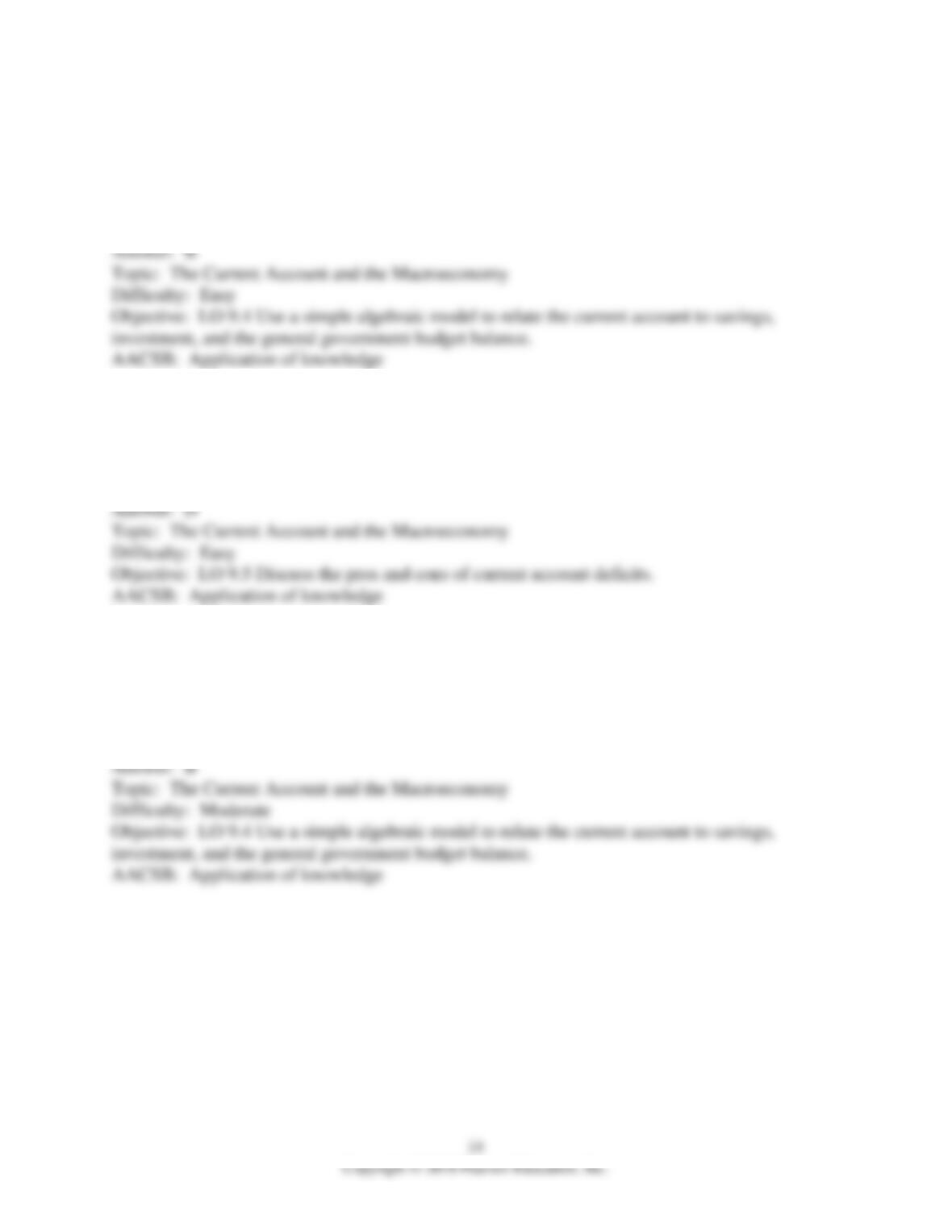
6) Which of the following is NOT true about the national income identity given by the equation:
S + (T – G) = I + CA?
A) If CA is positive, national saving finances the purchase of our goods by foreign users.
B) If CA is negative, our investment is less than our national savings.
C) A negative CA may imply that foreigners have confidence in the U.S. economy.
D) If CA is negative and large, a country risks foreigners owning a large piece of its assets.
7) During the 1990s, which of the following did NOT occur?
A) Private savings fell.
B) Investment rose.
C) The United States received capital inflows.
D) Private savings was greater than investment for most of the 1990s.
8) If a country runs a current account surplus and national private savings equals domestic
investment, then the combined governmental accounts
A) must be balanced.
B) must be positive.
C) must be negative.
D) could be either negative or positive, depending on the net international investment position.