1
CHAPTER 8
THE BASIS FOR TRADE:
Factor Endowments and the Heckscher-Ohlin Model
B.
M
Mu
ul
lt
ti
ip
pl
le
e–
–C
Ch
ho
oi
ic
ce
e
Q
Qu
ue
es
st
ti
io
on
ns
s
12. If relatively capital-abundant country A opens trade with relatively labor-abundant
country B and the trade takes place in accordance with the Heckscher-Ohlin theorem,
what would be the consequence for factor prices (w/r) in the two countries?
a. (w/r) rises in A and falls in B
13. An implication of the Heckscher-Ohlin theorem is that
a. if two countries have identical tastes, then no trade will occur between them.
14. If a commodity is classified as “labor–intensive” at one set of relative factor prices but
“capital–intensive” at another set of relative factor prices, this situation is known as
a. demand reversal.
15. In the situation of “demand reversal” in a 2x2x2 context where all the assumptions of the
Heckscher-Ohlin analysis hold except for the assumption of identical demands across
countries, and when the countries are trading with each other,
a. one country will be conforming to the trade pattern predicted by the Heckscher-Ohlin
theorem but the other country will not be conforming to that pattern.
16. In a two-country world, if country A is the relatively labor-abundant and country B is the
relatively capital-abundant country by the “price” definition of factor abundance (and
where w is the wage rate and r is the return to capital), then __________. When the
countries move from autarky to Heckscher-Ohlin-type trade, the result will be that
__________.
d. (w/r)A > (w/r)B; (w/r)A will fall and (w/r)B will rise
17. If good A costs $10 per unit in country A and $12 per unit in country B, and if transport
costs between A and B for the good are $3 per unit, an economist would say that
a. the good will be exported from A to B.
18. Which one of the following is NOT an assumption in the Heckscher-Ohlin analysis?
a. constant returns to scale
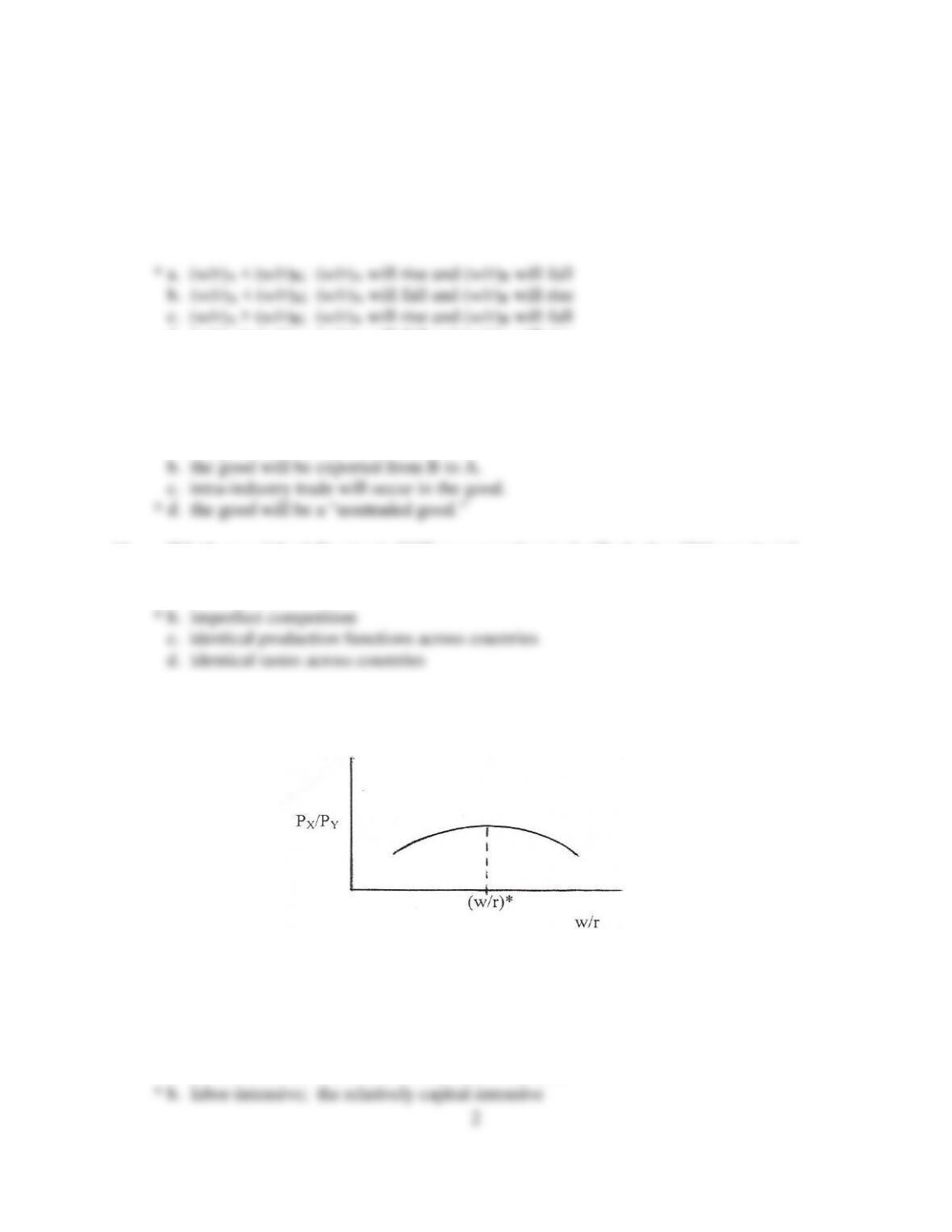
19. In the following diagram showing the relationship between the price of good X relative to
the price of good Y, (PX/PY), and the wage rate relative to the return to capital or rental
rate on capital, (w/r),
good X is the relatively __________ good at (w/r) values less than (w/r)*, and good X is
__________ good at (w/r) values greater than (w/r)*. [Note: The (PX/PY) associated
with (w/r)* is the highest (PX/PY) on the graph.]
a. labor-intensive; also the relatively labor-intensive
3
20. The “magnification effect” refers to the fact that, when a country is opened to trade,
a. the price of the export good rises.
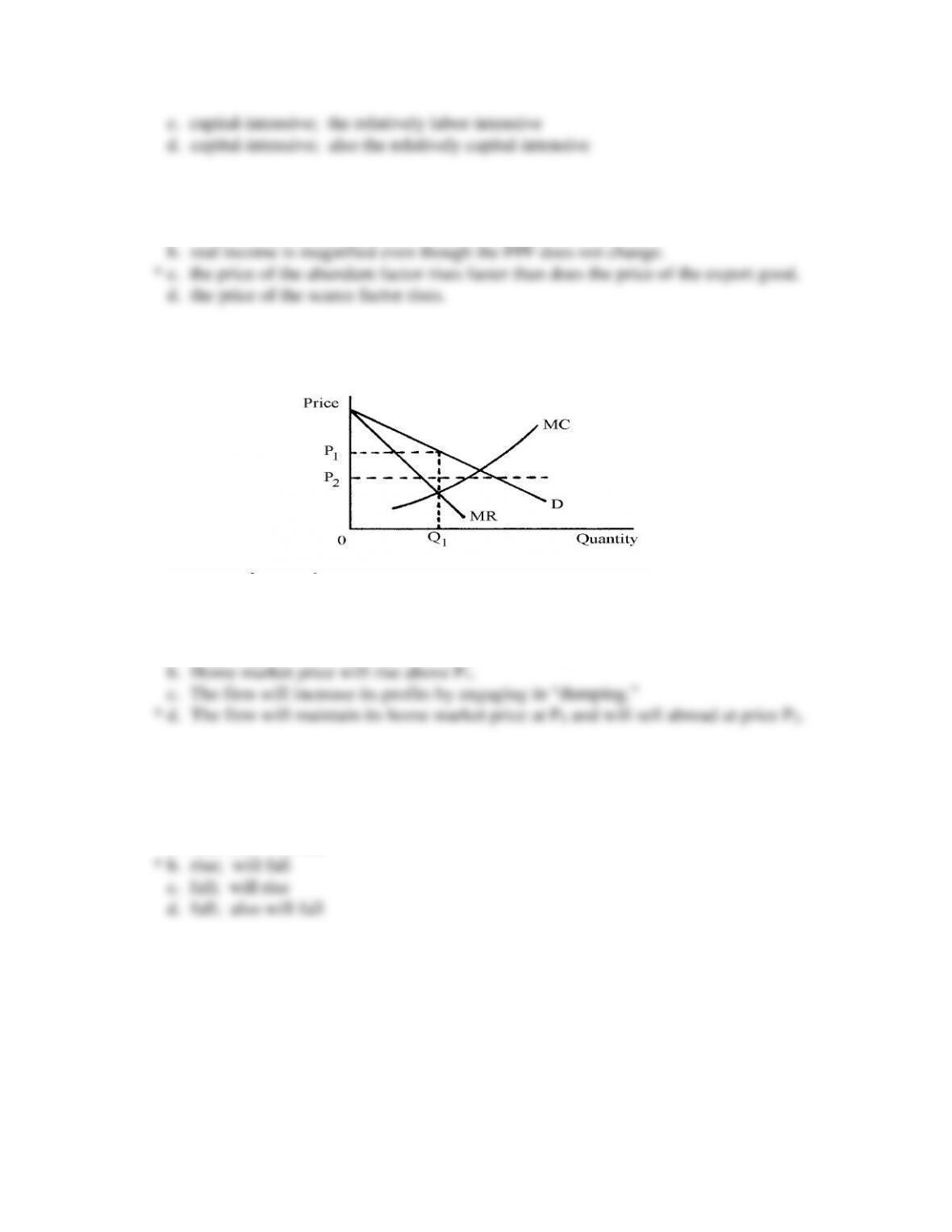
21. Suppose that a firm is maximizing profit in its home market at output Q1 and price P1 in
the following graph:
If the firm now has the opportunity to sell overseas at given world price P2 and the firm
can practice “dumping,” which one of the following will NOT happen?
a. Total output of the firm will become greater than Q1.
22. The Stolper-Samuelson theorem suggests that, when a country is opened to international
trade, the real income of the country’s abundant factor of production will __________
and the real income of the country’s scarce factor of production __________.
a. rise; also will rise
23. Which one of the following is NOT an assumption made in the standard 2x2x2
Heckscher-Ohlin analysis?
a. The production function for a given good is the same in both countries.
b. If a particular good is the relatively labor-intensive good at one set of relative factor
prices, then it is also the relatively labor-intensive good at any other set of relative
factor prices.
4
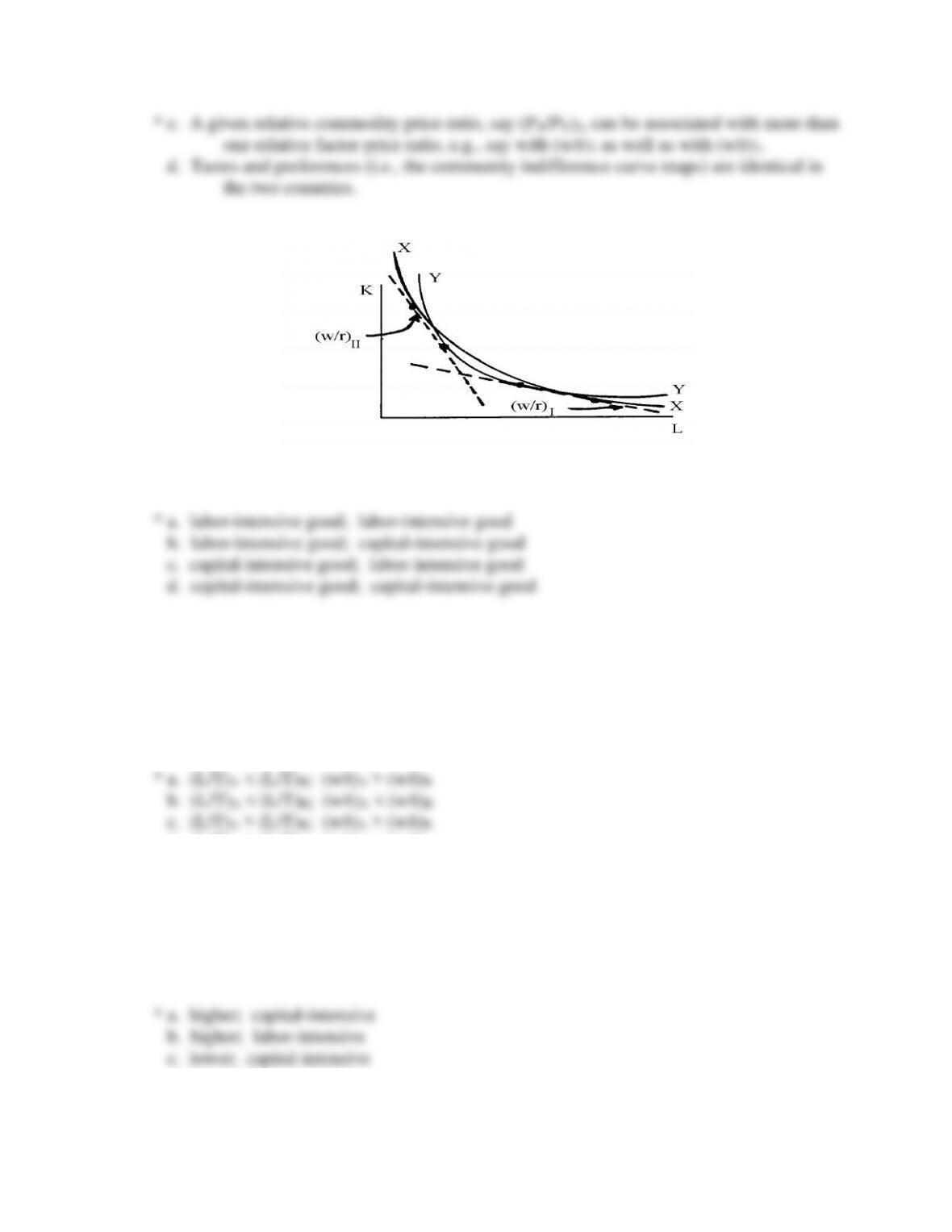
24. In the following diagram,
at factor prices (w/r)I, good X is the __________, and, at factor prices (w/r)II, good Y is
the __________.
25. Suppose that we are in a two-factor, two-country world where the factors of production
are labor (L) and land (T), the returns to the factors are the wage rate (w) and the rental
rate on land (t), and the countries are country A and country B. In this situation, country
A is land-abundant relative to country B by the physical definition of relative factor
abundance if __________, and country A is land-abundant relative to country B by the
price (or economic) definition if __________.
d. (L/T)A > (L/T)B; (w/t)A < (w/t)
26. If country I is defined as “relatively capital–abundant” in relation to country II by the
“price” (or “economic”) definition of factor abundance, then the price of labor relative to
the price of capital is __________ in country I than in country II, and the Heckscher-
Ohlin theorem would suggest that country I would export relatively __________ goods to
country II.
d. lower; labor-intensive
5
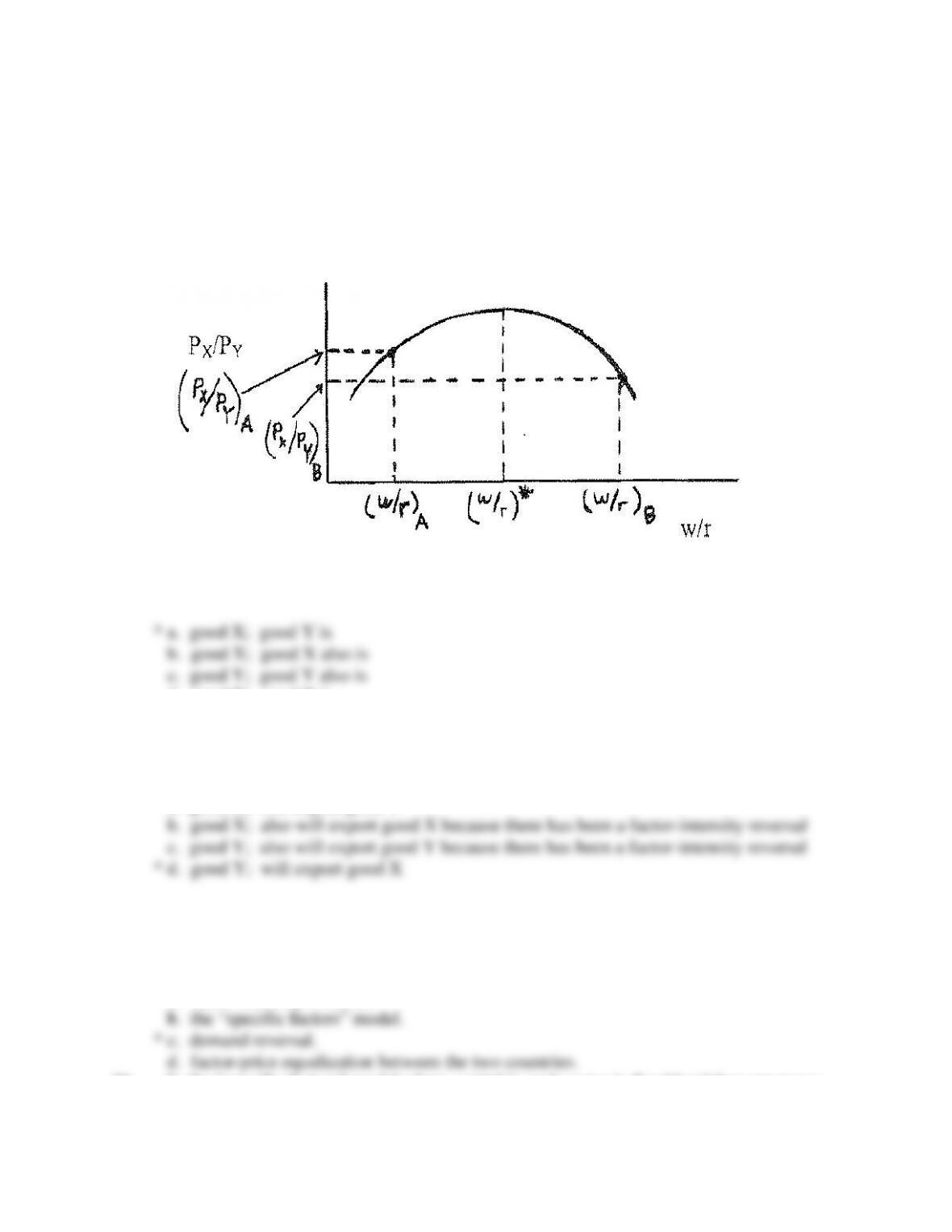
27. Given the following diagram that shows the relationship between the price of good X
relative to the price of good Y (PX/PY) and the wage rate relative to the return to capital
or
rental rate on capital (w/r), and also indicates relative factor prices in country A [(w/r)A],
relative factor prices in country B [(w/r)B], relative autarky goods prices in country A
[(PX/PY)A], relative autarky goods prices in country B [(PX/PY)B], and (w/r)* [where the
(PX/PY) associated with (w/r)* is the highest (PX/PY) on the graph]:
At (w/r) values less than (w/r)*, __________ is the relatively labor-intensive good and, at
(w/r) values greater than (w/r)*, __________ the relatively labor-intensive good.
d. good Y; good X is
28. In the graph in Question #27 above, if the two countries are opened to trade with each
other, country A will export __________ and country B __________.
a. good X; will export good Y
29. If skilled labor is physically more abundant relative to unskilled labor in country I than in
country II, but yet skilled labor is relatively higher-priced in comparison to unskilled
labor in country I than in country II, this phenomenon could be accounted for by
a. factor-intensity reversal.
30. In the “specific–factors” model where capital in each sector is fixed but labor can move
6
freely between the two sectors, the opening of the country to trade will increase the real
return to capital in the __________ sector and will increase the real wage of a worker
who __________.
d. import-competing; consumes mostly the export good
31. In the 2x2x2 Heckscher-Ohlin analysis, if a relatively labor-abundant country is opened
to trade, then, as the movement to trade takes place, the capital/labor ratio used in the
country’s export industry will __________ and the capital/labor ratio used in the
country’s import-competing industry __________.
a. increase; will decrease