CHAPTER 8—REGIONAL TRADING ARRANGEMENTS
MULTIPLE CHOICE
1. The European Union is primarily intended to permit:
a.
Countries to adopt scientific tariffs on imports
b.
An agricultural commodity cartel within the group
c.
The adoption of export tariffs for revenue purposes
d.
Free movement of resources and products among member nations
2. Which of the following represents the stage where economic integration is most complete?
a.
Economic union
b.
Customs union
c.
Monetary union
d.
Common market
3. Which of the following represents the stage where economic integration is least complete?
a.
Free trade area
b.
Monetary union
c.
Common market
d.
Customs union
4. Customs union theory reasons that the formation of a customs union will decrease members’ real
welfare when the:
a.
Trade diversion effect exceeds the trade creation effect
b.
Trade production effect exceeds the trade consumption effect
c.
Trade consumption effect exceeds the trade production effect
d.
Trade creation effect exceeds the trade diversion effect
5. Which economic integration scheme is solely intended to abolish trade restrictions among member
countries, while setting up common tariffs against nonmembers?
a.
Economic union
b.
Common market
c.
Free trade area
d.
Customs union
6. By 1992 the European Union had become a full-fledged:
a.
Economic union
b.
Monetary union
c.
Common market
d.
Fiscal union
7. Which device has the European Union used to equalize farm-product import prices with politically
determined European Union prices, regardless of shifts in world prices?
a.
Variable levies
b.
Import quotas
c.
Import subsidies
d.
Domestic content regulations
8. Which trade instrument has the European Union used to insulate its producers and consumers of
agricultural goods from the impact of changing demand and supply conditions in the rest of the world?
a.
Domestic content regulations
b.
Variable import levies
c.
Voluntary export quotas
d.
Orderly marketing agreements
9. Assume that the formation of a customs union turns out to include the lowest-cost world producer of
the product in question. Which effect could not occur for the participating countries?
a.
Trade creation-production effect
b.
Trade creation-consumption effect
c.
Trade diversion
d.
Scale economies and competition
10. Which organization of nations permits free trade among its members in industrial goods, while each
member maintains freedom in its trade policies toward non-member countries?
a.
European Union
b.
Benelux
c.
Council for Mutual Economic Assistance
d.
North American Free Trade Association
11. Which of the following organizations is considered a regional trading arrangement?
a.
Organization of Petroleum Exporting Countries
b.
North Atlantic Treaty Organization
c.
Benelux
d.
International Tin Agreement
12. When products from high-cost suppliers within a customs union replace imports from a low-cost
nation that is not a member of the customs union, there exist(s):
a.
Dynamic welfare losses
b.
Dynamic welfare gains
c.
Trade creation
d.
Trade diversion
13. Which form of economic integration occurs when participating countries abolish tariffs on trade
among themselves, establish a common tariff on imports from nonmembers, and permit free
movement of capital and labor within the organization?
a.
Free trade area
b.
Economic union
c.
Common market
d.
Monetary union
14. A static welfare effect resulting from the formation of the European Union would be:
a.
Economies of scale
b.
Trade diversion
c.
Investment incentives
d.
Increased competition
15. A dynamic welfare gain resulting from the formation of the European Union would be:
a.
Trade diversion
b.
Trade creation
c.
Diseconomies of scale
d.
Economies of scale
16. Which organization was founded in 1957 whose objective was to create an economic union among its
members?
a.
General Agreements on Tariffs and Trade
b.
Organization of Economic Cooperation and Development
c.
European Union
d.
Latin American Free Trade Association
17. The common agriculture policy of the European Union has supported European farmers via:
a.
Export tariffs and domestic content regulations
b.
Variable levies and voluntary export agreements
c.
Content regulations and export subsidies
d.
Export subsidies and variable levies
18. Which nation is not a member of the North American Free Trade Association?
a.
Canada
b.
Greenland
c.
Mexico
d.
United States
19. NAFTA is a:
a.
Monetary union
b.
Free trade area
c.
Common market
d.
Customs union
20. Under the European Union’s common agricultural policy, a variable import levy equals the:
a.
Amount by which the EU’s support price exceeds the world price
b.
Amount by which the world price exceeds the EU’s support price
c.
Support price of the EU
d.
World price
21. Members of the European Union find that “trade creation” is fostered when their economies are:
a.
Highly competitive
b.
Highly noncompetitive
c.
Small in economic importance
d.
Geographically distant
22. The European Union has achieved all of the following except:
a.
Adopted a common fiscal policy for member nations
b.
Established a common system of agricultural price supports
c.
Disbanded all tariffs among its member countries
d.
Levied common tariffs on products imported from nonmembers
23. When the United States, Canada, and Mexico form a free trade area, and Mexico begins importing a
product from Canada rather than from the lowest cost world producer.
a.
Trade diversion occurs
b.
Trade creation occurs
c.
World welfare rises
d.
World welfare falls to zero
24. When the formation of a free trade area results in the reduction of trade with nonmember nations in
favor of member countries, ____ occurs.
a.
Trade devaluation
b.
Trade revaluation
c.
Trade creation
d.
Trade diversion
25. Which country is not a member of the European Union?
a.
Spain
b.
Germany
c.
France
d.
Iceland
26. The implementation of the European Union has:
a.
Made it harder for Americans to compete against the Germans in the British market
b.
Made it easier for Americans to compete against the Germans in the British market
c.
Made it harder for Americans to compete against the Japanese in the British market
d.
Made it easier for Americans to compete against the Japanese in the British market
27. The common agricultural policy of the European Union has:
a.
Increased American farm exports to the EU
b.
Decreased American farm exports to the EU
c.
Lowered the price of American farm exports to the EU
d.
Not affected the price of American farm exports to the EU
28. The implementation of a common market involves all of the following except:
a.
Elimination of trade restrictions among member countries
b.
A common tax system and monetary union
c.
Prohibition of restrictions on factor movements
d.
A common tariff levied in imports from nonmembers
29. Under the common agricultural policy, exports of any surplus quantities of EU produce are encouraged
through the usage of:
a.
Variable levies
b.
Export subsidies
c.
Import quotas
d.
Countertrade
Figure 8.1 depicts the supply and demand schedules of calculators for Greece, a “small” country that
is unable to affect the world price. Greece’s supply and demand schedules of calculators are
respectively depicted by SG and DG. Assume that Greece imports calculators from either Germany or
France. Suppose Germany is the world’s low-cost producer who can supply calculators to Greece at
$20 per unit, while France can supply calculators at $30 per unit.
Figure 8.1. Effects of a Customs Union
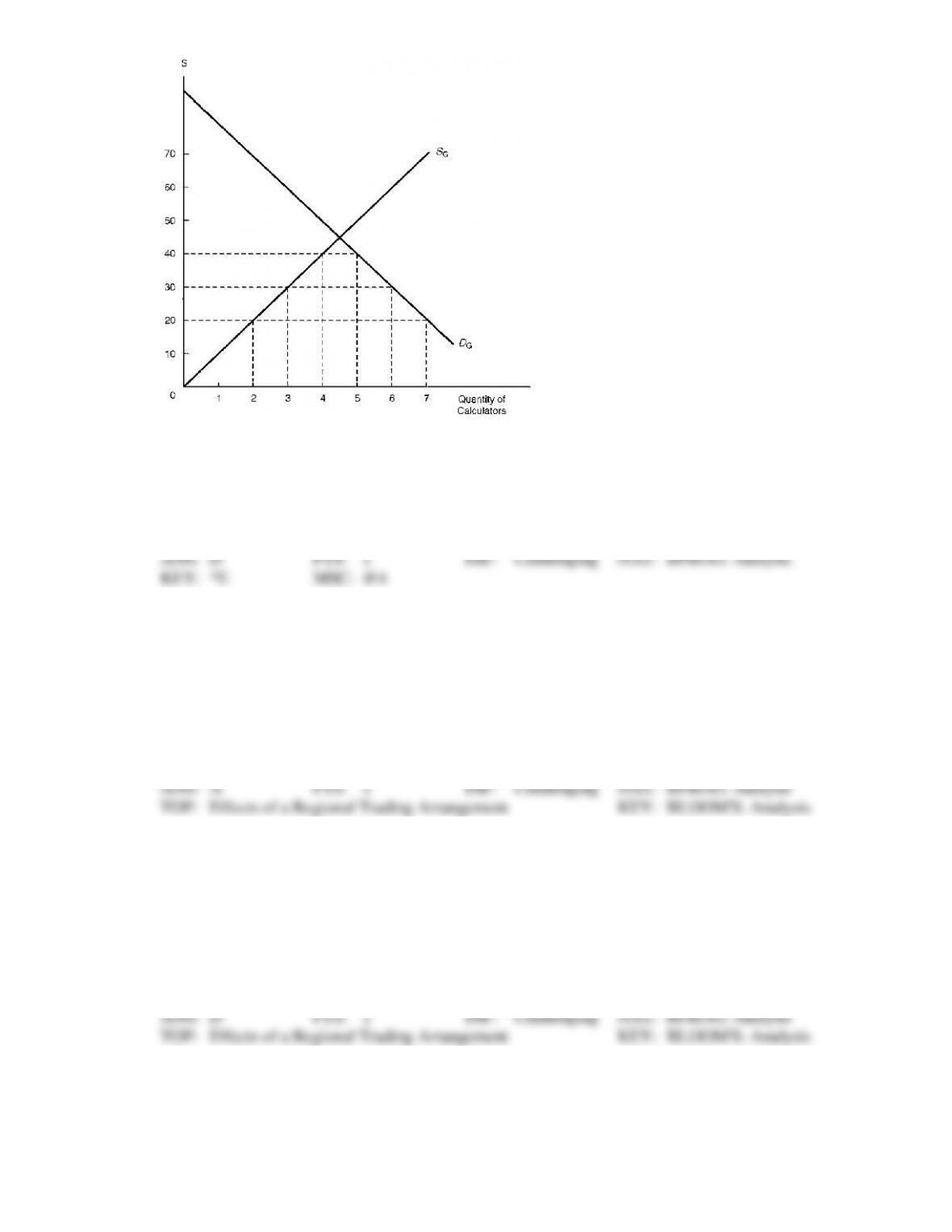
30. Consider Figure 8.1. With free trade, Greece imports:
a.
3 calculators from France
b.
5 calculators from France
c.
3 calculators from Germany
d.
5 calculators from Germany
31. Consider to Figure 8.1. Assume Greece levies a per-unit tariff of $20 on imports from both Germany
and France.
Greece will import:
a.
1 calculator from Germany
b.
1 calculator from France
c.
3 calculators from Germany
d.
3 calculators from France
32. Consider Figure 8.1. Assume Greece levies a per-unit tariff of $20 on imports from both Germany and
France.
As a result of the $20 tariff, Greece’s consumer surplus falls by:
a.
$90
b.
$100
c.
$110
d.
$120
33. Consider Figure 8.1. Assume Greece levies a per-unit tariff of $20 on imports from both Germany and
France.
The deadweight welfare loss to Greece, resulting from the $20 tariff, equals:
a.
$20
b.
$40
c.
$60
d.
$80
34. Referring to Figure 8.1, suppose Greece forms a customs union with France. Greece will import:
a.
3 calculators at a per-unit price of $30
b.
3 calculators at a per-unit price of $40
c.
6 calculators at a per-unit price of $30
d.
6 calculators at a per-unit price of $40
35. Consider Figure 8.1. The value of the trade diversion effect, resulting from the Greece/France customs
union, equals:
a.
$5
b.
$10
c.
$15
d.
$20
36. Consider Figure 8.1. The value of the trade creation effect, resulting from the Greece/France customs
union, equals:
a.
$5
b.
$10
c.
$15
d.
$20
37. Consider Figure 8.1. Comparing the trade creation and trade diversion effects, the impact of the
Greece/France customs union on the welfare of Greece is:
a.
A $5 increase in economic welfare
b.
A $10 increase in economic welfare
c.
A $5 decrease in economic welfare
d.
No change in economic welfare
38. Consider Figure 8.1. Suppose Greece had formed a customs union with Germany, rather than France.
The value of the trade diversion effect would be:
a.
Zero
b.
$5
c.
$10
d.
$15
39. According to Figure 8.1, the formation of a Greece/Germany customs union would result in:
a.
$20 of trade diversion
b.
$40 of trade diversion
c.
$20 of trade creation
d.
$40 of trade creation
40. In 1989 Canada and the United States agreed to implement a (an) ____ over a ten year period.
a.
Customs union
b.
Common market
c.
Free trade area
d.
Economic union
41. In the United States, the proposed North American Free Trade Agreement was generally supported by:
a.
Labor unions
b.
Electronics firms
c.
Environmentalists
d.
Citrus producers
42. At the Maastricht Summit of 1991, European Union negotiators called for the pursuit of a:
a.
Free trade area
b.
Customs union
c.
Common market
d.
Monetary union
43. By removing discriminatory government procurement laws within the European Union, member
nations hoped to benefit from all of the following except:
a.
EU governments could purchase from the cheapest foreign suppliers
b.
Increased competition occurs as domestic firms compete with foreign firms previously
shut out of the domestic market
c.
Industries are restructured which permits surviving firms to achieve economies of scale
d.
Agricultural prices fall as more farmers are allowed to produce their commodities
44. Suppose that government procurement liberalization results in the U.K. government importing
automobiles from Germany, the low-cost EU manufacturer. Cost savings could result from all of the
following except:
a.
Competition effect
b.
Scale-economy effect
c.
Protective effect
d.
Trade effect
45. Suppose that steel from Japan faces a 20 percent tariff in France and a 25 percent tariff in Italy, while
France and Italy maintain free trade between each other. France and Italy are therefore part of a (an):
a.
Free trade area
b.
Customs union
c.
Common market
d.
Economic union
46. Suppose that Mexico and Canada form a free-trade area and Canada begins importing steel from
Mexico rather than from Germany. There occurs:
a.
Trade diversion
b.
Trade creation
c.
Trade destruction
d.
Trade exhaustion
47. Suppose that Mexico and Canada form a free-trade area. Mexicans then decrease auto manufacturing
and increase imports of autos from Canada, while the Canadians decrease computer production and
import more computers from Mexico. This is an example of:
a.
Trade diversion
b.
Trade creation
c.
Trade destruction
d.
Trade exhaustion
48. If the United States and Canada abolish all tariffs on each other’s goods and implement a common
tariff on goods imported from other countries, there occurs a (an):
a.
Free-trade area
b.
Customs union
c.
Common market
d.
Economic union
49. Suppose that the United Kingdom and Italy abolish all tariffs on each other’s goods and all restrictions
on movements of factors of production between them. They also implement a common protectionist
policy toward other countries. This is an example of a (an):
a.
Free-trade area
b.
Customs union
c.
Common market
d.
Economic union
50. The North American Free Trade Agreement was expected to benefit ____ the most.
a.
Canada
b.
Mexico
c.
Greenland
d.
United States
51. The North American Free-Trade Agreement was most strongly opposed by U.S.:
a.
Electronics manufacturers
b.
Labor unions
c.
Commercial banks
d.
Engineering companies
52. In the United States, which group was most likely to be hurt by the North American Free Trade
Agreement?
a.
Unskilled labor
b.
Skilled labor
c.
Owners of capital equipment
d.
Owners of financial capital
53. By joining NAFTA, the United States, Canada, and Mexico would find their short-run welfare
decreasing due to the:
a.
Economies of scale effect
b.
Business investment effect
c.
Trade creation effect
d.
Trade diversion effect
54. When Mexico became a part of NAFTA, along with Canada and the United States, it:
a.
Eliminated tariffs against Canada and the United States but maintained them against
nonmembers
b.
Eliminated tariffs against Canada, the United States, and all nonmember countries
c.
Increased tariffs against Canada the United States, and all nonmember countries
d.
Increased tariffs against Canada and the United States, but did not change them against
nonmember countries
55. In a centrally-planned economy:
a.
Commercial decisions are made by independent buyers and sellers acting in their own
interest
b.
Market-determined prices are used for allocating scarce resources
c.
Prices play a rationing role so that the availability of goods is made consistent with buyer
preferences and income
d.
Government controls prices and output of goods bought and sold, with minimal
recognition given to considerations of efficiency
56. The failure of the centrally-planned economies was exemplified by all of the following except:
a.
Interest rates that were below free-market levels
b.
Consumer and producer goods of inferior quality
c.
Declining rates of economic growth
d.
Shortages of essential goods and services
57. The transition of the former communist countries to market economies requires:
a.
Implementation of governmental price controls
b.
Privatization of public property
c.
Transforming competitive industries into monopolies
d.
The sale of private industries to the government
58. The transition of the former communist countries to market economies would likely result in:
a.
The implementation of price ceilings
b.
The implementation of price floors
c.
Price inflation
d.
Price deflation