43. Assume the following information:
You have $400,000 to invest:
Current spot rate of Sudanese dinar (SDD)
=
$.00570
90-day forward rate of the dinar
=
$.00569
90-day interest rate in the U.S.
=
4.0%
90-day interest rate in Sudan
=
4.2%
If you conduct covered interest arbitrage, what amount will you have after 90 days?
a.
$416,000.00.
b.
$416,800.00.
c.
$424,242.86.
d.
$416,068.77.
e.
none of the above
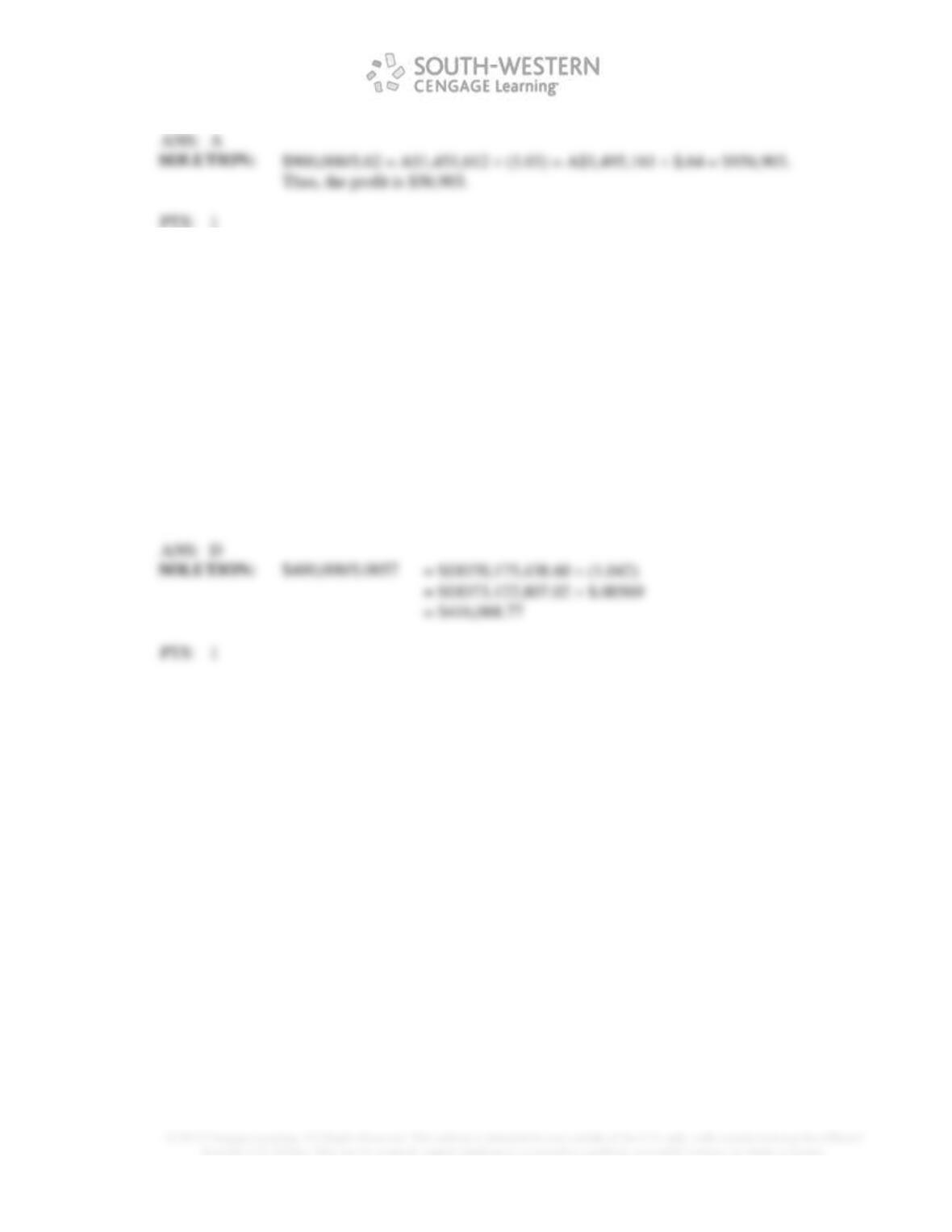
= SDD70,175,438.60 (1.042)
= SDD73,122,807.02 $.00569
= $416,068.77
Exhibit 7-1
Assume the following information:
You have $300,000 to invest:
The spot bid rate for the euro (€) is $1.08
The spot ask quote for the euro is $1.10
The 180-day forward rate (bid) of the euro is $1.08
The 180-day forward rate (ask) of the euro is $1.10
The 180-day interest rate in the U.S. is 6%
The 180-day interest rate in Europe is 8%
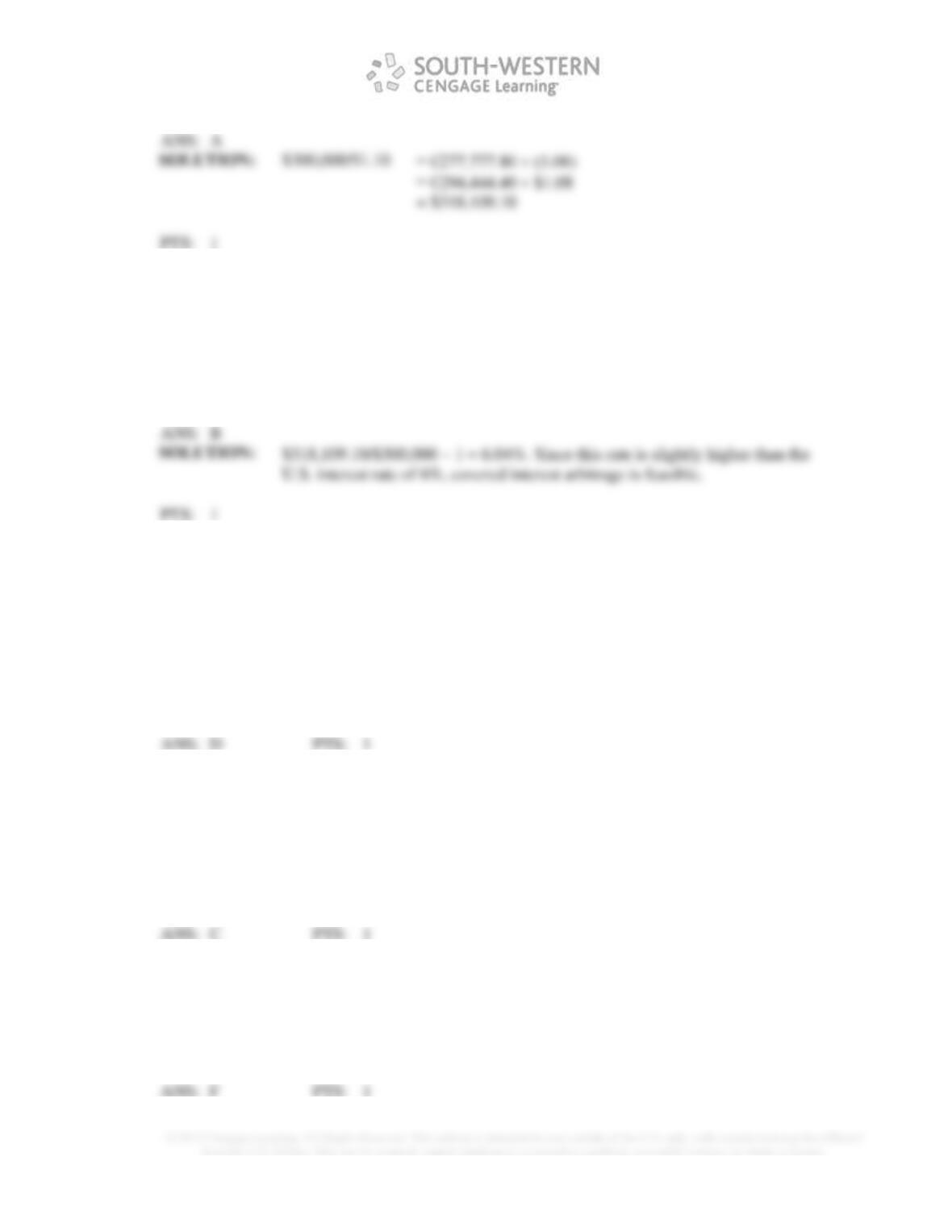
44. Refer to Exhibit 7-1. If you conduct covered interest arbitrage, what amount will you have after 180
days?
a.
$318,109.10.
b.
$330,000.00.
c.
$312,218.20.
d.
$323,888.90.
e.
none of the above
45. Refer to Exhibit 7-1. If you conduct covered interest arbitrage, what is your percentage return after 180
days? Is covered interest arbitrage feasible in this situation?
a.
7.96%; feasible
b.
6.04%; feasible
c.
6.04%; not feasible
d.
4.07%; not feasible
e.
10.00%; feasible
46. According to interest rate parity (IRP):
a.
the forward rate differs from the spot rate by a sufficient amount to offset the inflation
differential between two currencies.
b.
the future spot rate differs from the current spot rate by a sufficient amount to offset the
interest rate differential between two currencies.
c.
the future spot rate differs from the current spot rate by a sufficient amount to offset the
inflation differential between two currencies.
d.
the forward rate differs from the spot rate by a sufficient amount to offset the interest rate
differential between two currencies.
47. Assume that interest rate parity holds. The Mexican interest rate is 50%, and the U.S. interest rate is
8%. Subsequently, the U.S. interest rate decreases to 7%. According to interest rate parity, the peso’s
forward ____ will ____.
a.
premium; increase
b.
discount; decrease
c.
discount; increase
d.
premium; decrease
48. If the cross exchange rate of two nondollar currencies implied by their individual spot rates with
respect to the dollar is less than the cross exchange rate quoted by a bank, locational arbitrage is
possible.
a. True
b. False

49. For locational arbitrage to be possible, one bank’s ask rate must be higher than another bank’s bid rate
for a currency.
a. True
b. False
50. Assume locational arbitrage is possible and involves two different banks. The realignment that would
occur due to market forces would increase one bank’s ask rate and would decrease the other bank’s bid
rate.
a. True
b. False
51. Triangular arbitrage tends to force a relationship between the interest rates of two countries and their
forward exchange rate premium or discount.
a. True
b. False
52. The interest rate on euros is 8%. The interest rate in the U.S. is 5%. The euro’s forward rate should
exhibit a premium of about 3%.
a. True
b. False
53. Capitalizing on discrepancies in quoted prices involving no risk and no investment of funds is referred
to as interest rate parity.
a. True
b. False
54. Realignment in the exchange rates of banks will eliminate locational arbitrage. More specifically,
market forces will increase the ask rate of the bank from which the currency was bought to conduct
locational arbitrage and will decrease the bid rate of the bank to which the currency was sold to
conduct locational arbitrage.
a. True
b. False

55. Locational arbitrage involves investing in a foreign country and covering against exchange rate risk by
engaging in forward contracts.
a. True
b. False
56. To capitalize on high foreign interest rates using covered interest arbitrage, a U.S. investor would
convert dollars to the foreign currency, invest in the foreign country, and simultaneously sell the
foreign currency forward.
a. True
b. False
57. If interest rate parity (IRP) exists, then the rate of return achieved from covered interest arbitrage
should be equal to the rate available in the foreign country.
a. True
b. False
58. If interest rate parity (IRP) exists, then triangular arbitrage will not be possible.
a. True
b. False
59. Forward rates are driven by the government rather than market forces.
a. True
b. False
60. The foreign exchange market is an over-the-counter market.
a. True
b. False
61. The yield curve of every country has its own unique shape.
a. True
b. False
62. Assume the following information:
U.S. investors have $1,000,000 to invest:
1-year deposit rate offered by U.S. banks
=
10%
1-year deposit rate offered on British pounds
=
13.5%
1-year forward rate of Swiss francs
=
$1.26
Spot rate of Swiss franc
=
$1.30
Given this information:
a.
interest rate parity exists and covered interest arbitrage by U.S. investors results in the
same yield as investing domestically.
b.
interest rate parity doesn’t exist and covered interest arbitrage by U.S. investors results in a
yield above what is possible domestically.
c.
interest rate parity exists and covered interest arbitrage by U.S. investors results in a yield
above what is possible domestically.
d.
interest rate parity doesn’t exist and covered interest arbitrage by U.S. investors results in a
yield below what is possible domestically.
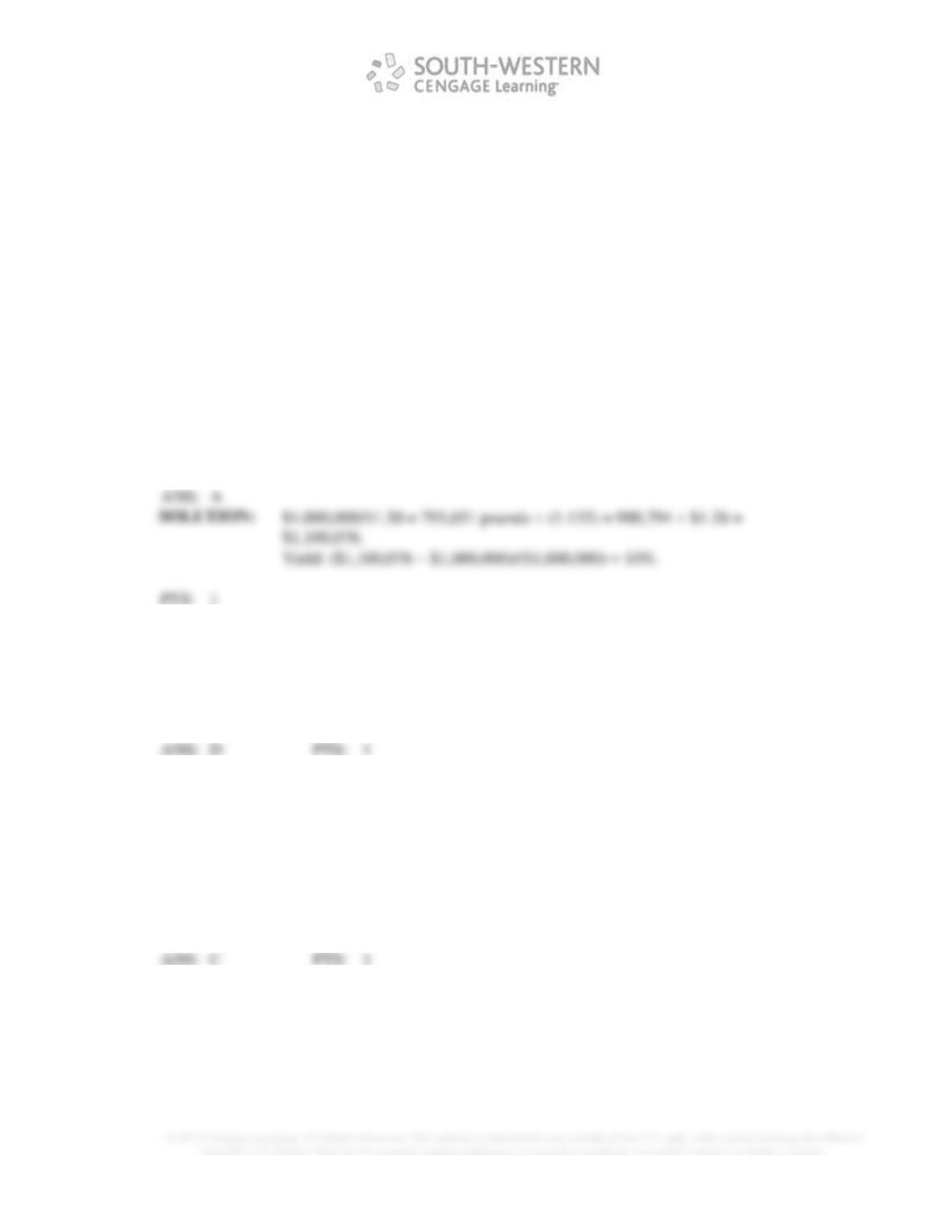
Yield: ($1,100,076 − $1,000,000)/($1,000,000) = 10%.
63. If quoted exchange rates are the same across different locations, then ____ is not feasible.
a.
triangular arbitrage
b.
covered interest arbitrage
c.
locational arbitrage
d.
A and C
64. Points above the IRP line represent situations where:
a.
covered interest arbitrage is feasible from the perspective of domestic investors and results
in the same yield as investing domestically.
b.
covered interest arbitrage is feasible from the perspective of domestic investors and results
in a yield above what is possible domestically.
c.
covered interest arbitrage is feasible from the perspective of foreign investors and results
in a yield above what is possible in their local markets.
d.
covered interest arbitrage is not feasible for neither domestic nor foreign investors.
65. Points below the IRP line represent situations where:
a.
covered interest arbitrage is feasible from the perspective of domestic investors and results
in the same yield as investing domestically.
b.
covered interest arbitrage is feasible from the perspective of domestic investors and results
in a yield above what is possible domestically.
c.
covered interest arbitrage is feasible from the perspective of foreign investors and results
in a yield above what is possible in their local markets.
d.
covered interest arbitrage is not feasible for neither domestic nor foreign investors.
66. Which of the following might discourage covered interest arbitrage even if interest rate parity does not
exist?
a.
transaction costs.
b.
political risk.
c.
differential tax laws.
d.
all of the above.
67. Assume that interest rate parity holds. U.S. interest rate is 13% and British interest rate is 10%. The
forward rate on British pounds exhibits a ____ of ____ percent.
a.
discount; 2.73
b.
premium; 2.73
c.
discount; 3.65
d.
premium; 3.65
68. Assume the following information:
Exchange rate of Japanese yen in U.S. $
=
$.011
Exchange rate of euro in U.S. $
=
$1.40
Exchange rate of euro in Japanese yen
=
140 yen
What will be the yield for an investor who has $1,000,000 available to conduct triangular arbitrage?
a.
$100,000
b.
−$90,909
c.
10%
d.
−9.09%
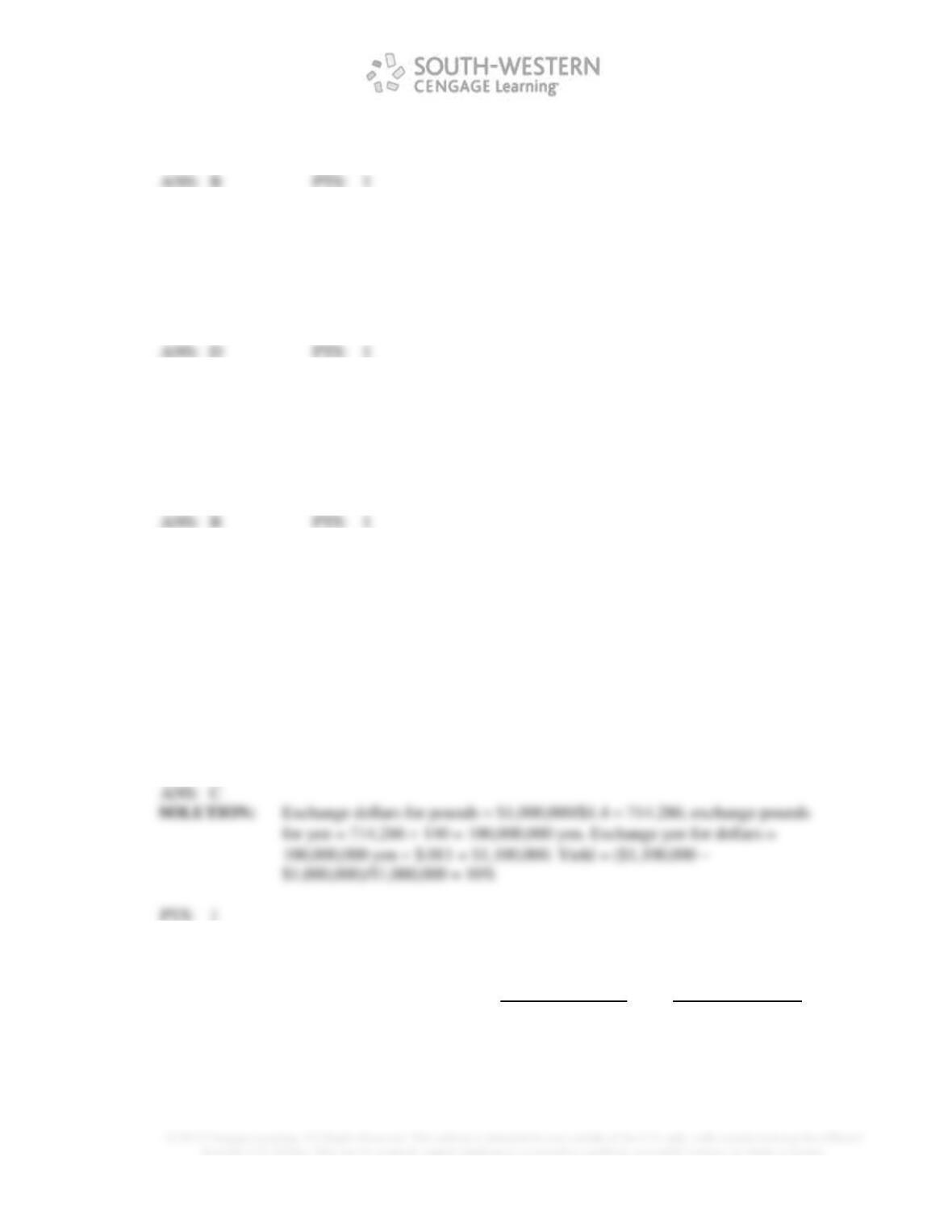
$1,000,000)/$1,000,000 = 10%
69. Assume the following information:
Quoted Bid Price
Quoted Ask Price
Value of an Australian dollar (A$) in $
$0.67
$0.69
Value of Mexican peso in $
$.074
$.077
Value of an Australian dollar in
Mexican pesos
8.2
8.5
Assume you have $100,000 to conduct triangular arbitrage. What will be your profit from
implementing this strategy?
a.
$6,133
b.
$2,368
c.
$6,518
d.
$13,711
70. The interest rate on yen is 7%. The interest rate in the U.S. is 9%. The yen’s forward rate should
exhibit a premium of about 2%.
a. True
b. False
71. The interest rate on pounds in the U.K. is 8%. The interest rate in the U.S. is 5%. Interest rate parity
exists. U.S. investors will earn a lower return domestically than British investors earn domestically.
a. True
b. False
72. Assume that the real interest rate in the U.S. and in the U.K. is 3%. The expected annual inflation in
the U.S. is 3%, while in the U.K. it is 4%. The forward rate on the pound should exhibit a premium of
about 1%.
a. True
b. False
73. If the cross exchange rate of two nondollar currencies implied by their individual spot rates with
respect to the dollar is less than the cross exchange rate quoted by a bank, locational arbitrage is
possible.
a. True
b. False
74. For locational arbitrage to be possible, one bank’s ask rate must be higher than another bank’s bid rate
for a currency.
a. True
b. False

75. Technology enables more consistent prices among banks and reduces the likelihood of significant
discrepancies in foreign exchange quotations among locations.
a. True
b. False
76. Assume locational arbitrage is possible and involves two different banks. The realignment that would
occur due to market forces would increase one bank’s ask rate and would decrease the other bank’s bid
rate.
a. True
b. False
77. Locational arbitrage explains why prices among banks at different locations will not normally differ by
a significant amount.
a. True
b. False
78. Cross exchange rates are used to determine the relationship between the dollar and two nondollar
currencies.
a. True
b. False
79. Triangular arbitrage tends to force a relationship between the interest rates of two countries and their
forward exchange rate premium or discount.
a. True
b. False
80. The equilibrium state in which covered interest arbitrage is no longer possible is called interest rate
parity (IRP).
a. True
b. False
81. If interest rate parity exists, then the rate of return achieved from covered interest arbitrage should be
equal to the interest rate available in the foreign country.
a. True
b. False

82. Interest rate parity (IRP) states that the foreign currency’s forward rate premium or discount is roughly
equal to the interest rate differential between the U.S. and the foreign country.
a. True
b. False
83. The interest rate in South Africa is 8%. The interest rate in the U.S. is 5%. The South African forward
rate should exhibit a premium of about 3%.
a. True
b. False
84. The larger the degree by which the foreign interest rate exceeds the home interest rate, the larger will
be the forward discount of the foreign currency specified by the interest rate parity (IRP) formula.
a. True
b. False
85. For points lying to the left of the interest rate parity (IRP) line, covered interest arbitrage is not
possible from a U.S. investor’s perspective, but is possible from a foreign investor’s perspective.
a. True
b. False
86. If interest rate parity (IRP) exists, then foreign investors will earn the same returns as U.S. investors.
a. True
b. False
87. If interest rate parity (IRP) does not hold, there is still the possibility that covered interest arbitrage is
not worthwhile because of such factors as transaction costs, currency restrictions, and differential tax
laws.
a. True
b. False
88. Which of the following is not mentioned in the text as a form of international arbitrage?
a.
Locational arbitrage
b.
Triangular arbitrage
c.
Transactional arbitrage
d.
Covered interest arbitrage
e.
All of the above are mentioned in the text as forms of international arbitrage.

89. Bank A quotes a bid rate of $0.300 and an ask rate of $0.305 for the Malaysian ringgit (MYR). Bank B
quotes a bid rate of $0.306 and an ask rate of $0.310 for the ringgit. What will be the profit for an
investor that has $500,000 available to conduct locational arbitrage?
a.
$2,041,667
b.
$9,804
c.
$500
d.
$1,639
90. American Bank quotes a bid rate of $0.026 and an ask rate of $0.028 for the Indian rupee (INR);
National Bank quotes a bid rate of $0.024 and an ask rate for $0.025. Locational arbitrage would
involve:
a.
buying rupees from American Bank at the bid rate and selling them to National Bank at
the ask rate.
b.
buying rupees from National Bank at the ask rate and selling them to American Bank at
the bid rate.
c.
buying rupees from American Bank at the ask rate and selling to National Bank at the bid
rate.
d.
buying rupees from National Bank at the bid rate and selling them to American Bank at
the ask rate.
e.
Locational arbitrage is not possible in this case.
91. Assume you discovered an opportunity for locational arbitrage involving two banks and have taken
advantage of it. Because of your and other arbitrageurs’ actions, the following adjustments must take
place.
a.
One bank’s ask price will rise and the other bank’s bid price will fall.
b.
One bank’s ask price will fall and the other bank’s bid price will rise.
c.
One bank’s bid/ask spread will widen and the other bank’s bid/ask spread will fall.
d.
A and C
92. Which of the following is an example of triangular arbitrage initiation?
a.
Buying a currency at one bank’s ask and selling at another bank’s bid, which is higher than
the former bank’s ask.
b.
Buying Singapore dollars from a bank (quoted at $0.55) that has quoted the South African
rand (ZAR)/Singapore dollar (S$) exchange rate at ZAR2.50 when the spot rate for the
South African rand is $0.20.
c.
Buying Singapore dollars from a bank (quoted at $0.55) that has quoted the South African
rand/Singapore dollar exchange rate at ZAR3.00 when the spot rate for the South African
rand is $0.20.
d.
Converting funds to a foreign currency and investing the funds overseas.

93. Hewitt Bank quotes a value for the Japanese yen (¥) of $0.007, and a value for the Canadian Dollar
(C$) of $0.821. The cross exchange rate quoted by the bank for the Canadian dollar is ¥118.00. You
have $5,000 to conduct triangular arbitrage. How much will you end up with if you conduct triangular
arbitrage?
a.
$6,053.27
b.
$5,030.45
c.
$6,090.13
d.
Triangular arbitrage is not possible in this case.
94. National Bank quotes the following for the British pound and the New Zealand dollar:
Quoted Bid Price
Quoted Ask Price
Value of a British pound (£) in $
$1.61
$1.62
Value of a New Zealand dollar (NZ$) in $
$0.55
$0.56
Value of a British pound in
New Zealand dollars
NZ$2.95
NZ$2.96
Assume you have $10,000 to conduct triangular arbitrage. What is your profit from implementing this
strategy?
a.
$77.64
b.
$197.53
c.
$15.43
d.
$111.80
95. Which of the following is not true regarding covered interest arbitrage?
a.
Covered interest arbitrage tends to force a relationship between the interest rates of two
countries and their forward exchange rate premium or discount.
b.
Covered interest arbitrage involves investing in a foreign country and covering against
exchange rate risk.
c.
Covered interest arbitrage opportunities only exist when the foreign interest rate is higher
than the interest rate in the home country.
d.
If covered interest arbitrage is possible, you can guarantee a return on your funds that
exceeds the returns you could achieve domestically.
e.
All of the above are true regarding covered interest arbitrage.
96. Which of the following is not true regarding covered interest arbitrage?
a.
Covered interest arbitrage is a reason for observing interest rate parity (IRP).
b.
If the forward rate is equal to the spot rate, conducting covered interest arbitrage will yield
a return that is exactly equal to the interest rate in the foreign country.
c.
When interest rate parity holds, covered interest arbitrage is not possible.
d.
When interest rate disparity exists, covered interest arbitrage may not be profitable.
e.
All of the above are true.

97. Which of the following is not true regarding interest rate parity (IRP)?
a.
When interest rate parity holds, covered interest arbitrage is not possible.
b.
When the interest rate in the foreign country is higher than that in the home country, the
forward rate of that country‘s currency should exhibit a discount.
c.
When the interest rate in the foreign country is lower than that in the home country, the
forward rate of that country‘s currency should exhibit a premium.
d.
When covered interest arbitrage is not feasible, interest rate parity must hold.
e.
All of the above are true.