CHAPTER 7—TRADE POLICIES FOR THE DEVELOPING NATIONS
MULTIPLE CHOICE
1. Which of the following is not a major factor that encourages developing nations to form international
commodity agreements?
a.
Inelastic commodity supply schedules
b.
Inelastic commodity demand schedules
c.
Export markets that tend to be unstable
d.
Secular increases in their terms of trade
2. International commodity agreements do not:
a.
Consist of consuming and producing nations who desire market stability
b.
Levy export cutbacks so as to offset rising commodity prices
c.
Utilize buffer stocks to generate commodity price stability
d.
Increase the supply of commodities to prevent rising prices
3. Concerning the price elasticities of supply and demand for commodities, empirical estimates suggest
that most commodities have:
a.
Inelastic supply schedules and inelastic demand schedules
b.
Inelastic supply schedules and elastic demand schedules
c.
Elastic supply schedules and inelastic demand schedules
d.
Elastic supply schedules and elastic demand schedules
4. If the demand schedule for bauxite is relatively inelastic to price changes, an increase in the supply
schedule of bauxite will cause a:
a.
Decrease in price and a decrease in sales revenue
b.
Decrease in price and an increase in sales revenue
c.
Increase in price and a decrease in sales revenue
d.
Increase in price and an increase in sales revenue
5. A primary goal of international commodity agreements has been the:
a.
Maximization of members’ revenues via export taxes
b.
Nationalization of corporations operating in member nations
c.
Adoption of tariff protection against industrialized nation sellers
d.
Moderation of commodity price fluctuations when markets are unstable
6. Which device has the International Tin Agreement utilized as a way of stabilizing tin prices?
a.
Multilateral contracts
b.
Export subsidies
c.
Buffer stocks
d.
Export tariffs
7. Which method has not generally been used by the international commodity agreements to stabilize
commodity prices?
a.
Production quotas applied to the level of commodity output
b.
Buffer stock arrangements among producing nations
c.
Export restrictions applied to international sales of commodities
d.
Measures to nationalize foreign-owned production operations
8. The OPEC nations during the 1970s manifested their market power by utilizing:
a.
Export tariffs levied for revenue purposes
b.
Export tariffs levied for protective purposes
c.
Import tariffs levied for protective purposes
d.
Import tariffs levied for revenue purposes
9. One factor that has prevented the formation of cartels for producers of commodities is that:
a.
The demand for commodities tends to be price inelastic
b.
Substitute products exist for many commodities
c.
Commodity produces have been able to dominate world markets
d.
Production of most commodities is capital intensive
10. Which device has been used by the International Wheat Agreement to stipulate the minimum prices at
which importers will buy stipulated quantities from producers and the maximum prices at which
producers will sell stipulated quantities to importers?
a.
Buffer stocks
b.
Export controls
c.
Multilateral contracts
d.
Production controls
11. If the bauxite exporting countries form a cartel to boost the price of bauxite so as to increase sales
revenue, they believe that the demand for bauxite:
a.
Is inelastic with respect to price changes
b.
Is elastic with respect to price changes
c.
Will increase in response to a price increase
d.
Will not change in response to a price change
12. If the supply schedule for tin is relatively inelastic to price changes, a decrease in the demand schedule
for tin will cause a:
a.
Decrease in price and an increase in sales revenue
b.
Decrease in price and a decrease in sales revenue
c.
Increase in price and an increase in sales revenue
d.
Increase in price and a decrease in sales revenue
13. Which of the following could partially explain why the terms of trade of developing countries might
deteriorate over time?
a.
Developing-country exports mainly consist of manufactured goods
b.
Developing-country imports mainly consist of primary products
c.
Commodity export prices are determined in highly competitive markets
d.
Commodity export prices are solely determined by developing countries
14. Which terms-of-trade concept emphasizes a nation’s capacity to import?
a.
Income terms of trade
b.
Commodity terms of trade
c.
Barter terms of trade
d.
Price terms of trade
15. Which trade strategy have developing countries used to restrict imports of manufactured goods so that
the domestic market is preserved for home producers, who thus can take over markets already
established in the country?
a.
International commodity agreement
b.
Export promotion
c.
Multilateral contract
d.
Import substitution
16. Which trade strategy have developing countries used to replace commodity exports with exports such
as processed primary products, semi-manufacturers, and manufacturers?
a.
Multilateral contract
b.
Buffer stock
c.
Export promotion
d.
Export quota
17. To help developing countries expand their industrial base, some industrial countries have reduced
tariffs on designated manufactured imports from developing countries below the levels applied to
imports from industrial countries. This scheme is referred to as:
a.
Generalized system of preferences
b.
Export-led growth
c.
International commodity agreement
d.
Reciprocal trade agreement
18. Which nation accounts for the largest amount of OPEC‘s oil reserves and production?
a.
Iran
b.
Libya
c.
Iraq
d.
Saudi Arabia
19. Assuming identical cost and demand curves, OPEC as a cartel will, in comparison to a competitive
industry:
a.
Produce greater output and charge a lower price
b.
Produce greater output and charge a higher price
c.
Produce less output and charge a higher price
d.
Produce less output and charge a lower price
20. Which of the following situations reduces the likelihood of successful operation of a cartel?
a.
Cartel sales experience a rapid expansion
b.
The demand for cartel output is price inelastic
c.
The number of firms in the cartel is large
d.
It is very difficult for new firms to enter the market
21. Which industrialization policy used by developing countries places emphasis on the comparative
advantage principle as a guide to resource allocation?
a.
Export promotion
b.
Import substitution
c.
International commodity agreements
d.
Multilateral contract
22. A widely used indicator to differentiate developed countries from developing countries is:
a.
International trade per capita
b.
Real income per capita
c.
Unemployment per capita
d.
Calories per capita
23. Concerning the hypothesis that there has occurred a long-run deterioration in the developing countries’
terms of trade, empirical studies provide:
a.
Mixed evidence that does not substantiate the deterioration hypothesis
b.
Overwhelming support for the deterioration hypothesis
c.
Overwhelming opposition to the deterioration hypothesis
d.
None of the above
24. For the oil-importing countries, the increases in oil prices in 1973-1974 and 1979-1980 resulted in all
of the following except:
a.
Balance of trade deficits
b.
Price inflation
c.
Constrained economic growth
d.
Improving terms of trade
25. Hong Kong and South Korea are examples of developing nations that have recently pursued
industrialization policies.
a.
Import substitution
b.
Export promotion
c.
Commercial dumping
d.
Multilateral contract
26. Stabilizing commodity prices around long-term trends tends to benefit importers at the expense of
exporters in markets characterized by:
a.
Demand-side disturbances
b.
Supply-side disturbances
c.
Demand-side and supply-side disturbances
d.
None of the above
27. Stabilizing commodity prices around long-term trends tends to benefit exporters at the expense of
importers in markets characterized by:
a.
Demand-side disturbances
b.
Supply-side disturbances
c.
Demand-side and supply-side disturbances
d.
None of the above
28. To be considered a good candidate for an export cartel, a commodity should:
a.
Be a manufactured good
b.
Be a primary product
c.
Have a high price elasticity of supply
d.
Have a low price elasticity of demand
29. To be considered a good candidate for an export cartel, a commodity should:
a.
Be a manufactured good
b.
Be a primary product
c.
Have a low price elasticity of supply
d.
Have a high price elasticity of demand
30. To help developing nations strengthen their international competitiveness, many industrial nations
have granted nonreciprocal tariff reductions to developing nations under the:
a.
International commodity agreements program
b.
Multilateral contract program
c.
Generalized system of preferences program
d.
Export-led growth program
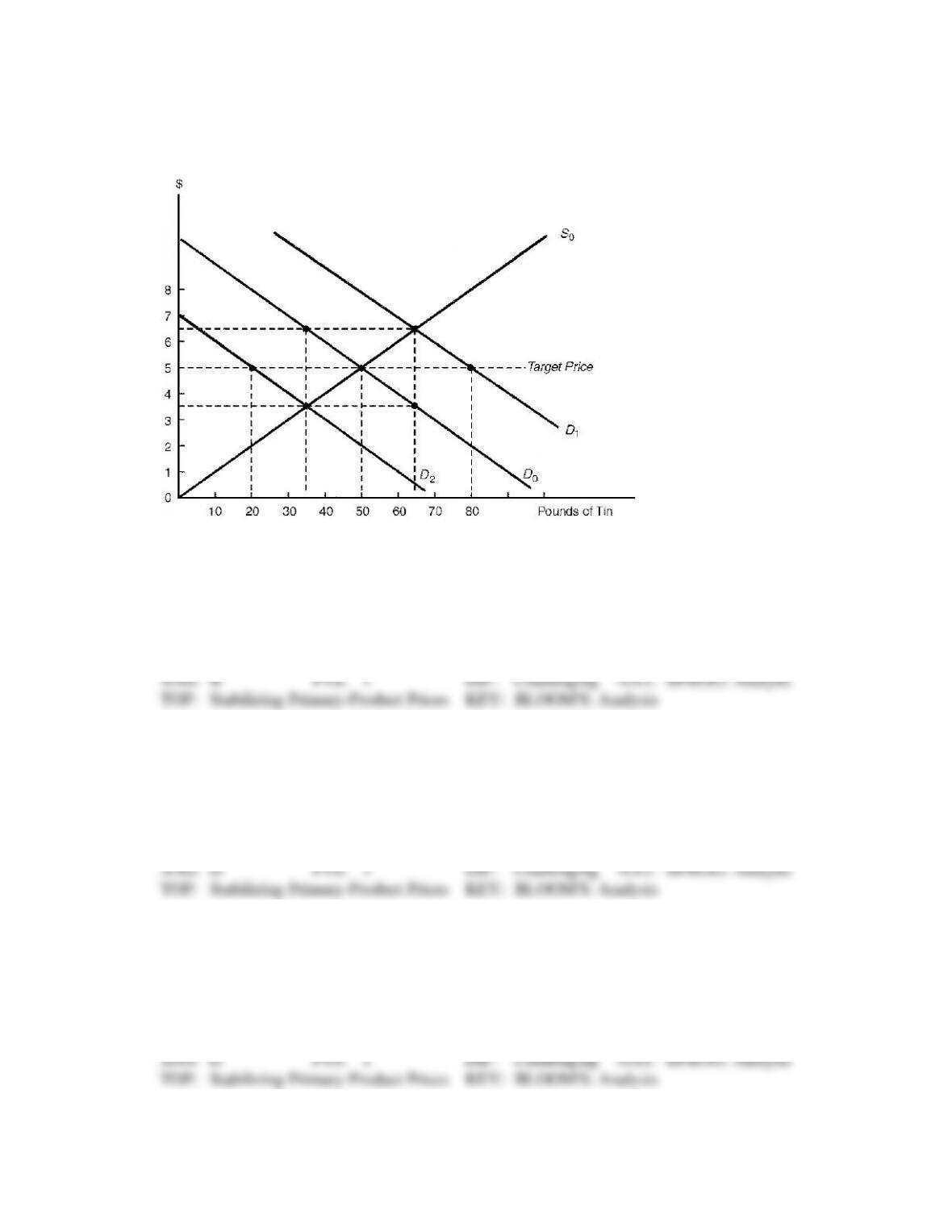
The diagram below illustrates the international tin market. Assume that producing and consuming
countries establish an international commodity agreement under which the target price of tin is $5 per
pound.
Figure 7.1. Defending the Target Price in Face of Changing Demand Conditions
31. Consider Figure 7.1. Suppose the demand for tin increases from D0 to D1. Under a buffer stock system,
the buffer-stock manager could maintain the target price by:
a.
Selling 15 pounds of tin
b.
Selling 30 pounds of tin
c.
Buying 15 pounds of tin
d.
Buying 30 pounds of tin
32. Consider Figure 7.1. Suppose the demand for tin decreases from D0 to D2. Under a buffer stock
system, the buffer-stock manager could maintain the target price by:
a.
Selling 15 pounds of tin
b.
Selling 30 pounds of tin
c.
Buying 15 pounds of tin
d.
Buying 30 pounds of tin
33. Consider Figure 7.1. Suppose the demand for tin decreases from D0 to D2. Under a system of export
quotas, the tin producers could maintain the target price by:
a.
Increasing the quantity of tin supplied by 15 pounds
b.
Increasing the quantity of tin supplied by 30 pounds
c.
Decreasing the quantity of tin supplied by 15 pounds
d.
Decreasing the quantity of tin supplied by 30 pounds
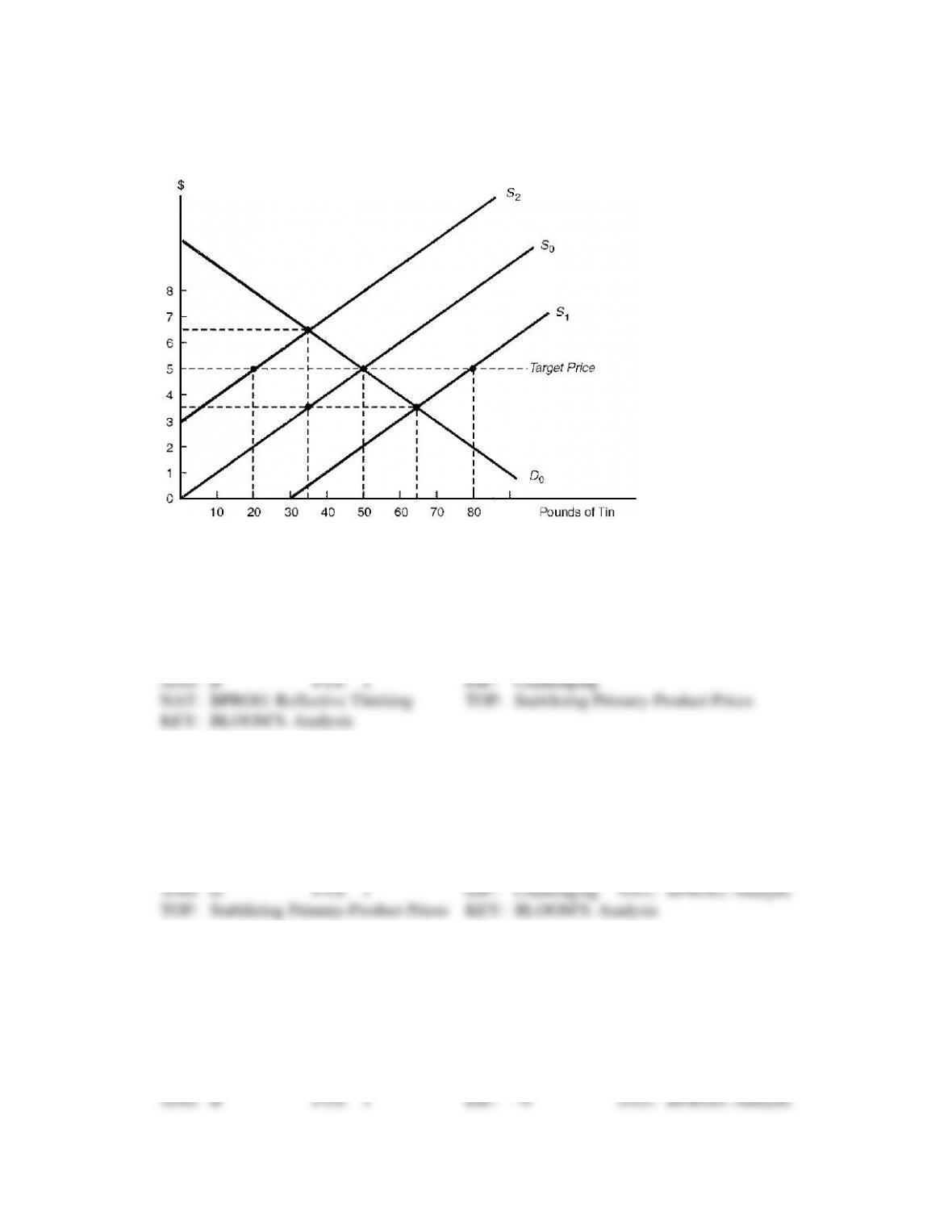
The diagram below illustrates the international tin market. Assume that the producing and consuming
countries establish an international commodity agreement under which the target price of tin is $5 per
pound.
Figure 7.2. Defending the Target Price in Face of Changing Supply Conditions
34. Consider Figure 7.2. Suppose the supply of tin increases from S0 to S1. Under a buffer stock system,
the buffer-stock manager could maintain the target price by:
a.
Purchasing 15 pounds of tin
b.
Purchasing 30 pounds of tin
c.
Selling 15 pounds of tin
d.
Selling 30 pounds of tin
35. Consider Figure 7.2. Suppose the supply of tin decreases from S0 to S2. Under a buffer stock system,
the buffer-stock manager could maintain the target price by:
a.
Purchasing 15 pounds of tin
b.
Purchasing 30 pounds of tin
c.
Selling 15 pounds of tin
d.
Selling 30 pounds of tin
36. Consider Figure 7.2. Assume there exists a cartel of several producers that is maximizing total profit.
If one producer cheats on the cartel agreement by decreasing its price and increasing its output,
rational action of the other producers is to:
a.
Increase their price in order to regain sacrificed profits
b.
Decrease their price as well
c.
Keep on selling at the agreed-upon price
d.
Give the product away for free
37. A reason why it is difficult for producers to maintain a cartel is that:
a.
The elasticity of demand for the cartel’s output decreases over time
b.
Producers in the cartel have the economic incentive to cheat
c.
Economic profits discourage other producers from entering the industry
d.
Producers in the cartel have the motivation to lower price but not to raise price
38. Once a cartel establishes its profit-maximizing price:
a.
Entry into the industry of new competitors will not affect the cartel’s profits
b.
Output changes by cartel members have no effect on the market price
c.
Each cartel member is tempted to cheat on the cartel price in order to add to its profit
d.
All cartel members have a strong incentive to adhere to the agreed-upon price
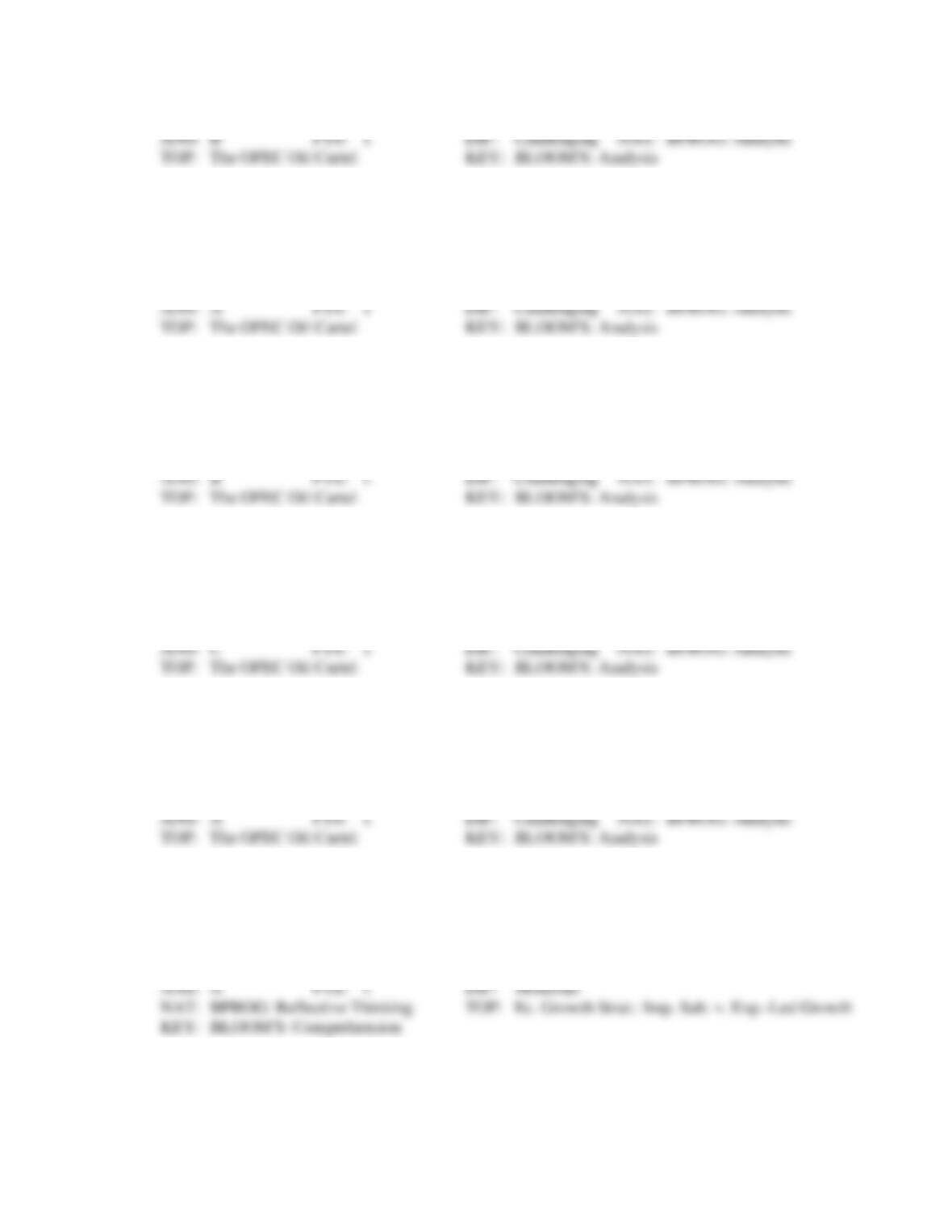
Figure 7.3. World Oil Market
39. Consider Figure 7.3. Under competitive conditions, the quantity of oil produced equals:
a.
40 barrels
b.
70 barrels
c.
90 barrels
d.
110 barrels
40. Consider Figure 7.3. Under competitive conditions, the price of a barrel of oil equals:
a.
$7
b.
$11
c.
$12
d.
$16
41. Consider Figure 7.3. Under competitive conditions, producer profits total:
a.
$0
b.
$140
c.
$200
d.
$280
42. Consider Figure 7.3. Under a profit-maximizing cartel, the quantity of oil produced equals:
a.
40 barrels
b.
70 barrels
c.
90 barrels
d.
110 barrels
43. Consider Figure 7.3. Under a profit-maximizing cartel, the price of a barrel of oil equals:
a.
$7
b.
$11
c.
$16
d.
$19
44. Consider Figure 7.3. Under a profit-maximizing cartel, producers realize:
a.
Profits totaling $280
b.
Profits totaling $360
c.
Losses totaling $140
d.
Losses totaling $180
45. Import substitution policies make use of:
a.
Tariffs that discourage goods from entering a country
b.
Quotas applied to goods that are shipped abroad
c.
Production subsidies granted to industries with comparative advantages
d.
Tax breaks granted to industries with comparative advantages
46. Export-led growth tends to:
a.
Exploit domestic comparative advantages
b.
Discourage competition in the global economy
c.
Lead to unemployment among domestic workers
d.
Help firms benefit from diseconomies of large-scale production
47. All of the following nations except ____ have recently utilized export-led (outward oriented) growth
policies.
a.
Hong Kong
b.
South Korea
c.
Argentina
d.
Singapore
48. The characteristics that have underlaid the economic success of the “high-performing Asian
Economies” have included all of the following except:
a.
High rates of domestic investment
b.
Diseconomies of scale occurring at low output levels
c.
Large endowments of human capital
d.
High levels of labor productivity
49. The development of countries like South Korea and Singapore has been underlaid by all of the
following except:
a.
High domestic interest rates
b.
R&D and product innovation
c.
Education and on-the-job training
d.
High levels of saving and investment
50. For most developing countries:
a.
Productivity is high among domestic workers
b.
Population-growth and illiteracy rates are low
c.
Saving and investment levels are high
d.
Agricultural goods and raw materials constitute much of domestic output
51. East Asian economies have performed well by
a.
Obtaining foreign technology
b.
Remaining open to international trade
c.
Investing in their people
d.
All of the above
52. East Asian economies started enacting export-push strategies
a.
By late 1950s and 1960s
b.
Immediately after World War II
c.
In the late 1980s
d.
In the early 2000s
53. Prior to the formation of the Organization of Petroleum Exporting Countries, individual oil producing
nations,
a.
Operated like sellers in a competitive market
b.
Behaved like individual sellers in a monopoly market
c.
Had considerable control over the price of oil
d.
Both b and c.
54. A key factor underlying the instability of primary product prices and export receipts of developing
nations is the
a.
Low price elasticity of the demand of primary products
b.
High price elasticity of supply of primary products
c.
High price elasticity of demand of primary products
d.
None of the above
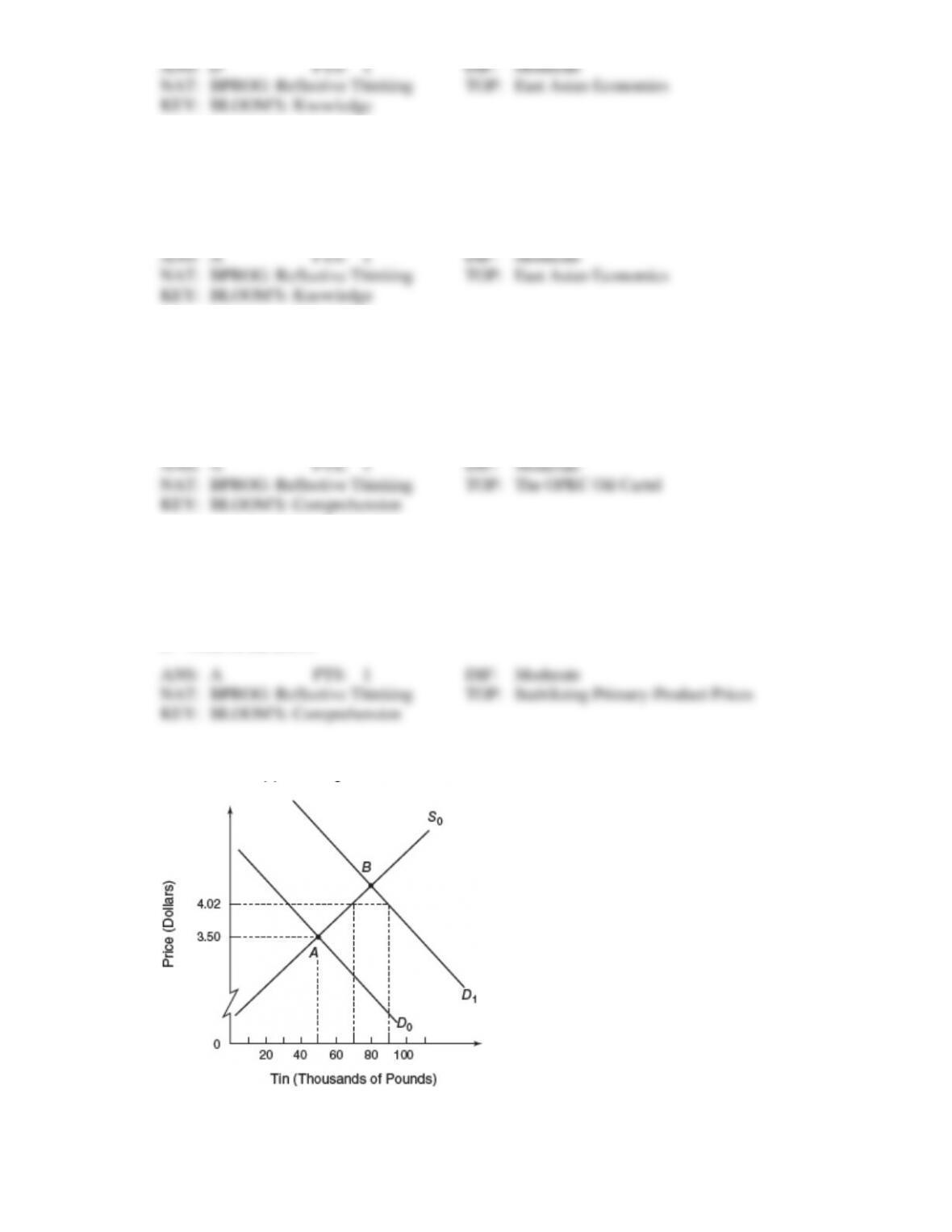
Figure 7.4 Global Market for Tin
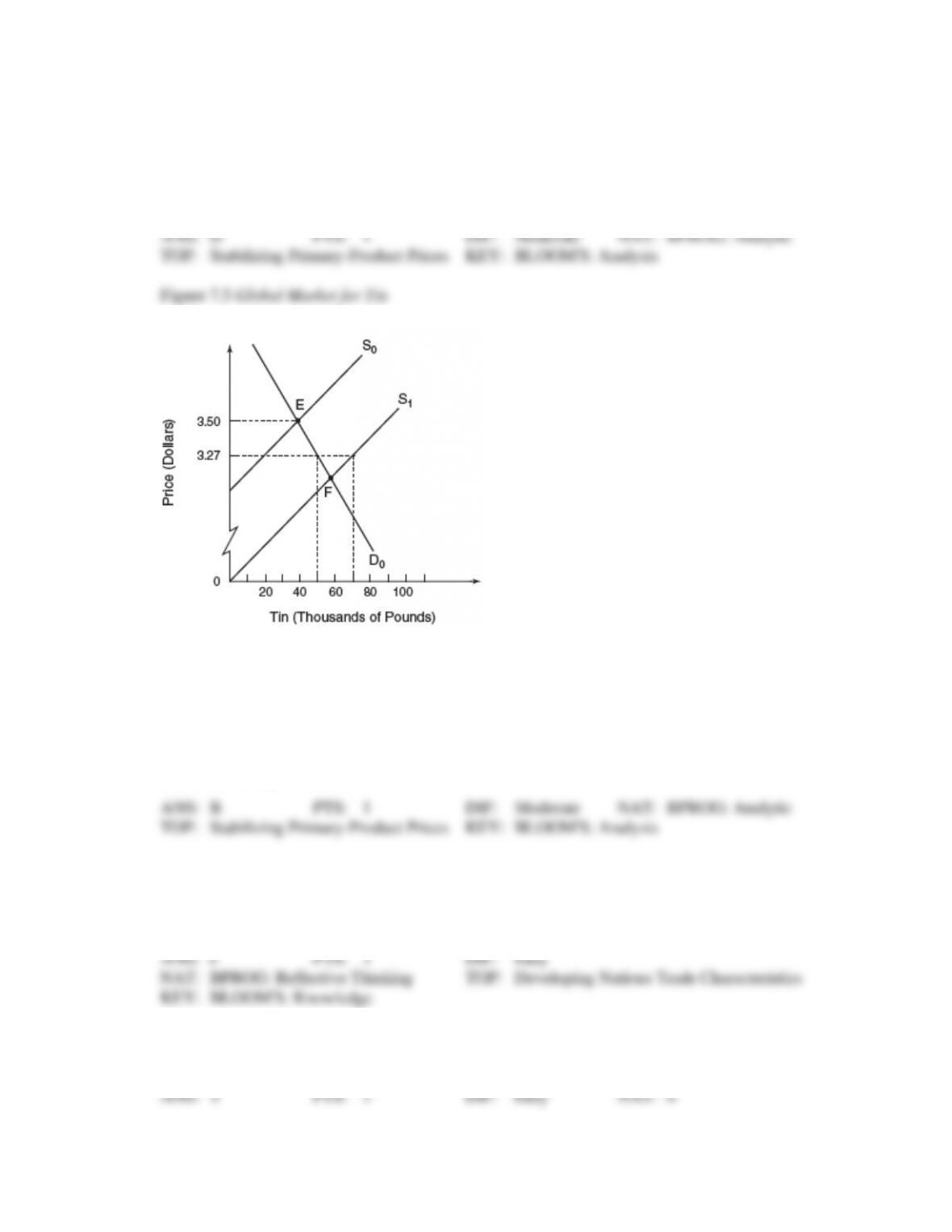
55. Consider the global market for tin represented by figure 7.4. Initially equilibrium is at point A with a
market price of $3.50 per pound and 50,000 pounds. In ordr to keep tin price relatively stable an
International Tin Agreement has set a price floor of $3.27 and a ceiling of $4.02. As the demand for
tin increases to D1 how will the buffer-stock manager need to respond?
a.
buy 10,000 pounds of tin
b.
buy 20,000 pounds of tin
c.
sell 10,000 pounds of tin
d.
sell 20,000 pounds of tin
56. Figure 7.5 represents the global market for tin. The initial equilibrium price and quantity is at point
A. As a result of an International Tin Agreement a price range of $3.27 – $4.02 is set. As the supply
of tin increases from S0 to S1, the buffer-stock manager will need to
a.
buy 10,000 pounds of tin
b.
buy 20,000 pounds of tin
c.
sell 10,000 pounds of tin
d.
sell 20,000 pounds of tin
TRUE/FALSE
1. The developing nations are most of those in Africa, Asia, North America, and Western Europe.
2. Most developing-nation exports go to industrial nations while most developing-nation imports
originate in industrial nations.
3. The majority of developing-nation exports are primary products such as agricultural goods and raw
materials; of the manufactured goods exported by developing nations, most are labor-intensive goods.
4. Developing nations overwhelmingly acknowledge that they have benefited from international trade
according to the principle of comparative advantage.
5. Among the economic problems facing developing countries have been low dependence on
primary-product exports, unstable export markets, and worsening terms of trade.
6. For developing countries, a key factor underlying the instability of primary-product prices and export
receipts is the high price elasticity of demand for products such as tin and copper.
7. Empirical research indicates that the demand and supply schedules for most primary products are
relatively inelastic to changes in price.
8. If the demand for coffee is price inelastic, an increase in the supply of coffee leads to falling prices and
rising sales revenues.
9. Not only do changes in demand induce relatively wide fluctuations in price when supply is inelastic,
but changes in supply induce relatively wide fluctuations in price when demand is inelastic.
10. Developing countries have complained that because their commodity terms of trade has deteriorated in
recent decades, they should receive preferential tariff treatment from industrialized countries.
11. To promote stability in commodity markets, International Commodity Agreements have utilized
production and export controls, buffer stocks, and multilateral contracts.
12. During periods of falling demand for coffee, an International Commodity Agreement could offset
downward pressure on price by implementing policies to increase the supply of coffee.
13. To prevent the market price of tin from rising above the target price, the manager of a buffer stock will
purchase excess supplies of tin from the market.
14. To prevent the market price of tin from falling below the target price, the manager of a buffer stock
would purchase any excess supply of tin that exists at the target price.
15. Prolonged defense of a price ceiling tends to increase the supply of a commodity held by a buffer stock
manager, thus putting downward pressure on price.
16. Rather than conduct massive stabilization operations, buffer stock officials will periodically revise
target prices should they move out of line with long-term price trends.
17. A multilateral contract stipulates the maximum price at which importing nations will purchase
guaranteed quantities from producing nations and the minimum price at which producing nations will
sell guaranteed amounts to importing nations.
18. It is widely agreed that import-substitution policies have been a main contributor to above-average
growth rates in developing countries.
19. Under the Generalized System of Preferences program, the major industrial countries agree to
temporarily reduce tariffs on designated imports from other industrial countries.
20. The “newly industrializing countries” of East Asia have emphasized the implementation of
import-substitution policies to insulate their industries from international competition.
21. In recent decades, the East Asian “newly industrializing countries” have pursued export-led growth
(outward orientation) as an industrialization strategy.
22. The purpose of a cartel is to support prices higher than would occur under more competitive
conditions, thus increasing the profits of cartel members.
23. A cartel tends to be most successful in maximizing the profits of its members when there are a large
number of producers in the cartel and these producers’ cost and demand conditions greatly differ from
each other.
24. When cartel members agree to restrict output to increase the price of their product, a single member of
the cartel has an economic incentive to violate the agreement by increasing its output so as to increase
profits.
25. Developing countries have often felt that it is easier to protect their manufacturers, via
import-substitution policies, against foreign competitors than to force industrial nations to reduce trade
restrictions on products exported by developing countries.
26. Import-substitution policies are supported by the fact that many developing countries have small
domestic markets and thus their producers enjoy the benefits of diseconomies of small-scale
production.
27. Export-led growth industrialization suffers a major problem: it depends on the willingness and ability
of foreign nations to absorb the goods exported by the country pursuing such a policy.
28. The so-called Four Tigers include Australia, South Korea, Taiwan, and Hong Kong.
29. By the 1990s, China had departed from a capitalistic economy and shifted to a Soviet-type economy
encompassing small-scale, labor-intensive industry.
30. During the late 1980s and early 1990s, China dismantled much of its centrally-planned economy and
permitted free enterprise to replace it.
31. In its transition toward capitalism, by the 1990s China permitted free enterprise as well as democracy
for its people.
32. Most of China’s manufactured exports have constituted labor-intensive goods.
33. In 1999 the United States revoked the normal-trade-relations (most-favored-nation) status it provided
China in retaliation for China’s suppression of human rights.
34. A multilateral contract specifies the maximum price at which exporting countries agree to sell a
product and the minimum price at which importing countries agree to buy a product.
35. As a profit-maximizing cartel, the Organization of Petroleum Exporting Countries would produce a
greater output and charge a lower price than what would occur in a competitive market.
36. The success of buffer stocks is limited by the fact that stockpiles of a product may be exhausted after
prolonged sales, while funds may be exhausted after prolonged purchases.
37. The United Nation Conference on Trade and Development in 1964 was successful in convincing
developing countries to switch from export-led industrialization to import-substitution
industrialization.
38. Under the Generalized System of Preferences program, the industrialized countries agree to maintain
lower tariffs on imports of natural resources and higher tariffs on imports of manufactured goods.
39. The replacement of imports of one nation with imports of another nation is known as “import
substitution.”
40. During periods of weak demand, the Organization of Petroleum Countries has implemented production
(export) quotas to ensure that excess oil supplies be kept off the market.
SHORT ANSWER
1. What are some major trade problems faced by developing nations?
2. Are economic downturns helpful to cartels?
ESSAY
1. What are some of the growth strategies that have been employed by the developing nations? How
successful are these strategies?
2. Describe the flying-geese pattern of economic growth? What countries have pursued this strategy?