1
CHAPTER 7
OFFER CURVES AND THE TERMS OF TRADE
B.
M
Mu
ul
lt
ti
ip
pl
le
e–
–C
Ch
ho
oi
ic
ce
e
Q
Qu
ue
es
st
ti
io
on
ns
s
10. The “income terms of trade” index would be calculated by which one of the following
formulas (where PX = price index of exports, PM = price index of imports, QX = quantity
index of exports, and QM = quantity index of imports)?
a. (PX/PM)100
11. In deriving an offer curve for a country, if a higher price of exports/price of imports leads
to a reduction in the quantity of exports which the country is willing to supply, then, in
this range of the offer curve, the offer curve is said to be __________.
d. inelastic, unit-elastic, or elastic – cannot be determined without more information
12. If country I is trading in the inelastic range of country II’s offer curve, then the
imposition of a tariff by country I, which still leaves country I in the inelastic range of
country II’s curve, will (assuming no retaliation) lead to __________ in country I’s terms
of trade and to __________ in the volume of imports of country I.
a. a deterioration; a decrease
13. In the following partially-completed table showing country I’s demand for import good Y
and supply of export good X at various terms of trade,
TOT Y demanded X supplied
4Y:1X 400Y 100X
3Y:1X v 120X
2Y:1X 300Y w
2
a. v = 40Y; w = 600X
14. In an offer curve graph with country A’s exports on the horizontal axis and country B’s
exports on the vertical axis, which one of the following events will shift or pivot country
A’s offer curve to the right?
a. the imposition of a tariff by country B
15. Suppose that country I is importing good Y and exporting good X. At a terms of trade of
1X:4Y, country I is willing to import 60 units of Y and to export 15 units of X in
exchange; at a terms of trade of 1X:5Y, country I is willing to import 70 units of Y and to
export 14 units of X in exchange. Considering just these two offer curve points, country
I’s demand for imports between the two points is __________.
a. elastic
16. In an offer curve graph with country A’s exports on the horizontal axis and country B’s
exports on the vertical axis, which one of the following events will shift or pivot country
B’s offer curve downward (or to the right)?
a. decreased demand by A for B-goods
17. International Monetary Fund data indicate that, with 2010 = 100.0, Thailand’s unit-value
index of exports (average price) for 2014 was 107.6 and Thailand’s unit-value index of
imports (average price) for 2014 was 104.8. Further, with 2010 = 100.0, the United
Kingdom’s unit-value index of exports for 2014 was 109.7 and the United Kingdom’s
unit-value index of imports for 2014 was 110.3. With this information, an economist
would say that, from 2010 to 2014, Thailand experienced __________ in its commodity
terms of trade and the United Kingdom __________ in its commodity terms of trade.
a. a deterioration; also experienced a deterioration
3
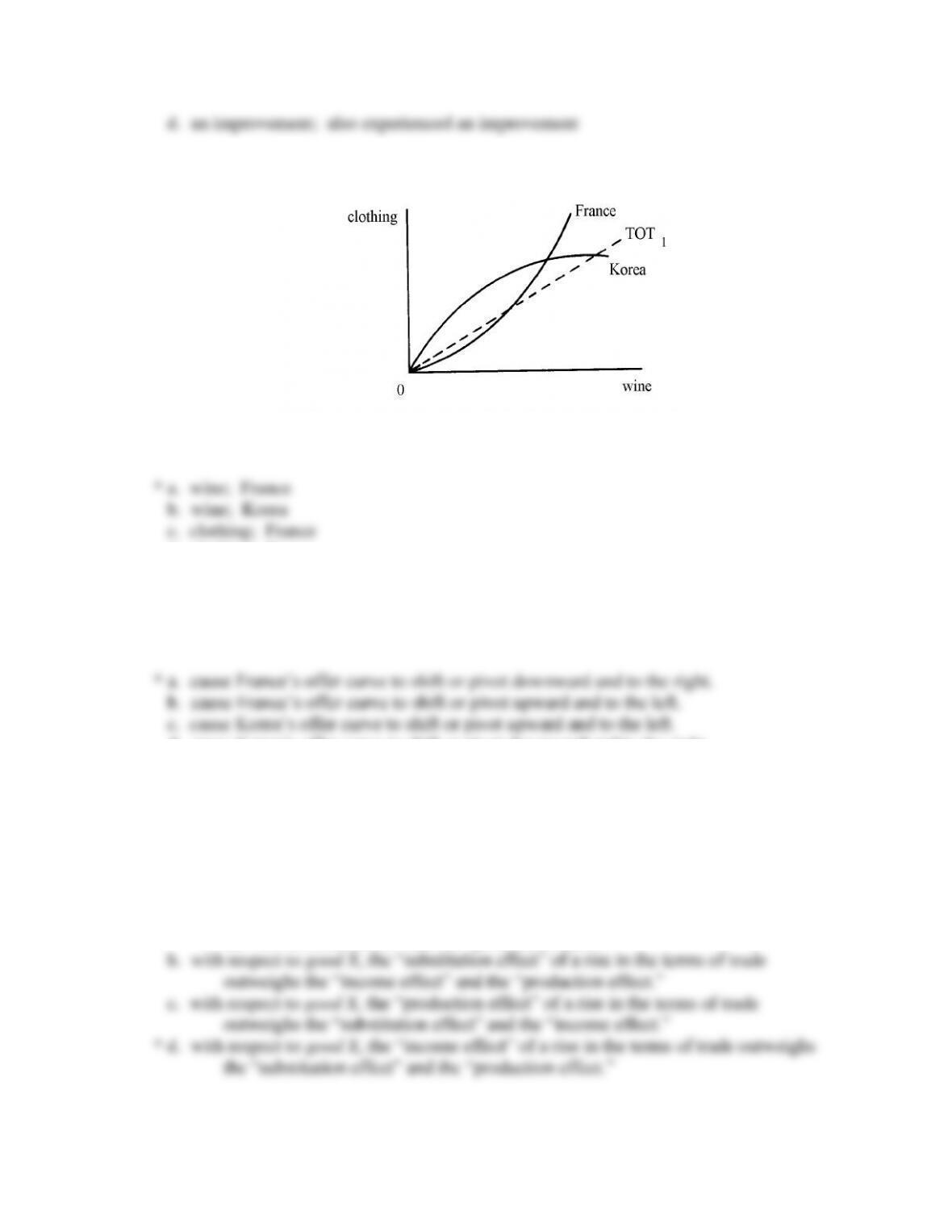
18. In the following offer curve diagram,
at TOT1, there is excess demand for __________, and the movement to equilibrium will
result in better terms of trade for __________.
d. clothing; Korea
19. In the graph in Question #18 above, suppose that, when trade is taking place at the
equilibrium position, consumers in France now change tastes and shift their demand more
toward clothing and away from wine. This change in tastes would
d. cause Korea’s offer curve to shift or pivot downward and to the right.
20. Suppose that a country is exporting good X and importing good Y. Suppose also that, in
a particular range of the country’s offer curve, a rise in the relative price of X causes the
country to export less of X and to import more of Y. Then, in this range,
a. with respect to good Y, the “income effect” of a rise in the terms of trade outweighs
the “substitution effect” and the “production effect.”
4
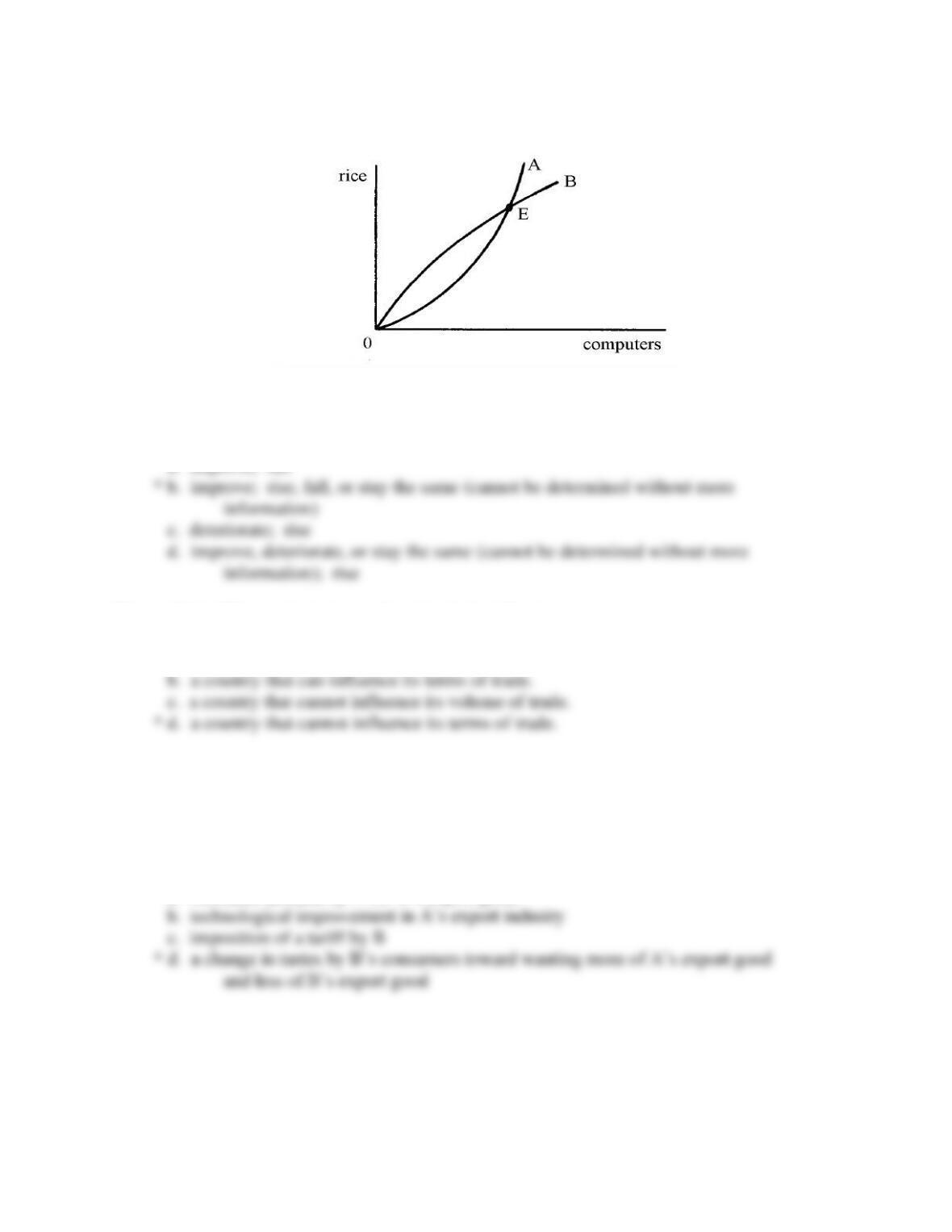
21. In the following offer curve diagram,
if, starting from the initial equilibrium point E, countries A and B both increase their
demand for computers, then country A’s terms of trade will __________ and the volume
of A’s exports will __________.
a. improve; fall
22. A “small” country in international trade is defined as
a. a country that can influence its volume of trade.
23. In an offer curve diagram with country A’s export good (country B’s import good) on the
horizontal axis and country B’s export good (country A’s import good) on the vertical
axis, which one of the following events will shift or pivot country B’s offer curve upward
(or to the left)?
a. increased demand by A for B’s export good
24. Suppose that country I is importing good Y and exporting good X. At a terms of trade of
1X:4Y, country I is willing to import 60 units of Y and to export 15 units of X in
exchange; at a terms of trade of 1X:5Y, country I is willing to import 75 units of Y and to
export 15 units of X in exchange. Considering just these two offer curve points, country
5
I’s demand for imports between the two points is __________.
a. elastic
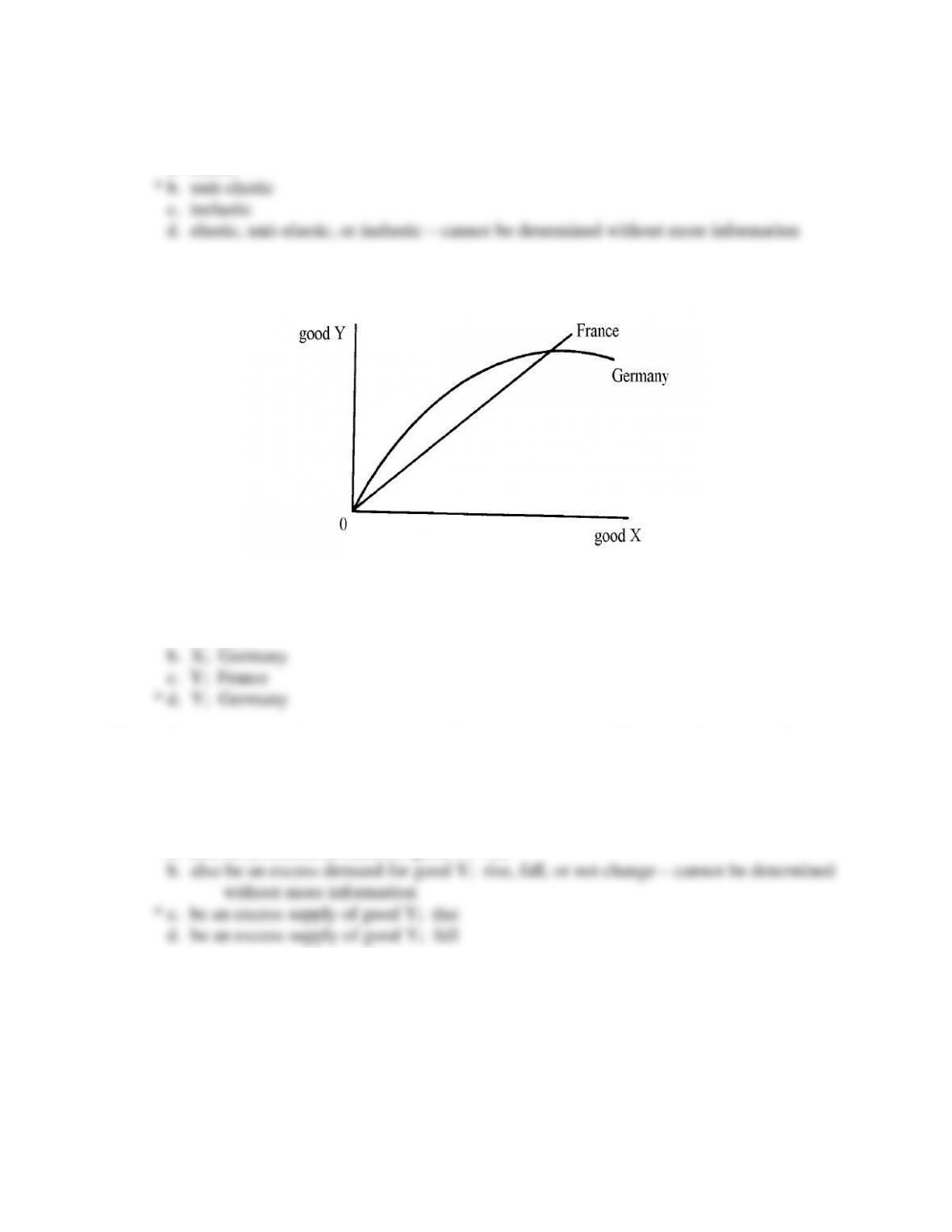
25. In the following offer curve diagram, showing one normally-shaped offer curve and one
straight-line offer curve,
Germany is exporting good __________, and __________ is a “small country” in this
particular situation.
a. X; France
26. In a two-commodity, two-country trading world (as in the offer curve diagrams), if, at a
given terms of trade (price of good X ÷ price of good Y), there is an excess demand for
good X, then there must __________ and the price of good X relative to the price of good
Y will therefore __________.
a. also be an excess demand for good Y; rise
27. International Monetary Fund data indicate that, with 2005 = 100.0, Sweden’s export price
index in 2011 was 129.7, its import price index in 2011 was 133.3, its export quantity
index in 2011 was 115.9, and its import quantity index in 2011 was 129.0. Given this
information, a calculation of Sweden’s “income” terms of trade for 2011 would give a
result of __________.
6
a. 87.4
28. Suppose that country I is importing good Y and exporting good X. At a terms of trade of
1X:3Y, country I is willing to import 90 units of Y and to export 30 units of X in
exchange; at a terms of trade of 1X:4Y, country I is willing to import 128 units of Y and
to export 32 units of X in exchange. Considering just these two offer curve points,
country I’s demand for imports over the range between these two points is __________.
a. inelastic