60. The most important determinants of sanctions include
a.
Cultural factors including nationalistic attitudes
b.
Strength of political opposition in the targeting nation
c.
The number of nations imposing sanctions
d.
All of the above
61. Industrial policies
a.
Require formal explicit efforts by governments
b.
May be implicit
c.
Have never been used by the U.S. government
d.
Both a and b
62. Trade adjustment assistance policies
a.
Can resolve all workers’ challenges to free trade
b.
Attempt to share gains from free trade with disadvantaged workers
c.
Have never been used to sustain a losing business concern
d.
Are financed by state and local tax revenues
63. The United States
a.
Has been a heavy user of antidumping laws to protect domestic producers
b.
Has rarely used antidumping laws to protect domestic producers
c.
Has targeted antidumping action against China, Japan, Canada, Italy, and Germany
d.
Both a and c
Figure 6.4 Japanese Market for Jetliners
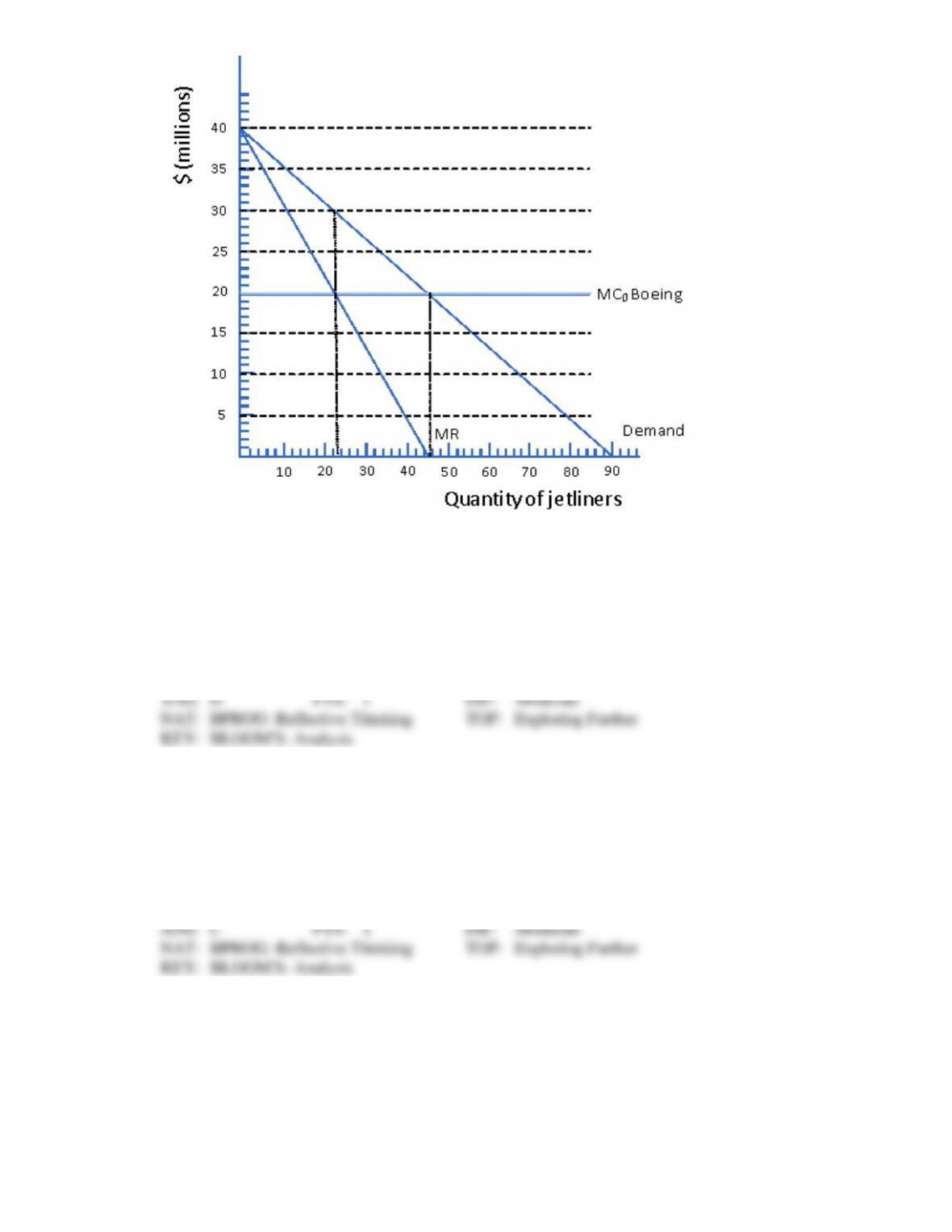
64. Consider the Japanese market for jetliners as depicted in Figure 6.4. Suppose lone producer of
jetliners in the world is Boeing and Boeing faces a constant marginal cost of $20 million per jetliner.
What price will Boeing charge for jetliners in the Japanese market and how many will they sell?
a.
$20 million, 23
b.
$20 million, 46
c.
$30 million, 46
d.
$30 million, 23
65. Consider the Japanese market for jetliners as depicted in Figure 6.4. Suppose lone producer of
jetliners in the world is Boeing and Boeing faces a constant marginal cost of $20 million per jetliner.
How much profit will boeing make?
a.
0
b.
$150 million
c.
$230 million
d.
$250 million
66. Consider the Japanese market for jetliners as depicted in Figure 6.4. Suppose lone producer of
jetliners in the world is Boeing and Boeing faces a constant marginal cost of $20 million per jetliner.
How much consumer surplus will the Japanese airlines who purchase the jetliners earn from their
transactions with Boeing?
a.
0
b.
$115 million
c.
$230 million
d.
$250 million
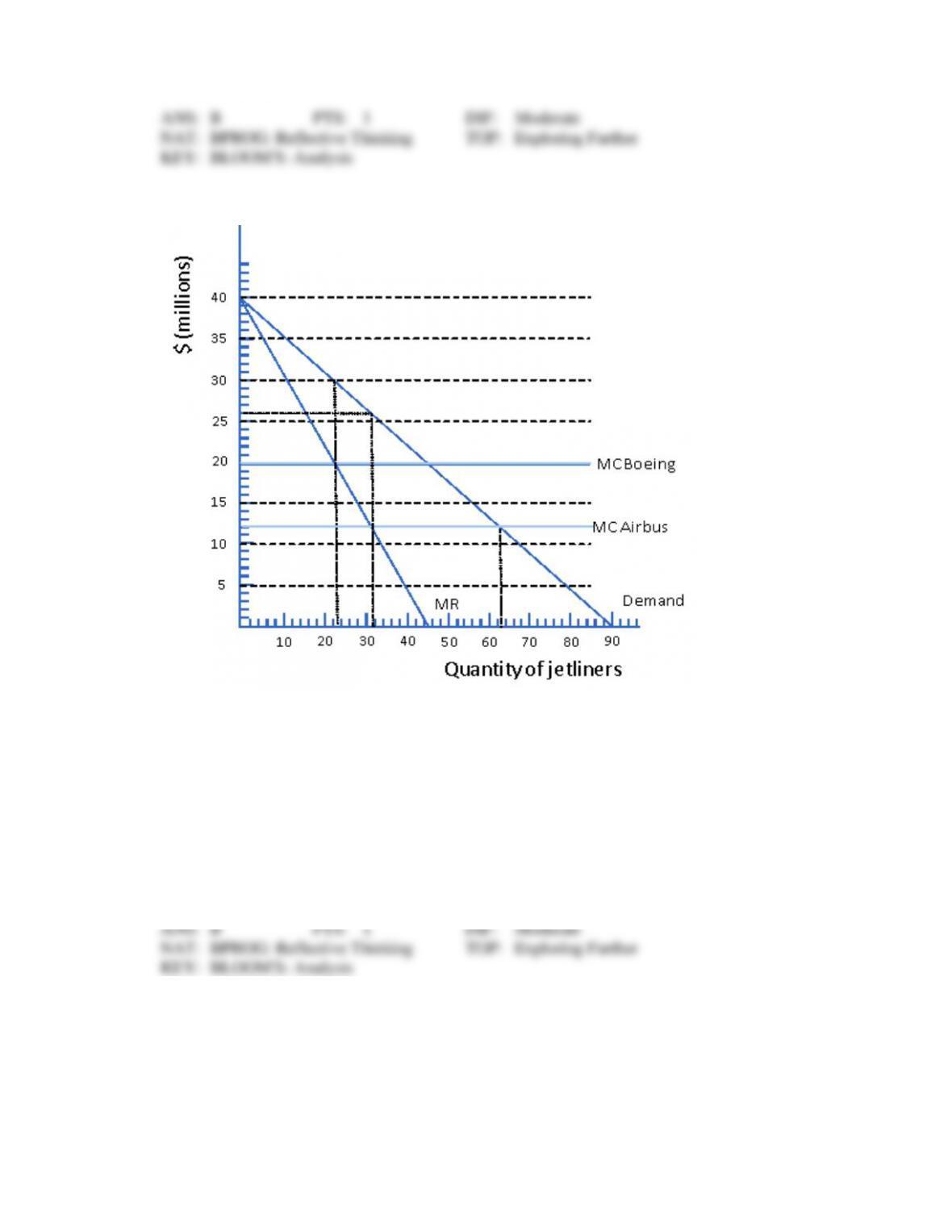
Figure 6.5 Japanese Market for Jetliners
67. Consider the Japanese market for jetliners as depicted in Figure 6.5. Suppose lone producer of
jetliners in the world is Boeing and Boeing faces a constant marginal cost of $20 million per jetliner
but now a European manufacturer, Airbus, begins production. Airbus faces the same marginal cost as
Boeing but the European government provides Airbus with a subsidy of $8 million per jetliner
produced. As a result of the competition, Boeing leaves the Japanese market leaving Airbus as a
monopoly. How many jetlines will airbus produce and what price will they sell them for?
a.
23, $30 million
b.
32, $26 million
c.
23, $26 million
d.
32, $30 million
68. Consider the Japanese market for jetliners as depicted in Figure 6.5. Suppose lone producer of
jetliners in the world is Boeing and Boeing faces a constant marginal cost of $20 million per jetliner
but now a European manufacturer, Airbus, begins production. Airbus faces the same marginal cost as
Boeing but the European government provides Airbus with a subsidy of $8 million per jetliner
produced. As a result of the competition, Boeing leaves the Japanese market leaving Airbus as a
monopoly. How much profit will Airbus earn?
a.
$230 million
b.
$350 million
c.
$416 million
d.
$450 million
69. Consider the Japanese market for jetliners as depicted in Figure 6.5. Suppose lone producer of
jetliners in the world is Boeing and Boeing faces a constant marginal cost of $20 million per jetliner
but now a European manufacturer, Airbus, begins production. Airbus faces the same marginal cost as
Boeing but the European government provides Airbus with a subsidy of $8 million per jetliner
produced. As a result of the competition, Boeing leaves the Japanese market leaving Airbus as a
monopoly. As a result of the entery of the subsidized producer what will happen to the consumer
surplus gained by Japanese airlines from buying jetliners?
a.
decrease by $109 million
b.
nothing
c.
increase by $50 million
d.
increase by $109 million
TRUE/FALSE
1. The high point of U.S. protectionism occurred with the passage of the Kennedy Act in the 1960s.
2. With the passage of the Smoot-Hawley Act in 1930, U.S. average tariffs were raised to over 50 percent
on protected imports.
3. Proponents of the Smoot-Hawley Act of 1930 viewed it as a means of combating domestic
unemployment.
4. It is generally agreed that the Smoot-Hawley Act of 1930 led to improvements in U.S. exports and an
overall increase in U.S. output and employment.
5. According to the Reciprocal Trade Agreements Act of 1934, the President could lower tariffs by up to
10 percent of the existing level without congressional approval.
6. Under the normal-trade-relations (most-favored-nation) principle, two nations agree to apply tariffs to
each other at rates as low as those applied to any other nation.
7. According to the normal-trade-relations (most-favored-nation) principle, if the United States extends
MFN treatment to China and then grants a low tariff on imports of shirts from South Korea, the United
States is obligated to provide the identical low-tariff on imports of shirts from China.
8. U.S. tariffs on imports from countries issued normal-trade-relations (most-favored-nation) status are
often three or four times as high as those on comparable imports from nations not receiving that status.
9. According to the General Agreement on Tariffs and Trade and its successor, the World Trade
Organization, only bilateral trade negotiations can take place between a country and its trading
partners.
10. Members of the General Agreement on Tariffs and Trade and its successor, the World Trade
Organization, agree to the principle of nondiscrimination in trade and the reduction of trade barriers by
multilateral negotiations.
11. The Uruguay Round of trade negotiations resulted in the General Agreement on Tariffs and Trade
being succeeded by the World Trade Organization.
12. The only members of the General Agreement on Tariffs and Trade and its successor, the World Trade
Organization, are developing countries rather than developed countries.
13. According to the fast-track provision of U.S. trade law, once the President has completed trade
negotiations, their outcome is subject to a vote (without amendment) in Congress within 90 legislative
days of submission.
14. The fast-track provision of U.S. trade law has the affect of speeding up the timetable during which the
President negotiates trade agreements with foreign governments.
15. The main focus of the Uruguay Round of multilateral trade negotiations was on tariff barriers rather
than nontariff trade barriers.
16. Although the Uruguay Round of multilateral trade negotiations succeeded in reducing nontariff trade
barriers, it could not achieve reductions in tariff trade barriers.
17. Among the codes of conduct addressed at the Tokyo Round of multilateral trade negotiations were
customs valuation, product standards, subsidies and countervailing duties, government procurement
policies, and import licensing procedures.
18. Under the government procurement policy of the World Trade Organization, federal-state-local
governments are prevented from discriminating in favor of the products of domestic suppliers on
contracts valued at $1 million and more.
19. Unlike the Tokyo Round of multilateral trade negotiations, the Uruguay Round addressed the issues of
intellectual property protection, trade barriers in services, and agricultural subsidies.
20. The U.S. trade-remedy laws attempt to redress hardships for U.S. firms resulting from actions and
policies of foreign firms and governments.
21. According to U.S. trade law, the escape clause provides relief to U.S. firms due to unfair foreign
competition.
22. According to the escape clause, temporary trade restrictions may be imposed in industries where
domestic producers are substantially being harmed by surging imports.
23. The purpose of “countervailing duties,” as levied by the domestic government, is to neutralize import
tariffs imposed by foreign governments.
24. Under the provisions of the World Trade Organization, Canada would have the right to impose
countervailing duties on imports of South Korean steel when the South Korean government provides
export subsidies to its steelmakers.
25. Economic theory suggests that if France is a net importer of automobiles, whose production is
subsidized by the Korean government, the overall welfare of France decreases because of the Korean
subsidy.
26. An antidumping duty levied on imports of foreign-produced steel leads to an increase in consumer
surplus in the home country.
27. U.S. antidumping duties are intended to neutralize exports to the United States at prices below average
total cost or exports to the United States at prices lower than those charged in the exporter’s home
market.
28. Intellectual property refers to holdings of rare books and pieces of art that are traded on the world
market.
29. Copyrights, trademarks, and patents are used to protect the intellectual property of a nation from
foreign imitators.
30. Under the trade adjustment assistance program, a domestic firm or worker can file for governmental
assistance only if it demonstrates that it suffered economic hardship due to imports of
foreign-subsidized goods.
31. Industrial policy attempts to foster the development of industries that offer long-run comparative
disadvantages and which are insulated from other sectors of the economy.
32. During the post World War II era, the United States has adopted explicit industrial policies similar to
those of France and Japan.
33. Industrial policies of the U.S. government have included subsidizing particular firms to promote
national champions, nationalizing basic industries, and encouraging cartelization of industries.
34. The Export-Import Bank provides export-credit subsidies to U.S. producers of agricultural goods.
35. Major beneficiaries of export-credit subsidies, granted by the Export-Import Bank, have included U.S.
producers of aircraft, telecommunications, and power-generating equipment.
36. The Commodity Credit Corporation makes available export credit financing for U.S. agricultural
exports.
37. As a way of helping U.S. business firms trade in the world market on a more equal terms with their
organized foreign competitors, the U.S. government permits them to form export trade associations
and export trading companies.
38. If the U.S. government pursued a “knowledge-based growth policy,” it would subsidize particular
firms to help them compete in the world economy.
39. In the post World War II era, the Japanese government formed industrial policies to encourage the
development of its steel, auto, shipbuilding, and machine tool industries.
40. Unlike Japan and the United States, France has refrained from forming explicit industrial policies to
enhance the competitiveness of its national champions.
41. According to the strategic- trade- policy hypothesis, governmental subsidies granted to domestic
producers can help them in capturing economic profits from foreign competitors.
42. The strategic-trade-policy hypothesis assumes that domestic firms operate under increasing cost
conditions as well as in perfectly competitive markets.
43. According to the strategic-trade-policy hypothesis, government can alter the terms of competition to
favor domestic companies, thus increasing their profits at the expense of their rivals.
44. The classical theory of comparative advantage assumes that firms operate in imperfectly competitive
markets, while the theory of strategic trade policy assumes that firms operate in perfectly competitive
markets.
45. According to the strategic-trade-policy hypothesis, a subsidy granted to domestic exporters may lead
to increased export profits which more than offset the cost of the subsidy to domestic taxpayers.
46. By reducing available supplies of a product, an export embargo leads to falling prices in the target
nation and increasing target-nation consumer surplus.
47. Assume that the United States is the only supplier of grain to China and that it levies a partial export
embargo against China. The embargo leads to increased U.S. welfare if the resulting improvement in
the U.S. terms of trade with China more than offset the costs of the lower export volume to China.
48. Economic sanctions are most effective in pressuring the target country to modify its behavior when the
sanctions are imposed by a small number of countries and when the target country had weak economic
ties to the imposing countries before the sanctions were initiated.
49. It is widely recognized that the economic sanctions levied against Iraq in 1990 were a major factor
causing Iraq to withdraw its military forces from Kuwait.
50. Assume that Russia has a comparative advantage in vodka. If the United States extends Russia the
benefits of the normal-trade-relations (most favored nation)principle, U.S. consumer surplus decreases
in the vodka market.
51. Assume that the United States imports chemicals from Germany. Trade theory predicts that if the
German government grants an export subsidy to its chemical firms, the overall welfare of the United
States will increase.
52. Concerning industrial policy, the United States has nationalized its major industries in an attempt to
promote global champions.
53. The Uruguay Round of multilateral trade negotiations succeeded in establishing the World Trade
Organization.
54. Established in 1995, the World Trade Organization took charge of administering the new global trade
rules agreed in the Uruguay Round of multilateral trade negotiations.
55. The World Trade Organization brings into the multilateral trading system manufactured goods and
agricultural products, but not trade in services, intellectual property protection, and investment.
56. The General Agreement on Tariffs and Trade was founded in 1995 as a successor to the World Trade
Organization.
SHORT ANSWER
1. What is the essential idea behind strategic trade policy?
2. What is the basis for trade adjustment assistance?
ESSAY
1. Has industrial policy contributed significantly to Japan’s economic growth?
2. Explain how advocates of strategic trade policy differ from the classical free traders in their treatment
of externalities?