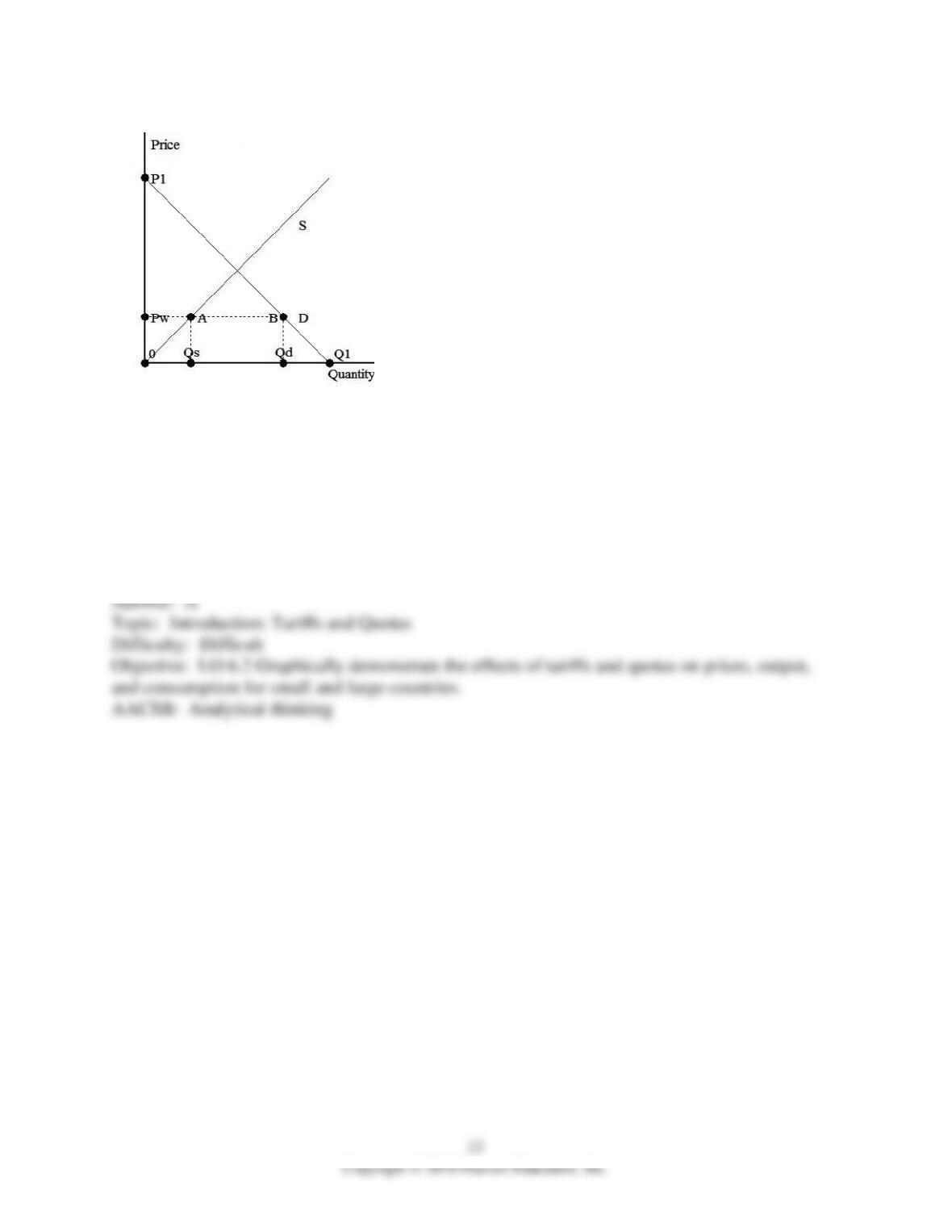
29)
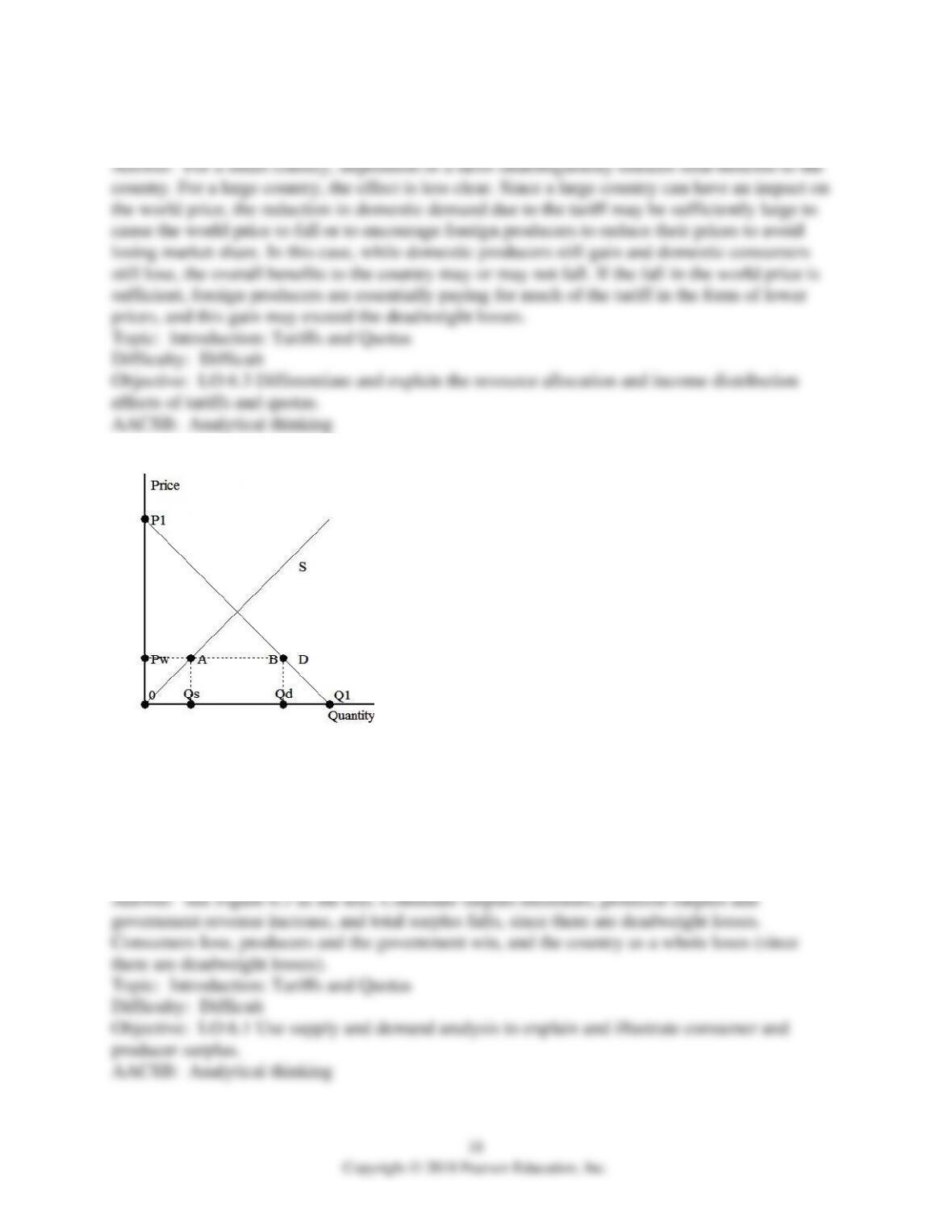
The graph above shows domestic supply and demand with trade in a SMALL country. With
trade, this country can purchase at the world price, Pw.
Suppose that this country imposes a $5 per unit tariff on this good. Which of the following is
true?
A) The domestic price will rise by $5.
B) Consumers will be better off.
C) There will not be deadweight losses due to this tariff, since it is a small country.
D) Producers will not increase domestic production.
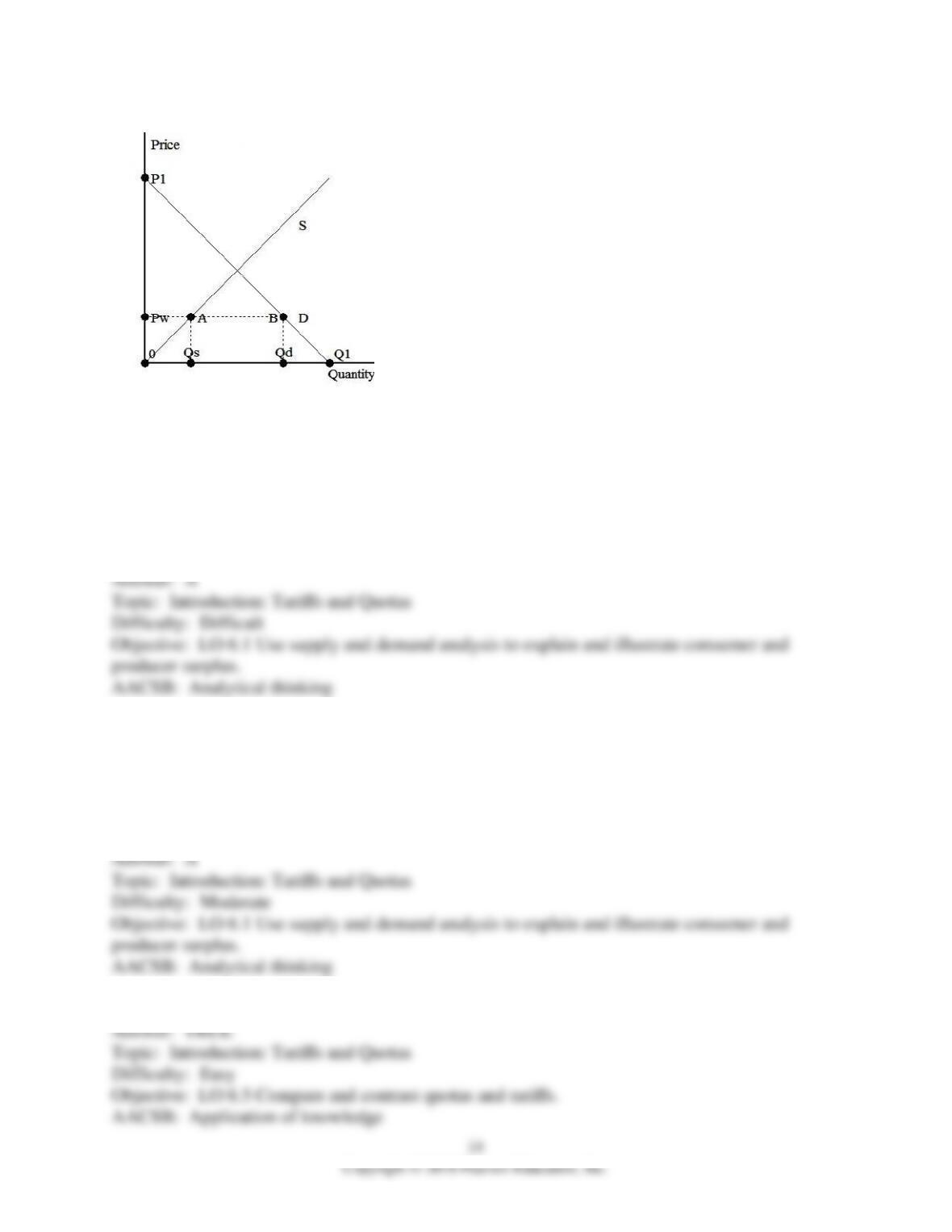
30)
The graph above shows domestic supply and demand with trade. With trade, this country can
purchase at the world price, Pw.
Which of the following areas represents producer surplus with trade?
A) Pw-A-0
B) Pw-B-Qd-0
C) P1-B-Pw
D) P1-B-A-0
31) Relative to the domestic market without trade, when the country is able to import from
abroad at a price less than the domestic price, which of the following will NOT occur?
A) The country will be worse off.
B) CS + PS will increase.
C) Producer surplus will decrease.
D) Consumer surplus will increase.
32) Nontariff barriers to trade are less transparent than tariffs.
33) If the effective rate of protection is greater than the nominal rate of protection, there must be
tariffs on intermediate products.
34) Since the mid-1980s, tariff rates in most nations have risen.
35) Tariff revenue is an important source of operating revenue for many governments of high
income countries.
36) Deadweight losses are the only potential cost associated with tariffs, which is why they are
preferred to quotas.
37) The rules for respecting property rights as they relate to trade were negotiated during the
Uruguay Round (1986-1994) and culminated in the Trade-Related Aspects of Intellectual
Property Rights (TRIPS) agreement.
38) How is the Agreement on Textiles and Clothing impacting trade today?
39) Why is the Doha Round called the Doha Development Round?
40) What has been the most significant obstacle to progress in the Doha Round?
41) What are some of the long-run costs of tariffs?
42) Developing countries have identified which key issues as important to them in current trade
talks?
43) What do developing countries want regarding agriculture in the Doha Round?
44) Draw a graph showing the effects of imposing a tariff in the small country case. Describe the
results, using the concepts of producer surplus, consumer surplus and deadweight loss.
Specifically address the effects on consumers, producers, government revenue and overall
national well-being, connecting those effects to areas of your graph.
45) Carefully explain why tariffs create deadweight losses.
46) Carefully explain how the imposition of a tariff is different for a large country (that can
affect the world price) than a small country.
47)
The graph above shows a small country that can import at the world price of Pw. Suppose that
the government imposes a tariff of $T per unit (and suppose that this does not raise the domestic
price so much that there will be no trade.
Use the graph above to illustrate the effects of the tariff. Show the new areas of consumer
surplus, producer surplus, and government revenue, and the deadweight losses due to the tariff.
Who wins and who loses from the tariff?
6.2 Analysis of Quotas
1) In which way are tariffs different from quotas?
A) They reduce the volume of imported products.
B) They raise the price of the imported products to consumers.
C) They increase the domestic quantity supplied of the product.
D) They raise government revenue.
2) In the case of a small country, consumer surplus
A) decreases less with a tariff than with an equivalent quota.
B) decreases less with a quota than with an equivalent tariff.
C) decreases the same with tariffs and equivalent quotas.
D) increases more with quotas.
3) Which of the following is NOT an expected benefit of reducing nontariff barriers to trade?
A) Fewer firms to compete with
B) Lower prices for many goods
C) Increase in the volume of exports and imports
D) Improved overall economic welfare
4) In economic terms, tariffs are preferred to quotas because
A) domestic manufacturers gain more producer surplus.
B) there is less loss of consumer surplus.
C) quotas create a greater production inefficiency.
D) given the way quotas are usually administered, tariffs cause a smaller net national welfare
loss.
5) A real cost of tariffs and quotas that is difficult to measure is that they
A) encourage rent seeking.
B) shift income from consumers to producers.
C) limit the quantity of imports.
D) reduce wages.
6) Which of the following is FALSE?
A) At the end of the twentieth century, more and more traded goods and services incorporated
specialized knowledge and unique ideas.
B) Pharmaceuticals, computer hardware, telecommunications equipment, and other high
technology products are valuable because of the innovation and research they incorporate.
C) Developing countries usually strongly advocate the protection of intellectual property rights.
D) The protection given to creators and innovators varied greatly internationally until
standardization began with the signing of the TRIPs agreement.
7) Which type of restriction on quantity of imports is the most transparent?
A) Quota
B) Licensing requirements
C) Voluntary export restraints
D) Government procurement policies
8) In the case of a small country, producer surplus
A) increases more with a tariff than with an equivalent quota.
B) increases more with a quota than with an equivalent tariff.
C) is not changed by tariffs or quotas.
D) increases the same amount with tariffs and equivalent quotas.
9) Both tariffs and quotas lead to a decrease in imports, a decrease in domestic consumption, and
an increase in domestic production.
10) Over time, quotas usually lead to larger deadweight losses than tariffs.
11) Nontariff measures are generally much more difficult to eliminate than tariffs and quotas
because they are embedded more deeply in national economic policies.
12) An increase in domestic demand for a product protected by a quota results in an increase in
producer surplus for domestic firms, while for a tariff it would result in more imports.
13) Intellectual property rights protection is a critical issue for the pharmaceutical industry
among others.
14) Internationally, the TRIPS agreement is uniformly regarded as a positive step for world
prosperity.
15) What are the three major types of quotas?
16) When did intellectual property rights become part of trade agreements?
17) What is the name of the agreement related to intellectual property rights?
18) Give an example of an industry that would seek intellectual property rights protection
because its product incorporates innovation and research.
19) What is Joseph Stiglitz’s main criticism regarding intellectual property rights protection?
20) Give an example of a nontariff measure that could reduce the quantity of imports or exports.
23
21) If politicians decide to proceed with protection, why might economists prefer tariffs to
quotas? Explain at least three reasons.
22) Describe intellectual property rights. What agreements have been reached regarding their
protection? What are the benefits and the costs of protecting intellectual property rights?
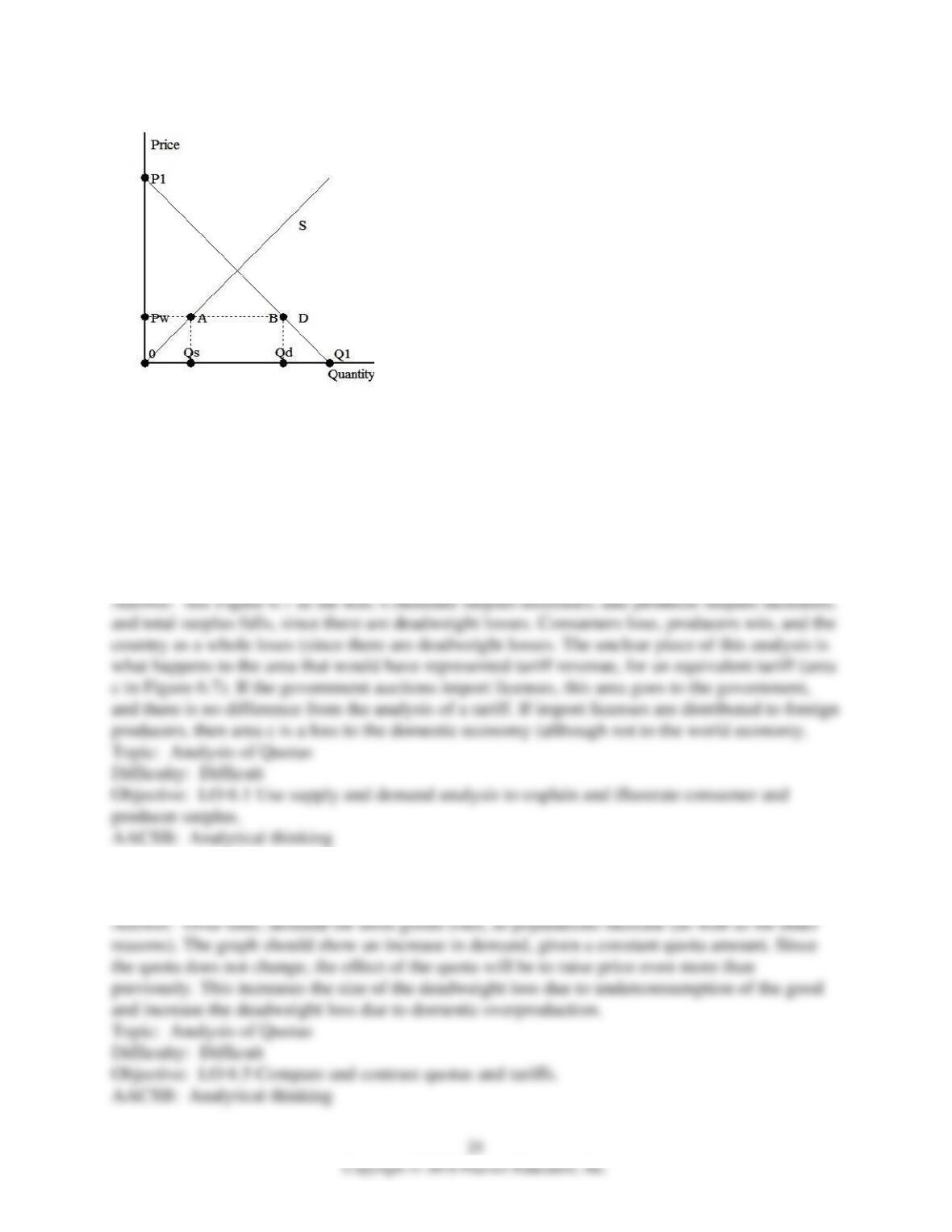
23)
The graph above shows a small country that can import at the world price of Pw and currently
imports (Qd-Qs). Suppose that the government imposes quota of 80% of the current import
amount (and suppose that this does not raise the domestic price so much that there will be no
trade).
Use the graph above to illustrate the effects of the quota. Show the new areas of consumer
surplus, producer surplus, and any other relevant areas, and the deadweight losses due to the
quota. Who wins and who loses from the tariff?
24) Use a graph to demonstrate why quotas are likely to cause increased deadweight losses over
time.