1
CHAPTER 6
GAINS FROM TRADE IN NEOCLASSICAL THEORY
B.
M
Mu
ul
lt
ti
ip
pl
le
e–
–C
Ch
ho
oi
ic
ce
e
Q
Qu
ue
es
st
ti
io
on
ns
s
11. If country A’s (PX/PY) in autarky is greater than the (PX/PY) on the world market, then, as
the country moves from autarky to trade, the relative price of good X facing A’s
producers will __________, and A’s producers will hence want to shift their production
toward producing __________.
a. decrease; more of good X and less of good Y
12. Which of the following does not contribute to a basis for trade between two countries?
a. different tastes and preferences
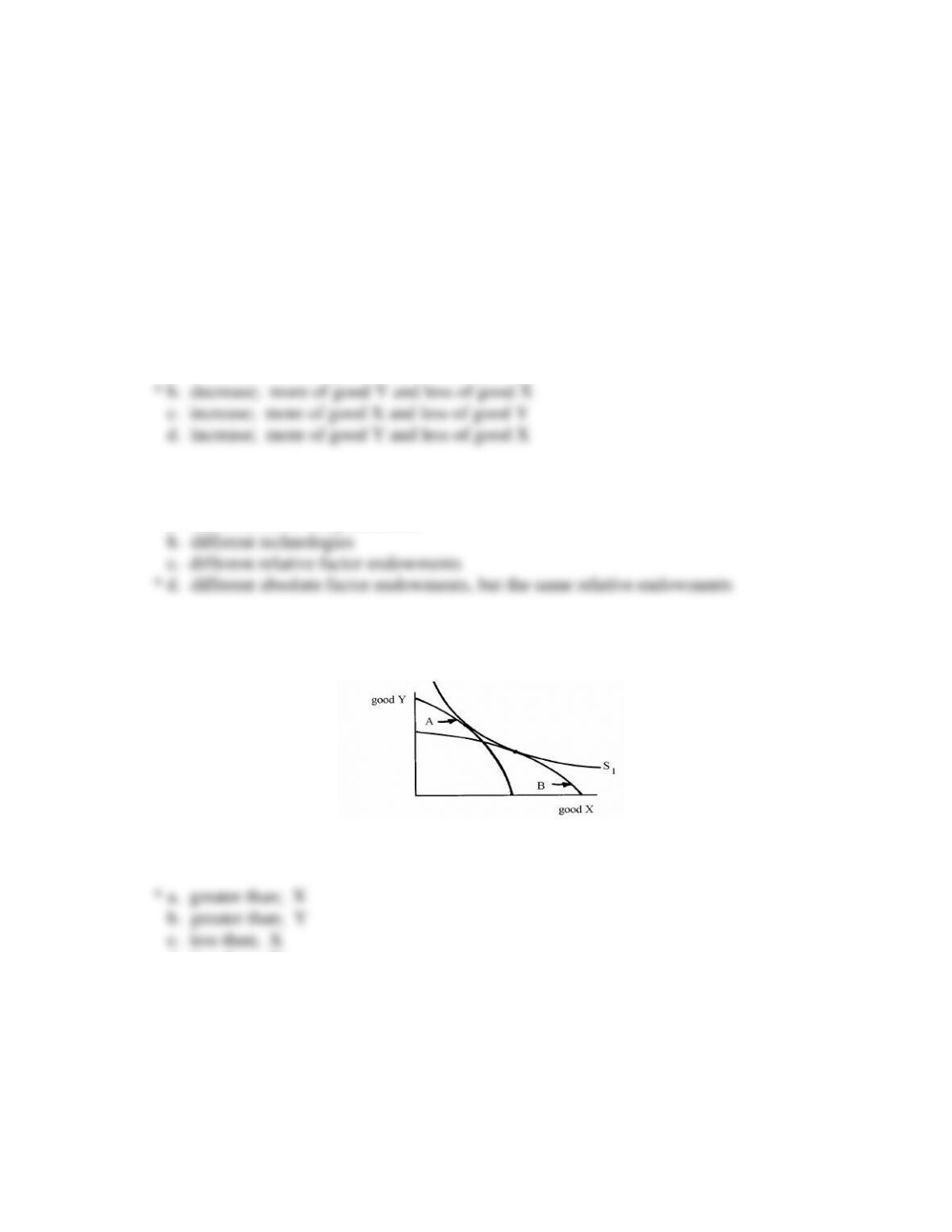
13. Given the following graph showing production-possibilities frontiers for country A and
country B in a situation where both countries are on the same community indifference
curve S1 in autarky:
Prior to trade, PX/PY in country A is __________ PX/PY in country B, and, when trade
begins, country A will import good __________.
d. less than; Y
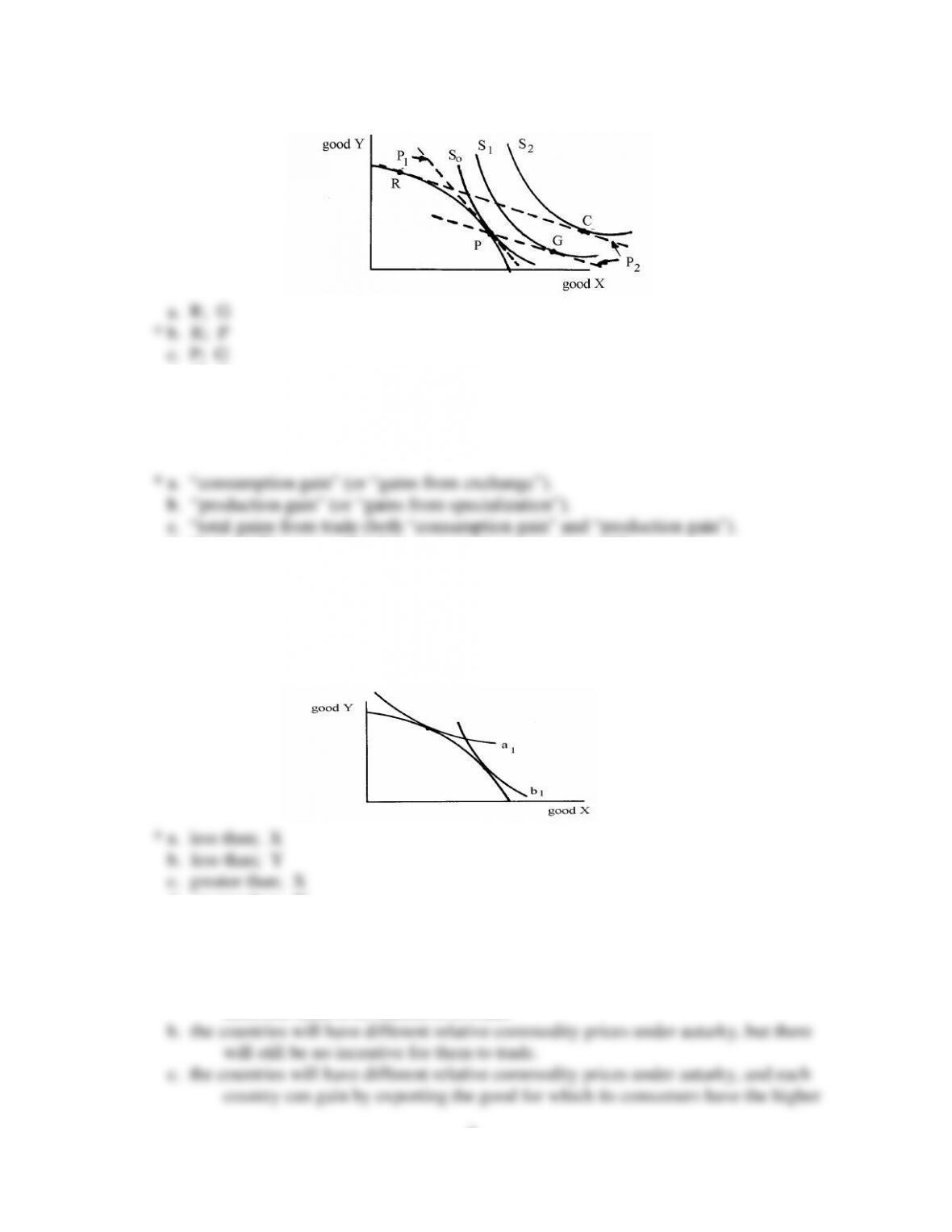
14. Given the production-possibilities-frontier/community-indifference-curve diagram below,
where P is the autarky production point, C is the free trade consumption point, P1
represents autarky prices, and P2 represents free-trade prices, the free-trade production
point is __________ and the autarky consumption point is __________.
2
d. G; P
15. In the diagram in Question #14 above, as the country moves from autarky to free trade,
the difference between the S0 and S1 satisfaction levels is called the
d. “lost tariff revenue effect” from removing protective tariffs.
16. In the following graph showing indifference curves for country A (a1) and for country B
(b1) in a situation where both countries have the same production-possibilities frontier, in
autarky, PX/PY in country A is __________ PX/PY in country B, and, if trade begins,
country A will export good __________.
d. greater than; Y
17. If two countries with increasing opportunity costs have identical PPFs but different tastes,
a. the countries will have identical relative commodity prices under autarky, and
therefore there is no incentive to trade.
3
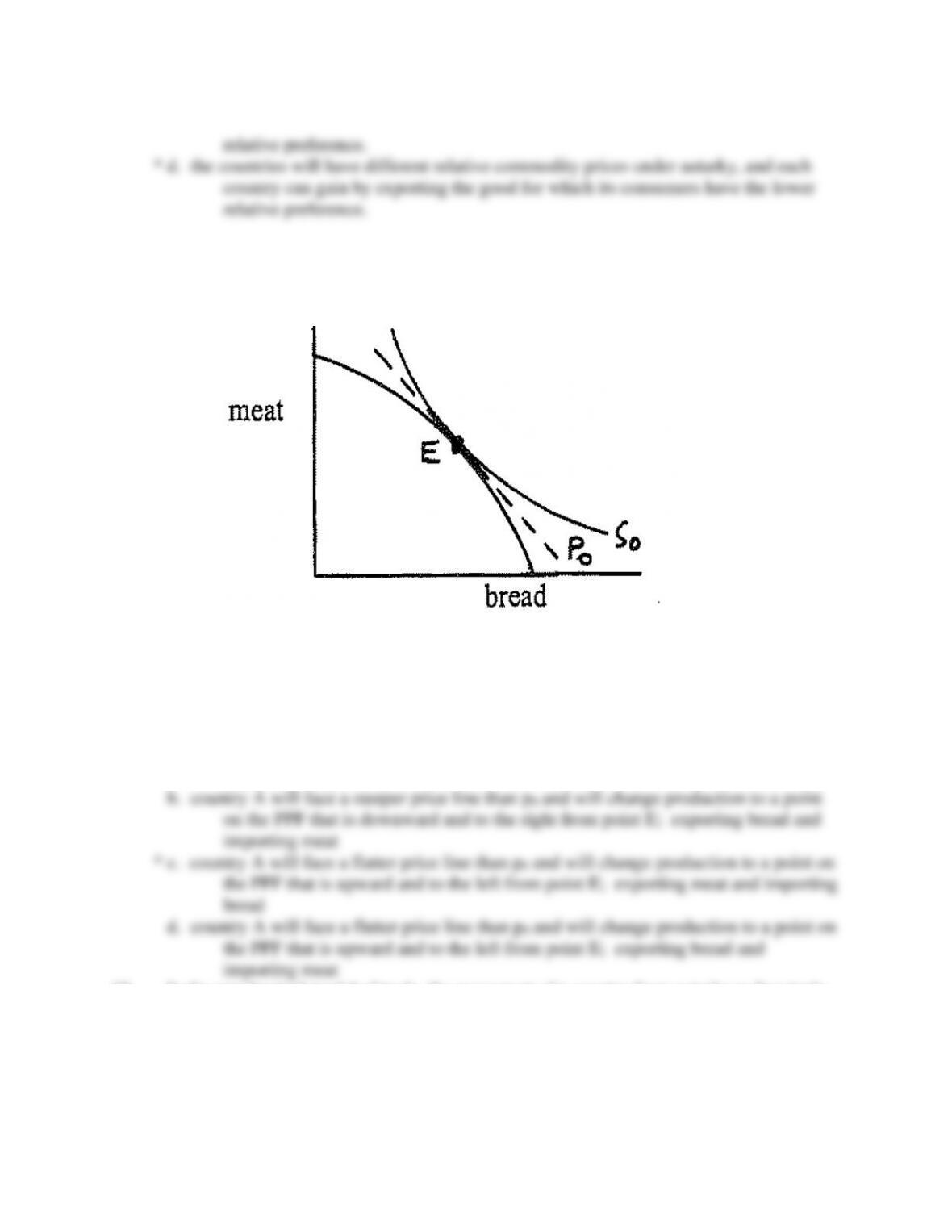
18. Given the diagram below, which shows country A in its autarky position at point E
[where the price line labeled p0 is tangent to both country A’s production-possibilities
frontier (PPF) and country A’s indifference curve S0]:
If country A now is opened to international trade in a situation where the price of bread
relative to the price of meat is lower on the world market than it is in A’s autarky
position, then __________; with international trade, country A will be __________.
a. country A will face a steeper price line than p0 and will change production to a point
on the PPF that is downward and to the right from point E; exporting meat and
importing bread
19. In the neoclassical model of trade, the movement of a country from autarky to free trade
generally results in __________ specialization in production, __________ the situation in
the Classical model.
a. complete; unlike
4
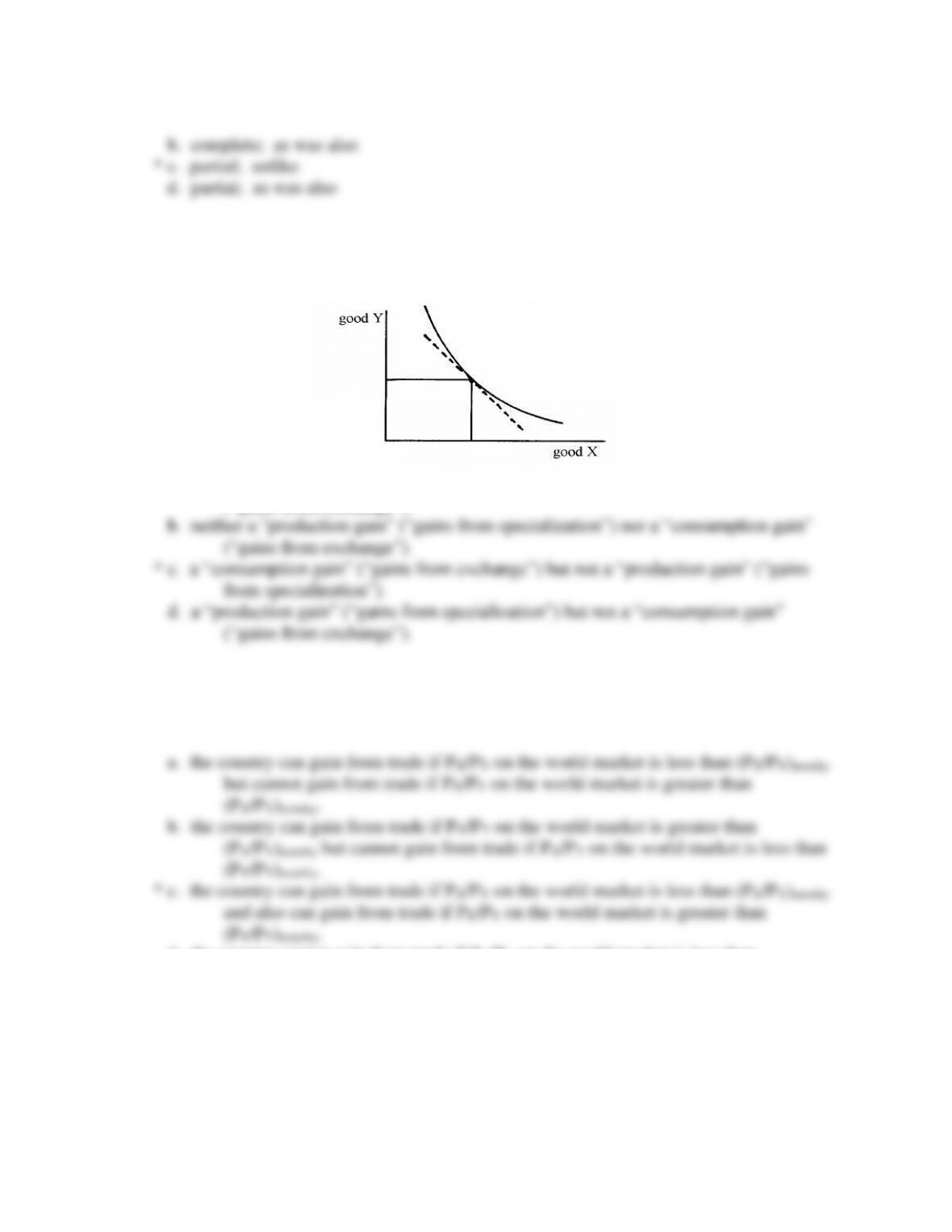
20. Given the following diagram showing a fixed-quantity production-possibilities frontier, a
community indifference curve, and the associated autarky price line, if this country is
opened to trade through exposure to different relative prices, the country can attain
a. both a “production gain” (“gains from specialization”) and a “consumption gain”
(“gains from exchange”).
21. In the diagram in Question #20 above, suppose that this country is opened to trade from
this initial situation where the dashed line indicates autarky prices [(PX/PY)autarky]. With
this opening to trade,
d. the country cannot gain from trade if PX/PY on the world market is less than
(PX/PY)autarky and also cannot gain from trade if PX/PY on the world market is
greater than (PX/PY)autarky.
22. If a country’s PX/PY in autarky is less than the PX/PY on the world market, then this
country has a comparative advantage in the __________ good, and, if the country now
engages in international trade and moves along its production-possibilities frontier, its
5
production of the X good will __________.
a. Y; increase
23. If a country’s PX/PY in autarky is less than the PX/PY on the world market, then, as the
country moves from autarky to trade, the relative price of good Y will __________ for
home consumers. Thus, consumers with a strong relative preference for good
__________ would tend to oppose the movement to trade.
a. increase; Y
24. If two countries have identical production-possibilities frontiers but different tastes, it is
possible for each country to gain from trade with the other country
a. in the Classical model but not in the neoclassical model.
25. In the neoclassical (or modern) theory, two countries with identical production-
possibilities frontiers (PPFs)
d. cannot gain from trade with each other under any circumstances.
26. As a country moves from autarky to trade, the relative price of the country’s export good
will __________ for home consumers, and the relative price of the country’s import good
__________ for home consumers.
a. fall; will rise
6
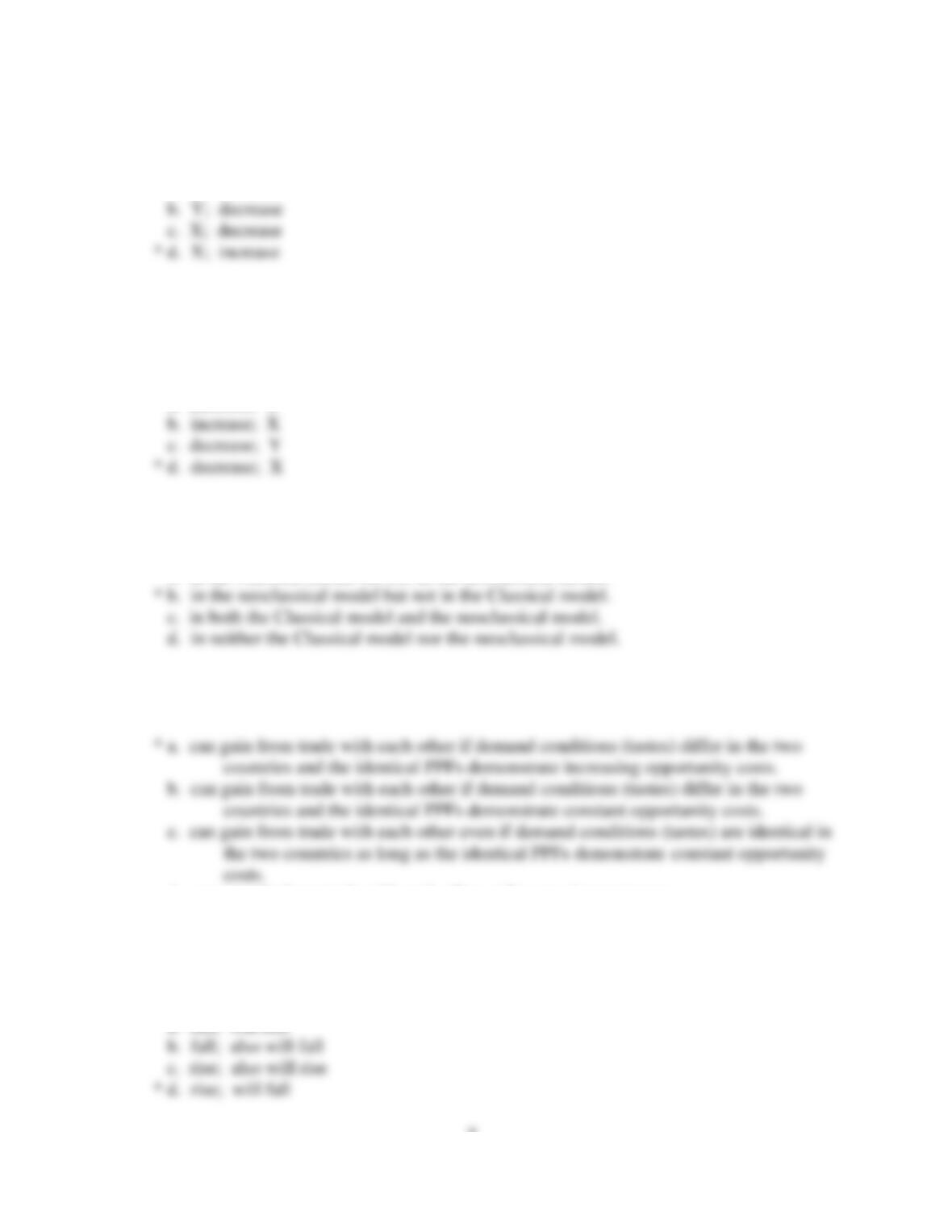
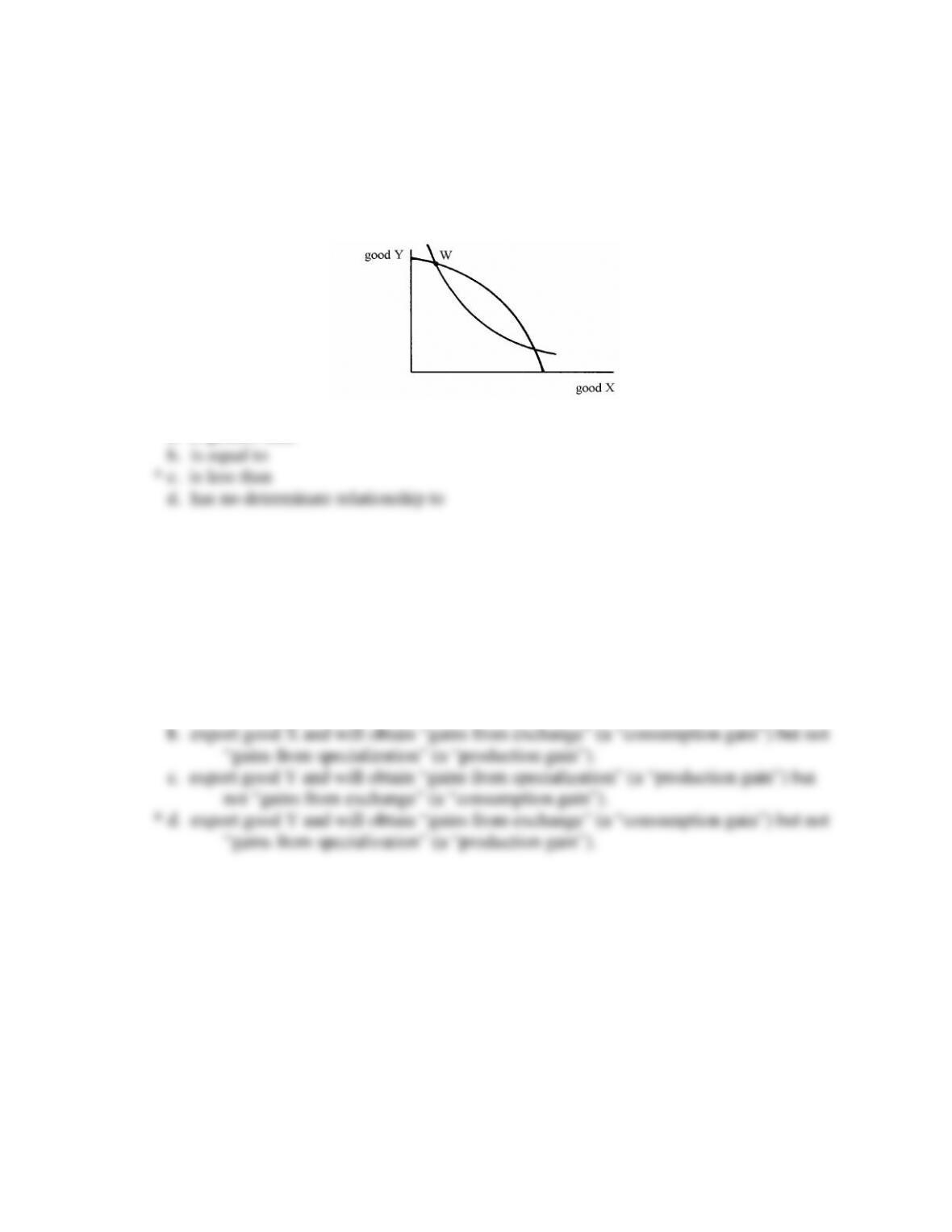
27. In the following graph, at point W (and ignoring the negative signs), the marginal rate of
transformation (MRT) in production __________ the marginal rate of substitution (MRS)
in consumption.
a. is greater than
28. Suppose that a country’s factors of production are “completely specific” to the industries
in which they are located (i.e., factors in the X industry would contribute nothing to Y
output if they were employed in the Y industry and factors in the Y industry would
contribute nothing to X output if they were employed in the X industry). In addition,
suppose that the country has an autarky PX/PY that is greater than the world PX/PY. In this
situation, if the country is opened to international trade, it will
a. export good X and will obtain “gains from specialization” (a “production gain”) but
not “gains from exchange” (a “consumption gain”).
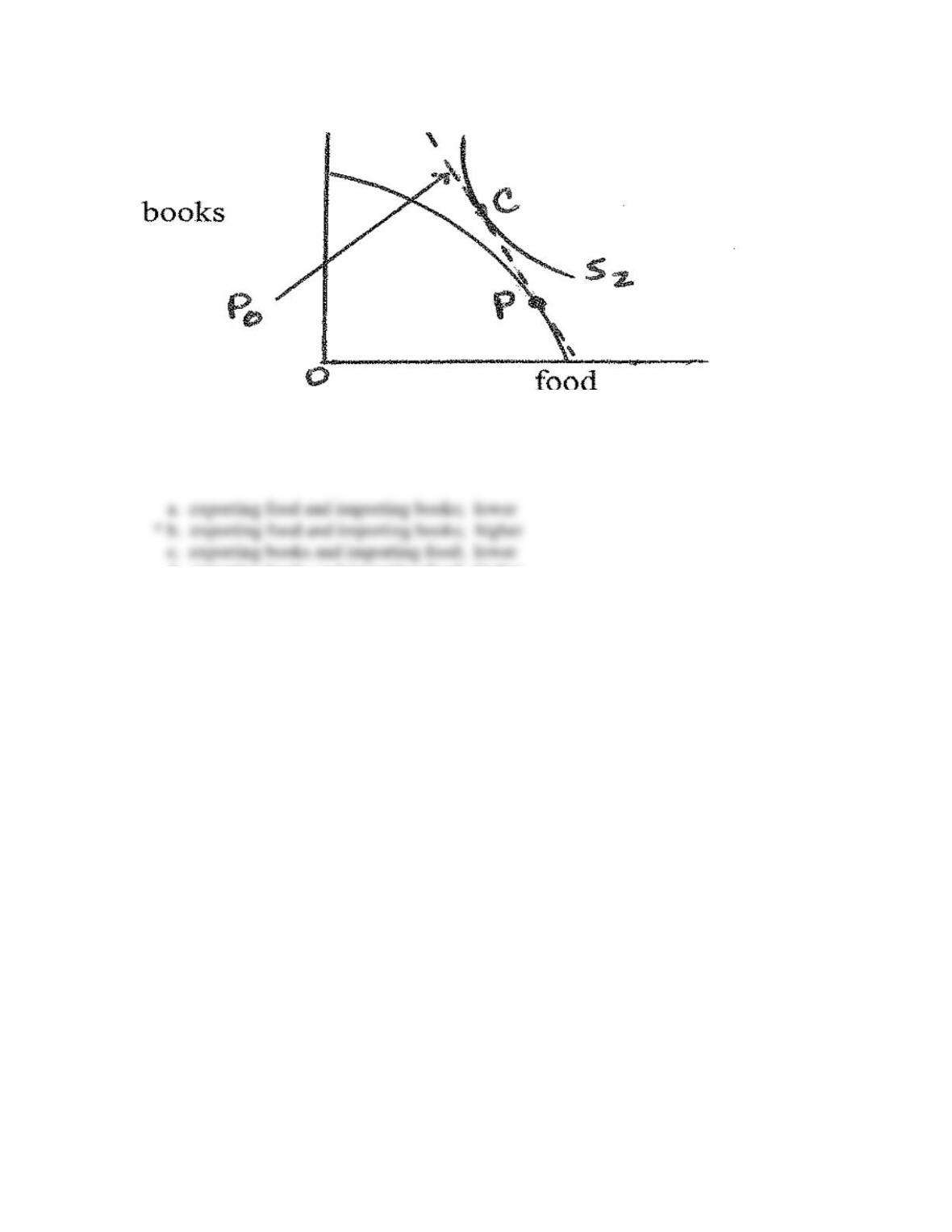
29. Given the diagram below, in which country A is producing at point P and consuming at
point C:
7
Country A is __________, and the ratio of the price of food relative to the price of books
[i.e., (Pfood/Pbooks)] reflected by price line P0 is __________ than the (Pfood/Pbooks) ratio that
existed when country A was in autarky.
d. exporting books and importing food; higher