CHAPTER 6—TRADE REGULATIONS AND INDUSTRIAL POLICIES
MULTIPLE CHOICE
1. The World Trade Organization was established by the ____ of multilateral trade negotiations:
a.
Kennedy Round
b.
Tokyo Round
c.
Uruguay Round
d.
Clinton Round
2. Under U.S. commercial policy, the escape clause results in:
a.
Temporary quotas granted to firms injured by import competition
b.
Tariffs that offset export subsidies granted to foreign producers
c.
Tax advantages extended to minority-owned exporting firms
d.
Duties which offset commercial dumping on the part of foreign firms
3. Adjustment assistance is sometimes used to assist:
a.
In retraining workers displaced by imports
b.
In retraining workers displaced by exports
c.
Foreign firms injured by our quotas
d.
Foreign firms injured by our tariffs
4. The Export-Import Bank of the United States encourages American firms to sell overseas by providing
direct loans and loan guarantees to foreign purchasers of American goods. To American firms, this
represents a:
a.
Specific subsidy
b.
Ad valorem subsidy
c.
Domestic subsidy
d.
Export subsidy
5. The Smoot-Hawley Tariff Act of 1930 has generally been associated with:
a.
Falling tariffs
b.
Increases in the volume of trade
c.
Intensifying the worldwide depression
d.
Efforts to liberalize nontariff trade barriers
6. A trade policy designed to alleviate some domestic economic problem by exporting it to foreign
countries is known as a (an):
a.
International dumping policy
b.
Trade adjustment assistance policy
c.
Most-favored-nation policy
d.
Beggar-thy-neighbor policy
7. Under U.S. commercial policy, which clause permits the modification of a trade liberalization
agreement on a temporary basis if serious injury occurs to domestic producers as a result of the
agreement?
a.
Adjustment assistance clause
b.
Escape clause
c.
Most-favored-nation clause
d.
Reciprocal-trade clause
8. Which policy reflects the notion that if society enjoys gains due to increased efficiency stemming from
trade liberalization, some sort of compensation should be provided to those who are temporarily hurt
by import competition?
a.
Countervailing duties
b.
Trade adjustment assistance
c.
Domestic subsidies
d.
Most-favored-nation standard
9. The Uruguay Round of Multilateral Trade Negotiations accomplished all of the following except:
a.
Placed primary emphasis on nontariff trade barriers
b.
Is estimated to yield modest gains in world output and employment
c.
Achieved cuts in tariffs but not in nontariff trade barriers
d.
Abolished all barriers to trade in agricultural products
10. The General Agreement on Tariffs and Trade and its successor, the World Trade Organization, have
resulted in:
a.
Termination of export subsidies applied to manufactured goods
b.
Termination of import tariffs applied to manufactured goods
c.
Encouragement of beggar-thy-neighbor policies
d.
Reductions in trade barriers via multilateral negotiations
11. For the United States, which organization makes loans to foreign buyers of U.S. manufactured goods?
a.
Export-Import Bank
b.
Domestic International Sales Corporation
c.
Organization for Economic Cooperation and Development
d.
Commodity Credit Corporation
12. The high point of U.S. protection culminated with the passage of the:
a.
Smoot-Hawley Act of 1930
b.
General Agreements on Tariffs and Trade in 1947
c.
Trade Reduction Act of 1962
d.
Adjustment Assistance Act of 1970
13. Countervailing duties are intended to neutralize any unfair advantage that foreign exporters might gain
over domestic producers because of foreign:
a.
Tariffs
b.
Subsidies
c.
Quotas
d.
Buy-national policies
14. Trade theory suggests that the United States would gain from a subsidy provided by Japan to its
calculator producers if the gains to American consumers of calculators more than offset the losses to
American calculator producers. This occurs as long as the United States:
a.
Is a net importer of calculators
b.
Is a net exporter of calculators
c.
Has an absolute advantage in calculator production
d.
Has a comparative advantage in calculator production
15. Under the original provisions of the Reciprocal Trade Agreements Act, the president of the United
States was authorized to cut tariffs up to:
a.
10 percent
b.
50 percent
c.
75 percent
d.
100 percent
16. The U.S. “trade-remedy laws” could establish all of the following except:
a.
Import tariffs to protect U.S. firms seriously injured by foreign competition
b.
Countervailing duties which neutralize foreign export subsidies
c.
Antidumping duties which protect U.S. firms from imports sold at less-than-fair-value
d.
Economic sanctions levied against hostile nations
17. The principle of normal trade relations (most-favored-nation)treatment was established with the
passage of the:
a.
Fordney-McCumber Act of 1922
b.
Smoot-Hawley Act of 1930
c.
Reciprocal Trade Agreements Act of 1934
d.
Trade Act of 1974
18. Throughout the post-World War II era, the importance of tariffs as a trade barrier has:
a.
Increased
b.
Decreased
c.
Remained the same
d.
None of the above
19. As a way of helping American firms trade in the world market, U.S. trade law provides antitrust
exemptions for horizontal combinations of American firms engaged solely in export trade. Such firms
are permitted to form:
a.
Export trade associations
b.
Domestic international sales corporations
c.
Export-import banks
d.
Commodity sales corporations
20. ____ attempt to produce a fair and free-trading environment in which there exists a level playing field.
a.
Trade-remedy laws
b.
Industrial policies
c.
Strategic trade policies
d.
Economic sanctions
21. Suppose the United States imposes trade sanctions (export quotas) on grain sold to the Russians.
Assuming other nations do not increase grain exports to the Russians, all of the following would occur
except:
a.
Grain prices would rise in Russia
b.
Consumer surplus would decrease for the Russians
c.
Grain prices would rise in the United States
d.
Export revenues would decrease for U.S. producers
22. In 1980 the United States announced an embargo on grain exports to the Soviet Union in response to
the Soviet armed invasion of Afghanistan. The embargo was mainly resisted by:
a.
U.S. grain consumers and producers of bread
b.
U.S. farmers and grain companies
c.
Grain producers in foreign countries
d.
Grain consumers in foreign countries
23. Export embargoes induce greater losses in consumer surplus for the target country:
a.
The lesser its initial dependence on foreign produced goods
b.
The more elastic the target country’s demand schedule
c.
The greater the available output from alternative suppliers
d.
The more inelastic the target country’s supply schedule
24. Suppose the president lowers tariffs on radios as the result of negotiations under the trade agreements
program. Radio producers in the United States can appeal under the:
a.
Escape clause if rising imports substantially injure the U.S. radio industry
b.
Escape clause if rising unemployment occurs even though imports remain unchanged
c.
Infant industry clause if rising imports cause unemployment to rise among U.S. radio
workers
d.
Infant industry clause if rising imports result in losses for U.S. radio companies
25. During the past four decades:
a.
Nontariff barriers (NTBs) and tariffs have increased in importance
b.
NTBs and tariffs have decreased in importance
c.
NTBs have increased and tariffs have decreased in importance
d.
NTBs have decreased and tariffs have increased in importance
26. The strongest political pressure for a trade policy that results in higher protectionism comes from:
a.
Domestic workers lobbying for import restrictions
b.
Domestic workers lobbying for export restrictions
c.
Domestic consumers lobbying for export restrictions
d.
Domestic consumers lobbying for import restrictions
27. The Uruguay Round of trade negotiations was primarily concerned with:
a.
Import tariffs
b.
Export tariffs
c.
Economic sanctions
d.
Nontariff trade barriers
28. The Uruguay Round of trade negotiations lowered:
a.
Trade sanctions levied against South Africa
b.
Trade sanctions levied against the Soviet Union
c.
Tariffs, but not nontariff trade barriers
d.
Tariffs as well as nontariff trade barriers
29. The average tariff rate today on dutiable imports in the United States is approximately:
a.
5 percent of the value of imports
b.
15 percent of the value of imports
c.
20 percent of the value of imports
d.
25 percent of the value of imports
30. Those who argue in favor of import protection generally give the impression that such restricted trade
will:
a.
Decrease the level of national security
b.
Provide benefits to some particular industry
c.
Provide benefits to the entire nation
d.
Not yield welfare losses for the nation
31. In 1990 the United States and its allies imposed trade embargoes on exports/imports to/from Iraq in
response to its invasion of Kuwait. The embargoes would induce smaller losses in Iraq’s consumer
surplus the:
a.
Lesser its initial dependence on foreign products
b.
Less elastic Iraq’s demand schedule
c.
Lesser the available output from alternative suppliers
d.
More inelastic Iraq’s supply schedule
32. In U.S. trade law, Section 301 cases involve accusations of:
a.
International dumping by U.S. companies
b.
Full-cost pricing by U.S. companies
c.
Unfair trade practices by foreign nations
d.
Trade embargoes by foreign nations
33. Industrial policy attempts to fulfill all of the following objectives except:
a.
Improving the infrastructure for an industry
b.
Easing transitions for workers in declining industries
c.
Supporting troubled industries if the difficulty is temporary
d.
Fostering industries which offer long-run comparative disadvantage
34. Countervailing duties may be imposed:
a.
In response to a foreign export subsidy
b.
In response to a foreign antidumping tariff
c.
To promote exports of domestic companies
d.
To promote imports of domestic consumers
35. The World Trade Organization provides for all of the following except:
a.
The usage of the normal-trade-relation (most-favored-nation) clause
b.
Assistance in the settlement of trade disagreements
c.
Multilateral tariff reductions
d.
Bilateral tariff reductions
36. In U.S. trade law, which measure permits the levying of restrictions on fairly traded imports that harm
or threaten to harm American manufacturers?
a.
Antidumping duty
b.
Countervailing duty
c.
National security clause
d.
Escape clause
37. Which international organization stipulates procedures for the settlement of international trade
disputes?
a.
World Trade Organization
b.
World Bank
c.
International Monetary Fund
d.
Organization of Economic Development
38. The most recent round of multilateral trade negotiations is the:
a.
Kennedy Round
b.
Tokyo Round
c.
Doha Round
d.
Geneva Round
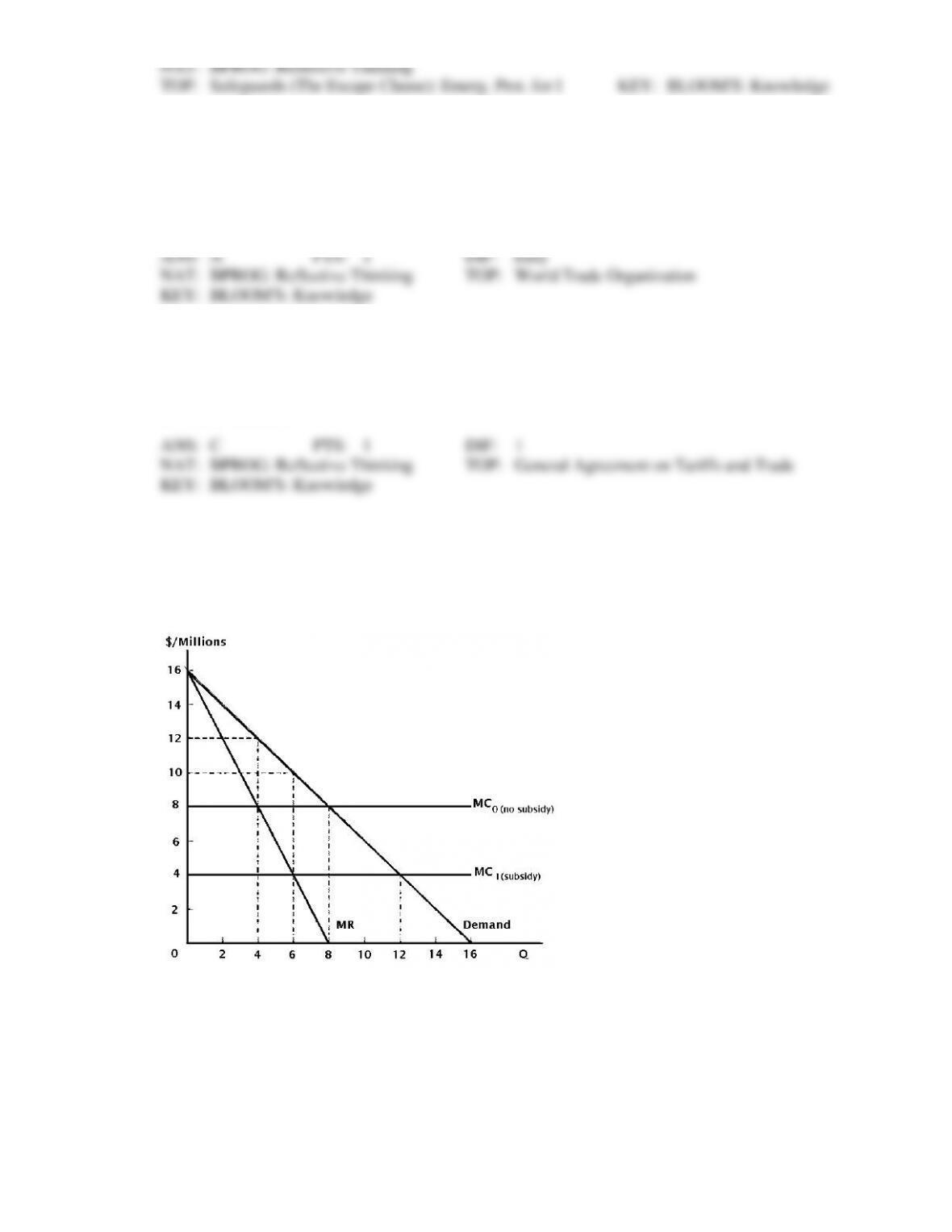
Assume Boeing Inc. (of the United States) and Airbus Industrie (of Europe) rival for monopoly profits
in the Canadian aircraft market. Suppose the two firms face identical cost and demand conditions, as
seen in Figure 6.1.
Figure 6.1. Strategic Trade Policy: Boeing versus Airbus
39. Referring to Figure 6.1, assume that Boeing is the first to enter the Canadian market. Without a
governmental subsidy, the firm maximizes profits by selling ____ aircraft at a price of $____, and
realizes profits totaling $____.
a.
4, $12 million, $16 million
b.
4, $16 million, $12 million
c.
8, $12 million, $16 million
d.
8, $16 million, $12 million
40. Consider Figure 6.1. At the monopoly price as established by Boeing, Canadian consumers realize
$____ of consumer surplus from the availability of aircraft.
a.
$4 million
b.
$8 million
c.
$12 million
d.
$16 million
41. Consider Figure 6.1. Suppose the European government provides Airbus a subsidy of $4 million on
each aircraft manufactured, and that the subsidy convinces Boeing to exit the Canadian market. As the
monopoly seller, Airbus maximizes profit by selling ____ aircraft at a price of $____, and realizes
profits totaling $____.
a.
6, $10 million, $36 million
b.
6, $12 million, $24 million
c.
12, $10 million, $36 million
d.
12, $12 million, $24 million
42. Referring to Figure 6.1, the total cost of the Airbus subsidy to the European taxpayer equals:
a.
$16 million
b.
$20 million
c.
$24 million
d.
$28 million
43. Referring to Figure 6.1, the Airbus subsidy leads to a (an) increase/decrease in Canadian consumer
surplus of $____, as compared to the consumer surplus that existed in the absence of a subsidy.
a.
Increase of $8 million
b.
Increase of $10 million
c.
Decrease of $8 million
d.
Decrease of $10 million
44. Consider Figure 6.1. For Europe as a whole (Airbus and European taxpayers), the subsidy leads to a
(an) increase/decrease in net revenues of $____.
a.
Increase of $12 million
b.
Increase of $16 million
c.
Decrease of $12 million
d.
Decrease of $16 million
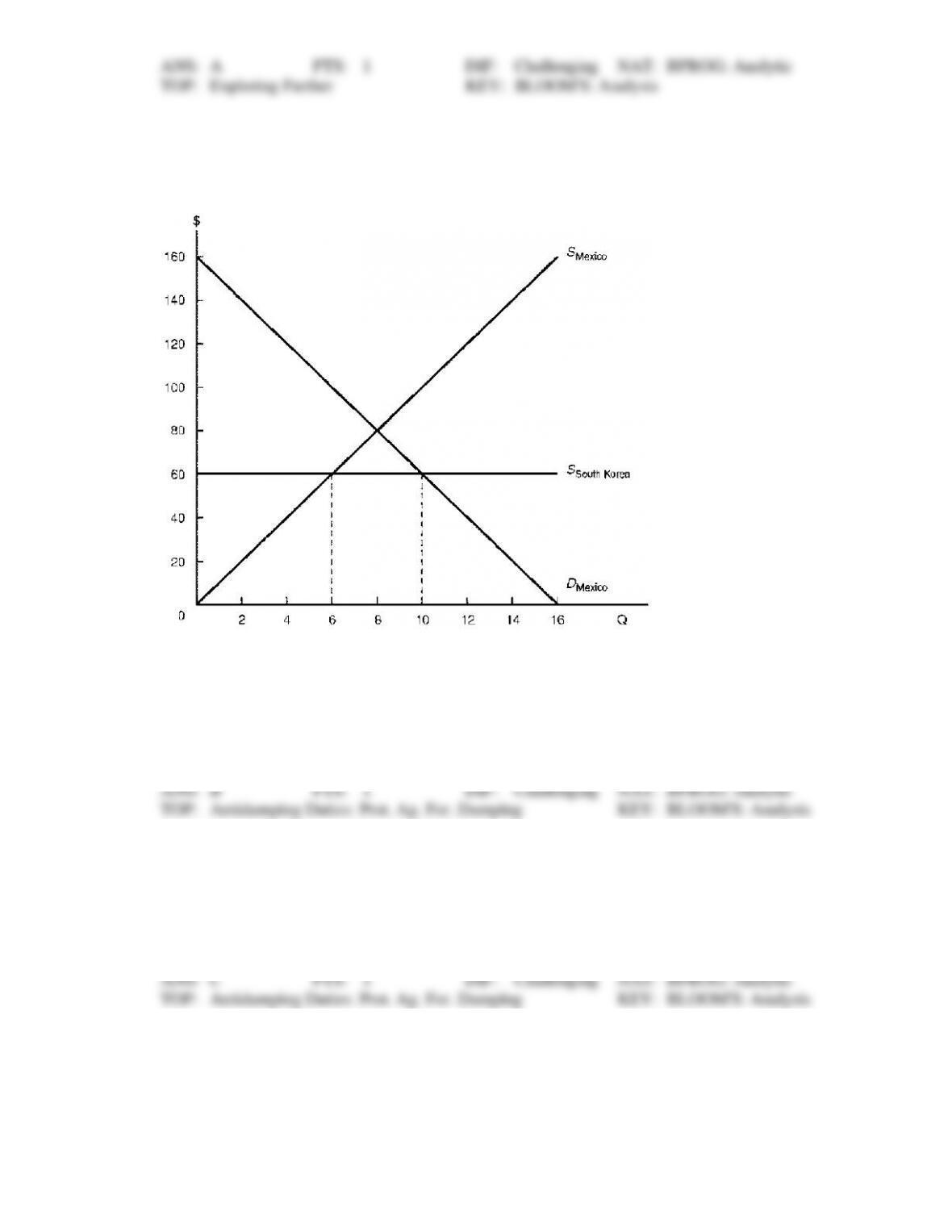
Figure 6.2 illustrates the calculator market for Mexico, assumed to be a small nation that is unable
influence the South Korean (world) price. Assume the South Korean price to be $60 per calculator.
Figure 6.2. Effects of an Export Subsidy
45. Consider Figure 6.2. With free trade, Mexican consumers purchase ____ calculators, Mexican firms
produce ____ calculators, and ____ calculators are imported.
a.
10, 4, 6
b.
10, 6, 4
c.
10, 8, 2
d.
10, 2, 8
46. Consider Figure 6.2. With free trade, Mexicans attain $____ of consumer surplus from the availability
of calculators, while Mexican producer surplus equals $____.
a.
$400, $200
b.
$200, $400
c.
$500, $180
d.
$500, $240
47. Consider Figure 6.2. To help its firms further penetrate export markets, suppose the South Korean
government provides them a production subsidy of $20 per calculator. With the subsidy, South Korean
firms charge a price of $____ and export ____ calculators to Mexico.
a.
$40, 8
b.
$40, 10
c.
$20, 8
d.
$20, 10
48. Consider Figure 6.2. The South Korean subsidy helps/hurts Mexican manufacturers, since their
producer surplus rises/falls by $____.
a.
Helps, rises, $60
b.
Helps, rises, $100
c.
Hurts, falls, $60
d.
Hurts, falls, $100
49. Consider Figure 6.2. As a result of the South Korean subsidy, Mexicans find their consumer surplus:
a.
Rising by $160
b.
Rising by $220
c.
Falling by $160
d.
Falling by $220
50. Consider Figure 6.2. For Mexico’s producers and consumers as a whole, the South Korean subsidy
leads to a:
a.
$120 welfare gain
b.
$320 welfare gain
c.
$120 welfare loss
d.
$320 welfare loss
Figure 6.3 represents the Iraqi computer market. Assume Iraq purchases all of its computers from the
United States.
Figure 6.3 Iraqi Computer Market and Economic Sanctions
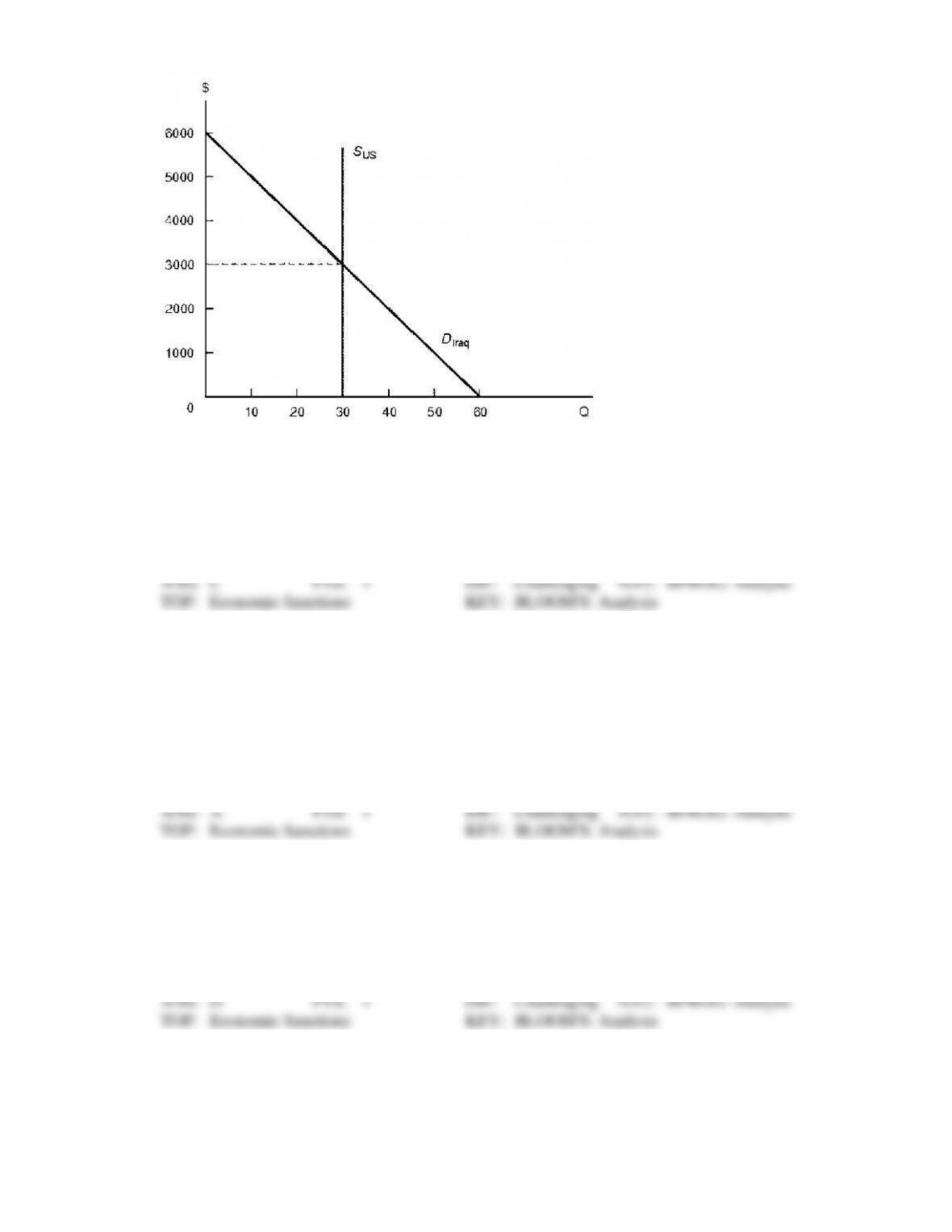
51. Consider Figure 6.3. With free trade, Iraq purchases ____ computers at a price of $____, and realizes
$____ of consumer surplus from the availability of computers.
a.
30, $3,000, $25,000
b.
30, $3,000, $35,000
c.
30, $3,000, $45,000
d.
30, $3,000, $55,000
52. Consider Figure 6.3. In response to Iraq’s armed invasion of neighboring countries, suppose the United
States imposes a partial embargo that limits exports to Iraq to 10 computers. The export quota leads to
an increase/decrease in the price of computers equal to $____, and an increase/decrease in consumer
surplus equal to $____.
a.
Increase, $2000, decrease, $40,000
b.
Increase, $4000, decrease, $60,000
c.
Decrease, $2000, increase, $40,000
d.
Decrease, $4000, increase, $60,000
53. Consider Figure 6.3. Of the quota-induced change in Iraqi consumer surplus, $____ is not transferred
to other sectors of Iraq’s economy and represents deadweight loss.
a.
$5000
b.
$10,000
c.
$15,000
d.
$20,000
54. Consider Figure 6.3. Of the quota-induced change in Iraqi consumer surplus, the amount of the change
in Iraq’s consumer surplus that is transferred to other sectors of Iraq’s economy is captured by the
United States as:
a.
Tax revenue
b.
Export revenue
c.
Producer surplus
d.
Consumer surplus
55. Consider Figure 6.3. For the United States, the export quota results in a (an):
a.
Improvement in its terms of trade with Iraq
b.
Increase in its export revenue
c.
Increase in domestic computer prices
d.
Decrease in domestic consumer surplus
56. The implicit industrial policies of the U.S. government have included:
a.
Formulating industry-specific economic policies designed to promote national champions
b.
Nationalizing basic industries such as steel and autos
c.
Encouraging cartelization of aircraft and aluminum manufacturers
d.
Improving the setting for industry such as communications and infrastructure
57. Economic sanctions are most effective in causing the target nation to modify its behavior when the:
a.
Target nation had negligible economic relationships with the imposing nation prior to the
sanctions
b.
People of the target nation have weak cultural ties to the people of the imposing nation
c.
Sanctions are levied by a large number of nations
d.
Target government is supported by the majority of its people
58. In 1995 the ____ was established to administer the new global trade rules agreed in the Uruguay
Round of multilateral trade negotiations.
a.
World Trade Organization
b.
Organization for Economic Cooperation and Development
c.
General Agreement on Tariffs and Trade
d.
United Nations
59. In 1995 the General Agreement on Tariffs and Trade was replaced by the ____.
a.
Agency for International Development
b.
Organization for Economic Cooperation and Development
c.
United Nations Center for Trade and Development
d.
World Trade Organization