International Economics, 10e (Krugman/Obstfeld/Melitz)
Chapter 6 The Standard Trade Model
6.1 A Standard Model of a Trading Economy
1) The meaning of “terms of trade” is
A) the price of a country’s exports divided by the price of its imports.
B) the amount of exports sold by a country.
C) the price conditions bargained for in international markets.
D) the quantities of imports received in free trade.
E) the tariffs in place between two trading countries.
2) A country cannot produce a mix of products with a higher value than where
A) the isovalue line is tangent to the production possibility frontier.
B) the isovalue line intersects the production possibility frontier.
C) the isovalue line is above the production possibility frontier.
D) the isovalue line is below the production possibility frontier.
E) the isovalue line is tangent with the indifference curve.
3) Tastes of individuals are represented by
A) indifference curves.
B) production possibility frontiers.
C) isovalue lines.
D) production functions.
E) the terms of trade.
4) If the ratio of price of cloth (PC) divided by the price of food (PF) increases in the
international marketplace, then
A) the terms of trade of cloth exporters will improve.
B) all countries would be better off.
C) the terms of trade of food exporters will improve.
D) the terms of trade of all countries will improve.
E) the terms of trade of cloth exporters will worsen.
5) If the ratio of price of cloth (PC) divided by the price of food (PF) increases in the
international marketplace, then
A) the cloth exporter will increase the quantity of cloth produced.
B) the cloth exporter will increase the quantity of cloth exported.
C) the food exporter will increase the quantity of food exported.
D) the cloth exporter will decrease the quantity of cloth exported.
E) the country would import more cloth.
6) If the ratio of price of cloth (PC) divided by the price of food (PF) increases in the
international marketplace, then
A) world relative quantity of cloth supplied will increase.
B) world relative quantity of cloth supplied and demanded will increase.
C) world relative quantity of cloth supplied and demanded will decrease.
D) world relative quantity of cloth demanded will decrease.
E) world relative quantity of food will increase.
7) A country will be able to consume a combination of goods that is not attainable solely from
domestic production if
A) the world terms of trade differ from its domestic relative costs.
B) the country specializes in one product.
C) the country avoids international trade.
D) the world terms of trade equal the domestic relative costs.
E) the country’s domestic production value equals world relative value.
8) Terms of trade refers to
A) the relative price at which trade occurs.
B) what goods are imported.
C) what goods are exported.
D) the volume of trade.
E) the tariffs applied to trade.
9) If points A and B are two locations on a country’s production possibility frontier, then
A) the country could produce either of the two bundles.
B) consumers are indifferent between the two bundles.
C) producers are indifferent between the two bundles.
D) at any point in time, the country could produce both.
E) both bundles must have the same relative cost.
10) If the economy is producing at point a on its production possibility frontier, then
A) all of the country’s workers are employed.
B) all of the country’s workers are specialized in one product.
C) all of the country’s capital is used for one product.
D) all of its capital is used, but not efficiently.
E) all of the country’s exports are produced in equal amounts.
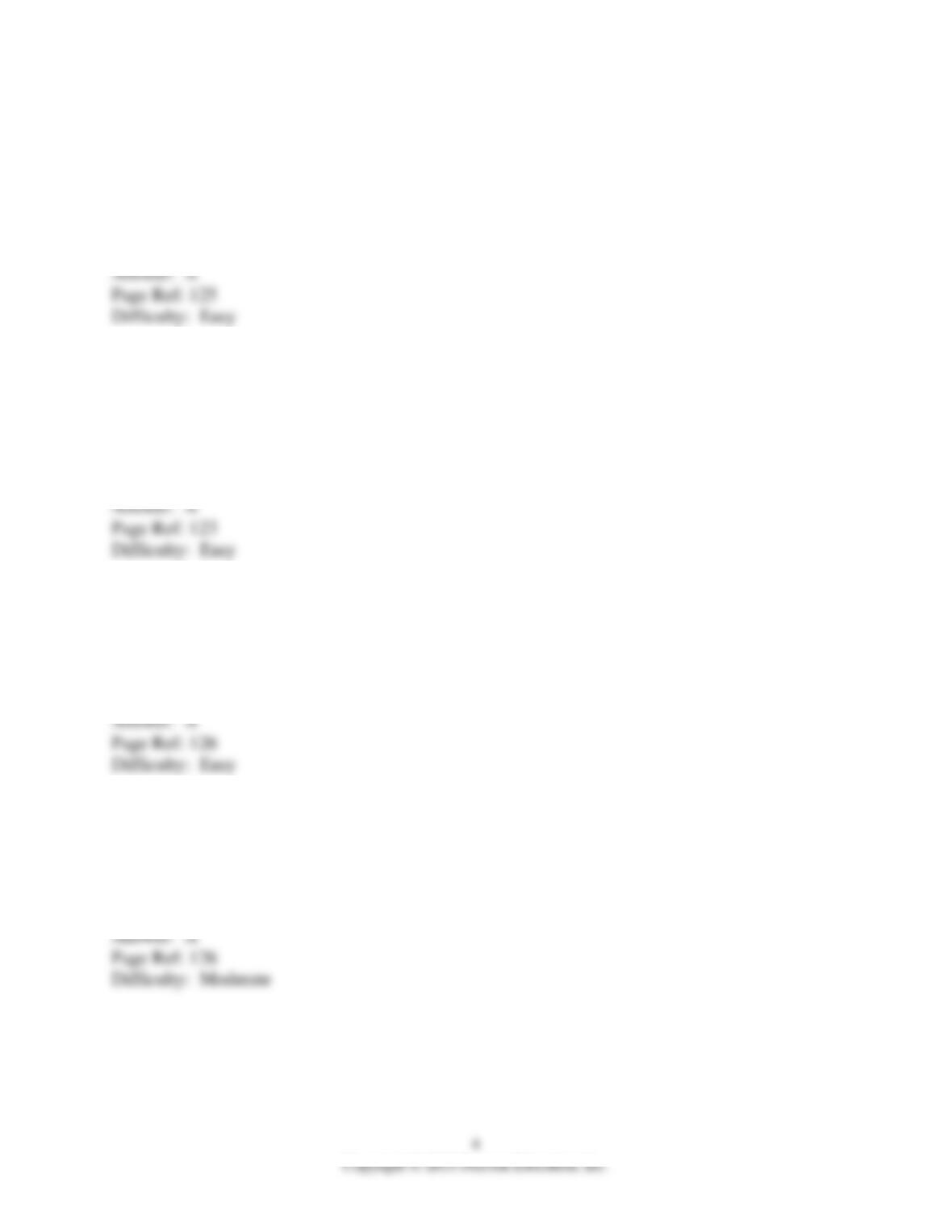
11) Refer to the figure above, which shows a country’s possible production possibility frontiers
and indifference curves. If the country is producing at ________, then moving to ________ will
cause utility to ________.
A) point b; point c; remain unchanged
B) point a; point b; increase
C) point c; point b; increase
D) point c; point b; decrease
E) point a; point c; remain unchanged
12) If two countries with diminishing returns and different marginal rates of substitution between
two products were to engage in trade, then
A) the marginal rates of substitution of both would become equal.
B) the shapes of their respective production possibility frontiers would change.
C) the larger of the two countries would dominate their trade.
D) the country with relatively elastic supplies would export more.
E) the opportunity costs for the smaller country would increase.
13) If a country began exporting product A and importing product B, then, as compared to the
autarky (no-trade) situation, the marginal cost of product A will
A) increase.
B) decrease.
C) shift outward.
D) shift inward.
E) remain the same.
14) When the production possibility frontier shifts out relatively more in one direction, we have
A) biased growth.
B) unbiased growth.
C) immiserizing growth.
D) balanced growth.
E) imbalanced growth.
15) Suppose that a country experiences growth strongly biased toward its export, cloth
A) this will tend to worsen the country’s terms of trade.
B) this will tend to improve the country’s terms of trade.
C) this will tend to leave the country’s terms of trade unchanged.
D) this will tend to worsen the terms of trade for the country’s trading partner.
E) this will increase the price of cloth relative to the imported good.
16) Suppose that a “small country” experiences growth strongly biased toward its export, cloth
A) this will have no effect on terms of trade for the country’s trading partner.
B) this will tend to worsen the country’s terms of trade.
C) this will tend to improve the country’s terms of trade.
D) this will tend to worsen terms of trade for the country’s trading partner.
E) this will tend to improve terms of trade for the country’s trading partner.
17) Other things being equal, a rise in a country’s terms of trade increases its welfare. What
would happen if we relax the ceteris paribus assumption, and allow for the law of demand to
operate internationally?
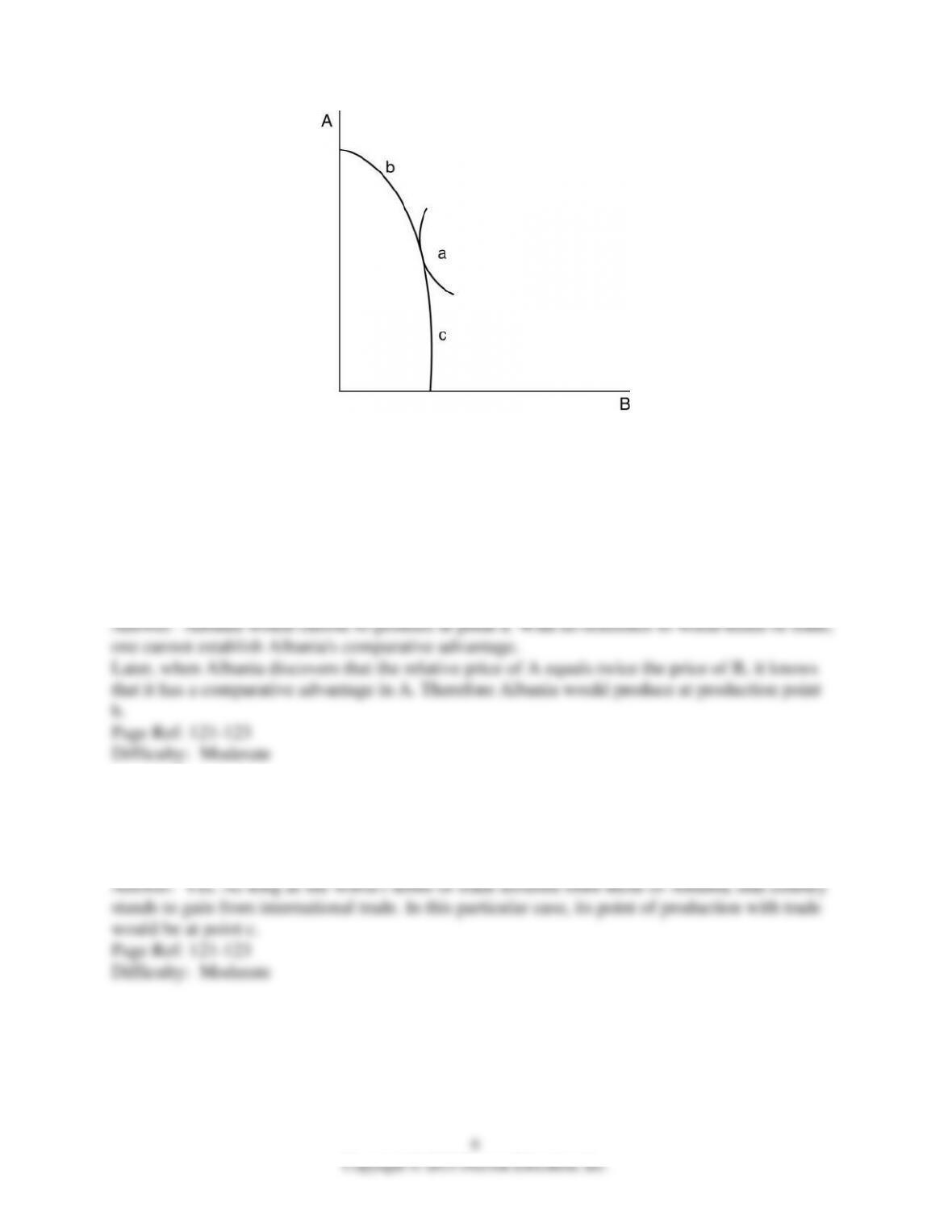
18) Refer to above figure. Albania refused to engage in international trade for ideological
reasons. To maximize its economic welfare it would choose to produce at which point in the
diagram above? Suppose the PA/PB at point a was equal to 1. Given this information, in which
good (A or B) does Albania enjoy a comparative advantage?
Now that the Cold War is over, Albania is interested in obtaining economic welfare gains from
trade. The relevant international relative price is PA/PB = 2. Albania would therefore choose to
produce at which point (a, b, or c)? Given this additional information, in which good does
Albania enjoy a comparative advantage?
19) Refer to above figure. Now, suppose that the relative price of A is actually not higher than
Albania’s autarkic level of 1, but quite the opposite (e.g., PA/PB = 0.5). Would Albania still be
able to gain from trade? If so, where would be its production point? Given the information in this
question, where is Albania’s comparative advantage?
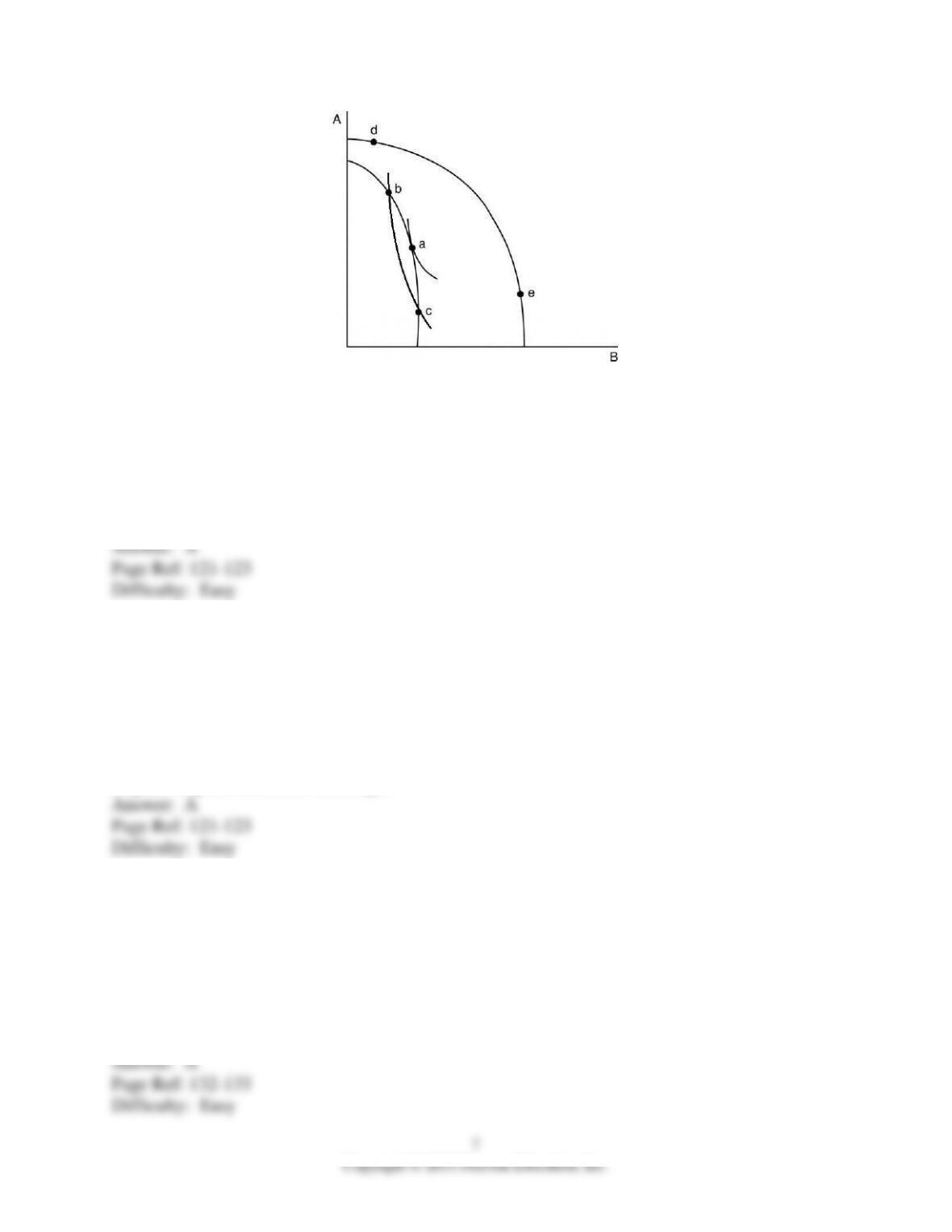
20) Refer to the figure above, which shows a country’s possible production possibility frontiers
and indifference curves. If the country is producing at ________, then moving to ________ will
cause utility to ________.
A) point c; point b; remain unchanged
B) point a; point b; increase
C) point c; point b; increase
D) point c; point b; decrease
E) point a; point c; remain unchanged
21) Refer to the figure above, which shows a country’s possible production possibility frontiers
and indifference curves. If the country is producing at ________, then moving to ________ will
cause utility to ________.
A) point b; point a; increase
B) point a; point b; increase
C) point c; point b; increase
D) point c; point b; decrease
E) point a; point c; remain unchanged
6.2 Tariffs and Export Subsidies: Simultaneous Shifts in RS and RD
1) If the U.S. (a large country) imposes a tariff on its imported good, this will tend to
A) improve the terms of trade of the United States.
B) have no effect on terms of trade.
C) improve the terms of trade of all countries.
D) cause a deterioration of U.S. terms of trade.
E) raise the world price of the good imported by the United States.
2) If Slovenia is a small country in world trade terms, then if it imposes a large series of tariffs
on many of its imports, this would
A) have no effect on its terms of trade.
B) improve its terms of trade.
C) deteriorate its terms of trade.
D) decrease its marginal propensity to consume.
E) increase its exports.
3) If Slovenia is a large country in world trade, then if it imposes a large set of tariffs on many of
its imports, this would
A) improve its terms of trade.
B) have no effect on its terms of trade.
C) harm its terms of trade.
D) decrease its marginal propensity to consume.
E) increase its exports.
4) If Slovenia were a large country in world trade, then if it imposes a large set of tariffs on its
imports, this must
A) decrease the internal price of imports below the world market rate.
B) cause retaliation on the part of its trade partners.
C) harm Slovenia’s real income.
D) improve Slovenia’s real income.
E) improve the real income of its trade partners.
5) If Slovenia were a large country in world trade, then if it instituted a large set of subsidies for
its exports, this must
A) harm its terms of trade.
B) have no effect on its terms of trade.
C) improve its terms of trade.
D) decrease its marginal propensity to consume.
E) harm world terms of trade.
6) If Slovenia were a large country in world trade, then if it instituted a large set of subsidies for
its exports, this must
A) improve the real income of its trade partners.
B) cause retaliation on the part of its trade partners.
C) harm Slovenia’s real income.
D) improve Slovenia’s real income.
E) increase internal prices above the world market rate.
7) An export subsidy has the opposite effect on terms of trade to the effect of an import tariff.
Domestically a tariff will raise the price of the import good, deteriorating the domestic terms of
trade. A production subsidy for the export product will lower the local price of the export good,
lowering the domestic terms of trade for the country. Hence the export subsidy and the import
tariff have the same effect. This analysis seems to contradict the first sentence in this paragraph.
Discuss this paradox.
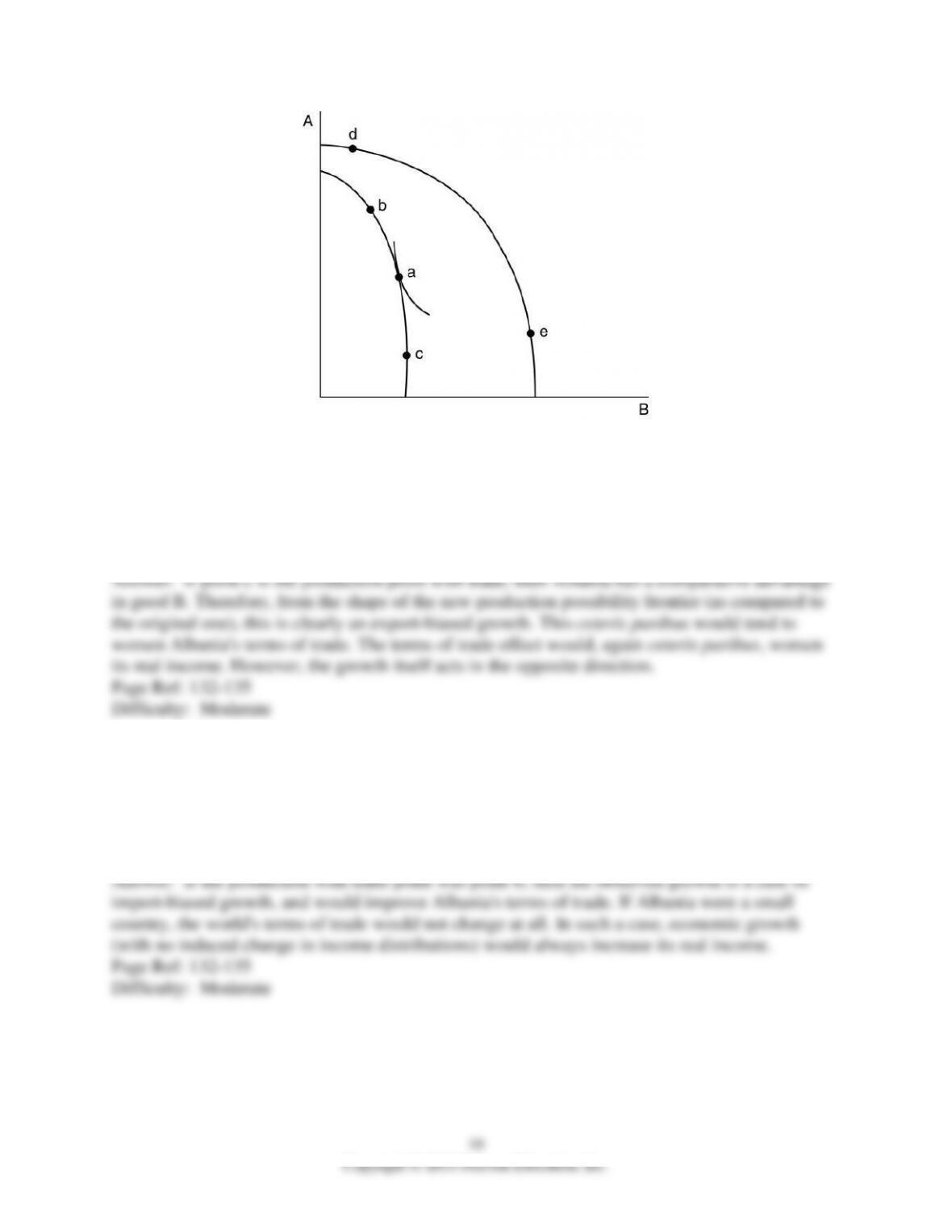
8) Suppose, as a result of various dynamic factors associated with exposure to international
competition, Albania’s economy grew, and is now represented by the rightmost production
possibility frontier in the figure above. If its point of production with trade was point c, would
you consider this growth to be export-biased or import biased? If Albania were a large country
with respect to the world trade of A and B, how would this growth affect Albania’s terms of
trade? Its real income?
9) Suppose, as a result of various dynamic factors associated with exposure to international
competition, Albania’s economy grew, and is now represented by the rightmost production
possibility frontier in the figure above. If its point of production with trade was point b, would
you consider this growth to be export-biased or import biased? If Albania were a large country
with respect to the world trade of A and B, how would this growth affect Albania’s terms of
trade? Its real income? What if Albania were a small country?
10) Suppose Albania is exporting product B, and experienced economic growth biased in favor
of product B as seen in the figure above. We are also told that Albania’s new consumption point
is at point d. Would you still consider the economic growth, which took place biased in favor of
B? If Albania were a large country how would this growth affect its terms of trade?
11) If a small country were to levy a tariff on its imports then this would
A) decrease the country’s economic welfare.
B) have no effect on that country’s economic welfare.
C) increase the country’s economic welfare.
D) change the terms of trade.
E) raise prices on its exports in other countries.
12) An increase in a country’s net commodity terms of trade will
A) not always guarantee positive changes in the country’s economy.
B) always increase the country’s economic welfare.
C) always increase the country’s real income.
D) never increase the country’s quantity of exports.
E) always increase the country’s production of its import competing good.
13) An import tariff will cause the relative demand for ________ to ________ and the relative
supply for ________ to ________.
A) imports; decrease; imports; increase
B) imports; increase; imports; decrease
C) exports; increase; exports; decrease
D) exports; decrease; exports; increase
E) exports; increase; imports; decrease
14) An export subsidy will cause the relative demand for ________ to ________ and the relative
supply for ________ to ________.
A) exports; decrease; exports; increase
B) imports; decrease; imports; increase
C) imports; increase; imports; decrease
D) exports; increase; exports; decrease
E) exports; increase; imports; decrease
15) An import tariff will cause the terms of trade of the ________ country to ________ and will
________ the country.
A) importing; improve; benefit
B) exporting; improve; benefit
C) importing; suffer; harm
D) exporting; improve; harm
E) importing; improve; harm
16) An export subsidy will cause the terms of trade of the ________ country to ________ and
will ________ the country.
A) exporting; suffer; harm
B) exporting; improve; benefit
C) importing; suffer; harm
D) importing; suffer; benefit
E) importing; improve; harm
6.3 International Borrowing and Lending
1) International borrowing and lending may be interpreted as one form of
A) intertemporal trade.
B) intermediate trade.
C) trade in services.
D) unrequited international transfers.
E) aid to offset trade advantages.
2) If one observes that Japan was traditionally a net foreign lender, one could conclude that
relative to its international trade and financial partners
A) Japan’s intertemporal production possibilities are biased toward present consumption.
B) Japan’s intertemporal production possibilities are biased toward future consumption.
C) Japan’s intertemporal production possibilities are larger than that of the other countries.
D) Japan’s intertemporal production possibilities are not biased.
E) Japan preferred to consume beyond its production in the present.
3) Rapidly growing developing countries tend to be borrowers on the international capital
markets. From this information we may surmise that they have a comparative advantage in
A) future income.
B) capital goods.
C) disposable income.
D) consumer goods.
E) present income.
4) It may be argued that theoretically, international capital movements
A) tend to hurt labor in donor countries.
B) tend to hurt the donor countries.
C) tend to hurt the recipient countries.
D) tend to hurt labor in recipient countries.
E) increase future production in donor countries.
5) The intertemporal tradeoff between present and future consumption is measured by the
A) real interest rate.
B) inflation rate.
C) nominal interest rate.
D) terms of trade.
E) rate of economic growth.
6) A fall in the real interest rate, all other things held constant, will cause a country’s ________
to ________.
A) current consumption: increase
B) current consumption: decrease
C) terms of trade; improve
D) terms of trade; worsen
E) welfare level; improve
7) An increase in the real interest rate, all other things held constant, will cause a country’s
________ to ________.
A) current consumption: increase
B) current consumption: decrease
C) terms of trade; improve
D) terms of trade; worsen
E) welfare level; improve
8) What is intertemporal comparative advantage?
6.4 Appendix to Chapter 6: More on Intertemporal Trade
1) The price of ________ consumption in terms of ________ consumption is ________.
A) future; current; 1/(1 + r)
B) present; future; 1/(1 + r)
C) future; current; r
D) present; future; r
E) future; current; 1 + r
2) The intertemporal budget constraint is defined as:
A) DP + DF/(1 + r) = QP + QF/(1 + r)
B) V = QP + QF/(1 + r)
C) V = DP + DF/(1 + r)
D) DF + DP/(1 + r) = QF + QP/(1 + r)
E) DP + DF(1 + r) = QP + QF(1 + r)
3) Describe the nature of trade between two countries based on intertemporal comparative
advantage.