College Accounting, 12e (Slater)
Chapter 6 Banking Procedure and Control of Cash
6.1 Learning Objective 6-1
1) Internal control over a company’s assets should include the following policy:
A) Responsibilities and duties of employees will be divided.
B) All cash receipts will be deposited into the bank the same day they arrive.
C) All cash payments will be made by check (except petty cash).
D) All of these answers are correct.
2) Company policy for internal control should include all of the following except:
A) Employees will be rotated.
B) Monthly bank statements should be sent to and reconciled by the same employees who authorize
payments and write checks.
C) The owner (or responsible employee) signs all checks after receiving authorization to pay from the
departments concerned.
D) At time of payment, all supporting invoices or documents will be stamped “paid.”
3) An example of an internal control is:
A) the use of bank account.
B) all checks are prenumbered.
C) all checks written must have reference source documents.
D) All of these answers are correct.
4) Endorsing a check:
A) guarantees payment.
B) transfers the right to deposit or transfer cash.
C) cancels the transaction.
D) All of these answers are correct.
5) A blank endorsement on a check:
A) can be further endorsed by someone else.
B) cannot be further endorsed by someone else.
C) is the safest type of endorsement.
D) permits only the original endorser to get the money.
6) A restrictive endorsement on a check:
A) can be further endorsed by someone else.
B) is the safest endorsement for businesses.
C) permits the bank to use its best judgment.
D) None of these answers are correct.
7) A full endorsement on a check:
A) is the same as a blank endorsement.
B) can be endorsed only by the person or company named in the original endorsement.
C) is the safest endorsement for businesses.
D) does none of the above.
8) The person or company to whom a check is payable is called the:
A) payer.
B) drawer.
C) drawee.
D) payee.
9) The check is written and signed by the:
A) drawer.
B) drawee.
C) payee.
D) payer.
10) The drawee is the:
A) person who writes the check.
B) bank that drawer has an account with.
C) the person to whom the check is payable.
D) the person who reconciles the account.
11) Advantages of on-line banking include:
A) convenience.
B) transaction speed.
C) effectiveness.
D) All of the above are correct.
12) A deposit received by the bank will include:
A) a debit to the company’s bank account.
B) a credit to the company’s bank account.
C) no increase or decrease is made to the company’s bank account.
D) a credit to the cash account on the company’s books.
13) When the bank pays a check written by the company, it would:
A) credit the customer’s bank account.
B) debit the customer’s bank account.
C) debit the cash account on the company’s books
D) no increase or decrease is made to the company’s bank account.
14) If the written amount on the check does not match the amount expressed in figures, the bank may:
A) pay the amount written in words.
B) return the check unpaid.
C) contact the drawer to see what was meant.
D) All of the above are correct choices.
15) The first two numbers of the ABA code listed on the check represent:
A) the Federal Reserve District.
B) the check number.
C) the routing number.
D) the account number.
16) One internal control safeguard is to assign all the duties of receiving, depositing, and recording cash
to one employee.
17) Using correct cash handling procedures, deposits should be made by the end of the week.
18) A signature card is kept in the bank files so that possible forgeries could be spotted.
19) When a bank credits your account, it is decreasing the balance.
20) A signature card shows the signature of only the person who authorizes others in the company to sign
checks.
21) The drawer writes the check.
22) The drawee of the check is the person receiving the money.
23) The drawee of a check is normally the bank.
24) A deposit ticket usually separates checks deposited from coin and currency deposited.
25) Phishing occurs when a bank customer receives an email requesting personal information.
26) What is the purpose of internal control?
27) List at least five company policies that would be included in an internal control system.
28) List and describe some of the electronic conveniences that we are now provided when doing our
banking.
Column 1
Column 2
Column 3
Column 4
Cash
Asset
Debit
Balance Sheet
Permanent
29)
Column 1
Column 2
Column 3
Column 4
Petty Cash
Column 1
Column 2
Column 3
Column 4
Petty Cash
asset
debit
balance sheet
permanent
30)
Column 1
Column 2
Column 3
Column 4
Misc. Expense
Column 1
Column 2
Column 3
Column 4
Misc. Expense
expense
debit
income statement
temporary
31)
Column 1
Column 2
Column 3
Column 4
Cash Short &
Over
Column 1
Column 2
Column 3
Column 4
Revenue
debit/ credit
income statement
temporary
32)
Column 1
Column 2
Column 3
Column 4
Change Fund
Column 1
Column 2
Column 3
Column 4
Change Fund
asset
debit
balance sheet
permanent
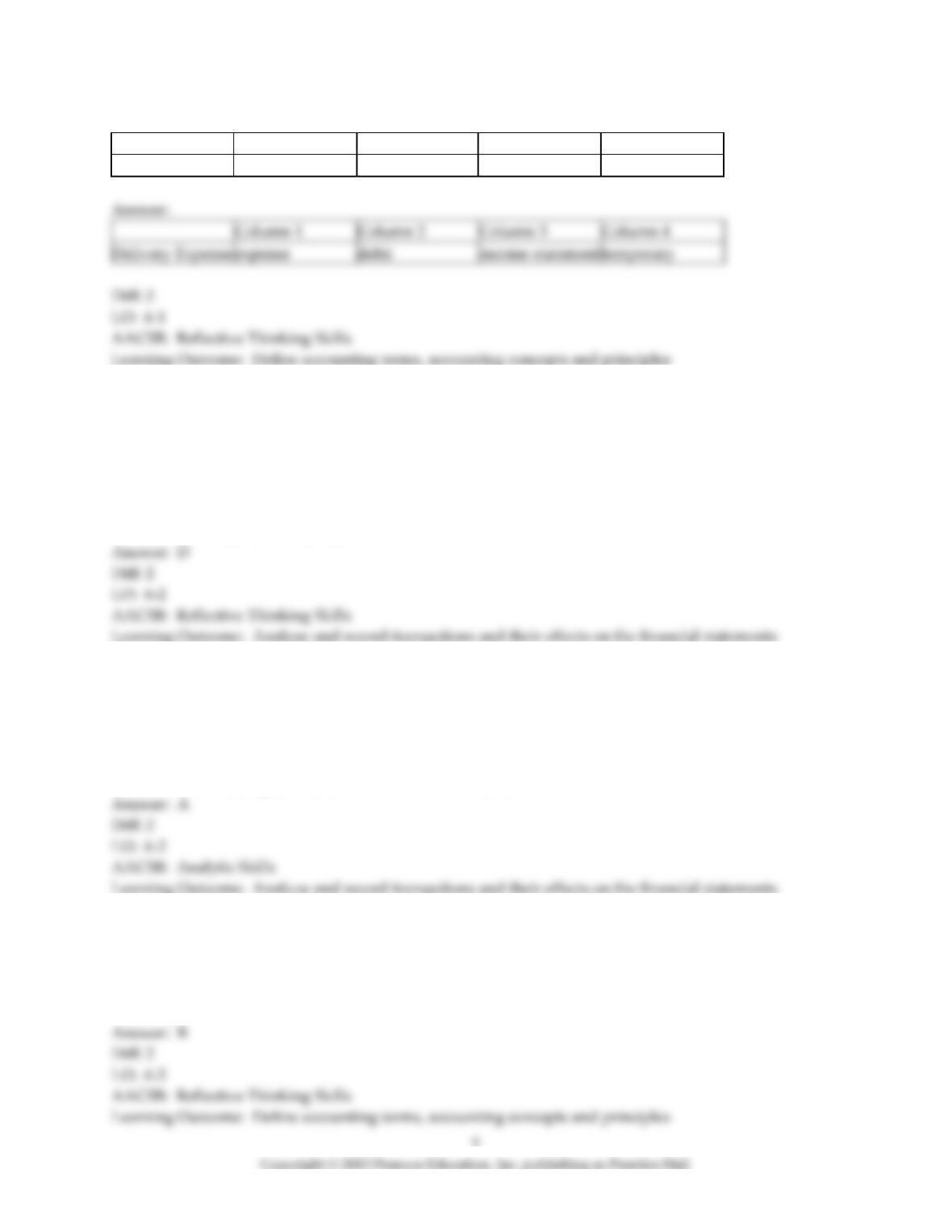
33)
Column 1
Column 2
Column 3
Column 4
Delivery Expense
Column 1
Column 2
Column 3
Column 4
Delivery Expense
expense
debit
income statement
temporary
6.2 Learning Objective 6-2
1) The bank statement shows:
A) the beginning bank balance of the cash at the start of the month.
B) the checks the bank has paid and any deposits received.
C) any other charges or additions to the bank balance.
D) All of these answers are correct.
2) Scotch Services received a credit memorandum from the bank. During the bank reconciliation they
should:
A) increase their cash account on the company’s books.
B) decrease their cash account on the company’s books.
C) increase the ending cash balance on the bank statement.
D) decrease the ending cash balance on the bank statement.
3) Checks that have been processed by the bank and are no longer negotiable are:
A) outstanding checks.
B) canceled checks.
C) checks in process.
D) blank checks.
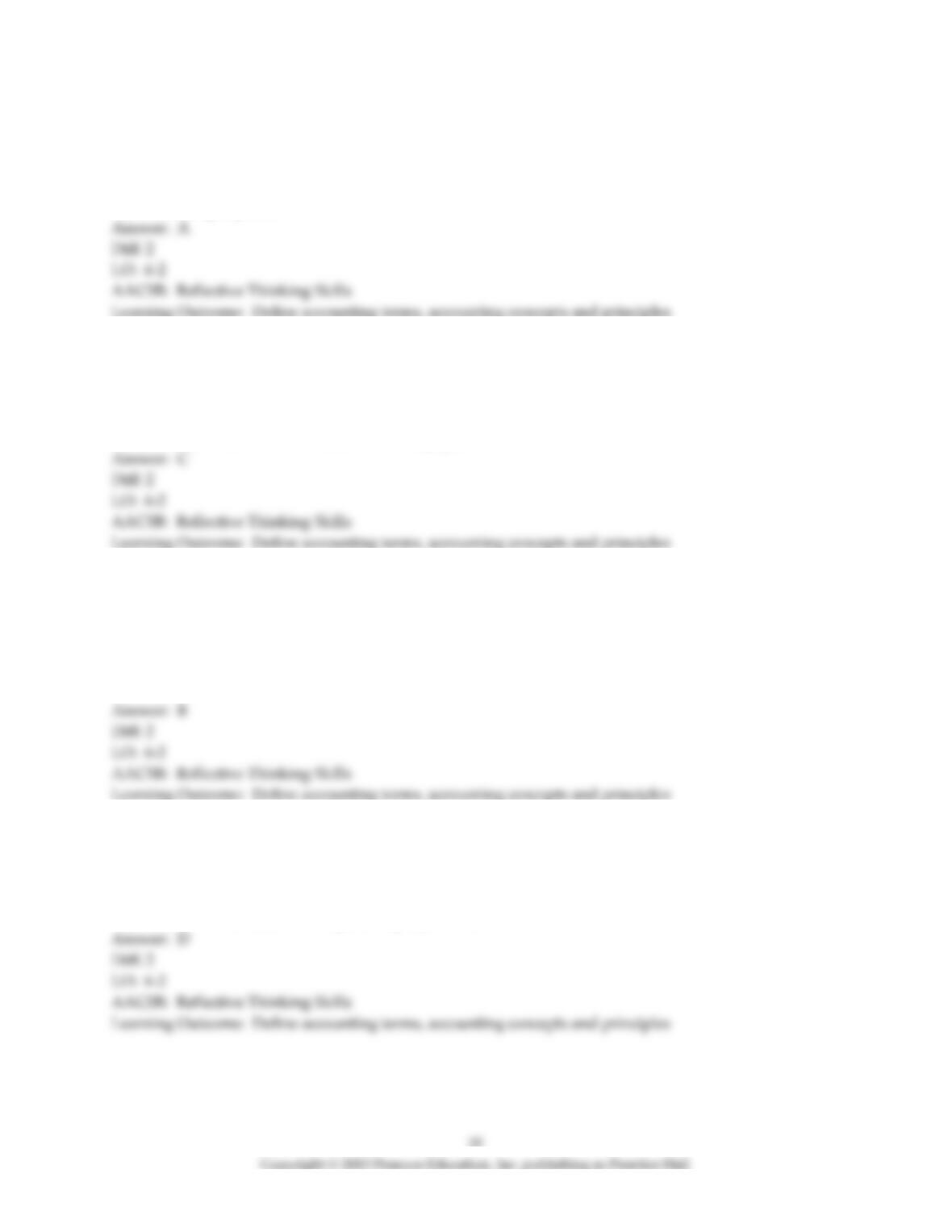
4) On a bank reconciliation, deposits added to the bank side are called:
A) deposits in transit.
B) late deposits.
C) deposits on hold.
D) outstanding deposits.
5) Outstanding checks:
A) have been subtracted on the bank records but not the checkbook records.
B) have not been presented to the bank for payment and have not been subtracted from the checkbook.
C) have not been presented to the bank for payment but have been subtracted in the checkbook.
D) have been returned to the business for nonpayment.
6) A nonsufficient funds check was returned to your company. How does the bank treat this on your
bank statement?
A) It is added to the bank balance.
B) It is shown as a debit memo.
C) It is shown as a credit memo.
D) None of these answers are correct.
7) The bank statement included bank charges. On the bank reconciliation, the item is:
A) an addition to the balance per company books.
B) an addition to the balance per bank statement.
C) a deduction from the balance per bank statement.
D) a deduction from the balance per company books.
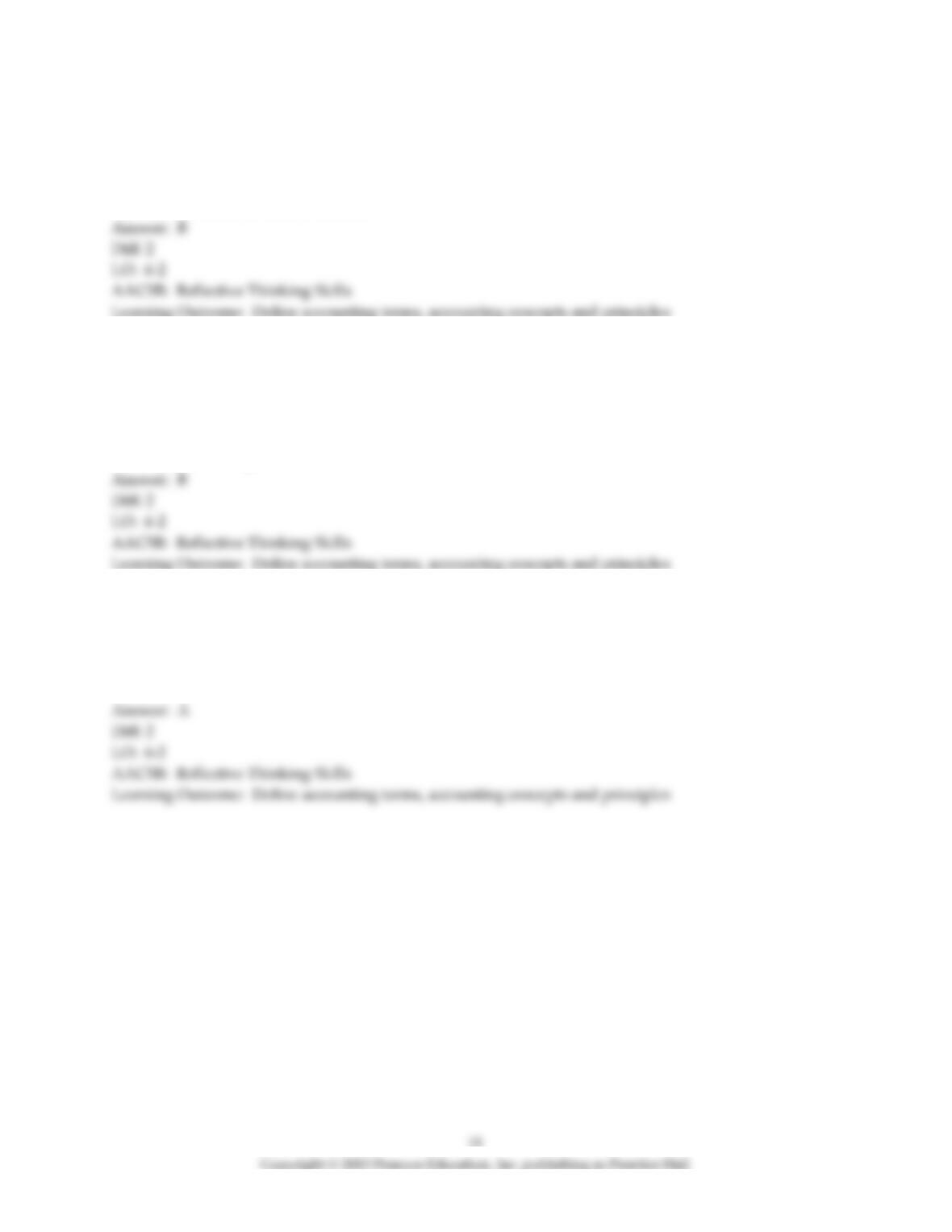
8) The bank would issue a credit memorandum to Maria‘s Life Management when the bank:
A) received the deposits in transit.
B) collects a note receivable from a customer.
C) discovered a check that was deposited was returned for nonsufficient funds.
D) None of these answers are correct.
9) How would outstanding checks be handled when reconciling the ending cash balance per the bank
statement to the correct adjusted cash balance?
A) They would be added to the balance of the bank statement.
B) They would be subtracted from the balance of the bank statement.
C) They would be added to the balance per books.
D) They would be ignored.
10) An example of electronic funds transfer is:
A) a transfer of funds without the use of paper checks.
B) a transfer of funds by writing a check.
C) the same as a deposit in transit.
D) All of these are correct.
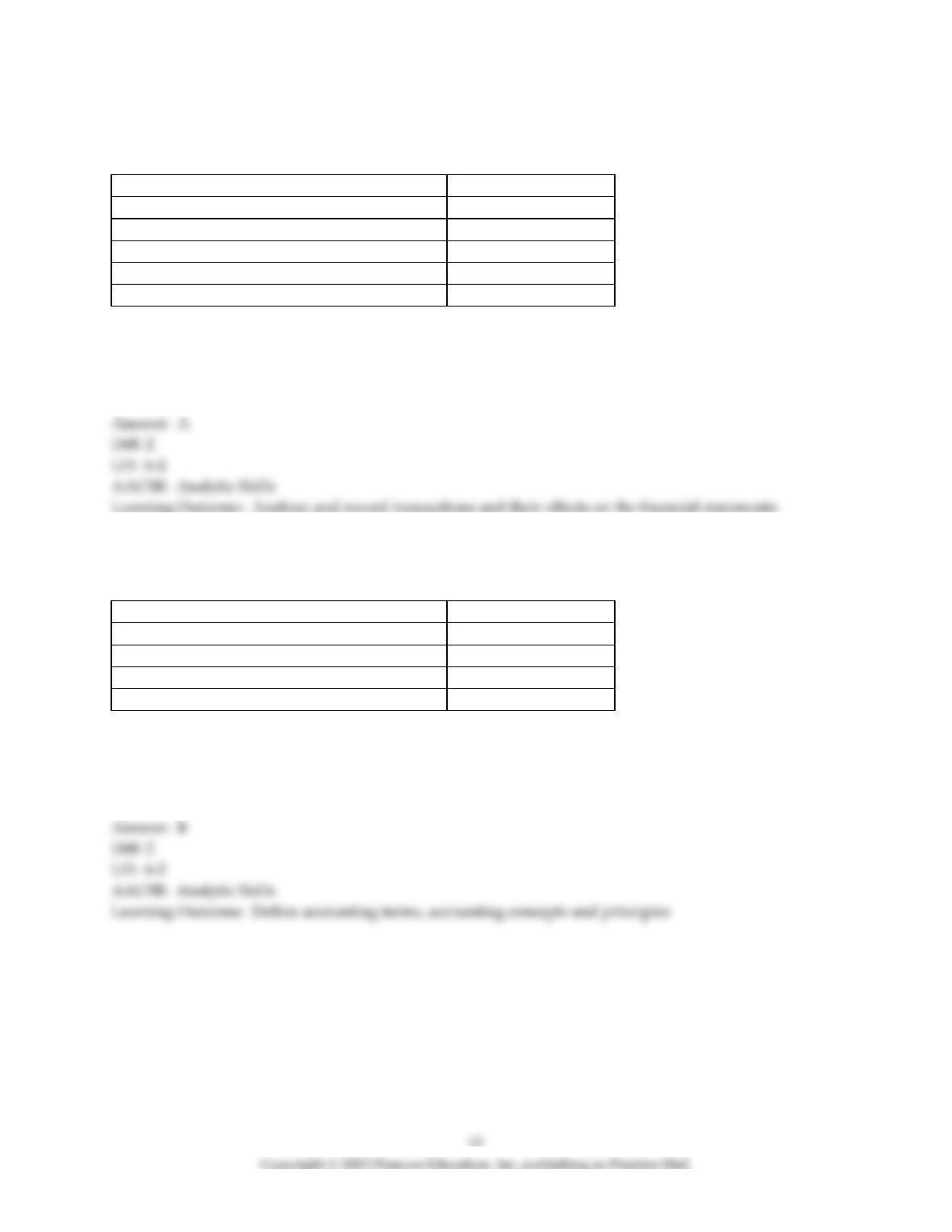
11) Calculate, from the following information accumulated by Sandra Johnson, the adjusted cash balance
at the end of April.
Bank statement ending cash balance
$2,000
General ledger cash balance ending
3,250
Bank monthly service charge
45
Deposits in transit
2,500
Outstanding checks
1,500
NSF check returned with bank statement
205
A) $3,000
B) $4,250
C) $4,000
D) $5,500
12) Determine the adjusted cash balance per bank for Santa’s Packaging on November 30, from the
following information:
Cash balance on the bank statement
$2,350
Customer’s check returned—NSF
500
Customer’s note collected by the bank
600
Deposits in transit, November 30
1,400
Outstanding checks, November 30
2,650
A) $1,250
B) $1,100
C) $1,550
D) $1,350
13) Information to calculate the adjusted cash balance for Sam’s Gift Wrapping is as follows:
Cash balance per general ledger
$2,100
Customer’s check returned—NSF
75
Bank service charges
40
Deposits in transit
500
Outstanding checks
700
Customer’s note collected by bank
645
A) $2,330
B) $2,430
C) $2,630
D) $2,230
14) The May bank statement for Accounting Services shows a balance of $6,300, but the balance per books
shows a cash balance of $7,980. Other information includes:
1. A check for $200 to pay the electric bill was recorded on the books as $20.
2. Included on the bank statement was a note collected by the bank for $400 plus interest of $30
3. Checks outstanding totaled $260.
4. Bank service charges were $50.
5. Deposits in transit were $2,140.
The adjusted cash balance at the end of August should be:
A) $9,810.
B) $7,620.
C) $7,980.
D) $8,180.
15) The May bank statement for Accounting Services shows a balance of $6300, but the balance per books
shows a cash balance of $7,980. Other information includes:
1. A check for $200 to pay the electric bill was recorded on the books as $20.
2. Included on the bank statement was a note collected by the bank for $400 plus interest of $30.
3. Checks outstanding totaled $260.
4. Bank service charges were $50.
5. Deposits in transit were $2,140.
Which item should be added to the company‘s book balance during the bank reconciliation?
A) Deposit in transit
B) Check outstanding
C) Bank service charge
D) Note collected by the bank
16) The May bank statement for Accounting Services shows a balance of $6,300, but the balance per books
shows a cash balance of $7,980. Other information includes:
1. A check for $200 to pay the electric bill was recorded on the books as $20.
2. Included on the bank statement was a note collected by the bank for $400 plus interest of $30.
3. Checks outstanding totaled $260.
4. Bank service charges were $50.
5. Deposits in transit were $2,140.
Which item(s) should be subtracted from the balance per books?
A) Bank service charge
B) Checks outstanding and bank service charge
C) Bank service charge and the note collected by the bank
D) None of the above are correct.
17) The May bank statement for Accounting Services shows a balance of $6,300, but the balance per books
shows a cash balance of $7,980. Other information includes:
1. A check for $200 to pay the electric bill was recorded on the books as $20.
2. Included on the bank statement was a note collected by the bank for $400 plus interest of $30.
3. Checks outstanding totaled $260.
4. Bank service charges were $50.
5. Deposits in transit were $2,140.
Which item(s) will require a journal entry to update the balance in the Cash account?
A) Checks outstanding and deposits in transit
B) Bank service charges, note collected by the bank, and deposits in transit
C) Bank service charges, note collected by the bank, and error made by Accounting Services
D) None of these answers are correct.
18) A payment for $25 is incorrectly recorded on the checkbook stub as $52. The $27 error should be
shown on the bank reconciliation as:
A) added to the balance per bank statement.
B) deducted from the balance per bank statement.
C) added to the balance per books.
D) deducted from the balance per books.
19) A payment for $31 is incorrectly recorded on the checkbook stub as $13. The $18 error should be
shown on the bank reconciliation as:
A) added to the balance per bank statement.
B) deducted from the balance per bank statement.
C) added to the balance per books.
D) deducted from the balance per books.
20) Bank interest earned on a checking account would be shown on a bank reconciliation as:
A) added to the balance per bank statement.
B) deducted from the balance per bank statement.
C) added to the balance per books.
D) deducted from the balance per books.
21) Bank service charges would be shown on a bank reconciliation as:
A) added to the balance per bank statement.
B) deducted from the balance per bank statement.
C) added to the balance per books.
D) deducted from the balance per books.
22) If the owner of Que Legal Services forgot to deduct a withdrawal from the balance per books, what
entry would be necessary?
A) Debit Cash; credit Withdrawals
B) Debit Withdrawals; credit Cash
C) Debit Revenue; credit Cash
D) Debit cash; credit Revenue
23) Which of the following bank reconciliation items would be reflected in a journal entry?
A) Error made by the bank
B) Outstanding Checks
C) Bank service charges
D) Deposit in transit
24) The journal entry to adjust the records from Nothin’ But Organization bank reconciliation would
include:
A) the total of outstanding checks.
B) deposits in transit.
C) notification from the bank of a customer‘s NSF check.
D) correction of any errors or omissions on the bank statement.
25) The journal entry to reverse the entry of a customer‘s nonsufficient funds check would include a:
A) debit to Cash.
B) credit to Cash.
C) debit to Accounts Payable.
D) credit to Accounts Receivable.
26) From the bank reconciliation no entry was recorded for a debit memo for a new check fee expense.
This would cause:
A) liabilities to be understated.
B) liabilities to be overstated.
C) expenses to be understated.
D) expenses to be overstated.
27) From the bank reconciliation no entry was recorded for deposits in transit. This would cause:
A) assets to be overstated.
B) assets to be understated.
C) no impact since deposits in transit are already included in the balance per books.
D) no impact since deposits are not recorded on the books.
28) The bank charged another company’s check against our account, this would be included on the bank
reconciliation as a(n):
A) addition to the balance per books.
B) subtraction from the balance per books.
C) addition to the balance per bank.
D) subtraction from the balance per bank.
29) A bank service charge would be included on the bank reconciliation as a(n):
A) addition to the balance per books.
B) subtraction from the balance per books.
C) addition to the balance per bank.
D) subtraction from the balance per bank.
30) An error, on the company’s books, in recording a $82 deposit as $28 would be included on the bank
reconciliation as a(n):
A) addition to the balance per bank.
B) subtraction from the balance per bank.
C) addition to the balance per books.
D) subtraction from the balance per books.
31) The bank added another company‘s deposit to our account. This would be included on the bank
reconciliation as a(n):
A) addition to the balance per books.
B) subtraction from the balance per books.
C) addition to the balance per bank.
D) subtraction from the balance per bank.